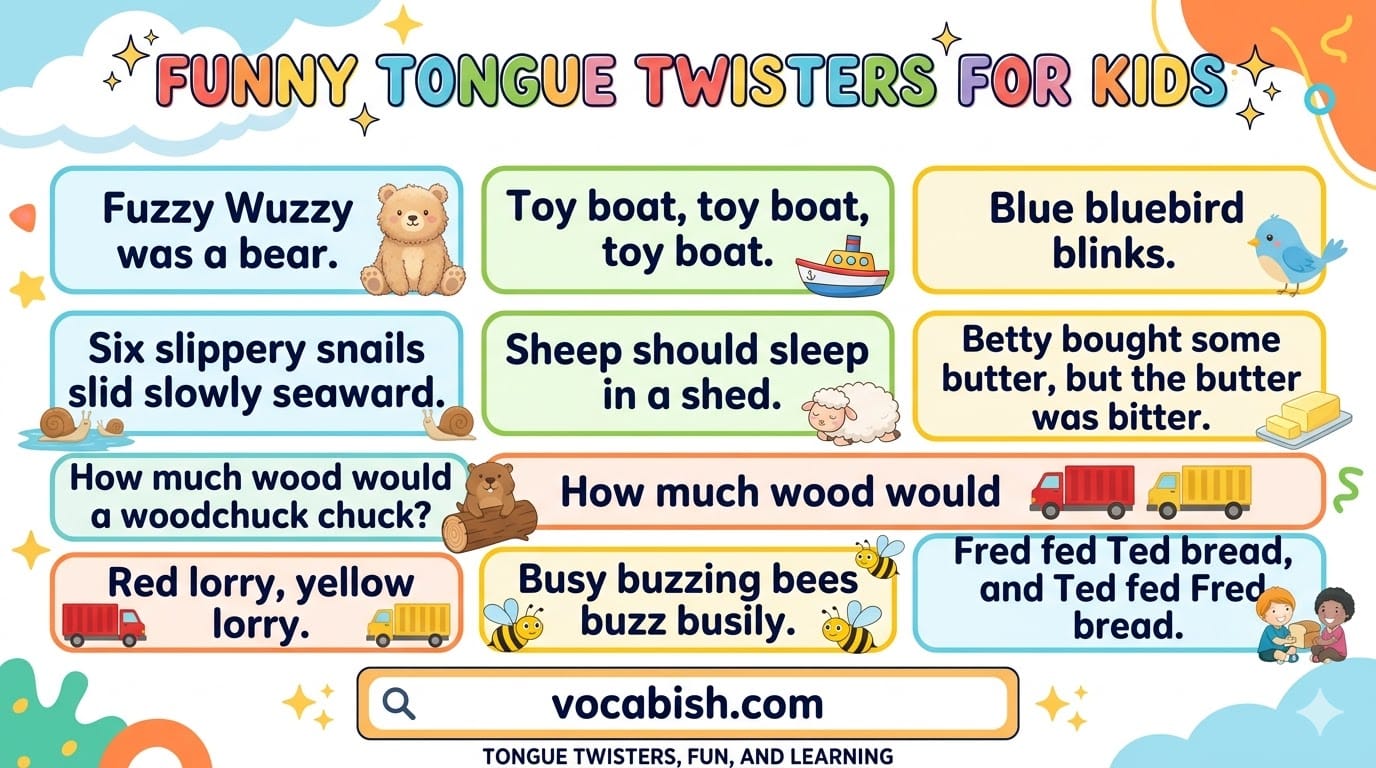

In this blog post, you will learn funny tongue twisters for kids and see how they help improve your English skills. Funny tongue twisters are short sentences with tricky or silly sounds that challenge your tongue and make pronunciation more accurate. Practicing them helps you master speaking, read aloud with confidence, and listen carefully to word sounds. They also improve writing by helping you notice how words are spelled and used. Step by step, you will understand how to say difficult words correctly, speak faster without mistakes, and enjoy learning new vocabulary in English.
What Are Funny Tongue Twisters?
Funny tongue twisters are short sentences with repeated sounds that are tricky to say quickly. They often include silly or unusual words that make kids laugh. These tongue twisters help learners notice sounds, pronounce words correctly, and speak with confidence.
Why Kids Should Practice Funny Tongue Twisters
Practicing funny tongue twisters helps kids:
- Improve pronunciation and clarity
- Increase speaking speed while maintaining correct sounds
- Train listening and attention to word patterns
- Build confidence for reading and speaking aloud
- Make learning memorable through laughter
Funny sentences stick in the mind, helping children remember sounds better.
Vocabulary Words in Funny Tongue Twisters
Here are some common words that appear in funny tongue twisters:
- Fuzzy – soft and hairy
- Wuzzy – a playful sound for a bear
- Toy – an object for play
- Boat – a vehicle for water
- Busy – always active or moving
- Bees – insects that buzz
- Sheep – farm animals that say “baa”
- Silly – playful or not serious
- Red – a color
- Black – a dark color
- Green – a color of nature
- Quick – fast
- Sticky – something that sticks
Learning these words helps kids understand and enjoy tongue twisters more.
Funny Tongue Twisters for Kids
Easy and Silly Tongue Twisters
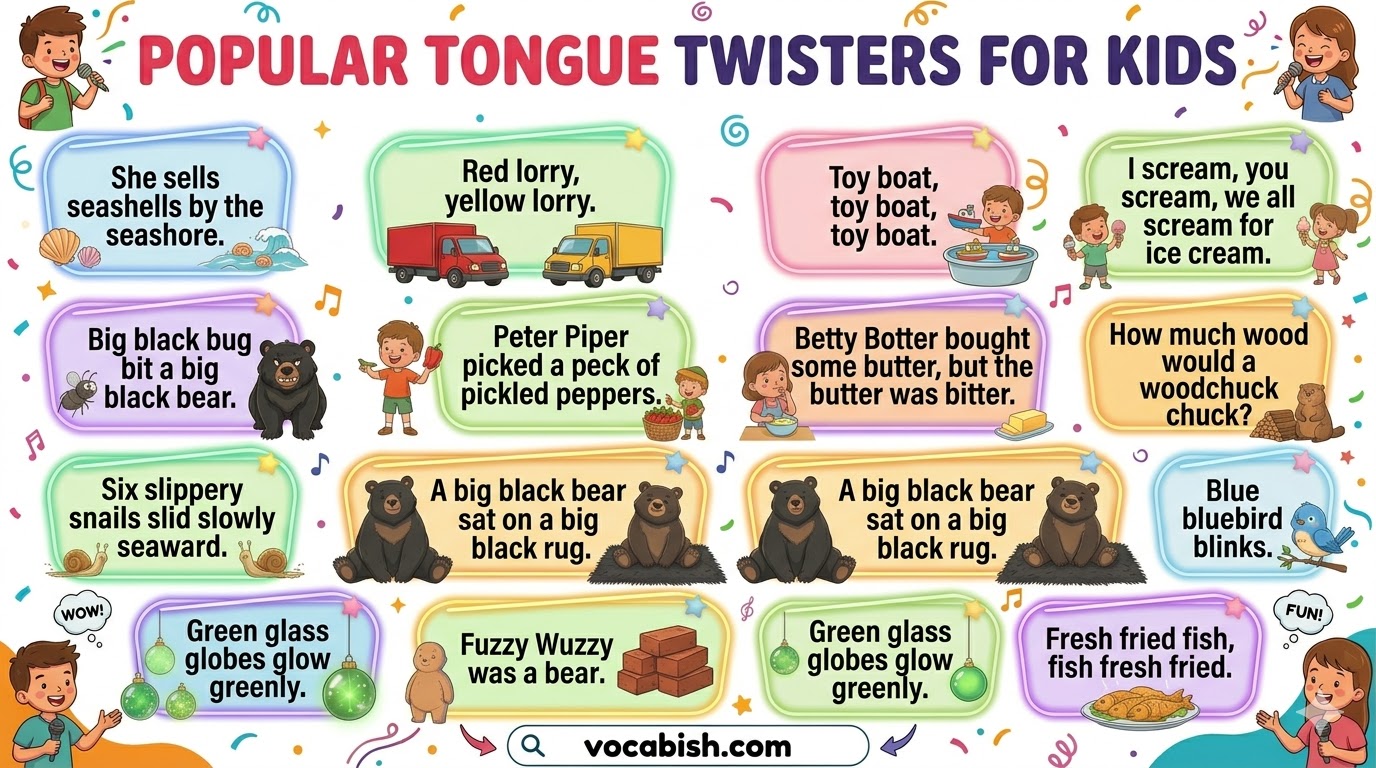
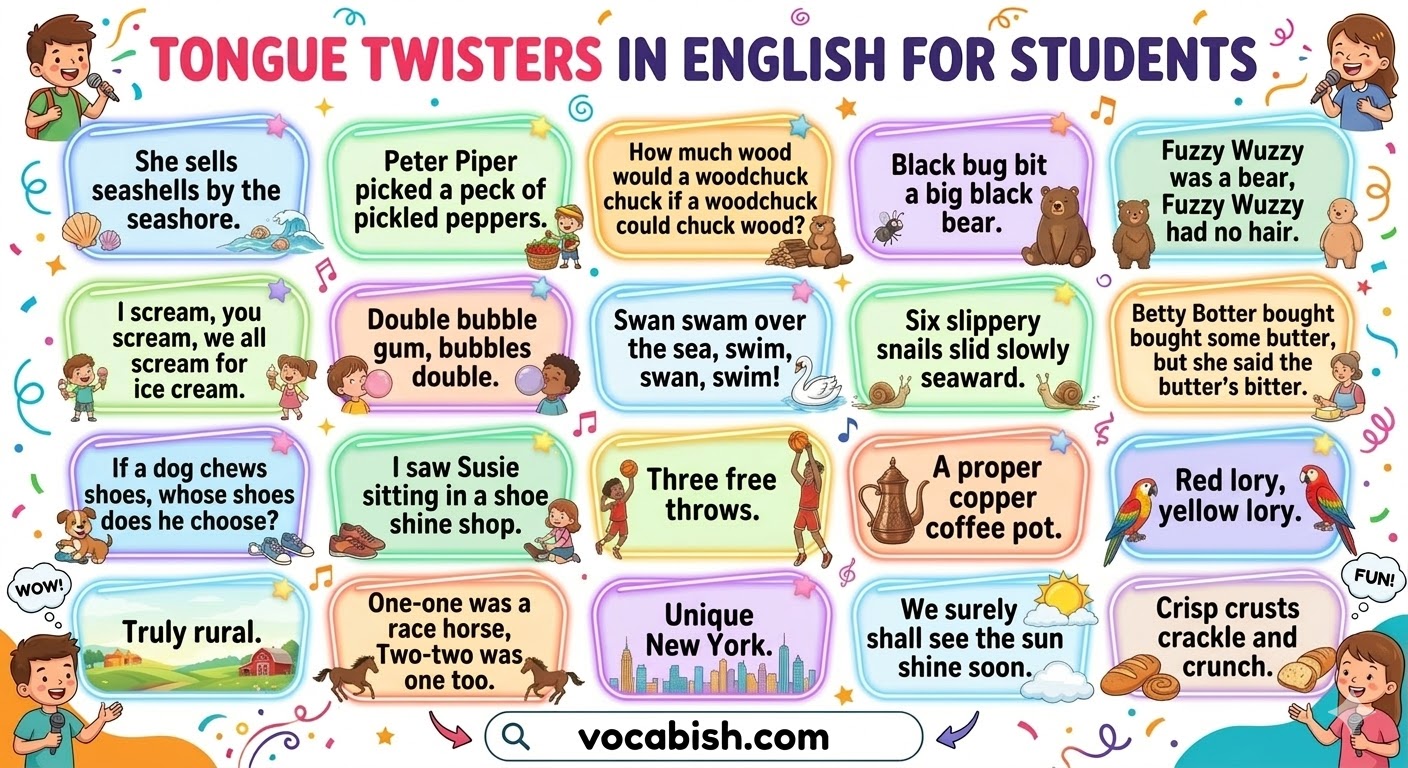
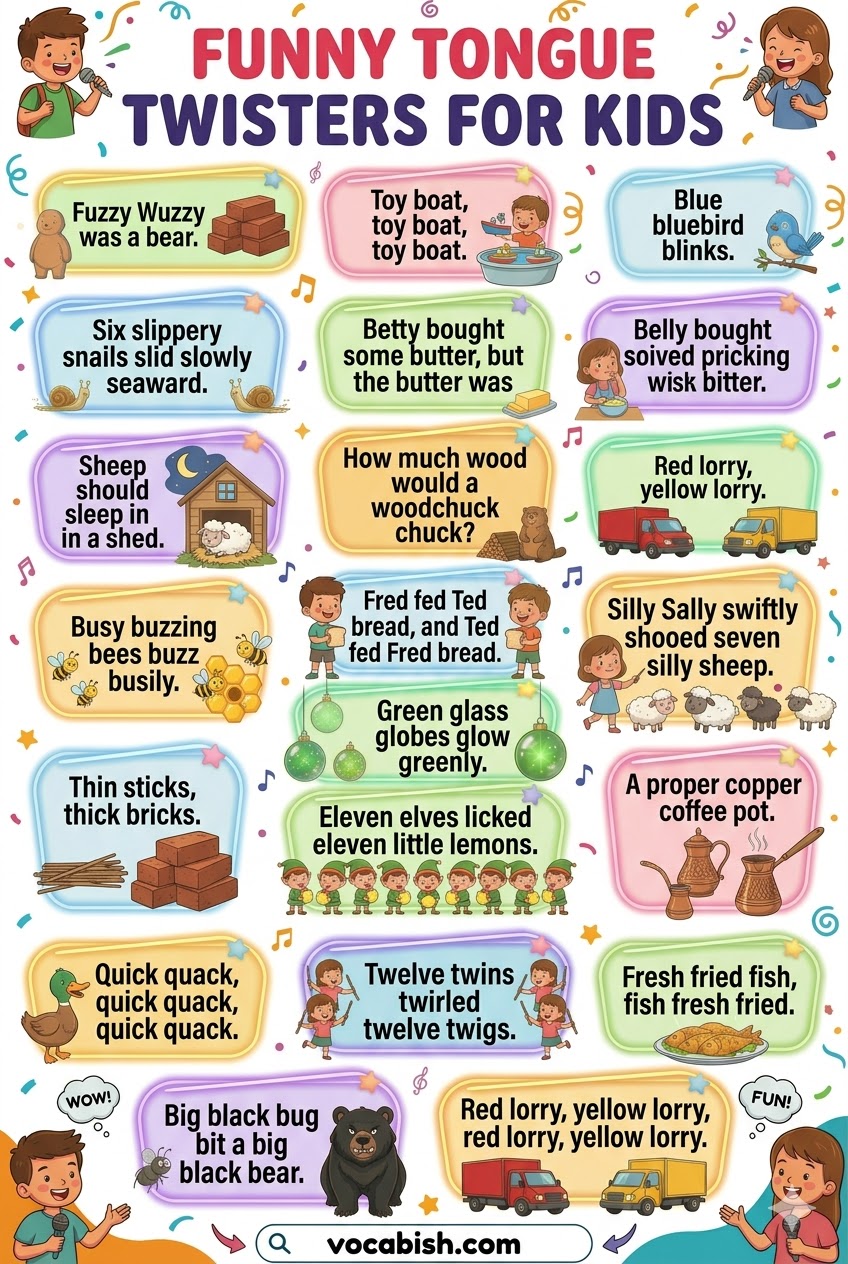
- Fuzzy Wuzzy was a bear.
- Toy boat, toy boat, toy boat.
- Blue bluebird blinks.
- Six slippery snails slid slowly seaward.
- Sheep should sleep in a shed.
Medium-Level Funny Tongue Twisters
- Betty bought some butter, but the butter was bitter.
- How much wood would a woodchuck chuck?
- Red lorry, yellow lorry.
- Busy buzzing bees buzz busily.
- Fred fed Ted bread, and Ted fed Fred bread.
Tricky and Laughable Tongue Twisters
- Silly Sally swiftly shooed seven silly sheep.
- Green glass globes glow greenly.
- Thin sticks, thick bricks.
- Eleven elves licked eleven little lemons.
- A proper copper coffee pot.
Extra Funny Tongue Twisters
- Quick quack, quick quack, quick quack.
- Twelve twins twirled twelve twigs.
- Fresh fried fish, fish fresh fried.
- Big black bug bit a big black bear.
- Red lorry, yellow lorry, red lorry, yellow lorry.
- Silly snakes silently slithered.
- Peter Piper picked a peck of pickled peppers.
- Which witch watches which watch?
- Fuzzy Wuzzy had no hair, Fuzzy Wuzzy wasn’t very fuzzy, was he?
- Five fat frogs fled from fifty fierce fish.
Daily Practice Tips
- Start slowly, then gradually increase speed.
- Repeat each tongue twister 3–5 times.
- Focus on tricky sounds like “s,” “sh,” and “b.”
- Practice in front of a mirror to watch mouth movements.
- Listen carefully and self-correct mistakes.
Regular practice strengthens pronunciation, fluency, and listening skills.
Common Mistakes to Avoid
- Rushing too fast at the start
- Ignoring tricky or repeated sounds
- Skipping practice days
- Speaking unclearly
Focus on correct pronunciation first, then gradually increase speed.
FAQs
Funny tongue twisters for kids are short, tricky sentences with silly sounds. They help learners practice pronunciation, speaking speed, and listening while enjoying playful English words.
Examples include “Fuzzy Wuzzy was a bear,” “Toy boat, toy boat,” and “Sheep should sleep in a shed.” These are short and perfect for beginners.
Yes. They strengthen tongue control, improve sound recognition, and help kids speak faster, smoother, and more confidently in English.
Daily practice for 5–10 minutes is best. Consistency improves pronunciation, fluency, and confidence in speaking and reading English.
Yes. They help kids notice sounds, read aloud smoothly, and listen carefully to differences in pronunciation, improving overall English comprehension.
Related Articles:
- 30 Short Tongue Twisters for Kids
- Thanksgiving Tongue Twisters in English
- 150+ Tongue Twisters for Kids PDF
Conclusion
Funny tongue twisters for kids are more than just silly sentences—they are tools to improve speaking, pronunciation, and listening. By practicing daily, children gain confidence, speak more clearly, and enjoy learning English. Start with simple lines and move to trickier ones to master pronunciation step by step.