
Many English learners get confused between already and all ready. These two phrases sound similar but have very different meanings. Understanding the difference helps you master reading, writing, speaking, and listening more effectively. Using them correctly makes your sentences more accurate and your communication stronger. In this blog post, you will learn the meanings of already and all ready, see examples, and understand how to use them in everyday English.
Meanings of Already and All Ready
Already
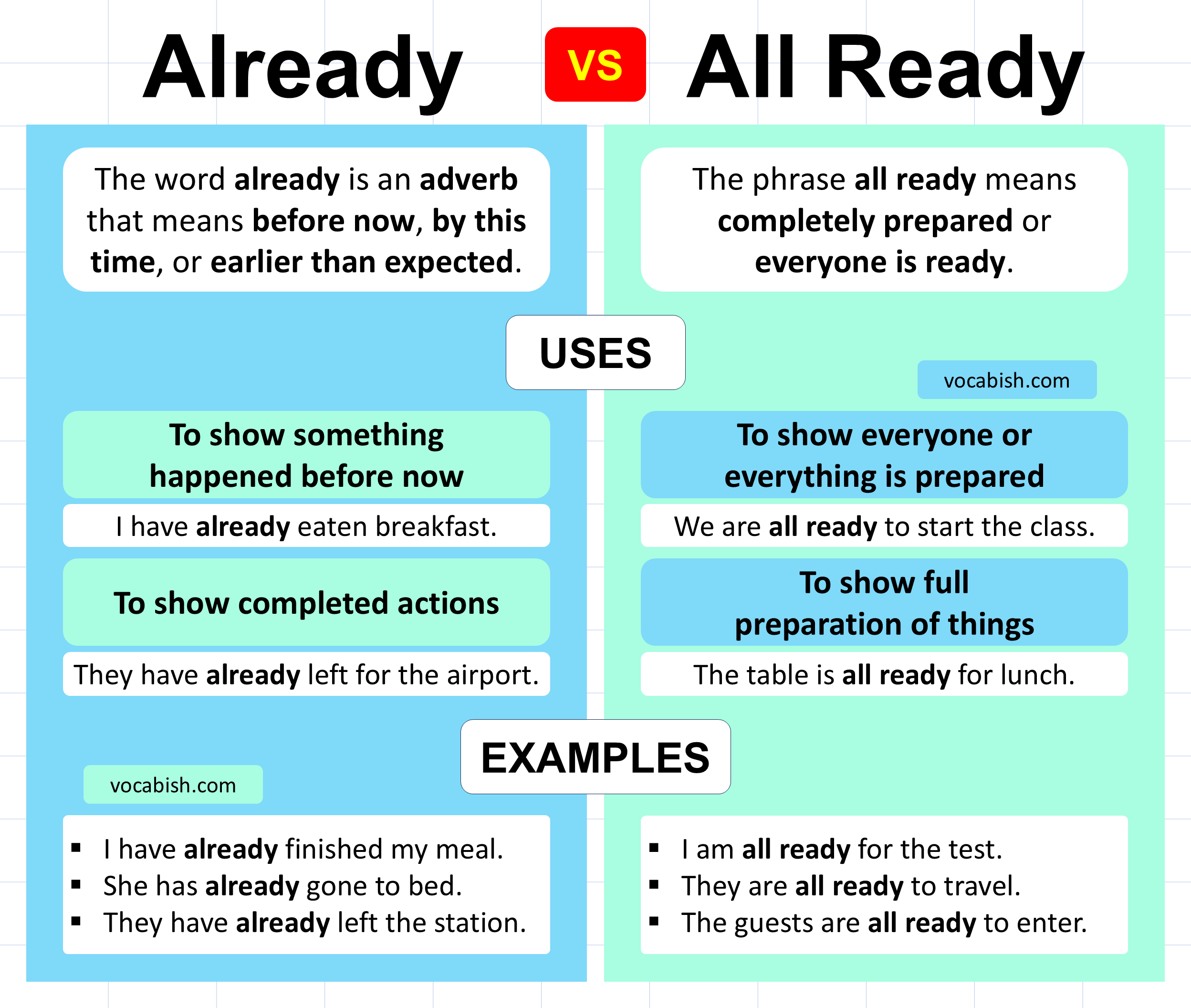
The word already is an adverb that means before now, by this time, or earlier than expected. It shows that something has happened or been completed.
Examples:
- She has already finished her homework.
- They were already tired when they arrived.
All Ready
The phrase all ready means completely prepared or everyone is ready. It is made of two words — all and ready, meaning everything or everyone is set to begin.
Examples:
- We are all ready to leave.
- The team is all ready for the match.
Difference Between Already and All Ready
| Word/Phrase | Meaning | Use in a Sentence | Part of Speech |
|---|---|---|---|
| Already | Happened before now | She has already gone home. | Adverb |
| All Ready | Completely prepared | We are all ready for dinner. | Phrase |
Quick Tip:
- Already = before now
- All Ready = all are ready
Usage of Already
1. To show something happened before now
- I have already eaten breakfast.
- She has already finished her work.
2. To express surprise about something happening sooner than expected
- You’re home already?
- He’s already done the project!
3. With perfect tenses to show completed actions
- They have already left for the airport.
- I had already seen that movie before.
Usage of All Ready
1. To show everyone or everything is prepared
- We are all ready to start the class.
- The guests are all ready for dinner.
2. To describe readiness for an event or action
- She is all ready to travel tomorrow.
- The students are all ready for the test.
3. To show full preparation of things
- The room is all ready for the party.
- The table is all ready for lunch.
Formal and Informal Usage
Both already and all ready are used in formal and informal English. The key is to use the correct word depending on the meaning.
Formal Examples:
- The report has already been completed.
- The team is all ready for the presentation.
Informal Examples:
- I’ve already told you that!
- We’re all ready to watch the movie.
Example Sentences of Already
- I have already finished my meal.
- She has already gone to bed.
- They have already left the station.
- He has already started working.
- We have already met before.
- The movie has already begun.
- I already know the answer.
- She already did her homework.
- We already booked the tickets.
- He was already tired.
- The sun had already set.
- They had already reached the hotel.
- I have already sent the email.
- She already spoke to the manager.
- We were already there.
- He had already finished the task.
- I already told you the truth.
- They have already visited London.
- She has already written the letter.
- We have already done this before.
Example Sentences of All Ready
- We are all ready to go.
- The kids are all ready for school.
- The table is all ready for dinner.
- I am all ready for the test.
- They are all ready to travel.
- The guests are all ready to enter.
- The cake is all ready to serve.
- The bags are all ready for the trip.
- We are all ready for the meeting.
- She is all ready to perform.
- The team is all ready for the match.
- The house is all ready for the party.
- The students are all ready to learn.
- The food is all ready on the table.
- We’re all ready to begin.
- He’s all ready to leave.
- Everyone is all ready for the event.
- The room is all ready for guests.
- They’re all ready to celebrate.
- She was all ready when we called her.
Summary on All Ready vs Already
| Word | Meaning | Example |
|---|---|---|
| Already | Happened before now | I’ve already seen that film. |
| All Ready | Completely prepared | We are all ready to start. |
- Use already for time or completion.
- Use all ready for preparation or readiness.
FAQs
What is the main difference between “already” and “all ready”?
Already means “before now,” while all ready means “completely prepared.”
Can I use “already” instead of “all ready”?
No. They have different meanings and cannot replace each other.
Is “already” one word or two?
Already is one word. All ready is two words.
Which tense is “already” used with?
It is mostly used with perfect tenses like present perfect or past perfect.
How can I remember the difference easily?
Think of already as before now, and all ready as everyone prepared.
Read More