
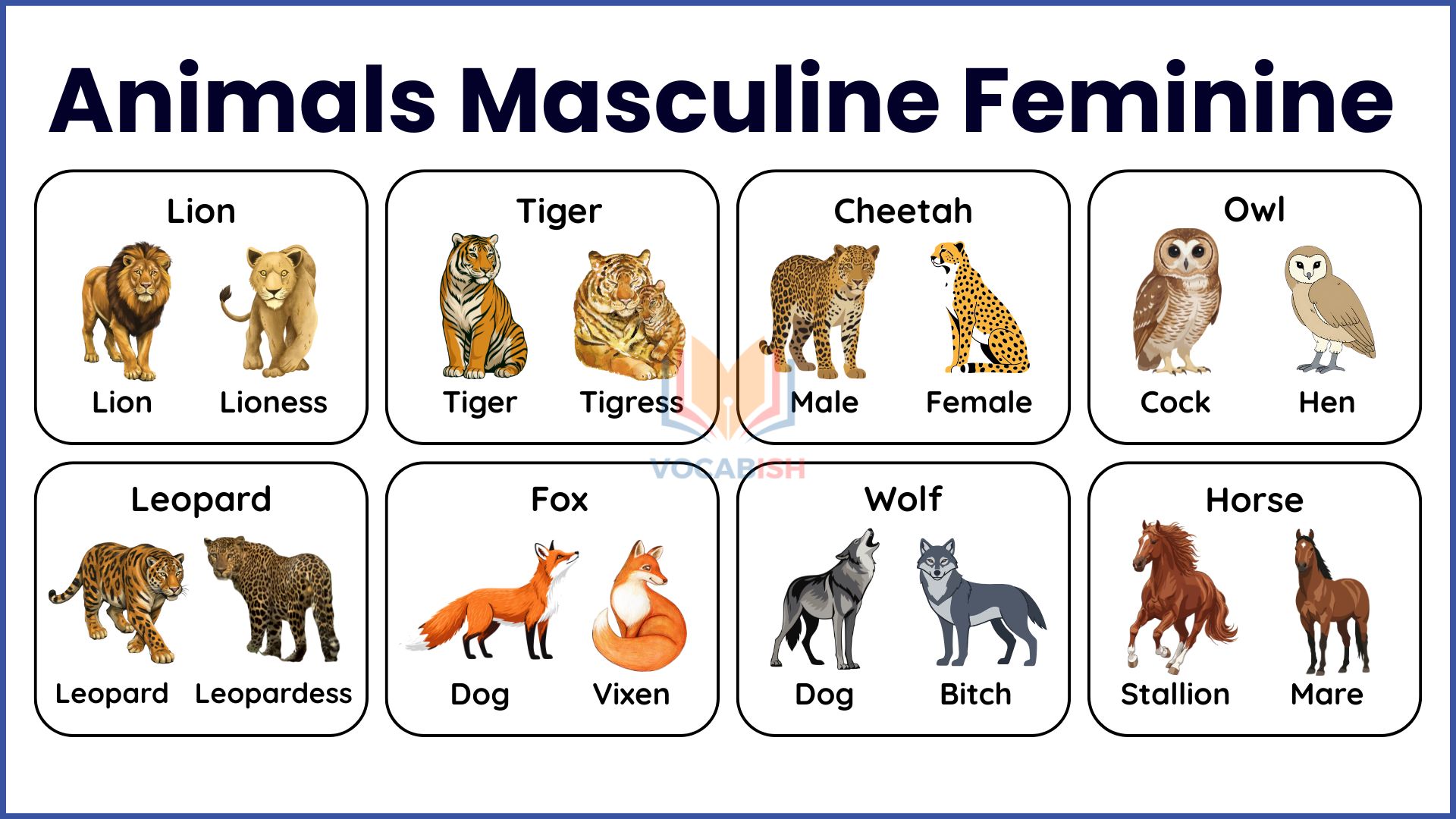
In this blog post, you will learn the names of male and female animals in English. These words show the difference between males, like lion or bull, and females, like lioness or cow. Understanding these terms helps you improve your vocabulary, speak more accurately, read and write correctly, and listen carefully in conversations or stories. By mastering male and female animal names, you can describe animals confidently and use English naturally in everyday situations.
Understanding masculine and feminine forms also strengthens your vocabulary. When you read books, articles, or stories about animals, you will recognize the correct terms for each gender. This makes reading easier and more meaningful.
Why Learn Male and Female Animal Names?
Learning the masculine and feminine of animals is important for English learners. It helps you speak more accurately, read better, and write clearly. Knowing these words also improves listening skills when someone talks about animals in real life, stories, or lessons.
By learning animal gender vocabulary, you will understand sentences like:
- The rooster is in the farmyard.
- The hen is laying eggs.
This makes your English more natural and easy to understand.
What Are Masculine and Feminine Forms
In English, many animals have two forms: one for males (masculine) and one for females (feminine).
- Masculine – the male animal (e.g., lion, bull, rooster)
- Feminine – the female animal (e.g., lioness, cow, hen)
Some animals do not have different names, but most common ones do.
List of Common Male and Female Animals
Here is a list of 15 important animal names with male and female forms:
- Lion → Lioness (Male and female lions)
- Tiger → Tigress (Male and female tigers)
- Dog → Bitch (Male and female dogs; note: ‘bitch’ can also be offensive in slang)
- Cat → Queen (Female cat, usually used in breeding)
- Rooster → Hen (Male and female chickens)
- Cock → Hen (Another word for rooster)
- Bull → Cow (Male and female cattle)
- Stallion → Mare (Male and female horses)
- Buck → Doe (Male and female deer)
- Ram → Ewe (Male and female sheep)
- Goat → Nanny (Female goat)
- Dogfish → Bitch (Female dogfish)
- Drake → Duck (Male and female ducks)
- Gander → Goose (Male and female geese)
- Fox → Vixen (Male and female foxes)
- Panther → Pantheress (Male and female panthers; less common)
- Boar → Sow (Male and female pigs)
- Buck → Doe (Male and female rabbits)
- Cockatoo → Hen (Male and female cockatoos)
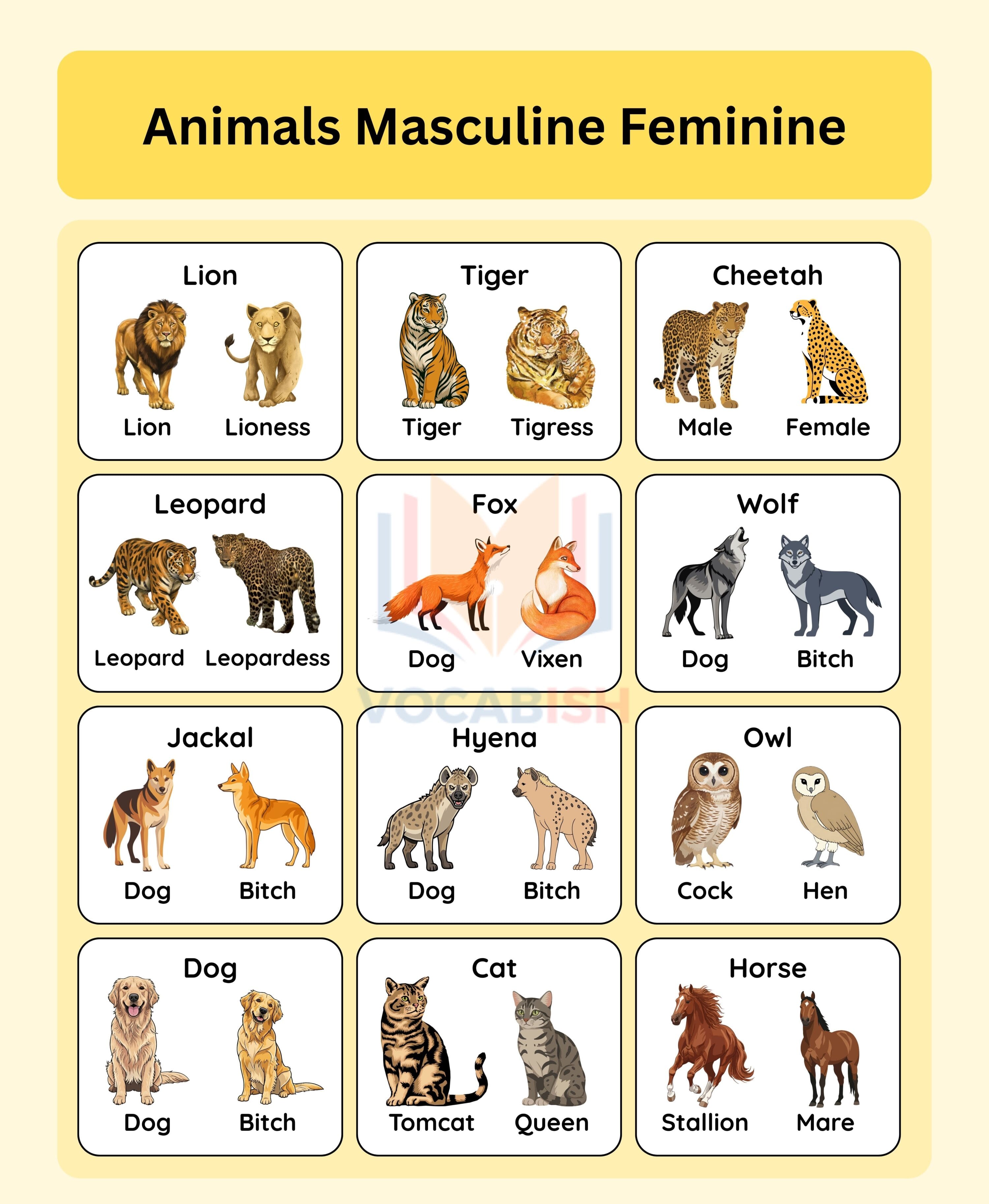
Tip: Words like “bitch” or “queen” are mostly used in animal breeding or zoology. In casual English, we often use the general animal name for both genders.
Masculine and Feminine Animals Name by Types
Big Cats and Predators
| Original Animal | Masculine Animal | Feminine Animal |
|---|---|---|
| Lion | Lion | Lioness |
| Tiger | Tiger | Tigress |
| Cheetah | Male | Female |
| Leopard | Leopard | Leopardess |
| Fox | Dog | Vixen |
| Wolf | Dog | Bitch |
| Jackal | Dog | Bitch |
| Hyena | Dog | Bitch |
Farm Animals
| Original Animal | Masculine Animal | Feminine Animal |
|---|---|---|
| Dog | Dog | Bitch |
| Cat | Tomcat | Queen |
| Horse | Stallion | Mare |
| Cow | Bull | Cow |
| Sheep | Ram | Ewe |
| Goat | Billy | Nanny |
| Chicken | Rooster | Hen |
| Duck | Drake | Duck |
| Turkey | Tom | Hen |
| Donkey | Jack | Jenny |
| Mule | Jack | Mare |
| Camel | Bull | Cow |
| Pig | Boar | Sow |
| Bison | Bull | Cow |
Deer and Antelope
| Original Animal | Masculine Animal | Feminine Animal |
|---|---|---|
| Deer | Buck | Doe |
| Antelope | Buck | Doe |
| Reindeer | Buck | Doe |
| Moose | Bull | Cow |
Birds
| Original Animal | Masculine Animal | Feminine Animal |
|---|---|---|
| Peafowl | Peacock | Peahen |
| Goose | Gander | Goose |
| Swan | Cob | Pen |
| Owl | Cock | Hen |
| Eagle | Cock | Hen |
| Hawk | Tiercel | Hen |
| Falcon | Tiercel | Falcon |
| Pigeon | Cock | Hen |
| Parrot | Cock | Hen |
| Flamingo | Cock | Hen |
| Crow | Cock | Hen |
| Ostrich | Rooster | Hen |
Marine Animals
| Original Animal | Masculine Animal | Feminine Animal |
|---|---|---|
| Whale | Bull | Cow |
| Dolphin | Bull | Cow |
| Seal | Bull | Cow |
| Walrus | Bull | Cow |
| Narwhal | Bull | Cow |
| Seahorse | Male | Female |
| Salmon | Cock | Hen |
| Shark | Bull | Female |
| Octopus | Male | Female |
| Sea Lion | Bull | Cow |
Hoofed or Large Herbivores
| Original Animal | Masculine Animal | Feminine Animal |
|---|---|---|
| Elephant | Bull | Cow |
| Rhinoceros | Bull | Cow |
| Hippopotamus | Bull | Cow |
| Giraffe | Bull | Cow |
| Zebra | Stallion | Mare |
| Kangaroo | Boomer | Flyer |
| Llama | Macho | Female |
| Tapir | Boar | Sow |
| Bandicoot | Boar | Sow |
| Armadillo | Boar | Sow |
Small Mammals and Rodents
| Original Animal | Masculine Animal | Feminine Animal |
|---|---|---|
| Rabbit | Buck | Doe |
| Guinea Pig | Boar | Sow |
| Wombat | Male | Female |
| Koala | Male | Female |
| Chinchilla | Buck | Doe |
| Squirrel | Buck | Doe |
| Mouse | Buck | Doe |
| Rat | Buck | Doe |
Carnivorous Mammals and Others
| Original Animal | Masculine Animal | Feminine Animal |
|---|---|---|
| Ferret | Hob | Jill |
| Badger | Boar | Sow |
| Wolverine | Boar | Sow |
| Weasel | Boar | Sow |
| Skunk | Boar | Sow |
| Meerkat | Boar | Sow |
Reptiles
| Crocodile | Bull | Cow |
| Alligator | Bull | Cow |
| Snake | Male | Female |
| Lizard | Male | Female |
| Turtle | Male | Female |
| Tortoise | Male | Female |
| Chameleon | Male | Female |
| Gecko | Male | Female |
| Komodo Dragon | Male | Female |
| Iguana | Male | Female |
Insects and Arachnids
| Original Animal | Masculine Animal | Feminine Animal |
|---|---|---|
| Bee | Drone | Queen |
| Ant | Drone | Queen |
| Spider | Male | Female |
| Crab | Cock | Hen |
Miscellaneous and Unique Species
| Original Animal | Masculine Animal | Feminine Animal |
|---|---|---|
| Platypus | Male | Female |
| Jackal | Dog | Bitch |
| Tapir | Boar | Sow |
Usage of Gender of Animals in Sentences
Knowing masculine and feminine forms is useful in daily conversation. Here are some examples:
- The lioness hunted for her cubs early in the morning.
- The bull is very strong and cannot be approached easily.
- I saw a drake swimming in the pond with the duck.
- The vixen raised her young foxes carefully in the forest.
These examples help learners connect vocabulary to real situations.
Tips to Remember
- Group animals by category – farm, wild, birds, pets.
- Use pictures – visuals help memorize names faster.
- Practice speaking – say both forms aloud.
- Create simple sentences – apply new words in context.
- Learn exceptions – some animals do not have different masculine and feminine names.
Conclusion
Learning the masculine and feminine of animals makes your English more accurate and natural. You can now name animals correctly, understand sentences better, and speak confidently. Practice these words daily and connect them with pictures to remember easily.
FAQs
What is the masculine and feminine of animals?
The masculine and feminine of animals refers to the words used for male and female animals. For example, a lion is masculine, and a lioness is feminine.
What are common masculine and feminine names of farm animals?
Common farm animals have separate masculine and feminine names. For example: bull (male) and cow (female), stallion (male) and mare (female), rooster (male) and hen (female).
Do all animals have separate masculine and feminine names?
No, many animals use the same word for both genders, like elephant, koala, or dolphin. Special masculine/feminine forms exist mainly for common farm animals, birds, and big cats.
What are some examples of masculine and feminine names of birds?
Examples include peacock (male) and peahen (female), drake (male) and duck (female), cock (male) and hen (female).
What are the 10 examples of masculine and feminine?
Here are 10 common examples of masculine and feminine animals in English:
- Lion – Lioness
- Tiger – Tigress
- Bull – Cow
- Stallion – Mare
- Rooster – Hen
- Ram – Ewe
- Dog – Bitch
- Peacock – Peahen
- Buck – Doe
- Drake – Duck
What is the feminine gender of cow?
The feminine gender of a cow is still called a cow, while the male is called a bull. In English, “cow” refers specifically to the adult female cattle.
Related Articles: