
In this blog post, you will learn about masculine, feminine, and gender nouns in English. These words help us identify whether a person or animal is male or female, such as man and woman or king and queen. Understanding masculine and feminine forms helps learners choose the right words when speaking and writing. It also improves reading and listening because many stories, lessons, and conversations use these gender pairs. When learners practice these words with rules and examples, they build stronger vocabulary and communicate with greater confidence.
Meaning of Masculine Gender
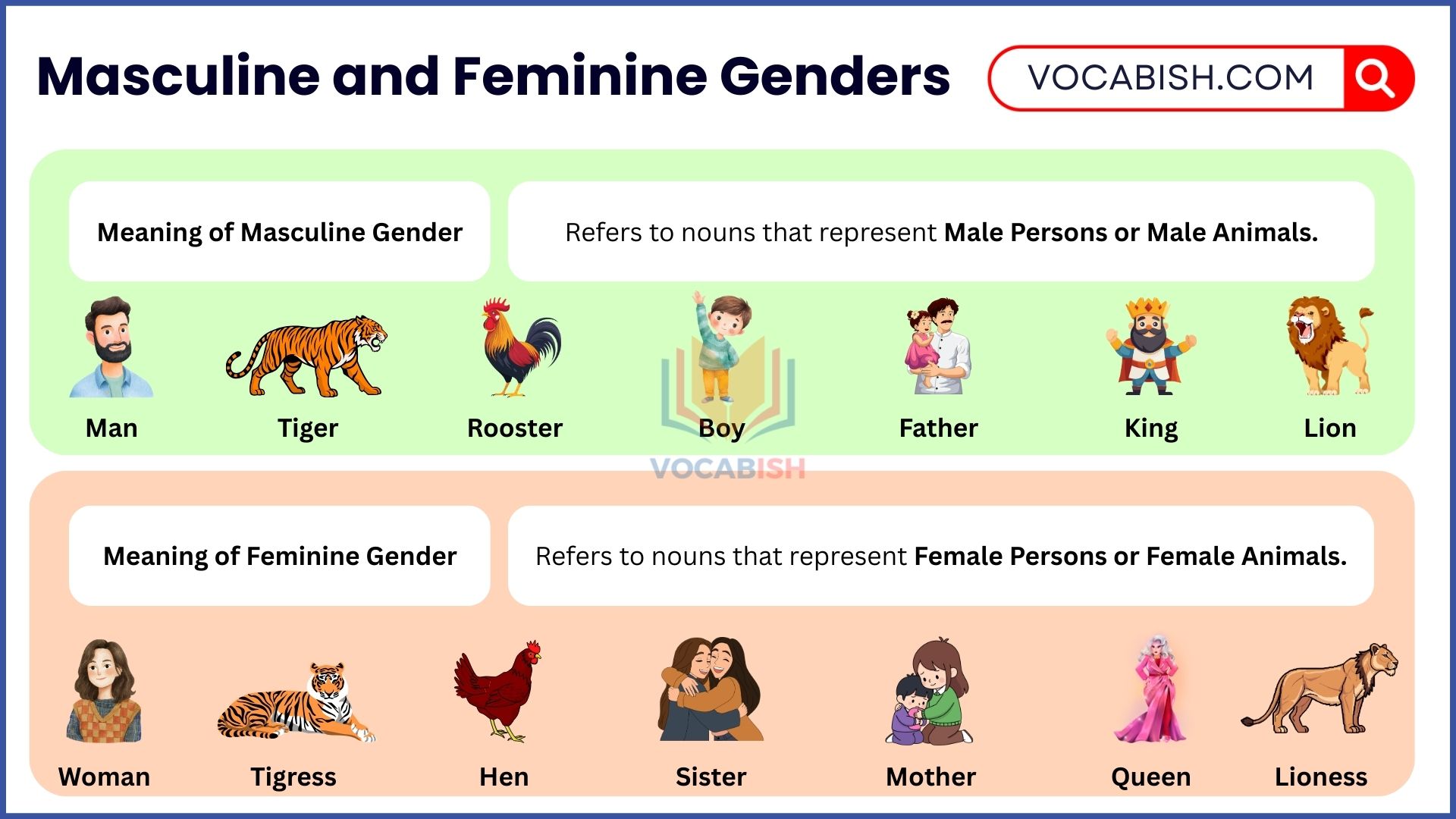
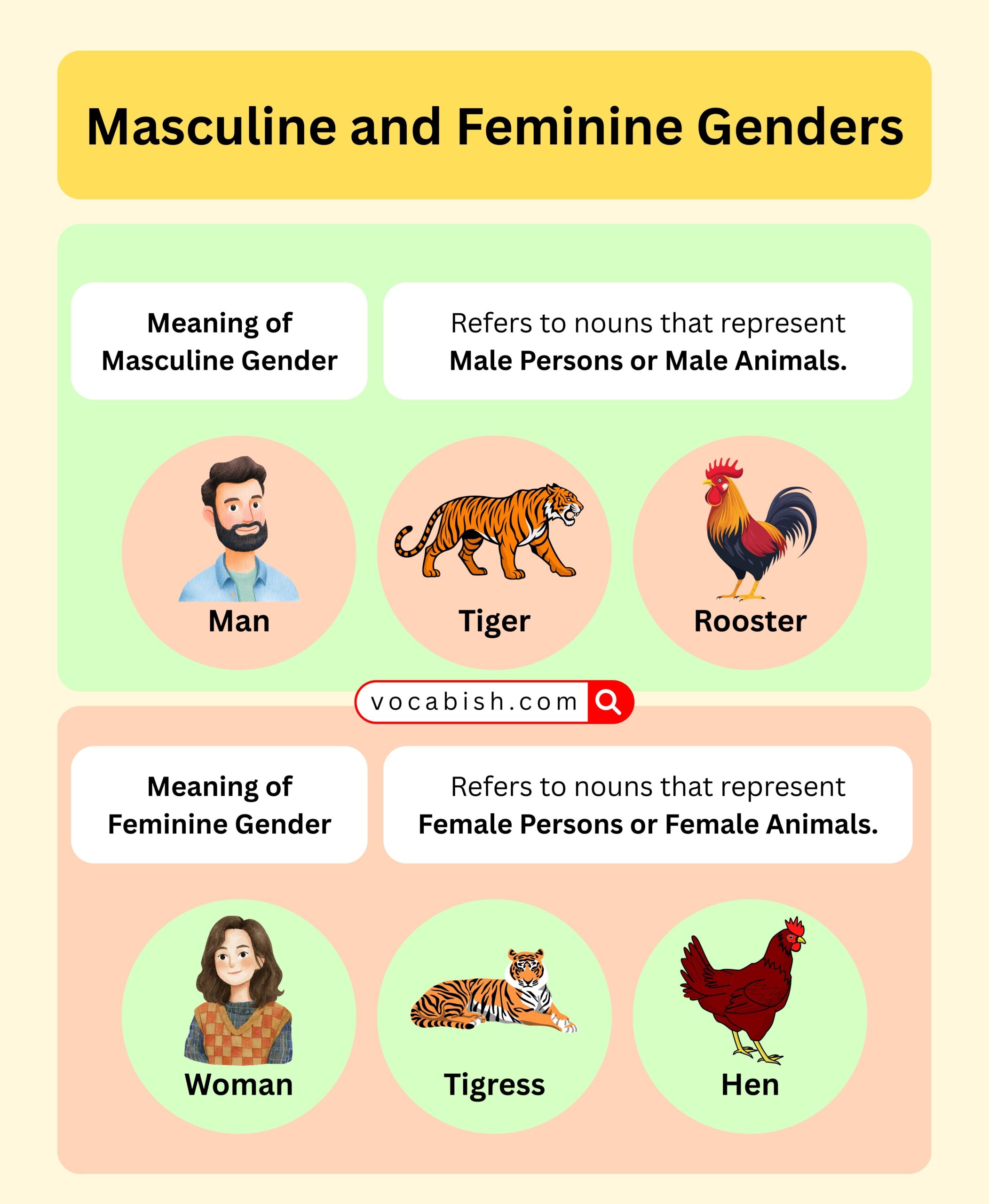
Masculine gender refers to nouns that represent male persons or male animals. These words identify someone or something that is male.
Examples of Masculine Gender Words
- Man – an adult male person
- Boy – a young male child
- Father – a male parent
- Brother – a male sibling
- Tiger – a male tiger
- Rooster – a male chicken
Example Sentences:
- The boy is playing in the park.
- The king ruled the kingdom wisely.
- The lion protects its territory.
Meaning of Feminine Gender
Feminine gender refers to nouns that represent female persons or female animals. These words identify someone or something that is female.
Feminine nouns help learners describe women, girls, and female animals accurately in English.
Examples of Feminine Gender Words
- Woman – an adult female person
- Girl – a young female child
- Mother – a female parent
- Sister – a female sibling
- Tigress – a female tiger
- Hen – a female chicken
Example Sentences:
- The girl is reading a storybook.
- The queen welcomed the guests.
- The lioness hunts for food.
Why Learning Gender Words Is Important
Gender vocabulary plays an important role in everyday communication.
When learners understand masculine and feminine words, they can:
- Describe people correctly
- Understand stories and conversations
- Improve vocabulary knowledge
- Speak more naturally in English
- Write clearer sentences
For example:
- The king ruled the kingdom.
- The queen welcomed the guests.
Knowing these words makes English easier to understand and use.
Rules of Masculine and Feminine Nouns
English does not have many gender rules compared to some other languages, but several common patterns exist.
1. Different Words for Male and Female
Sometimes English uses completely different words.
Examples:
- Man → Woman
- Father → Mother
- Brother → Sister
- King → Queen
2. Adding “-ess” for Feminine Form
Some feminine nouns form by adding -ess.
Examples:
- Actor → Actress
- Host → Hostess
- Lion → Lioness
- Tiger → Tigress
3. Using “Male” or “Female”
Sometimes English simply adds male or female before the noun.
Examples:
- Male teacher
- Female doctor
- Male elephant
- Female nurse
This pattern appears often in modern English.
Common Masculine and Feminine Words for People
These words describe male and female people in daily life.
Man – Woman
A man is an adult male. A woman is an adult female.
Boy – Girl
A boy is a young male child. A girl is a young female child.
Father – Mother
A father is a male parent. A mother is a female parent.
Brother – Sister
A brother is a male sibling. A sister is a female sibling.
Husband – Wife
A husband is a married man. A wife is a married woman.
King – Queen
A king is a male ruler of a kingdom. A queen is a female ruler.
Prince – Princess
A prince is the son of a king or queen. A princess is their daughter.
Uncle – Aunt
An uncle is a male relative. An aunt is a female relative.
Masculine and Feminine Words for Animals
Many animals also have gender-specific names.
Lion – Lioness
A lion is a male wild cat. A lioness is a female lion.
Tiger – Tigress
A tiger is the male form. A tigress is the female form.
Bull – Cow
A bull is a male cattle animal. A cow is a female cattle animal.
Horse – Mare
A horse can refer to the male animal. A mare is a female horse.
Rooster – Hen
A rooster is a male chicken. A hen is a female chicken.
Peacock – Peahen
A peacock is the male bird with colorful feathers. A peahen is the female.
Masculine and Feminine Words Used in Jobs and Roles
Many job titles once had different masculine and feminine forms.
Actor – Actress
An actor performs in movies or plays. An actress is a female performer.
Host – Hostess
A host welcomes guests. A hostess is the female form.
Waiter – Waitress
A waiter serves food in a restaurant. A waitress is the female server.
Prince – Princess
A prince is a male royal member. A princess is the female form.
Hero – Heroine
A hero is a brave male person. A heroine is a brave female person.
Modern English often uses gender-neutral words like actor or server for both men and women.
Everyday Masculine and Feminine Vocabulary
Below are useful gender pairs that learners often see in books, conversations, and lessons.
- King – Queen
- Prince – Princess
- Boy – Girl
- Man – Woman
- Father – Mother
- Brother – Sister
- Husband – Wife
- Actor – Actress
- Hero – Heroine
- Lion – Lioness
- Tiger – Tigress
- Bull – Cow
- Rooster – Hen
- Peacock – Peahen
- Horse – Mare
These words appear frequently in English stories, news, and daily conversation.
How to Use Gender Words in Sentences
Learners should practice using masculine and feminine nouns in simple sentences.
Examples:
- The king lives in a large palace.
- The queen welcomed the visitors.
- The boy is playing football.
- The girl is reading a book.
- The lioness protects her cubs.
- The actor performed well in the movie.
Using these words in sentences helps learners remember them faster.
Tips for Learning Gender Vocabulary Easily
Follow these simple strategies to remember masculine and feminine words.
- Learn gender pairs together
- Practice writing short sentences
- Read simple English stories
- Use flashcards for vocabulary review
- Listen to English conversations
Regular practice builds strong vocabulary knowledge and improves confidence in speaking English.
Conclusion
Masculine and feminine genders help English learners describe people and animals correctly. Understanding these word pairs makes communication clearer and improves vocabulary skills.
By learning common gender words, basic rules, and simple examples, learners can recognize and use these nouns easily in daily English. With regular practice, gender vocabulary becomes natural and helps build stronger language skills.
FAQs
What are masculine and feminine genders in English?
Masculine and feminine genders in English refer to nouns that show whether a person or animal is male or female. Masculine nouns describe males, such as man or king. Feminine nouns describe females, such as woman or queen.
What is the difference between masculine and feminine gender?
The difference between masculine and feminine gender lies in the gender they represent. Masculine gender refers to male people or animals, while feminine gender refers to female ones. For example, boy is masculine and girl is feminine.
What are some examples of masculine and feminine words in English?
Common examples of masculine and feminine words include king–queen, man–woman, boy–girl, father–mother, and lion–lioness. These pairs clearly show male and female forms.
How do you change masculine nouns to feminine nouns in English?
English forms feminine nouns in different ways. Some nouns change completely, such as man to woman. Others add endings like -ess, for example actor to actress or lion to lioness. In many modern cases, English uses the same word for both genders, depending on the context.
What are masculine and feminine nouns for animals?
Many animals have different masculine and feminine names. For example, bull and cow, lion and lioness, rooster and hen, and peacock and peahen. These gender words help learners describe animals correctly and understand nature-related vocabulary in English learning materials.
Can one word be used for both masculine and feminine in English?
Yes, many English nouns are gender-neutral and can describe both males and females. Words like teacher, student, doctor, and friend work for any gender. Modern English often prefers these neutral words because they are simple and suitable for both masculine and feminine usage.
Related Articles: