
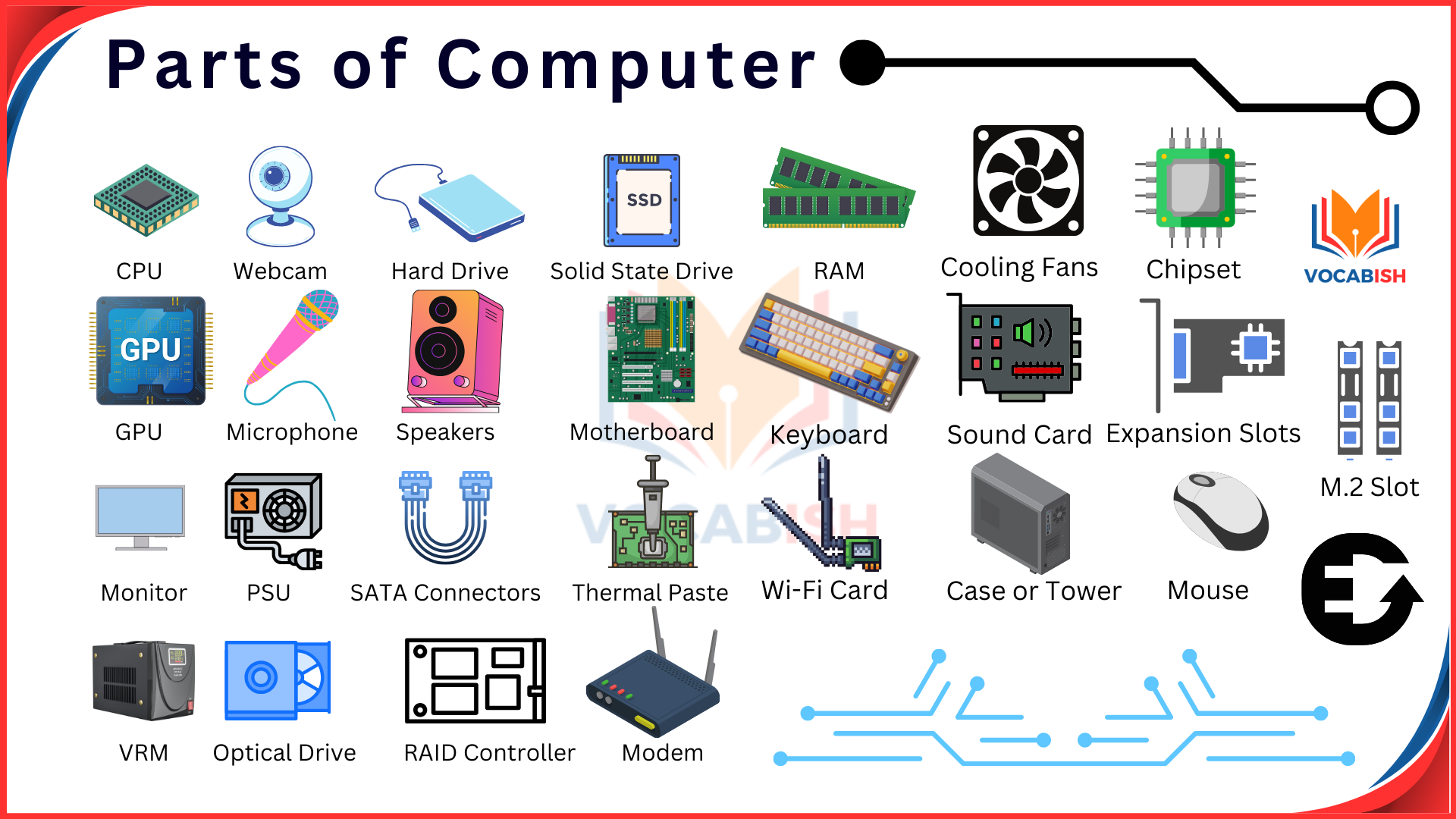
Computers are part of daily life at school, at work, and at home. To speak about technology correctly, you need to know the parts of a computer and their uses. These words are important vocabulary for modern English learners. When you understand hardware terms like input devices, output devices, and internal components, you can follow lessons, read technical texts, and write about technology with confidence. You also improve your listening skills because you recognize common computer terms in conversations and videos. In this blog post, you will learn the names and uses of computer parts so you can master this essential vocabulary and use it correctly in real situations.
What Is a Computer?
A computer is an electronic machine that receives information, processes it, and shows results.
It works in three simple steps:
- Input – You give information.
- Process – The computer works on it.
- Output – The computer shows the result.
For example, when you type a sentence and print it, the keyboard gives input, the computer processes it, and the printer gives output.
Why Learning Computer Vocabulary Is Important
Learning computer parts vocabulary helps you:
- Follow classroom instructions
- Understand technical manuals
- Communicate at work
- Use digital tools confidently
- Improve reading and speaking skills
In modern English, computer words are common in daily conversations. Therefore, knowing these terms builds practical language skills.
Basic Parts of a Computer
These are the main parts every beginner should know.
Monitor
Shows text, images, and videos.
Example: I read my lesson on the monitor.
Central Processing Unit (CPU)
The brain of the computer. It processes instructions.
Example: The CPU runs programs quickly.
Keyboard
Used to type letters and numbers.
Example: She typed her email on the keyboard.
Mouse
Moves the pointer and selects items.
Example: Click the icon with the mouse.
Case or Tower
The outer box that holds internal components.
Example: All the hardware is inside the tower.
Important Computer Parts
These parts help the computer work efficiently.
Graphics Processing Unit (GPU)
Handles images and video quality.
Example: A strong GPU improves gaming graphics.
Random Access Memory (RAM)
Temporary memory for running programs.
Example: More RAM makes the computer faster.
Power Supply Unit (PSU)
Provides electricity to all parts.
Example: The PSU powers the motherboard.
Motherboard
Main circuit board that connects all components.
Example: The CPU and RAM attach to the motherboard.
Chipset
Controls communication between processor, memory, and devices.
Example: The chipset manages data flow.
BIOS (Basic Input/Output System)
Starts the computer before the operating system loads.
Example: The BIOS checks hardware during startup.
CMOS Battery
Keeps system time and BIOS settings saved.
Example: If the CMOS battery dies, the clock resets.
Internal Parts of the Computer
These components are inside the computer tower.
Hard Drive (HDD)
Stores operating system and files permanently.
Example: My documents are saved on the HDD.
Solid State Drive (SSD)
Faster storage device than HDD.
Example: The SSD makes the system boot quickly.
M.2 Slot
Slot on motherboard for SSDs.
Example: The new SSD fits into the M.2 slot.
SATA Connectors
Connect storage drives to motherboard.
Example: The HDD connects using SATA cables.
Internal Drive Bays
Spaces inside the case for installing drives.
Example: The SSD is fixed in a drive bay.
External Drive Bays
Front slots for optical drives.
Example: The DVD drive fits in the external bay.
RAID Controller
Manages multiple drives for speed or backup.
Example: RAID protects data from failure.
Cooling Fans
Move air to reduce heat.
Example: The fans keep the CPU cool.
Heatsink
Absorbs heat from the processor.
Example: The heatsink prevents overheating.
Thermal Paste
Improves heat transfer between CPU and heatsink.
Example: Apply thermal paste before installing the cooler.
VRM (Voltage Regulator Module)
Controls power supplied to the CPU.
Example: VRM ensures stable voltage.
Expansion Slots
Slots for adding cards like GPU or sound card.
Example: The GPU fits into an expansion slot.
Sound Card
Controls audio input and output.
Example: The sound card improves music quality.
Network Interface Card (NIC)
Connects computer to wired internet.
Example: The NIC connects to Ethernet cable.
Wi-Fi Card
Enables wireless internet connection.
Example: The Wi-Fi card connects without cables.
I/O Shield
Covers and protects rear ports.
Example: The I/O shield keeps dust out.
External Parts of a Computer
These parts connect from outside.
Monitor
Displays visual output.
Example: I read my lesson on the monitor.
Keyboard
Used for typing.
Example: He typed his name on the keyboard.
Mouse
Used for pointing.
Example: Click the icon with the mouse.
Speakers
Play sound.
Example: The speakers play music loudly.
Webcam
Captures video.
Example: We used the webcam for a meeting.
Microphone
Records voice.
Example: Speak into the microphone clearly.
USB Hub
Adds extra USB ports.
Example: I connected many devices using a USB hub.
Bluetooth Adapter
Allows wireless device connection.
Example: The adapter connects wireless headphones.
Ports (USB, HDMI)
Connection points for devices.
Example: Plug the cable into the HDMI port.
Modem
Connects the computer to the internet service provider.
Example: The modem provides internet access.
Input Devices in a Computer
Input devices send data to the computer.
- Keyboard – Types text
- Mouse – Selects items
- Microphone – Records sound
- Webcam – Captures video
- Scanner – Scans documents
Output Devices in a Computer
Output devices show results.
- Monitor – Displays visuals
- Printer – Prints documents
- Speakers – Play audio
- Headphones – Personal audio listening
Storage Devices in a Computer
Storage devices save data.
- Hard Drive (HDD) – Permanent storage
- Solid State Drive (SSD) – Fast permanent storage
- External Hard Drive – Portable storage
- USB Flash Drive – Small portable storage
- Optical Drive (CD/DVD/Blu-ray) – Reads discs
- Cloud Storage – Online storage
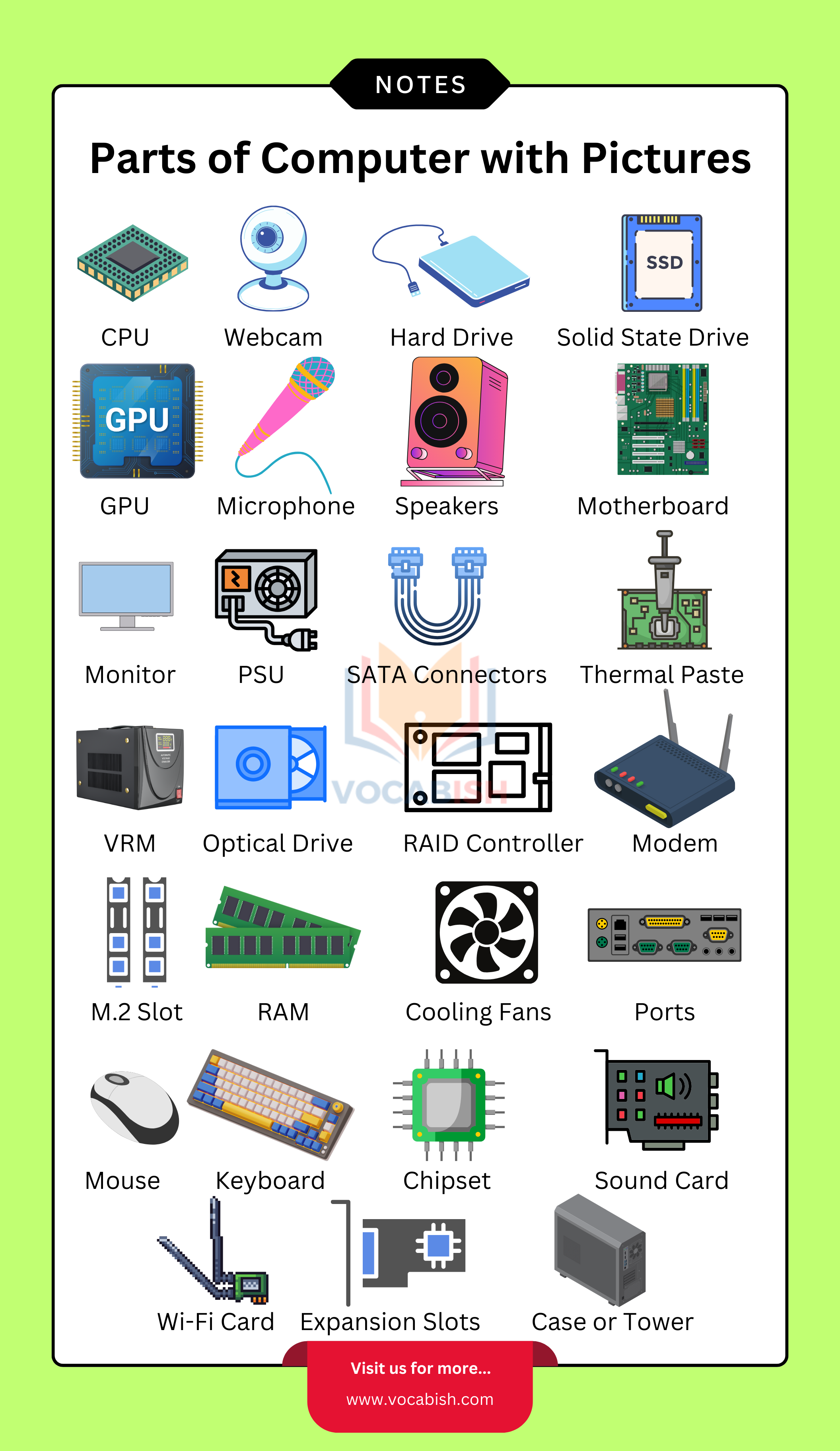
Parts of Computer Image
Conclusion
Understanding the parts of a computer gives you practical vocabulary that you can use every day. From the monitor and keyboard to the CPU, RAM, and storage devices, each component has a clear purpose. When you know these names and uses, you can follow instructions easily and speak about technology with confidence.
FAQs
What are the main parts of a computer?
The main parts of a computer are the monitor, keyboard, mouse, and Central Processing Unit (CPU). These basic hardware components allow users to input data, process information, and view results. Together, they help the computer perform everyday tasks such as typing, browsing, and studying.
What is the function of the CPU in a computer?
The Central Processing Unit (CPU) is the brain of the computer. It processes instructions, performs calculations, and controls other hardware components. Every program you open depends on the CPU. Without it, the computer cannot run software or complete tasks.
What are input and output devices in computer parts?
Input devices send data to the computer, such as the keyboard and mouse. Output devices show results, such as the monitor and printer. These parts of a computer work together to complete the input-process-output cycle used in daily computing activities.
What are the internal parts of a computer?
Internal parts of a computer include the motherboard, CPU, RAM, hard drive, and power supply unit. These components are inside the case or tower. They manage memory, processing, storage, and power, which keeps the computer working properly.
What are storage devices in computer parts?
Storage devices save data permanently or temporarily. Examples include hard disk drives (HDD), solid-state drives (SSD), USB flash drives, and cloud storage. These devices store files, programs, and the operating system for future use.
What is the use of RAM in computer parts?
Random Access Memory (RAM) is temporary memory that stores data while the computer is running. It helps programs open faster and improves performance. More RAM allows smoother multitasking, especially when using multiple applications at the same time.
Read More