
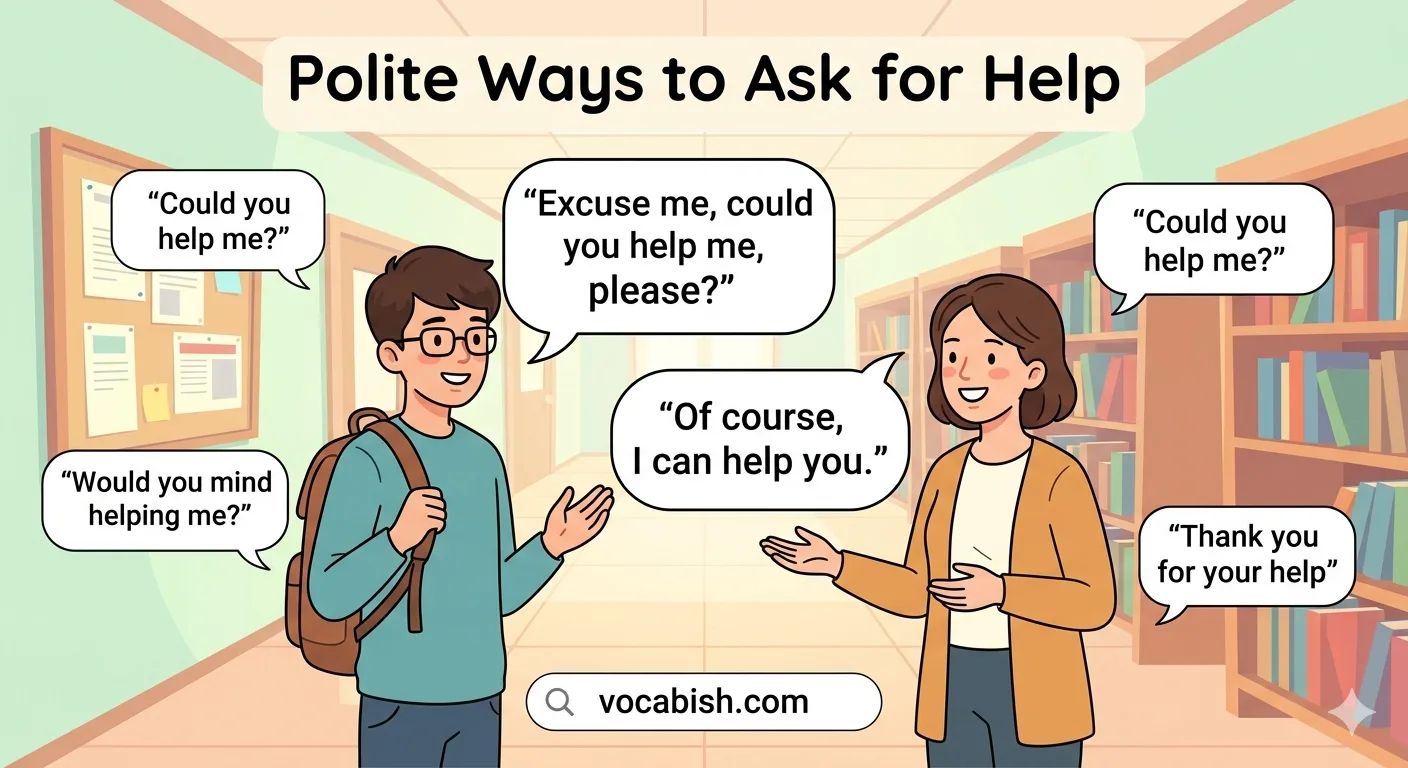
Knowing how to ask for help politely is an important skill in English communication. People often need help in daily life at school, at work, in stores, or when traveling. Using polite words and respectful expressions makes conversations smoother and more friendly. When learners use polite expressions, others feel respected and are more willing to help. It also helps learners sound more natural and confident in English.
What Does It Mean to Ask for Help Politely?
To ask for help politely means using respectful words and expressions when you need assistance from someone. Instead of giving direct commands, English speakers usually ask questions in a gentle and respectful way.
For example:
Direct request:
Give me your notes.
Polite request:
Could you please share your notes with me?
Polite language shows respect, patience, and good communication skills.
Why Polite Language Is Important in English
Politeness plays an important role in English-speaking cultures. People usually expect requests to sound respectful.
Using polite expressions helps learners:
- communicate respectfully
- build positive relationships
- avoid sounding rude
- improve speaking confidence
Because of this, polite requests are a key part of daily conversation vocabulary.
Words Used When Asking for Help
Here are useful words often used in polite requests.
- Help – Assistance from another person
- Please – A polite word used when asking for something
- Excuse me – A polite way to get someone’s attention
- Sorry – Used when interrupting someone politely
- Question – Something you ask to get information
- Problem – A situation that needs a solution
- Advice – Helpful suggestions from someone
- Direction – Information about where to go
- Explanation – Information that helps someone understand
- Support – Help or assistance from others
These words appear often in everyday English conversations.
Polite Phrases to Ask for Help
English speakers use certain phrases to make requests sound polite.
- Excuse me, could you help me?
- Can you please help me with this?
- Could you show me how to do this?
- Would you mind helping me?
- May I ask you something?
- Could you explain this to me?
- I need some help with this.
Useful Sentence Patterns
Certain sentence structures help learners ask for help naturally.
Pattern 1: Could you + verb
Example sentences:
- Could you help me with my homework?
- Could you explain this word?
- Could you tell me where the library is?
Pattern 2: Can you + verb
Examples:
- Can you help me carry this bag?
- Can you show me the correct answer?
Pattern 3: Would you mind + verb + ing
Examples:
- Would you mind helping me for a moment?
- Would you mind explaining this problem?
These patterns help learners form polite requests easily.
Polite Questions in Daily Situations
People ask for help in many everyday situations.
At School
- Excuse me, could you explain this question?
- Can you help me understand this lesson?
At Work
- Could you show me how to complete this task?
- May I ask you a question about this project?
In Public Places
- Excuse me, could you tell me where the bus stop is?
- Can you help me find this address?
Using polite language makes communication comfortable and respectful.
Asking for Help with Answers Politely
| Situation | Asking for Help | Polite Answer |
|---|---|---|
| Finding a place | Excuse me, could you tell me where the station is? | Yes, go straight and turn left at the corner. |
| Understanding a lesson | Could you explain this to me, please? | Of course, I will explain it step by step. |
| Carrying something | Can you help me carry this bag? | Sure, I can help you with that. |
| Asking for directions | Would you mind showing me the way to the library? | Not at all, it’s next to the school building. |
| Asking for information | May I ask you something? | Yes, of course. What do you need? |
| Using public transport | Could you tell me which bus goes to the mall? | Take bus number 5. It goes directly there. |
| Asking at a shop | Can you help me find this item? | Yes, it is on aisle three. |
| Requesting assistance | Would you mind helping me with this task? | Sure, I’d be happy to help you. |
| Asking for clarification | Could you repeat that, please? | Of course, I’ll say it again slowly. |
| Asking for advice | Can you give me some advice? | Yes, I suggest you try this method. |

Ways to Ask for Help Politely in English
- Excuse me, could you help me?
- Can you please help me with this?
- Could you help me, please?
- Would you mind helping me?
- May I ask you for some help?
- Could you show me how to do this?
- Could you explain this to me?
- Can you tell me how to get there?
- Could you give me some advice?
- I need some help, please.
- Could you please assist me?
- Would it be possible for you to help me?
- Can I ask you something?
- Sorry to bother you, but could you help me?
- Do you think you could help me?
Conversation Examples and Short Dialogues
Short dialogues help learners understand real communication.
Dialogue 1: Asking a Teacher for Help
Student: Excuse me, could you help me with this math problem?
Teacher: Of course. Let me explain it to you.
Dialogue 2: Asking for Directions
Person A: Excuse me, could you tell me where the train station is?
Person B: Yes, go straight and turn left at the next corner.
Dialogue 3: Asking a Friend for Help
Anna: Can you help me carry these books?
Tom: Sure, I can help you.
Dialogue 4: Asking a Coworker
Worker A: Would you mind helping me with this report?
Worker B: No problem. I will help you.
Helpful Tips for Speaking Politely
Learners can improve polite communication by following simple habits.
- Use please when asking for something.
- Start with excuse me to get attention.
- Speak in a calm and respectful tone.
- Use questions instead of commands.
- Thank the person after receiving help.
Example:
- Thank you for helping me.
Politeness helps conversations stay positive and respectful.
Related Articles:
Conclusion
Learning polite ways to ask for help in English helps learners communicate effectively in daily life. Words like please, excuse me, could you, and would you mind make requests sound respectful and friendly.
When learners practice these phrases, they can:
- ask questions confidently
- receive help easily
- communicate clearly in school, work, and public places