
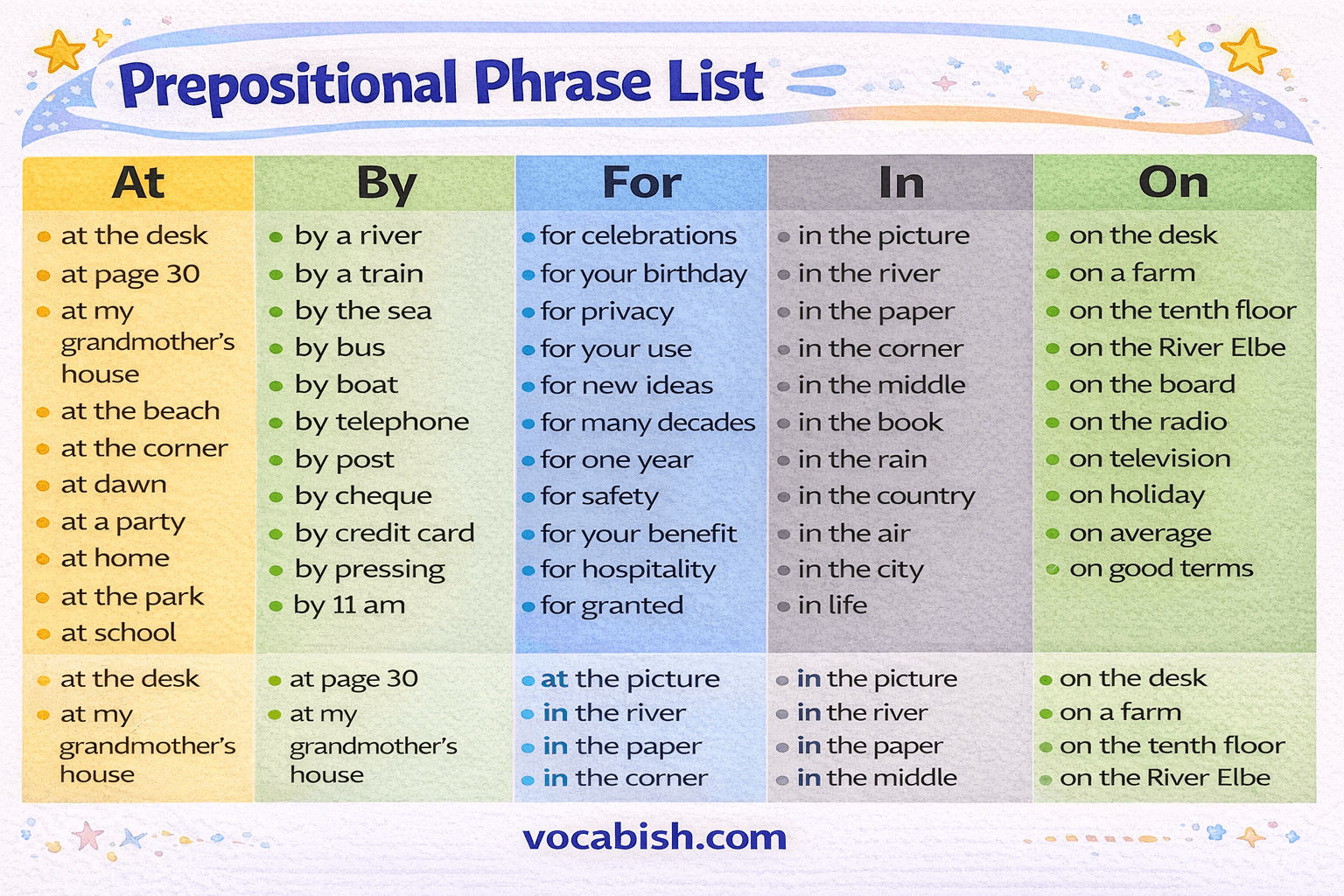
Prepositional phrases are groups of words that start with a preposition and end with a noun or pronoun. They show relationships of place, time, direction, cause, and more. Examples include “on the table,” “after the class,” and “under the bridge.” In this blog post, you will learn common prepositional phrases with sentences in English to see how they are used in real contexts. When you understand prepositional phrases, your speaking and writing become more precise, and your reading becomes easier to follow. With practice, you will master using these phrases correctly in daily conversations and writing. Keep reading to explore useful examples and improve your English step by step.
Prepositional Phrases with Sentences
Usage of At
The preposition “at” is mainly used to show a specific point, exact place, or exact time. It does not describe a large area. It focuses on a point.
“At” – Place
We use at to talk about a specific location or point.
Examples:
- She is waiting at the bus stop.
- He works at the hospital.
- I met him at the gate.
- The children are playing at the park entrance.
- She is standing at the door.
Usage of By
The preposition “by” has many uses in English. It is commonly used for place, transport, communication, payment, time, and actions.
“By” – Place
By means near or next to something.
Examples:
- The house is by the river.
- She sat by the window.
- The school is by the main road.
- He parked the car by the shop.
- There is a tree by the wall.
“By” – Method of Transport
We use by to talk about how we travel, but we do not use articles (a, an, the) after it.
Examples:
- I go to school by bus.
- She travelled to London by train.
- He goes to work by car.
- We moved the goods by truck.
- They travelled by plane.
“By” – Method of Communication
By is used to show how we communicate.
Examples:
- I sent the message by email.
- She talked to me by phone.
- He learned the news by radio.
- We contacted the teacher by WhatsApp.
- The order was sent by fax.
“By” – Method of Payment
We use by to explain how payment is made.
Examples:
- I paid by credit card.
- She paid the bill by cash.
- He bought the ticket by debit card.
- We paid by online transfer.
- The fee was paid by cheque.
“By” – Reflexive Pronoun
By with a reflexive pronoun means alone or without help.
Examples:
- She finished the work by herself.
- He lives by himself.
- The child dressed by himself.
- I completed the project by myself.
- They built the house by themselves.
“By” – ING Verb
By + ing verb shows how something is done.
Examples:
- He passed the exam by studying hard.
- She lost weight by exercising daily.
- We learned English by practising every day.
- He solved the problem by thinking carefully.
- She earned money by teaching online.
“By” – Time Expression
By is used to show a deadline or latest time.
Examples:
- Please finish the work by Monday.
- He will return by evening.
- The report must be ready by tomorrow.
- She promised to call by 6 o’clock.
- Complete the task by next week.
Usage of For
The preposition for is used to show purpose, reason, duration, or benefit.
Examples:
- This gift is for you.
- She waited for two hours.
- He is studying for the exam.
- The medicine is for fever.
- They left early for safety reasons.
- I bought flowers for my mother.
Use of In
The preposition in is used for inside places, long periods of time, and situations.
Examples:
- The keys are in the bag.
- She lives in a big city.
- I was born in 2005.
- He will finish the work in two days.
- The children are in the classroom.
- She spoke in a soft voice.
Usage of On
The preposition on is used for surface, specific days, and devices.
Examples:
- The book is on the table.
- We will meet on Monday.
- She wrote the answer on the board.
- He watched the match on TV.
- The picture is on the wall.
- I found the news on the internet.

Prepositional phrases help English learners speak clearly and correctly. Learning how to use at, by, for, in, and on will improve your grammar and confidence. Practice these sentences daily and try to make your own examples. With regular use, prepositions will become easy and natural for you.
Frequently Asked Questions
What is a prepositional phrase in English?
A prepositional phrase is a group of words that starts with a preposition and ends with a noun or pronoun. For example: in the room, at the door, and by the bus stop.
How do we use “at” in prepositional phrases?
“At” is used for a specific place or point. Examples include at the station, at the door, and at 5 o’clock.
How is “by” used in prepositional phrases?
“By” is used to show place, method, or time. Examples include by the window, by bus, and by tomorrow.
What is the difference between “in” and “on” in prepositional phrases?
“In” is used for inside spaces or long periods, like in the box or in 2024. “On” is used for surfaces or specific days, like on the table or on Monday.
Can prepositional phrases show how something is done?
Yes, they can show method or manner. Examples include by studying hard, by email, and by paying cash.
Read More