
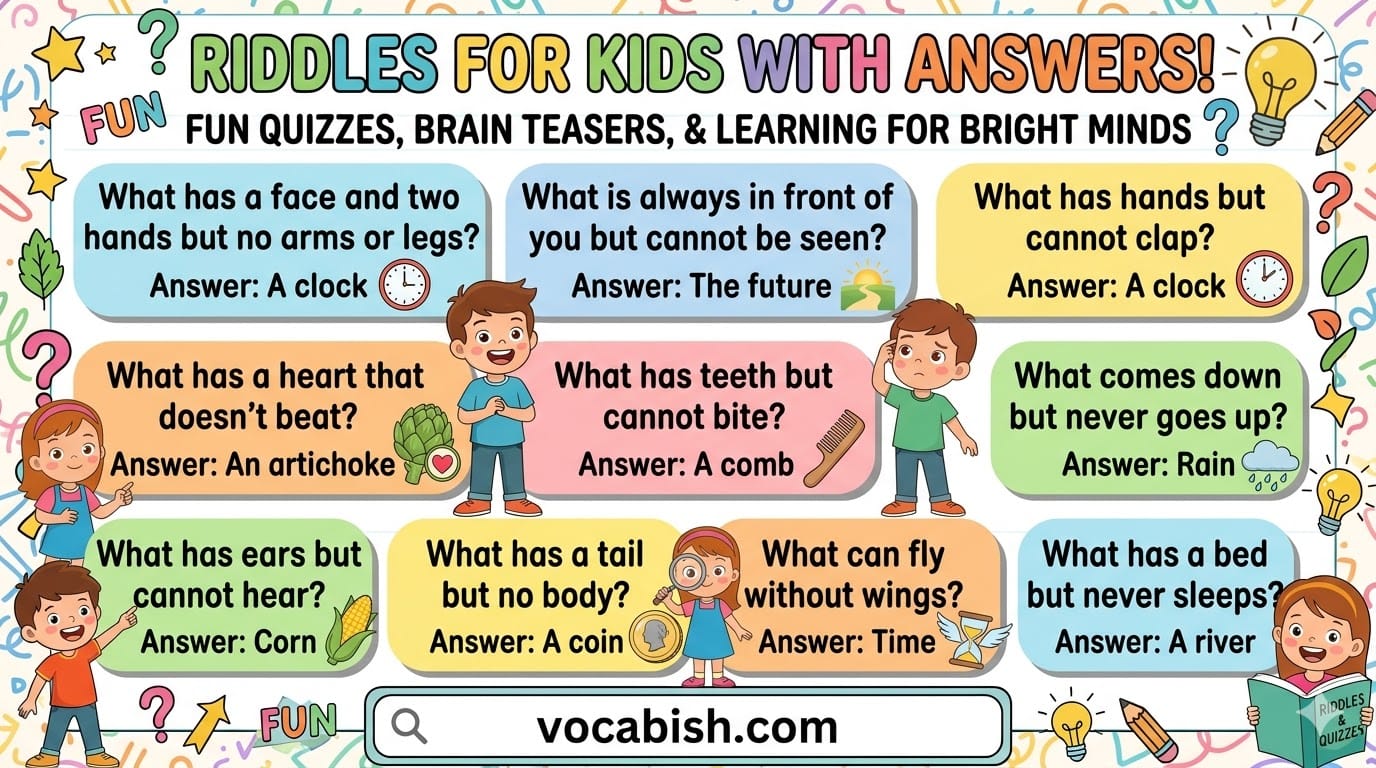
In this blog post, you will learn riddles, short questions that make you think and find hidden meanings in words. These riddles help you understand how English works in real life. When you read and guess answers, you build strong vocabulary and learn how to use words correctly. You also practice speaking by saying your answers, improve reading by understanding clues, and develop writing by using new words in sentences. Step by step, you will explore 50 riddles with answers that help you think, guess, and learn English in an active way.
What Are Riddles?
Riddles are questions or statements that have a hidden meaning. You must think carefully to find the correct answer.
For example:
“I have hands but cannot clap.”
Answer: A clock
This helps learners understand words like hands and clap in different contexts.
Why Riddles Help English Learners
Riddles are powerful learning tools because:
- They improve vocabulary
- They build thinking skills
- They make learning fun and active
- They teach real-life word usage
- They help memory and understanding
As a result, learners remember words faster and use them correctly.
Common Words You Learn from Riddles
Here are important vocabulary words often used in riddles:
- Shadow – a dark shape made by light
- Mirror – something that reflects your face
- Clock – a tool to tell time
- River – flowing water
- Light – brightness from the sun or lamp
- Dark – no light
- Key – opens a lock
- Door – an entrance
- Foot – part of the body
- Eye – helps you see
- Wind – moving air
- Fire – heat and flame
- Water – liquid we drink
- Sun – gives light and heat
- Moon – shines at night
- Star – bright object in the sky
- Book – something you read
- Chair – something you sit on
- Table – used for placing things
- Tree – a tall plant
These words appear often in riddles and daily conversation.
50 Easy Riddles for Kids with Answers
Simple and Fun Riddles
- What has keys but can’t open locks?
Answer: A piano - What has a face and two hands but no arms or legs?
Answer: A clock - What gets wetter as it dries?
Answer: A towel - What has one eye but cannot see?
Answer: A needle - What has legs but does not walk?
Answer: A table - What runs but never walks?
Answer: Water - What has a neck but no head?
Answer: A bottle - What has a ring but no finger?
Answer: A phone - What is always in front of you but cannot be seen?
Answer: The future - What can you catch but not throw?
Answer: A cold
Thinking Riddles with Answers
- What has hands but cannot clap?
Answer: A clock - What goes up but never comes down?
Answer: Age - What has a heart that doesn’t beat?
Answer: An artichoke - What has teeth but cannot bite?
Answer: A comb - What comes down but never goes up?
Answer: Rain - What has ears but cannot hear?
Answer: Corn - What is full of holes but still holds water?
Answer: A sponge - What has a tail but no body?
Answer: A coin - What can fly without wings?
Answer: Time - What has a bed but never sleeps?
Answer: A river
Easy Riddles for Kids with Answers
- What has four wheels and flies?
Answer: A garbage truck - What is black when clean and white when dirty?
Answer: A blackboard - What has a thumb and four fingers but is not alive?
Answer: A glove - What can travel around the world while staying in one spot?
Answer: A stamp - What is always coming but never arrives?
Answer: Tomorrow - What is tall when young and short when old?
Answer: A candle - What has a head and a tail but no body?
Answer: A coin - What can you break without touching?
Answer: A promise - What begins with T, ends with T, and has tea inside?
Answer: A teapot - What has many pages but no words?
Answer: A notebook
Fun Brain Riddles with Answers
- What can you hear but not see?
Answer: Sound - What is always moving but never stops?
Answer: Time - What has no life but can die?
Answer: A battery - What has a mouth but cannot eat?
Answer: A river - What has an eye but cannot see?
Answer: A storm - What is light as a feather but hard to hold?
Answer: Breath - What has no legs but can walk?
Answer: A clock - What has no wings but can fly?
Answer: Imagination - What can you see once in a minute, twice in a moment, but never in a thousand years?
Answer: The letter “M” - What has no sound but can speak?
Answer: A book
Easy Riddles for Beginners
- What is yellow and shines in the sky?
Answer: The sun - What comes out at night and glows?
Answer: The moon - What do you use to write?
Answer: A pen - What do you read?
Answer: A book - What do you sit on?
Answer: A chair - What do you drink?
Answer: Water - What grows in the ground and is green?
Answer: A plant - What keeps you dry in rain?
Answer: An umbrella - What tells time?
Answer: A clock - What do you wear on your feet?
Answer: Shoes
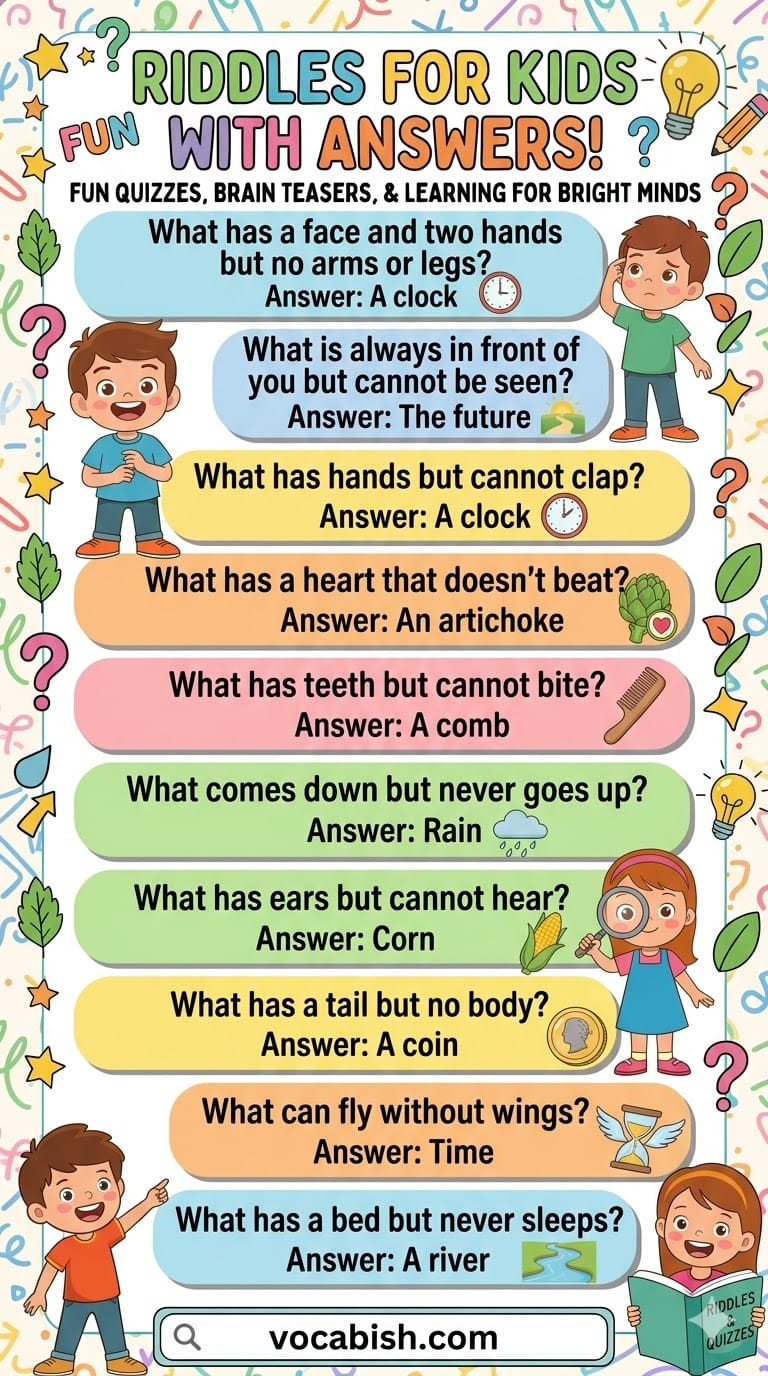
Tips to Use Riddles for Learning
- Read riddles aloud to improve speaking
- Guess answers before checking
- Learn new words from each riddle
- Use new words in sentences
- Practice with friends or family
This method builds confidence and improves fluency.
Related Articles:
FAQs
Riddles for kids with answers are short, fun questions that have hidden meanings. Children think carefully to guess the correct answer and learn new English words naturally.
Riddles improve vocabulary, thinking skills, and understanding. They help children learn word meanings in context, making it easier to remember and use English in daily life.
Riddles introduce common words like “clock,” “shadow,” and “river.” Children learn meanings through guessing, which improves memory and helps them use words correctly in speaking and writing.
Easy riddles use simple words and daily-life objects. For example, “What has hands but cannot clap?” Answer: A clock. Such riddles are perfect for beginners.
Kids can start learning riddles from age 5 or 6. Simple riddles build early vocabulary and thinking skills, making English learning fun and easy from a young age.
Teachers can use riddles as warm-up activities, group games, or speaking practice. This keeps students engaged while improving vocabulary, listening skills, and confidence in English.
Simple riddles about everyday objects, animals, and nature are best. They use basic vocabulary and clear ideas, which helps beginners understand and learn quickly.
Conclusion
Riddles are a fun and effective way to learn English. They improve vocabulary, thinking, and understanding in a simple way. By practicing these 50 riddles, learners can build strong language skills and enjoy the learning process.