
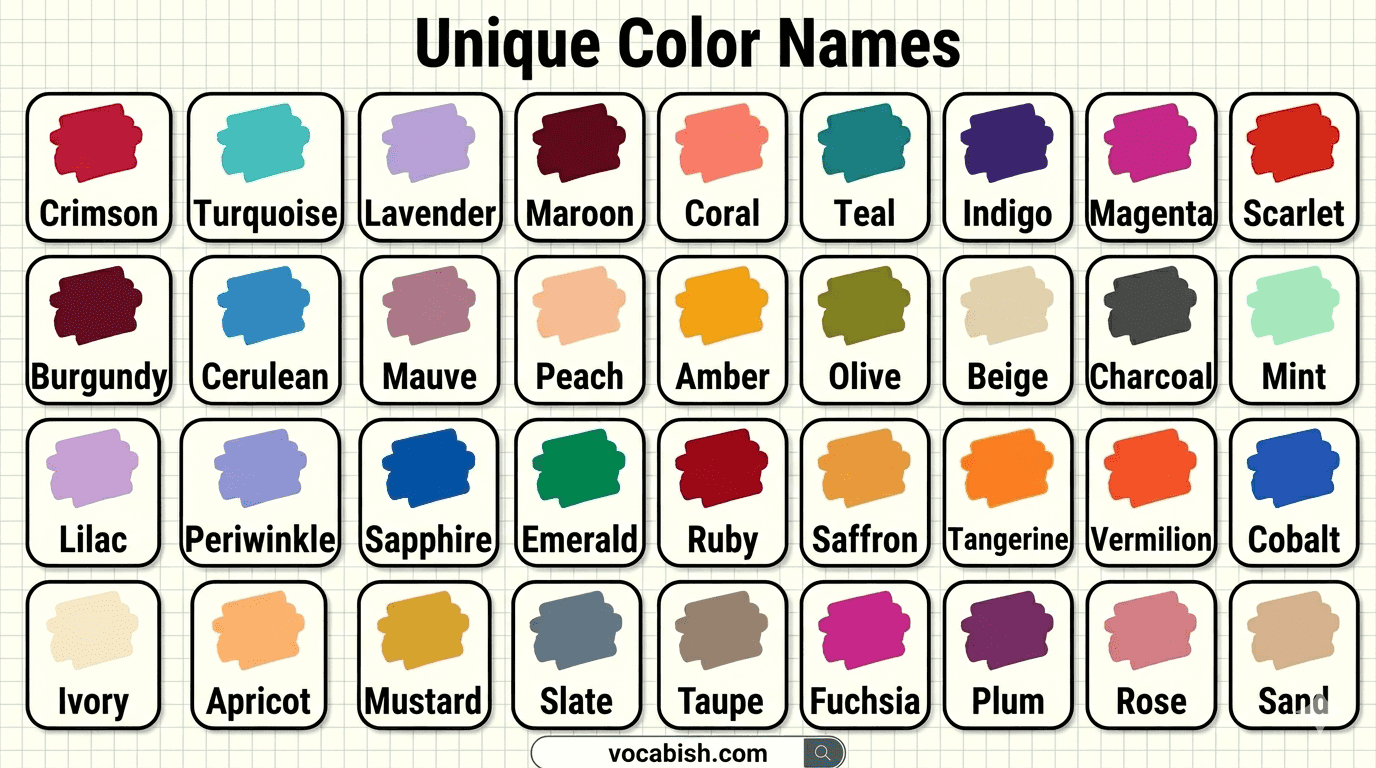
In English, many colors have special names that describe very specific shades. Words like turquoise, crimson, and lavender help people talk about colors more exactly. These words are called unique, color, names because each one represents a different shade or tone. Learning these words helps English learners describe objects, clothes, nature, and pictures with better detail. When you know more color vocabulary, you can speak with better descriptions, understand stories and articles more easily, and write sentences that sound more natural. You will also recognize these words when you hear them in conversations, videos, or lessons. In this blog post, you will learn important unique color names, understand their meanings, and see how people use them in everyday English.
What Are Unique Colors?
Unique colors are special that describe specific shades of color instead of basic colors.
For example:
- Crimson is a deep red color
- Turquoise is a mix of blue and green
- Ivory is a soft off-white color
These names help people describe colors more exactly.
For instance:
- Instead of saying dark red, you can say crimson.
- Instead of saying blue-green, you can say turquoise.
Because of this, writers, designers, artists, and fashion experts often use these words.
Common Unique Color Names in English
Below are useful unique color names with meanings.
- Crimson – a deep, rich red color often seen in roses or velvet
- Turquoise – a bright mix of blue and green like tropical sea water
- Ivory – a soft creamy white color
- Magenta – a bright pinkish-purple color
- Scarlet – a strong, bright red color
- Indigo – a deep blue color close to violet
- Maroon – a dark red-brown color
- Lavender – a light purple color like lavender flowers
- Peach – a soft pink-orange color
- Coral – a warm pinkish-orange color found in sea coral
- Amber – a golden yellow-brown color
- Mint – a very light green color
- Olive – a dark yellow-green color like olives
- Beige – a light brown or sandy color
- Charcoal – a dark gray color close to black
These color names appear often in fashion, home decoration, and art descriptions.
Unique Color Names Inspired by Nature
Many color names come from plants, minerals, and natural objects.
Nature helps people identify and remember colors easily.
- Sapphire – deep blue like the sapphire gemstone
- Emerald – bright green like emerald stones
- Ruby – rich red like the ruby gem
- Sand – pale yellow-brown like beach sand
- Sky Blue – light blue like the daytime sky
- Ocean Blue – deeper blue like sea water
- Rose – soft pink like a rose flower
- Chocolate – deep brown like chocolate
- Honey – warm golden yellow color
- Slate – cool gray color like slate rock
These names are common in design, clothing, and interior decoration.
Rare and Creative Color Names
Some color names are more unusual or creative. Writers and designers use them to describe very specific shades.
- Cerulean – a clear, bright sky-blue color
- Periwinkle – a soft mix of blue and purple
- Vermilion – a bright orange-red color
- Chartreuse – a bright yellow-green color
- Auburn – a reddish-brown color, often used for hair
- Teal – a dark blue-green color
- Burgundy – a deep purple-red color like red wine
- Mauve – a pale purple color with a gray tone
- Taupe – a gray-brown neutral color
- Cobalt – a strong, vivid blue color
You may see these words in:
- Fashion magazines
- Paint color charts
- Interior design guides
- Art descriptions
A to Z List of All Unique Color Names
| Amber | Amethyst | Apricot |
| Aqua | Aquamarine | Azure |
| Beige | Bisque | Blush |
| Bronze | Burgundy | Buttermilk |
| Camel | Canary | Cappuccino |
| Caramel | Carmine | Celadon |
| Cerise | Cerulean | Champagne |
| Charcoal | Chartreuse | Chestnut |
| Chocolate | Cinnamon | Cobalt |
| Coral | Cornflower | Cream |
| Crimson | Cyan | Dandelion |
| Denim | Eggplant | Emerald |
| Fawn | Fern | Flax |
| Fuchsia | Garnet | Ginger |
| Gold | Goldenrod | Grape |
| Hazel | Honey | Indigo |
| Ivory | Jade | Jasper |
| Khaki | Lavender | Lemon |
| Lilac | Lime | Linen |
| Magenta | Mahogany | Mango |
| Marigold | Maroon | Mauve |
| Midnight | Mint | Mocha |
| Moss | Mustard | Navy |
| Ochre | Olive | Onyx |
| Orchid | Papaya | Peach |
| Pearl | Periwinkle | Persimmon |
| Pine | Plum | Pomegranate |
| Pumpkin | Quartz | Raspberry |
| Ruby | Russet | Saffron |
| Salmon | Sand | Sapphire |
| Scarlet | Sepia | Sienna |
| Silver | Sky | Slate |
| Smoke | Snow | Steel |
| Strawberry | Sunflower | Tangerine |
| Taupe | Teal | Terracotta |
| Thistle | Tomato | Topaz |
| Turquoise | Ultramarine | Vanilla |
| Vermilion | Violet | Walnut |
| Wheat | Wine | Wisteria |
| Zinc | Zaffre | Zucchini |
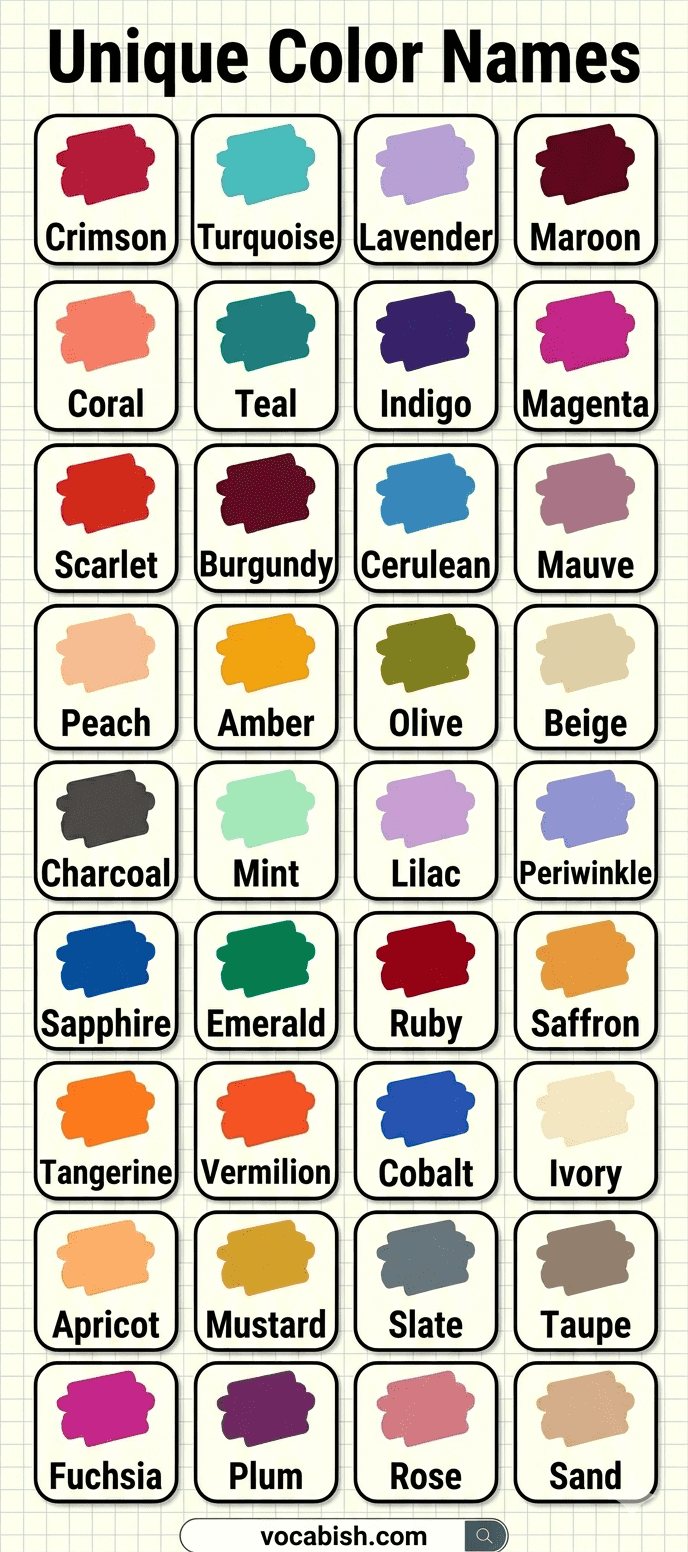
Tips for Remembering Color Vocabulary
Learning many color names may feel difficult at first. These tips make learning easier.
1. Connect Colors to Real Objects
Example:
- Chocolate → dark brown
- Rose → pink
2. Use Images
Looking at pictures helps your brain remember color words faster.
3. Practice in Sentences
Try simple sentences:
- “She wore a lavender dress.”
- “The lake looked turquoise.”
4. Learn a Few at a Time
Study 5 new color names each day.
Small steps help long-term memory.
FAQs
Unique color names are special words that describe specific shades of color instead of basic colors like red or blue. Examples include turquoise, crimson, lavender, and burgundy.
Common unique color names include turquoise, lavender, crimson, maroon, coral, teal, beige, and indigo. These words describe specific shades and are widely used in design, clothing, and writing.
Basic colors are general words like red, blue, and green. Unique color names describe exact shades or tones, such as scarlet, turquoise, or burgundy, which give more detailed color descriptions.
Yes. Turquoise is a unique color name that describes a bright mix of blue and green. The word comes from the turquoise gemstone and is widely used in fashion and design.
There is no single “most unique” color name because uniqueness depends on how rare or specific the shade is. However, cerulean is often considered very unique. It describes a bright, clear sky-blue color and appears frequently in art and design vocabulary.
Fancy color names are descriptive words used to explain specific shades. Examples include crimson, turquoise, burgundy, lavender, cerulean, chartreuse, mauve, and auburn. These words help people describe colors more precisely in fashion, art, and design.
The seven pure colors usually refer to the seven colors of the rainbow. These colors are red, orange, yellow, green, blue, indigo, and violet. Scientists often use them to explain how visible light separates into different colors.
Related Articles:
Conclusion
Unique color names allow English learners to describe the world more clearly and creatively. Instead of using only basic colors, these words help express exact shades and tones.
By learning words like turquoise, lavender, burgundy, cerulean, and coral, you expand your vocabulary and improve communication.