

In this blog post, you will learn about the shortest English sentences. These are tiny sentences with just a few words that still give a complete idea, like “I run” or “Birds fly.” Understanding these sentences helps English learners master basic sentence structure and common verbs. By practicing them, you can improve your speaking, reading, writing, and listening skills step by step. Learning the shortest English sentences makes it easier to build longer sentences, talk with confidence, and understand everyday English faster.
What Are the Shortest English Sentences?
The shortest English sentences are very small sentences that express a complete idea. Most of them contain:
- A subject (who or what)
- A verb (the action)
Example:
- Birds fly.
- I run.
Although these sentences are short, they communicate clear meaning. That is why teachers often use them to teach beginners.
Why Short Sentences Are Important for Learners
Short sentences help learners build strong English skills.
Key benefits include:
- Improve speaking confidence
- Build basic grammar understanding
- Increase daily vocabulary
- Help learners practice pronunciation
- Make reading easier for beginners
Because the structure is simple, learners quickly understand how English sentences work.
Basic Structure of Short English Sentences
Most short sentences follow a simple pattern.
Subject + Verb
Examples:
- I run.
- She sings.
- Dogs bark.
Another simple pattern is:
Subject + Verb + Object
Examples:
- I drink tea.
- We play games.
- She reads books.
These patterns help learners create many new sentences easily.
100 Shortest English Sentences
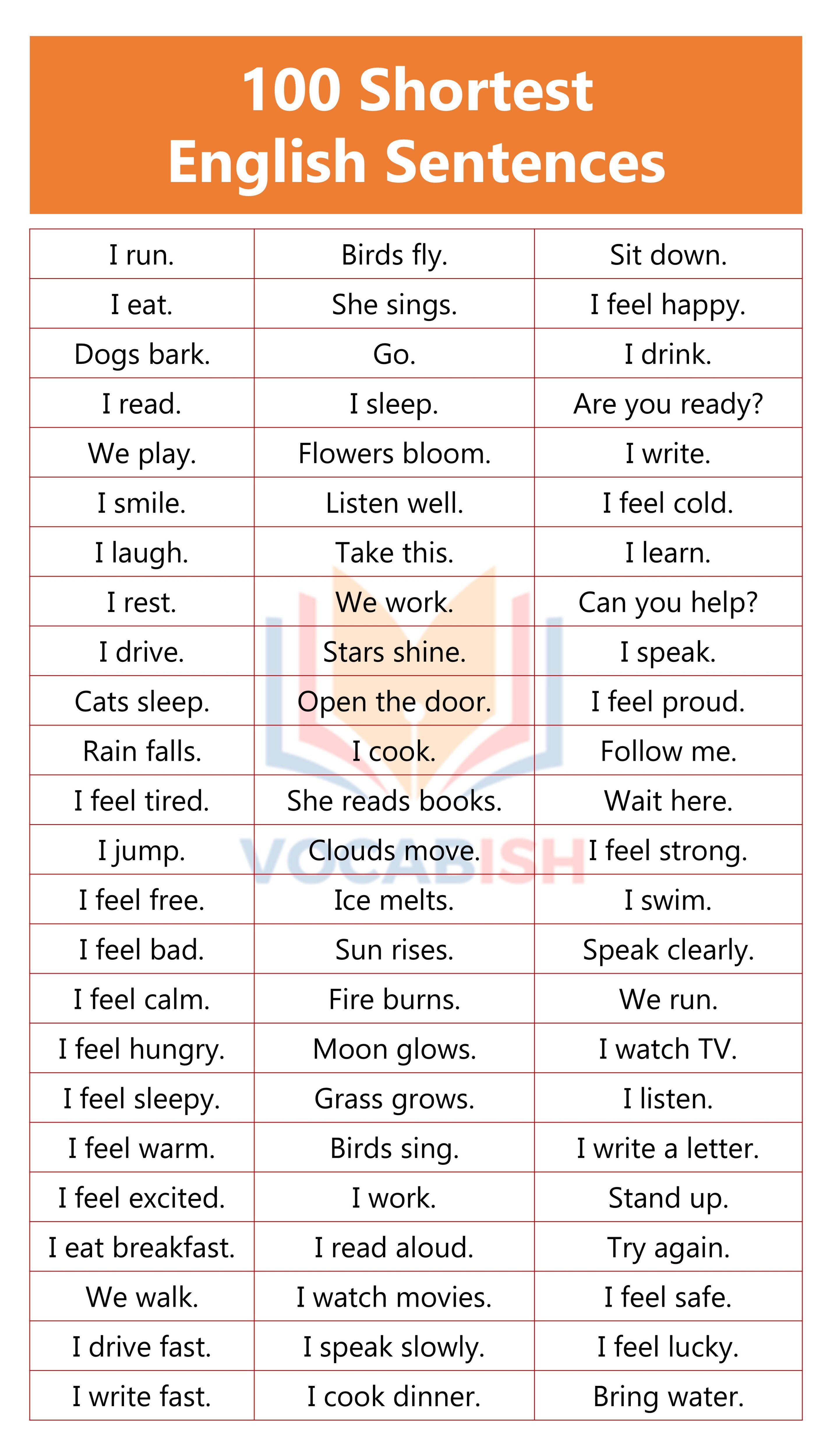
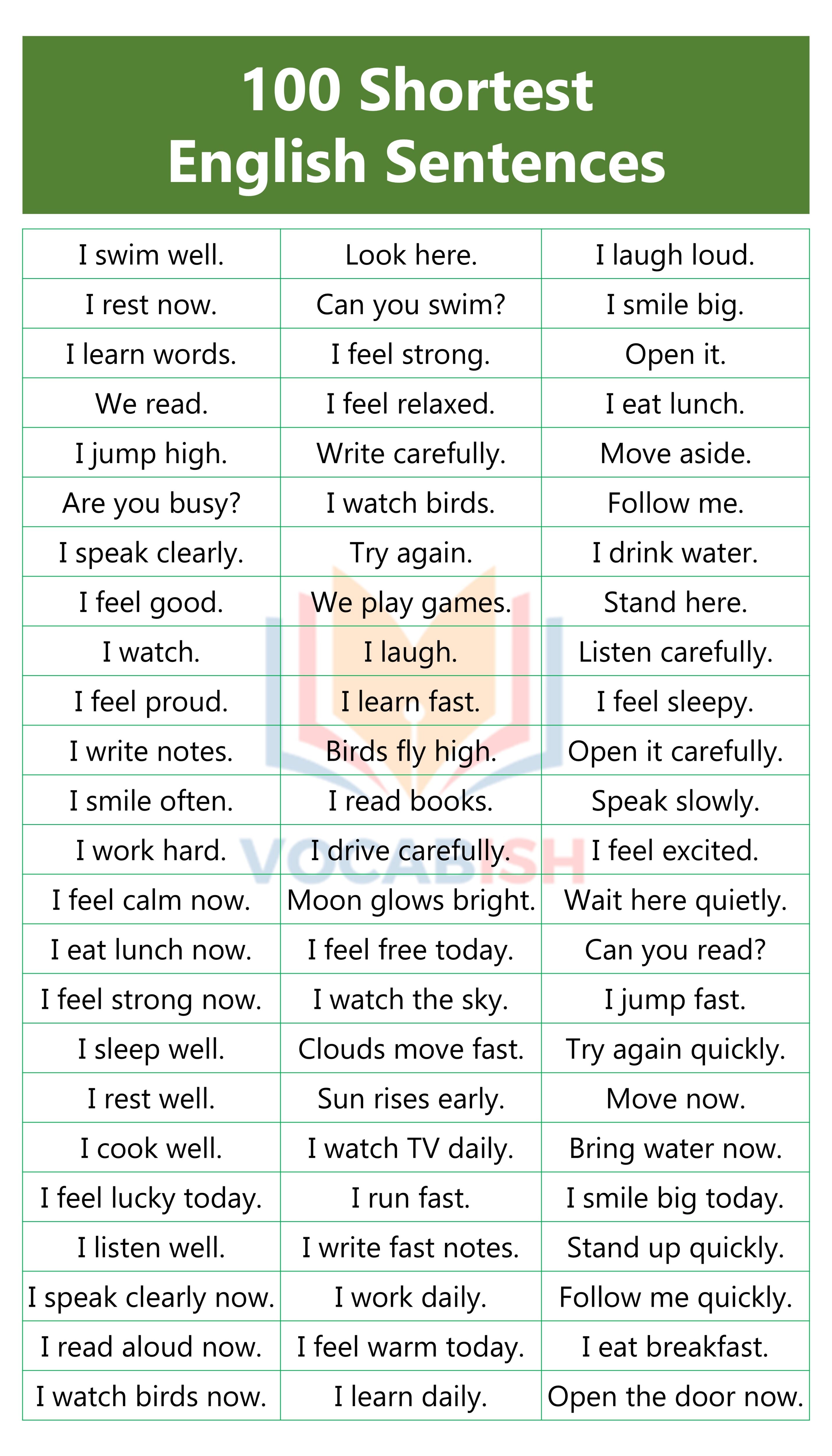
Below is a practical list of 100 shortest English sentences used in everyday English.
Daily Action Sentences
- I run.
- I walk.
- I eat.
- I drink.
- I sleep.
- I write.
- I read.
- I cook.
- I drive.
- I work.
- I clean.
- I learn.
- I watch.
- I listen.
- I speak.
- I jump.
- I swim.
- I smile.
- I laugh.
- I rest.
Simple Observation Sentences
- Birds fly.
- Dogs bark.
- Cats sleep.
- Fish swim.
- Leaves fall.
- Stars shine.
- Rain falls.
- Wind blows.
- Fire burns.
- Water flows.
- Sun rises.
- Moon glows.
- Flowers bloom.
- Snow falls.
- Ice melts.
- Clouds move.
- Waves crash.
- Trees grow.
- Rivers flow.
- Grass grows.
Feeling and Emotion Sentences
- I am happy.
- I am sad.
- I am tired.
- I am calm.
- I am ready.
- I feel good.
- I feel bad.
- I feel cold.
- I feel warm.
- I feel strong.
- I feel weak.
- I feel safe.
- I feel proud.
- I feel lucky.
- I feel free.
- I feel sleepy.
- I feel hungry.
- I feel thirsty.
- I feel excited.
- I feel relaxed.
Question Sentences
- Are you ready?
- Are you okay?
- Are you tired?
- Are you busy?
- Are you happy?
- Do you run?
- Do you cook?
- Do you read?
- Do you work?
- Do you sing?
- Is it ready?
- Is it hot?
- Is it cold?
- Is it safe?
- Is it open?
- Can you help?
- Can you swim?
- Can you drive?
- Can you read?
- Can you hear?
Command Sentences
- Come here.
- Go now.
- Sit down.
- Stand up.
- Look here.
- Listen well.
- Speak clearly.
- Read aloud.
- Write carefully.
- Wait here.
- Try again.
- Stop now.
- Move aside.
- Open it.
- Close it.
- Bring water.
- Take this.
- Keep quiet.
- Follow me.
- Stay calm.
Common Verbs Used in Short Sentences
Learning these verbs helps learners create many short sentences.
- Run — move fast with legs
- Walk — move slowly on foot
- Eat — take food
- Drink — take liquid
- Sleep — rest the body
- Read — look at written words
- Write — make words with a pen
- Speak — say words
- Listen — hear carefully
- Cook — prepare food
- Drive — control a vehicle
- Jump — push body into the air
- Swim — move in water
- Smile — show happiness with the face
- Laugh — make a happy sound
- Work — do a job
- Learn — gain knowledge
- Watch — look carefully
- Rest — relax the body
- Clean — remove dirt
These verbs are common in everyday English communication.
Short English Sentences PDF
Tips for Learning Short English Sentences
Learners can improve quickly by practicing these simple steps:
- Read the sentences aloud every day
- Practice speaking them in conversations
- Write them in a daily notebook
- Replace the subject with new words
Example:- I run → We run → They run
- Try creating new short sentences using the same verbs
Regular practice builds strong language habits.
How to Practice These Sentences
Effective practice helps learners remember sentences longer.
Helpful methods include:
- Reading practice – read sentences slowly and clearly
- Speaking practice – repeat sentences many times
- Writing practice – write five new sentences daily
- Listening practice – hear sentences in simple conversations
This method improves reading, speaking, writing, and listening at the same time.
Final Thoughts
Learning the 100 shortest English sentences is one of the easiest ways to start understanding English grammar and vocabulary. These sentences show how English ideas form with simple words and clear structure.
Once learners master these small sentences, they can easily build longer sentences, better conversations, and stronger communication skills.
Start practicing them daily, and English will become clearer and more natural step by step.
FAQs
The shortest English sentences usually contain a subject and a verb, such as “I run” or “Birds fly.” These simple sentences express a complete idea with very few words.
One famous shortest sentence is “Go.” It is a complete command sentence with an understood subject “you.” Imperative sentences often create the shortest correct English sentences.
Many shortest English sentences contain one or two words. Examples include “Go.” or “I run.” Even with very few words, these sentences still express a clear and complete meaning.
Common examples include “I run,” “She sings,” “Birds fly,” and “Dogs bark.” These shortest English sentences help beginners learn verbs, pronunciation, and basic sentence structure easily.
Yes. A one-word sentence like “Stop!” or “Listen!” can be correct because the subject “you” is understood. These are imperative sentences commonly used in everyday English.
Related Articles: