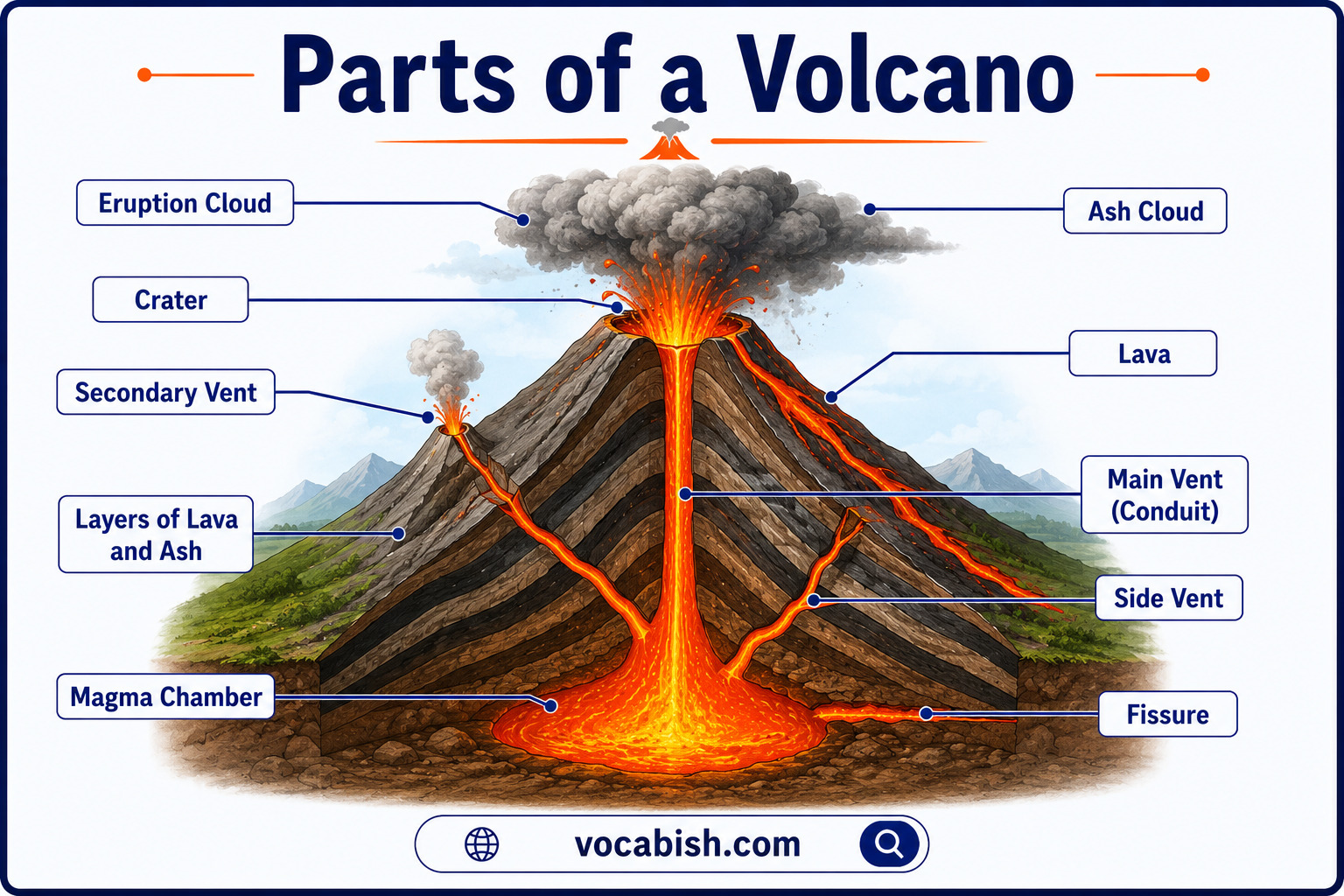

A volcano is a natural opening in the Earth’s surface where lava, ash, gases, and hot materials come out from deep inside the planet. In this blog post, you will learn the parts of a volcano with names, functions, and a labeled diagram to understand how a volcano is structured and how each part works during volcanic activity. From the magma chamber and main vent to the crater and lava flow, every part has a specific role in the eruption process. Learning the names of volcano parts helps readers understand English vocabulary related to Earth science, geology, natural disasters, and environmental studies commonly used in schools, books, and educational learning.
What Is a Volcano?
A volcano is an opening in the Earth’s surface where hot melted rock, gas, and ash come out. The melted rock inside the Earth is called magma, and when it reaches the surface it becomes lava.
Volcanoes form when pressure builds deep inside the Earth. Eventually, the pressure pushes magma upward through cracks in the crust.
Why Learn Volcano Vocabulary?
Learning volcano-related words helps English learners in many ways.
- Improves science vocabulary
- Helps understand geography lessons
- Makes reading educational books easier
- Helps describe natural disasters and landforms
These words are common in school textbooks, documentaries, and news about earthquakes and eruptions.
Main Parts of a Volcano
Below are the most important parts of a volcano. Each word includes a short and clear meaning.
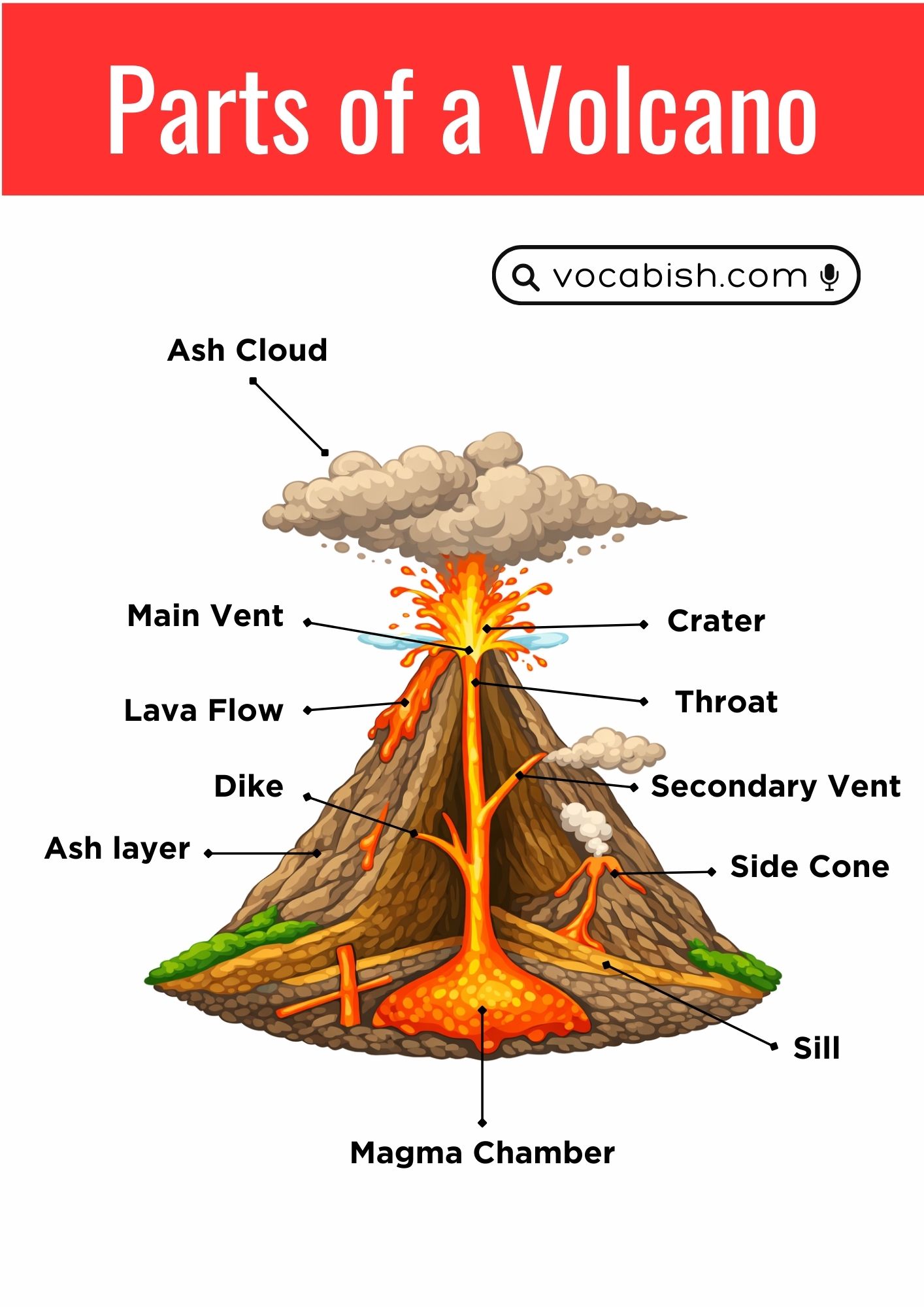
- Magma Chamber
A large underground space where hot melted rock collects before an eruption. - Main Vent
The main passage that carries magma from the magma chamber to the surface. - Crater
A bowl-shaped hole at the top of a volcano where lava, ash, and gases escape. - Volcanic Cone
The mountain-shaped structure formed by layers of lava and ash. - Lava Flow
Hot melted rock that flows out of the volcano during an eruption. - Ash Cloud
A large cloud of fine volcanic ash released into the air during an eruption. - Secondary Vent
A smaller opening on the side of a volcano where magma can also escape. - Side Cone
A smaller cone-shaped hill formed by eruptions from a secondary vent. - Fumarole
A small opening that releases steam and volcanic gases. - Caldera
A very large crater formed when the top of a volcano collapses after a huge eruption.
Internal Parts of a Volcano
These parts exist inside the Earth and cannot usually be seen.
- Magma
Hot melted rock located beneath the Earth’s surface. - Magma Chamber
The underground storage area for magma. - Conduit
A pipe-like channel that moves magma upward. - Dike
A vertical crack in rock through which magma moves. - Sill
A horizontal sheet of magma that forms between rock layers.
These structures control how magma travels underground.
Surface Parts of a Volcano
These parts are visible on the volcano.
- Crater
The main opening at the top of the volcano. - Cone
The mountain built from lava and ash. - Vent
The hole where magma and gas escape. - Lava Flow
Streams of molten rock moving down the volcano. - Ash Layer
A layer of volcanic ash deposited after eruptions.
Materials Released by a Volcano
Volcanoes release several materials during eruptions.
- Lava
Melted rock that reaches the Earth’s surface. - Volcanic Ash
Very small particles of rock and glass. - Volcanic Gas
Gases such as water vapor, carbon dioxide, and sulfur dioxide. - Tephra
Any volcanic rock fragments thrown into the air. - Volcanic Bomb
Large pieces of lava that cool and harden while flying through the air.
List of Volcano Parts
Here is a list of important volcano vocabulary:
- Magma
- Magma Chamber
- Conduit
- Main Vent
- Secondary Vent
- Crater
- Caldera
- Volcanic Cone
- Lava Flow
- Ash Cloud
- Fumarole
- Dike
- Sill
- Side Cone
- Tephra
- Volcanic Bomb
- Volcanic Gas
- Ash Layer
These words form the core vocabulary for understanding volcano structures.
Parts of a Volcano Diagram
How to Use Volcano Vocabulary in Sentences
Seeing vocabulary in sentences helps learners remember meanings.
- The magma chamber stores hot melted rock beneath the volcano.
- Lava came out of the main vent during the eruption.
- A large ash cloud covered the sky.
- The crater sits at the top of the volcano.
- Hot lava flow moved slowly down the mountain.
These simple sentences show how the words work in real communication.
Tips to Remember Volcano Parts
Learning vocabulary becomes easier with a few simple strategies.
- Study volcano diagrams while learning the words.
- Group words into internal and surface parts.
- Use the words in short sentences.
- Watch volcano documentaries and notice these terms.
- Review the list regularly.
Understanding the parts of a volcano helps learners build strong science vocabulary in English. Words like magma chamber, crater, vent, and lava flow appear often in geography and natural science topics.
By learning these terms, students improve reading comprehension, speaking skills, and general knowledge about the Earth. With regular practice and simple examples, these words become easy to remember and use in everyday learning.
FAQs about Parts of Volcano
The main parts of a volcano include the magma chamber, conduit, main vent, crater, and volcanic cone. These structures store magma underground and allow lava, ash, and gases to reach the Earth’s surface.
A volcano has several important parts, usually 10–20 depending on the diagram. Commonly studied parts include the magma chamber, vent, crater, lava flow, ash cloud, caldera, and volcanic cone.
The magma chamber is a large underground space where hot molten rock collects before an eruption. It acts as the main storage area for magma beneath the volcano.
The main parts of a volcano include the magma chamber, conduit (pipe), main vent, crater, and volcanic cone. These structures store magma underground and allow lava, ash, and gases to reach the Earth’s surface during an eruption.
Yes, a volcanic eruption is part of the rock cycle. During an eruption, magma becomes lava and cools on the surface to form igneous rock, which is one stage of the rock cycle.
The four main parts of a volcano are the magma chamber, conduit, vent, and crater. These parts store magma underground and provide the pathway for lava and gases to erupt.
Magma has four main components: liquid molten rock, solid mineral crystals, dissolved gases, and surrounding rock fragments. Together, these materials form the hot mixture beneath the Earth’s surface.
Related Articles: