
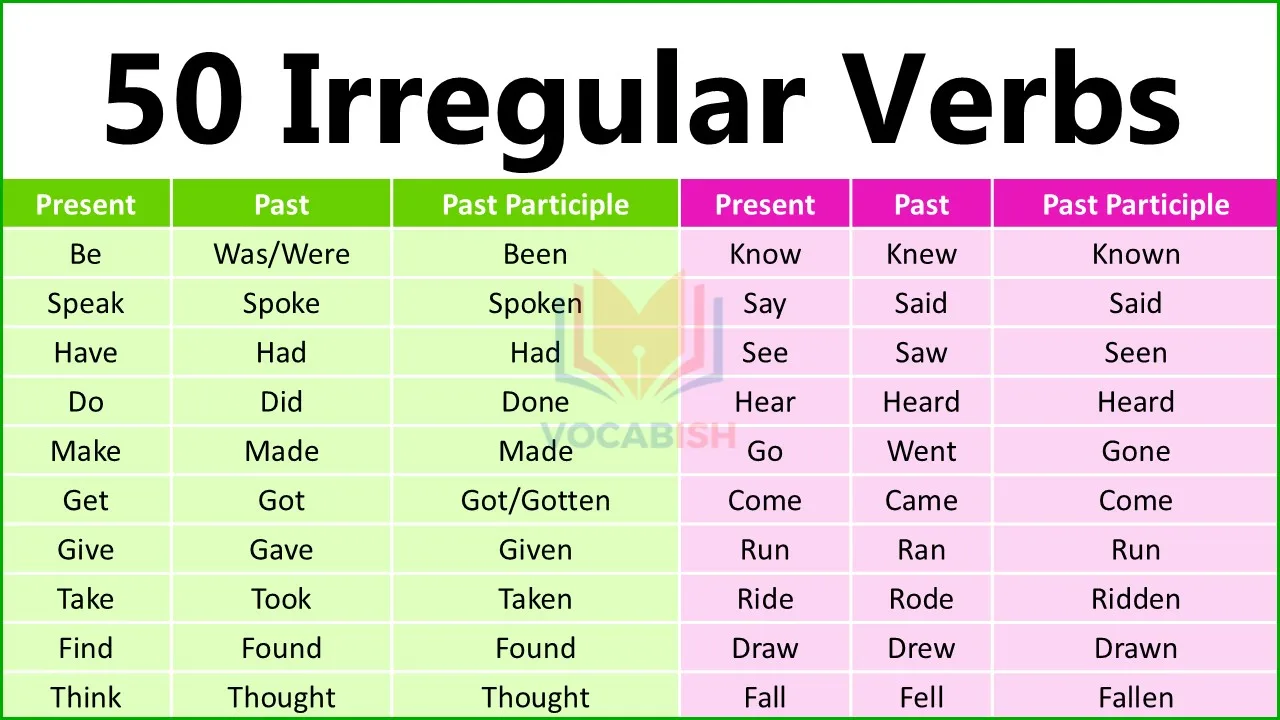
In this blog post, you will learn 50 irregular verbs along with their present, past, and past participle forms. These verbs help you understand how English verbs change in different tenses, which is essential for accurate speaking, reading, writing, and listening. Knowing irregular verbs allows you to form sentences correctly and communicate confidently. Our aim is to help you master these important verbs step by step. Keep reading and strengthen your English grammar skills today.
Irregular Verbs Definition and Example
Irregular verbs are action words that do not follow the usual pattern of adding -ed for the past. They have special forms that you must learn. These verbs are common in daily speech, writing, and school study.
In short: irregular verbs = no standard rules.
Why Irregular Verbs Are Important
Irregular verbs appear in:
- Daily conversation
- School writing
- Travel communication
- Emails and messages
- Work instructions
Knowing them helps you speak and write in a clear and natural way.
How Irregular Verbs Are Used
Irregular verbs are used in:
- Simple Past: actions finished in the past
- Past Participle: used with have, has, had
- Present: the base form of the verb
Example:
- I see you today (present)
- I saw you yesterday (past)
- I have seen that movie (past participle)
Types of Irregular Verbs
1. Verbs With All Three Forms Different
These verbs change in every form.
Example: go – went – gone
2. Verbs With Two Forms the Same
These verbs keep the same past and past participle.
Example: teach – taught – taught
3. Verbs That Stay the Same
These verbs do not change at all.
Example: cut – cut – cut
50 Irregular Verbs List
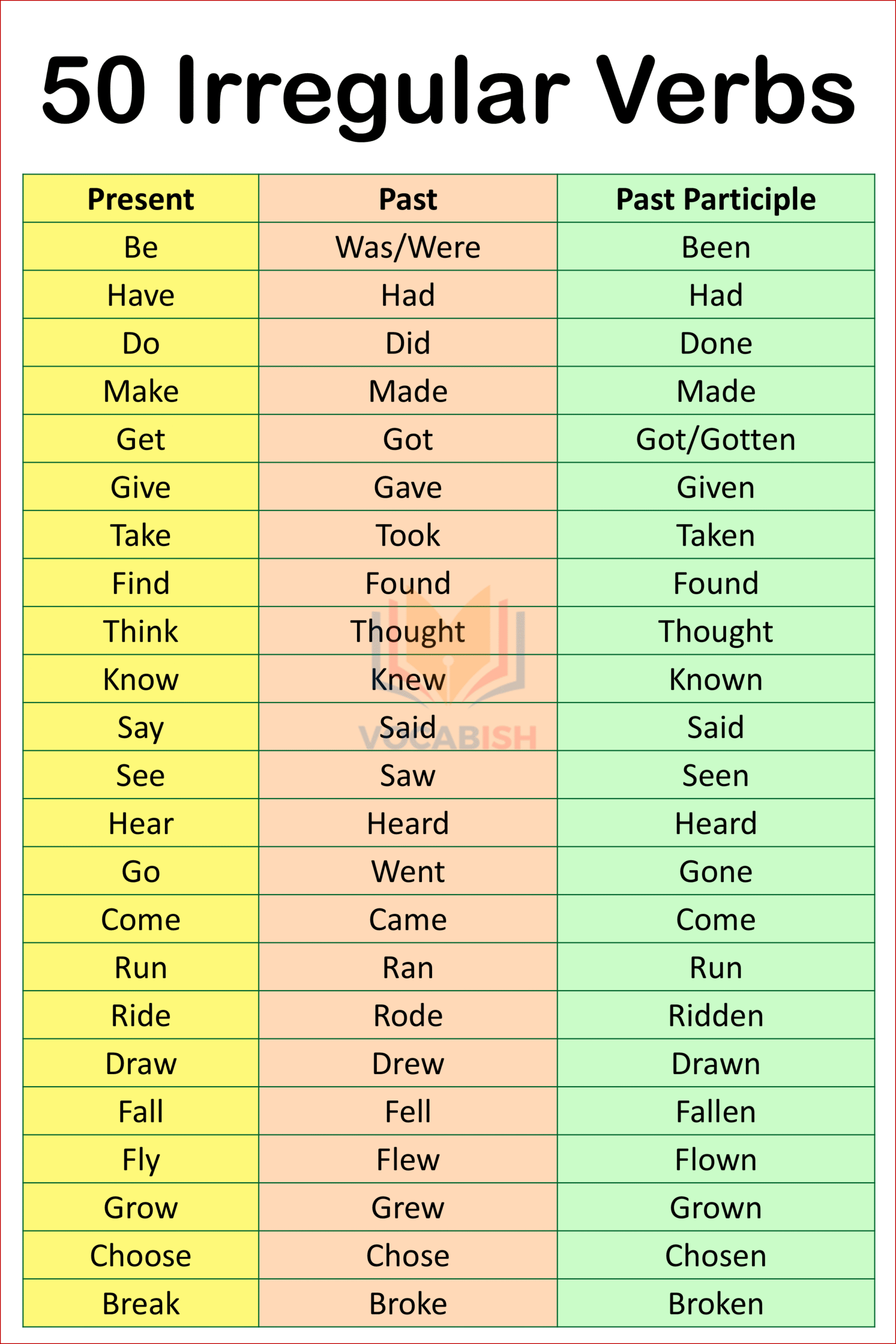
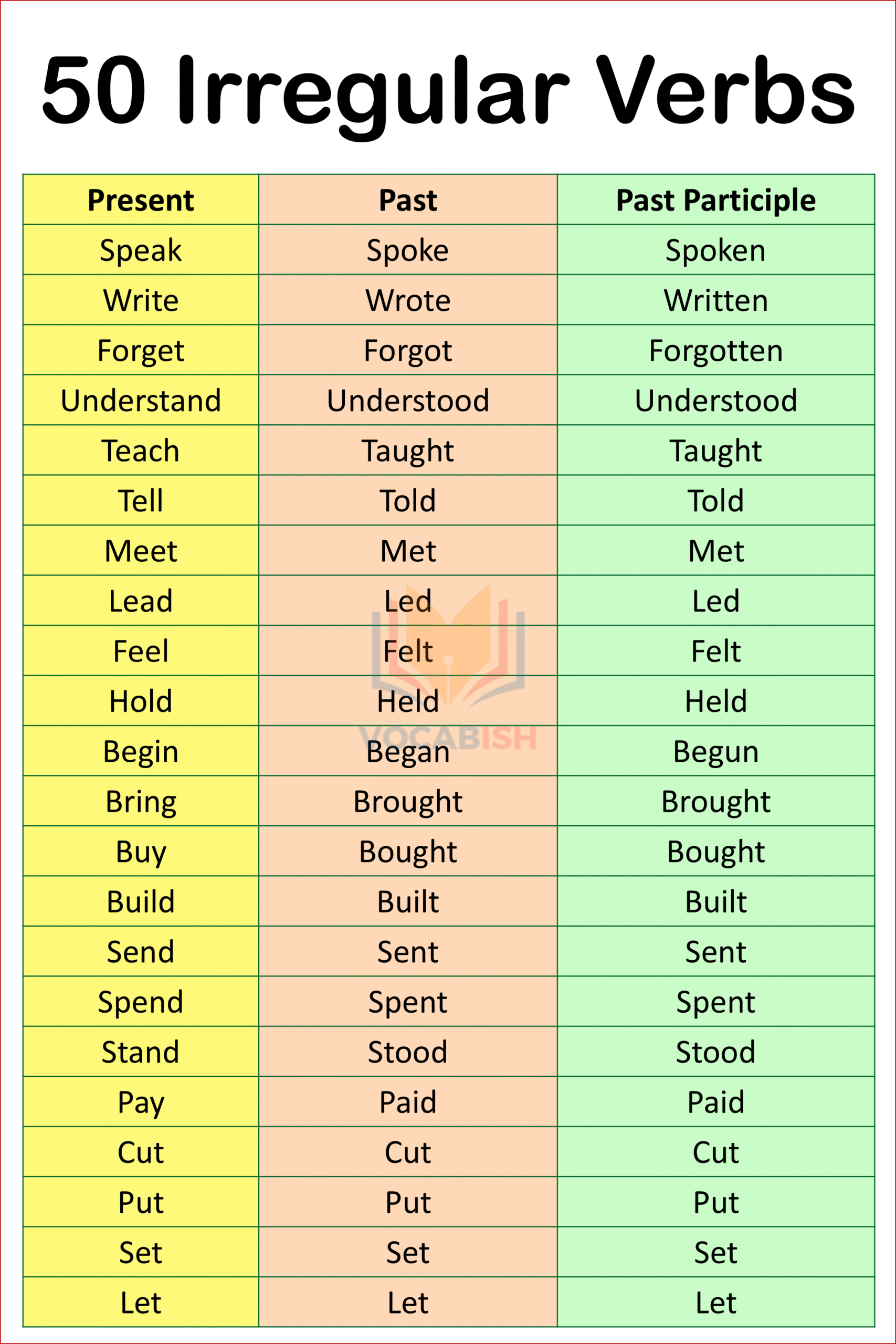
Below are the 50 most common irregular verbs, organised for easy learning.
Everyday Action Verbs
| Present | Past | Past Participle |
|---|---|---|
| be | was/were | been |
| have | had | had |
| do | did | done |
| make | made | made |
| get | got | got/gotten |
| give | gave | given |
| take | took | taken |
| find | found | found |
| think | thought | thought |
| know | knew | known |
| say | said | said |
| see | saw | seen |
| hear | heard | heard |
Movement Verbs
| Present | Past | Past Participle |
|---|---|---|
| go | went | gone |
| come | came | come |
| run | ran | run |
| ride | rode | ridden |
| draw | drew | drawn |
| fall | fell | fallen |
| fly | flew | flown |
| grow | grew | grown |
| choose | chose | chosen |
| break | broke | broken |
Speaking and Thinking Verbs
| Present | Past | Past Participle |
|---|---|---|
| speak | spoke | spoken |
| write | wrote | written |
| forget | forgot | forgotten |
| understand | understood | understood |
| teach | taught | taught |
| tell | told | told |
| meet | met | met |
| lead | led | led |
| feel | felt | felt |
| hold | held | held |
Common Useful Verbs
| Present | Past | Past Participle |
|---|---|---|
| begin | began | begun |
| bring | brought | brought |
| buy | bought | bought |
| build | built | built |
| send | sent | sent |
| spend | spent | spent |
| stand | stood | stood |
| pay | paid | paid |
| cut | cut | cut |
| put | put | put |
| set | set | set |
| let | let | let |
Irregular Verb Examples in Sentences
- I began my homework early.
- She has written a long message.
- They chose a new leader.
- We bought fresh food yesterday.
- He has gone home already.
- I felt tired after school.
- She has taken the book with her.
- They built a new house last year.
Tips to Remember Irregular Verbs
- Group verbs by similar patterns.
- Practise short sentences every day.
- Read simple stories and notice verb forms.
- Repeat the present–past–part participle pattern aloud.
- Learn in small sets of 5–10 verbs.
Irregular verbs are an essential part of everyday English. When you learn the 50 key verbs in this guide, you strengthen your understanding of present, past, and past participle forms. With short explanations, simple wording, and clear tables, this article is designed to help learners build confidence and use these verbs smoothly in real life.
FAQs
What are irregular verbs in English?
Irregular verbs are verbs that do not use -ed in the past tense. Their past and past participle forms change in unique ways and must be memorised.
What is the difference between past and past participle?
The past tense describes a completed action. The past participle is used with have, has, or had to form perfect tenses.
Why do irregular verbs not follow normal rules?
Irregular verbs come from older forms of English. Their spellings and sounds changed over time, so they do not follow the modern -ed pattern.
Are irregular verbs used more than regular verbs?
Yes. Many common verbs like go, have, make, and see are irregular, so learners use them very often in speaking and writing.
Do irregular verbs have any fixed patterns?
Some irregular verbs follow small patterns, such as keeping one form the same or having similar vowel changes. Grouping these patterns makes learning easier.
Read More