
In this blog post, you will learn 20 examples of irregular adjectives in English and how to use them correctly in sentences. These adjectives help you understand how some descriptive words change forms in ways that are different from regular patterns. Knowing irregular adjectives improves speaking, reading, writing, and listening skills. Our aim is to help you master these adjectives step by step. Keep reading and make your English more accurate and expressive today.
To learn more about each and everything related to adjectives in English, you can visit our category: Adjectives
Irregular Adjectives: Definition and Example
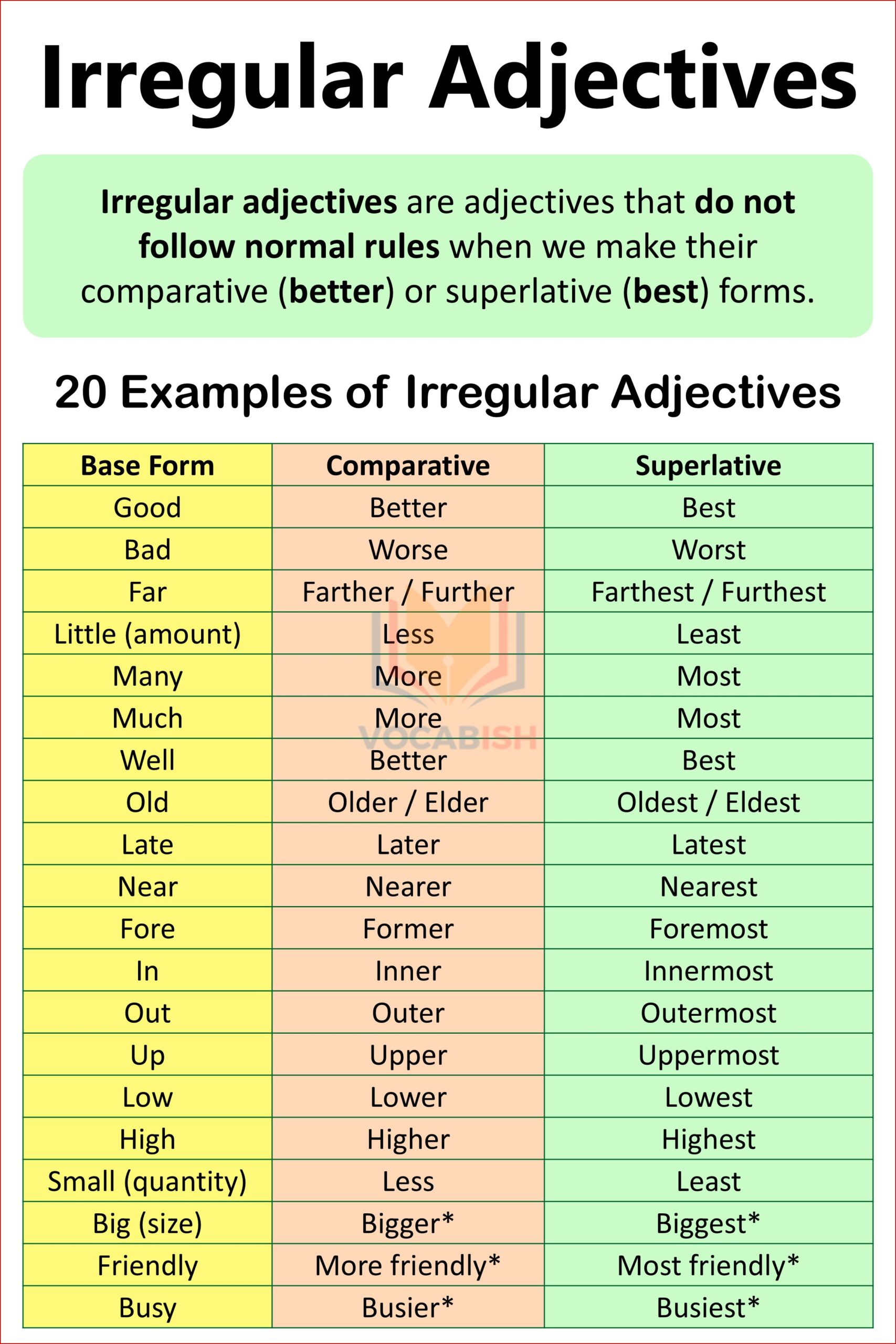
Irregular adjectives are adjectives that do not follow normal rules when we make their comparative (better) or superlative (best) forms.
Read more about: Comparative and Superlative Adjectives in detail.
Instead of adding -er or -est, the whole word often changes completely.
Key idea: These adjectives have special forms, different patterns, and unique changes.
20 Examples of Irregular Adjectives
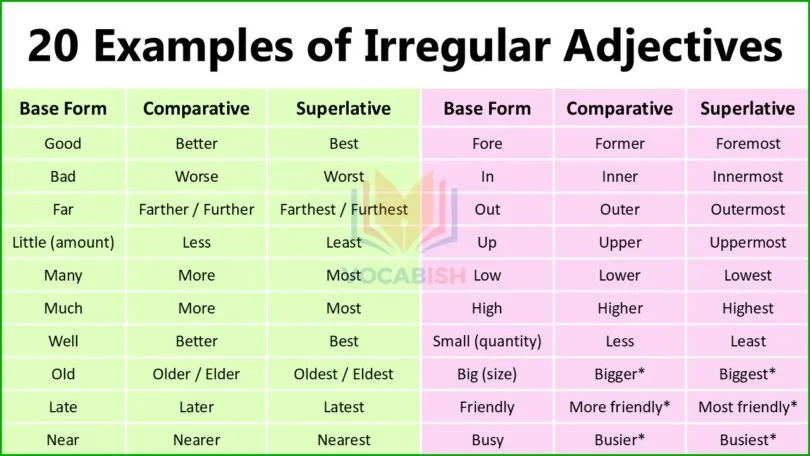
Below is the complete list of 20 common irregular adjectives with their basic, comparative, and superlative forms.
Base Form | Comparative | Superlative |
|---|---|---|
Good | Better | Best |
Bad | Worse | Worst |
Far | Farther / Further | Farthest / Furthest |
Little (amount) | Less | Least |
Many | More | Most |
Much | More | Most |
Well | Better | Best |
Old | Older / Elder | Oldest / Eldest |
Late | Later | Latest |
Near | Nearer | Nearest |
Fore | Former | Foremost |
In | Inner | Innermost |
Out | Outer | Outermost |
Up | Upper | Uppermost |
Low | Lower | Lowest |
High | Higher | Highest |
Small (quantity) | Less | Least |
Big (size) | Bigger* | Biggest* |
Friendly | More friendly* | Most friendly* |
Busy | Busier* | Busiest* |
20 Examples of Irregular Adjectives
*Note: The last four follow some spelling changes but remain irregular in use because the word changes shape rather than simply adding -er or -est.
Irregular Adjectives Examples in Sentences
Here are short and simple examples for easy understanding.
- Good: This book is good, but that one is better.
- Bad: His idea was bad, but the next one was worse.
- Far: The shop is farther than the school.
- Little: I have less sugar than you.
- Many: She has more friends now.
- Old: My eldest brother lives abroad.
- High: This wall is higher than the gate.
- Busy: He is busier today than yesterday.
- Friendly: She is the most friendly in class.
Summary of 20 Irregular Adjectives
Adjective Type | Examples |
|---|---|
Shows quality change | Good → Better → Best |
Shows negative quality | Bad → Worse → Worst |
Shows distance | Far → Farther/Further |
Shows amount | Little → Less → Least |
Shows number | Many → More → Most |
Shows physical change | High → Higher → Highest |
Shows spelling change | Busy → Busier → Busiest |
Irregular adjectives are a small group of adjectives with special forms. You cannot change them using the normal -er or -est rules. Learning these 20 useful examples will help you speak and write with more confidence. Keep practising them with sentences, and soon they will feel natural and easy to use.
FAQs
What are irregular adjectives?
Irregular adjectives are adjectives that do not follow the normal rules for comparatives and superlatives. Their forms change completely, such as good → better → best.
What are the most common irregular adjectives?
Common irregular adjectives include good, bad, far, little, many, much, old, late, well, and high. Their comparative and superlative forms do not follow regular -er or -est rules.
How do irregular adjectives change in comparison?
Irregular adjectives change in unique ways. For example: bad → worse → worst, and little → less → least. You must memorise them because they do not follow standard patterns.
What is the difference between farther and further?
Farther is usually used for physical distance, while further is used for extra degree or additional information. Both are comparative forms of the adjective far.
Read More