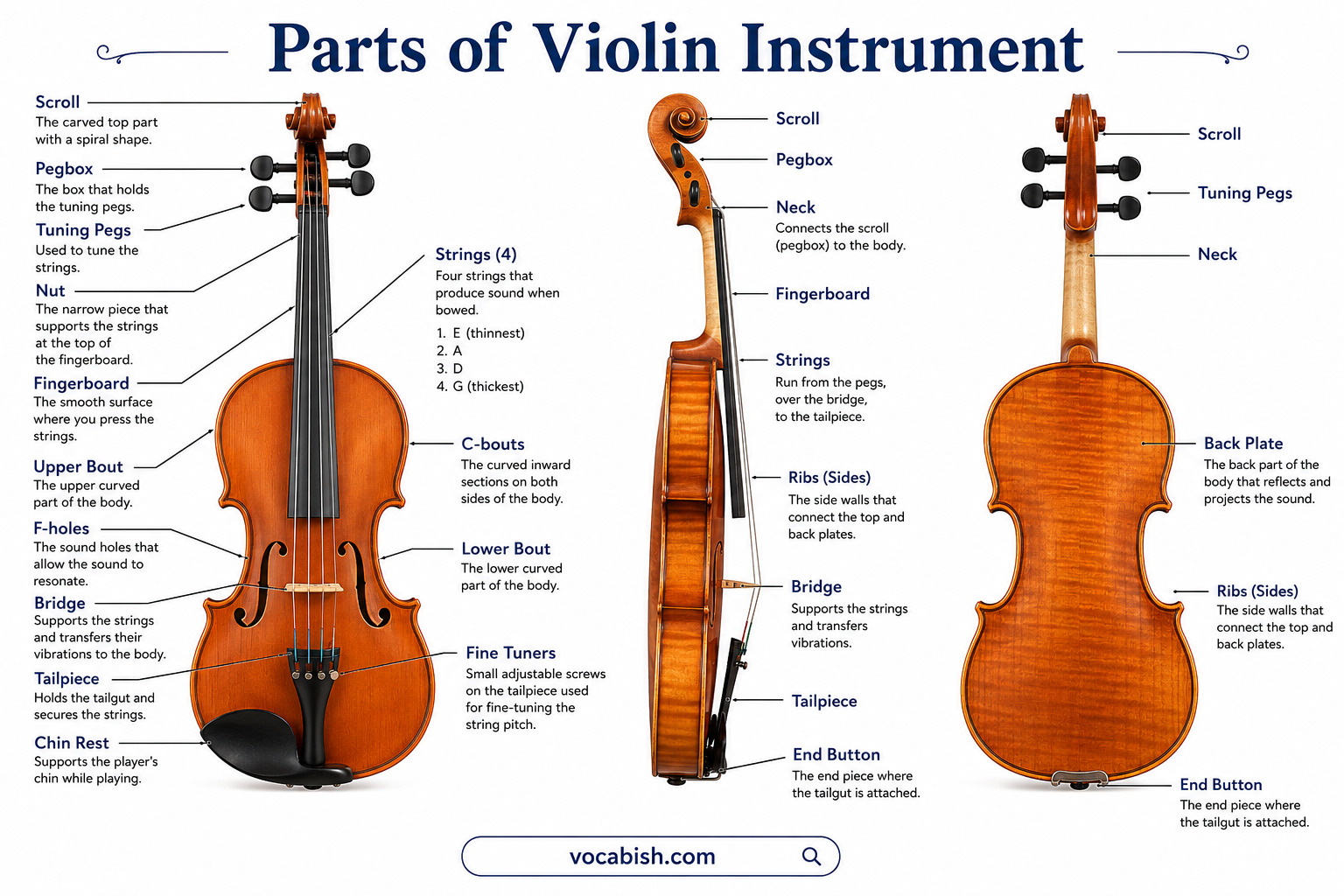

A violin is a string musical instrument used in classical, folk, and modern music around the world. In this blog post, you will learn the parts of a violin instrument with their functions and diagram to understand how each section of the violin works to produce sound and music. From the strings and bow to the bridge and fingerboard, every part has a specific role in sound production, tuning, and playing performance. Learning the names of violin parts helps readers understand English vocabulary related to musical instruments, music education, orchestra equipment, and instrument structure commonly used in schools, music classes, and educational learning.
What Is a Violin Instrument?
A violin is a small string instrument. Musicians play it with a bow. It creates soft, high, and beautiful sounds.
People use violins in the following:
- Classical music
- School bands
- Folk music
- Orchestras
- Movie music
The violin usually has four strings. Players hold it under the chin while playing.
Main Parts of Violin Instrument
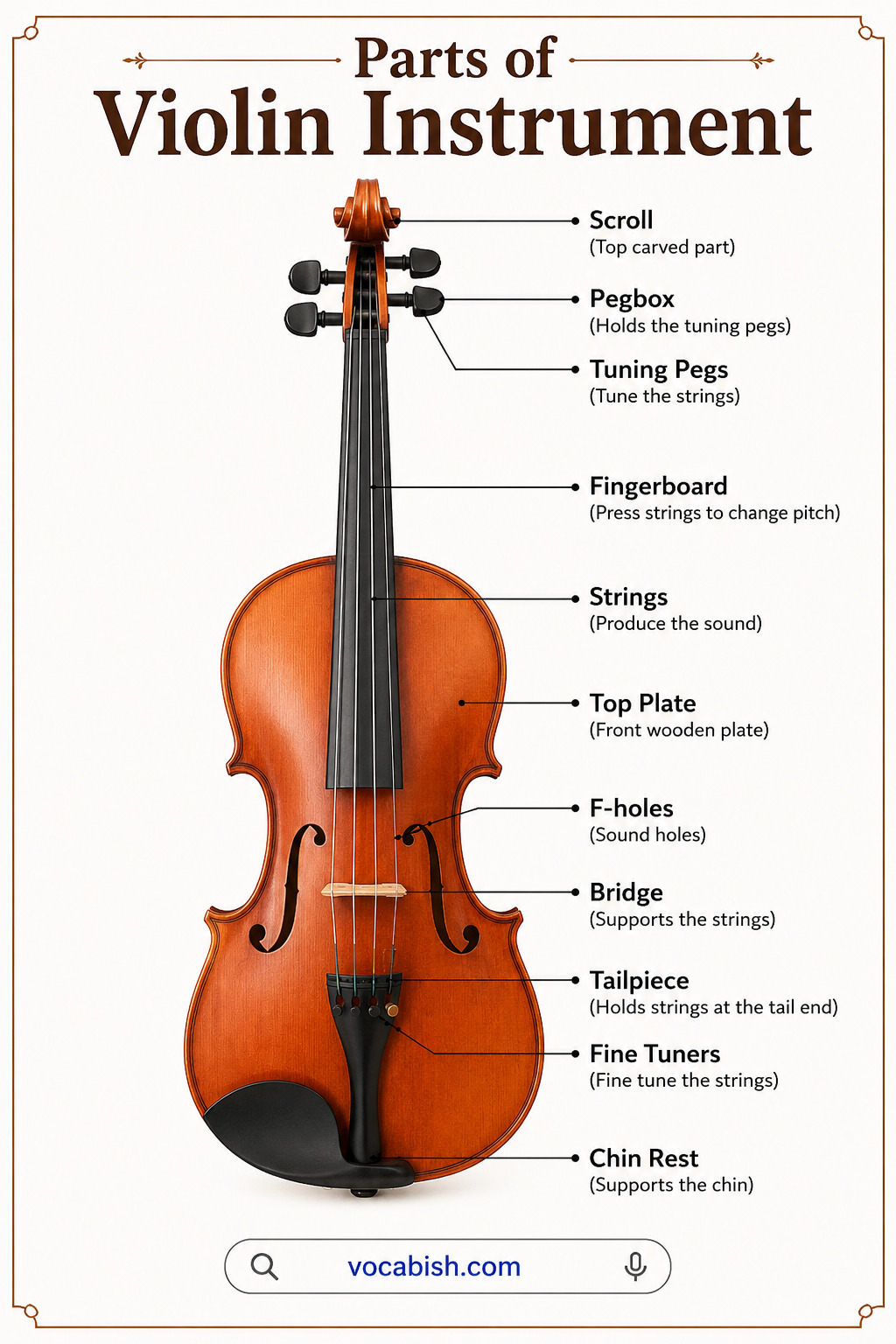
1. Scroll
- The scroll is the curled top part of the violin.
- It adds beauty and balance to the instrument.
2. Pegbox
- The pegbox holds the tuning pegs.
- It helps keep the strings tight.
3. Pegs
- Pegs tune the violin strings.
- Players turn them to change sound pitch.
4. Nut
- The nut is a small piece between the pegbox and fingerboard.
- It keeps strings in the correct position.
5. Fingerboard
- The fingerboard is a long black piece.
- Players press strings here to create notes.
6. Strings
- Strings produce sound when the bow moves across them.
- A violin usually has four strings.
7. Bridge
- The bridge supports the strings.
- It transfers vibration into the violin body.
8. F-Holes
- F-holes are openings on the violin body.
- They help sound come out clearly.
9. Tailpiece
- The tailpiece holds the strings at the bottom.
- It keeps the strings connected securely.
10. Fine Tuners
- Fine tuners help make small tuning changes.
- Beginners often use them often.
11. Chin Rest
- The chin rest supports the player’s chin.
- It makes playing more comfortable.
12. Bow
- The bow moves across the strings.
- It creates sound from the violin.
13. Bow Hair
- Bow hair touches the strings.
- It helps produce vibration and sound.
14. Frog
- The frog is the lower part of the bow.
- Players hold the bow near this part.
15. Sound Post
- The sound post sits inside the violin.
- It supports the violin and improves sound quality.
16. Saddle
- The saddle supports the tailpiece near the bottom edge.
- It protects the violin body from pressure.
17. Ribs
- Ribs are the sides of the violin body.
- They connect the front and back panels.
18. Varnish
- Varnish is the shiny outer coating.
- It protects the wood and adds beauty.
Parts of Violin Labeled Diagram
Different Types of Violins and Their Parts
Parts of Acoustic Violin
The acoustic violin is the traditional wooden violin.
- Scroll — decorative top part
- Pegbox — holds tuning pegs
- Pegs — tune the strings
- Nut — guides string position
- Fingerboard — area for pressing strings
- Neck — supports fingerboard
- Strings — create sound
- Bridge — supports strings
- F-Holes — release sound
- Tailpiece — holds string ends
- Fine Tuners — help accurate tuning
- Chin Rest — supports the chin
- Saddle — supports tailpiece
- Ribs — violin side walls
- Back Plate — rear wooden body
- Top Plate — front wooden body
- Purfling — thin decorative border
- End Button — holds tailgut
Parts of Electric Violin
The electric violin uses electronic technology to amplify sound.
- Pickup — changes vibration into electronic signal
- Volume Control — adjusts sound level
- Tone Control — changes sound quality
- Output Jack — connects amplifier
- Battery Compartment — powers electronics
- Electric Bridge — supports strings
- Shoulder Rest — supports player comfort
- LED Display — appears on some modern violins
Parts of Baroque Violin
The Baroque violin is an older classical violin style.
- Short Fingerboard
- Gut Strings
- Lighter Bass Bar
- Wooden Tailpiece
- Curved Bow
- Pegbox
- Scroll
- Bridge
- Chin Area Without Modern Chin Rest
Parts of Silent Violin
The silent violin produces very little natural sound.
- Frame Body
- Headphone Jack
- Audio Output
- Control Panel
- Electronic Pickup
- Fingerboard
- Strings
- Chin Rest
- Fine Tuners
- Volume Buttons
Bow Parts of a Violin
The bow is also an important part of violin playing.
- Bow Stick — long wooden or carbon rod
- Bow Hair — touches strings to create sound
- Frog — handle area of bow
- Screw — tightens bow hair
- Tip — upper end of bow
- Grip — helps comfortable holding
- Winding — metal wrapping near frog
Internal Parts of Violin
Some violin parts stay inside the instrument.
- Sound Post — improves sound quality
- Bass Bar — supports vibration
- Corner Blocks — strengthen violin body
- Linings — support violin structure
English Sentences About Violin
- She practices violin every evening.
- The bow moves across the strings smoothly.
- He tuned the violin before the concert.
- My violin has four strings.
- The bridge supports the strings carefully.
- Electric violins need power to work.
- The sound post improves the violin sound.
- The orchestra played beautiful violin music.
Tips to Remember Violin Parts
- Study one violin type at a time
- Use labeled violin pictures
- Repeat the part names daily
- Practice speaking the words aloud
- Watch violin learning videos
- Use vocabulary flashcards
- Compare acoustic and electric violins
Learning all parts of a violin instrument by types helps English learners improve vocabulary and understand musical instruments more clearly.
Every violin part has a special function. Some parts create sound, while others support tuning, comfort, or structure.
FAQs about Parts of a Violin
The main parts of a violin are the scroll, pegbox, pegs, fingerboard, strings, bridge, f-holes, tailpiece, chin rest, and bow.
The bridge supports the strings and transfers their vibrations to the violin body to produce clear musical sound.
F-holes help sound move out from the violin body. They improve sound quality and make the instrument louder and clearer.
Violin strings are usually made from steel, synthetic material, or gut. Different materials create different sound qualities.
The fingerboard helps players create different musical notes by pressing the strings with their fingers while playing.
Violin pegs tighten or loosen the strings to tune the instrument and change the pitch of each string.
Electric violins include electronic parts like pickups, output jacks, and volume controls, while acoustic violins produce natural sound without electronics.
A standard violin has four strings named G, D, A, and E. Each string produces a different musical pitch.
Related Articles: