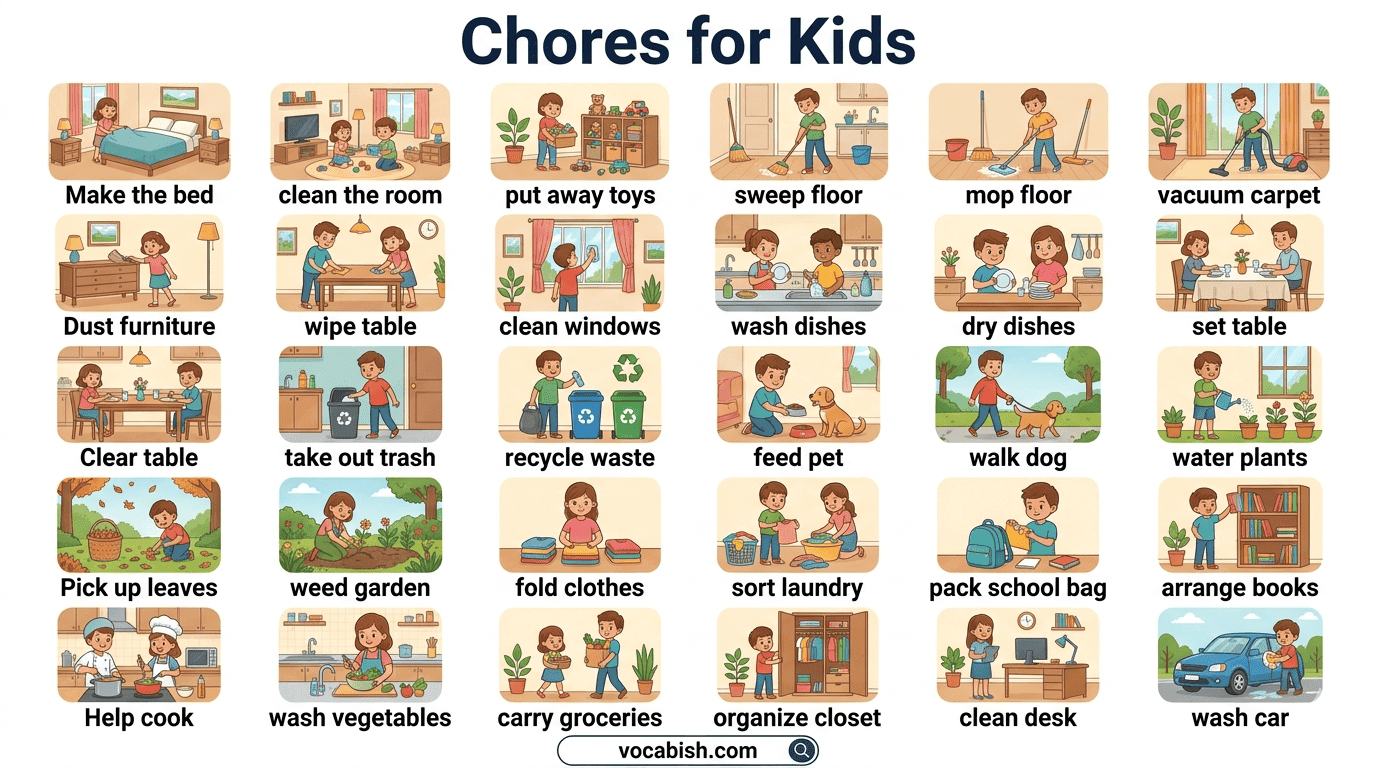

Have you ever asked a child to “make the bed” or “set the table” and wondered if they truly understood the words? Chores for kids are everyday household tasks, and learning these words in English helps children speak confidently at home, in school, and in daily conversations.
For English learners, chores are more than housework. They teach useful action verbs, common nouns, responsibility, routines, and polite communication. In this article, you will learn chore meanings, examples, age-wise tasks, daily and weekly lists, and a clear chart you can use with children.
Chores for Kids Meaning in English
Chores are small jobs that people do at home to keep the house clean, safe, and organized. For children, chores can include easy tasks like putting toys away, feeding a pet, watering plants, or making the bed.
In English, the phrase chores for kids means household tasks that children can do based on their age, ability, and safety. These tasks help kids learn responsibility while building useful English vocabulary.
Simple Definition:
Chores for kids are safe home tasks that children do to help their family.
Easy Examples:
Chore | Meaning | Example Sentence |
|---|---|---|
Make the bed | Arrange the blanket and pillows neatly | I make my bed every morning. |
Set the table | Put plates, cups, and spoons on the table | Please set the table before dinner. |
Feed the pet | Give food to an animal | My brother feeds the cat. |
Water the plants | Give water to plants | I water the plants after school. |
Sweep the floor | Clean the floor with a broom | She sweeps the kitchen floor. |
Fold clothes | Bend clothes neatly after washing | We fold clothes on Sunday. |
Take out the trash | Carry garbage outside | Dad asks me to take out the trash. |
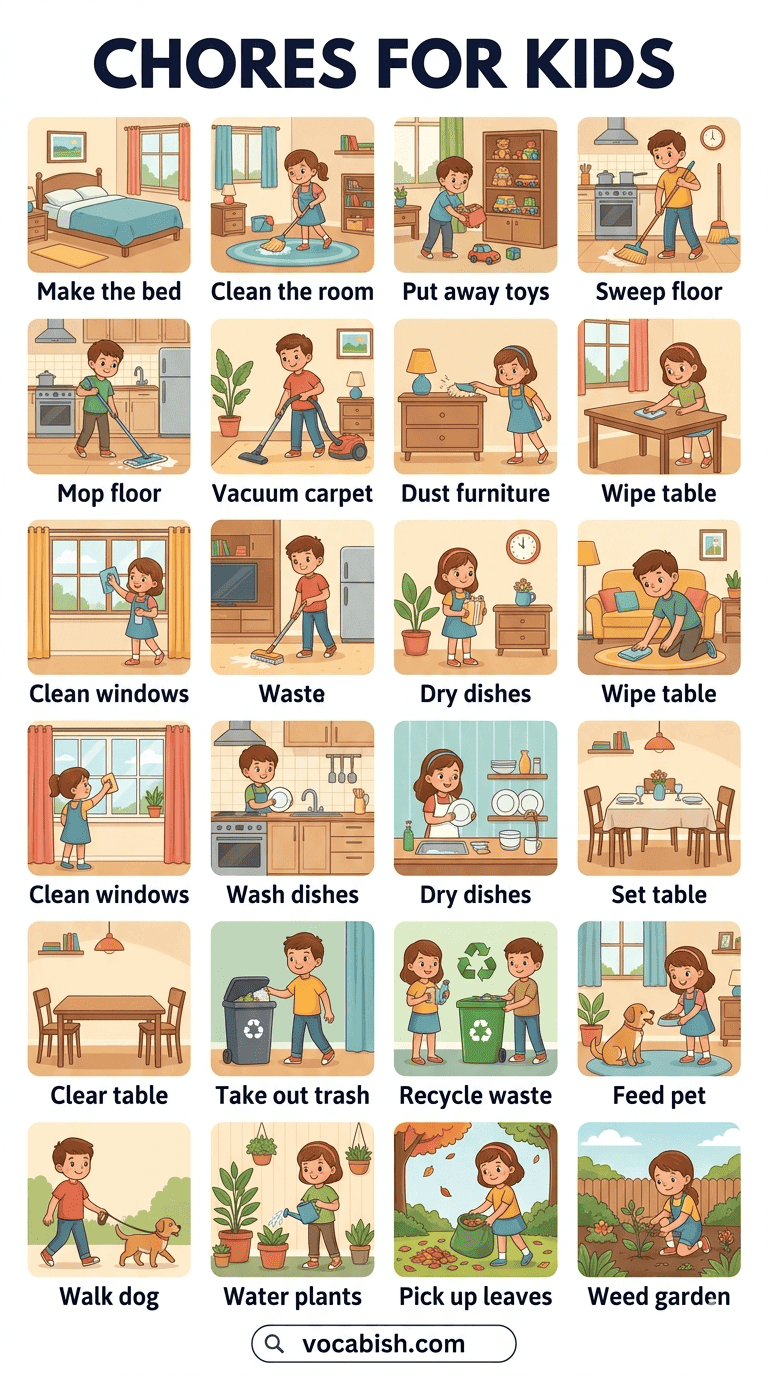
List of All Chores for Kids with Examples
Here’s the plenty of chores list for kids that they can do it their everyday life:
Chore Name | Example Sentence |
|---|---|
Make the bed | Please make your bed before breakfast. |
Put toys away | Put your toys away when you finish playing. |
Feed the pet | I feed the cat every morning. |
Water the plants | Can you water the plants after school? |
Set the table | Please set the table for dinner. |
Clear the table | Clear the table after everyone finishes eating. |
Wash the dishes | I wash the dishes after lunch. |
Dry the dishes | Please dry the dishes and put them away. |
Put dishes in the sink | Put your plate in the sink, please. |
Load the dishwasher | Can you load the dishwasher after dinner? |
Unload the dishwasher | Please unload the dishwasher this morning. |
Wipe the table | Wipe the table after your snack. |
Sweep the floor | I sweep the kitchen floor every evening. |
Mop the floor | Please mop the floor where the water spilled. |
Vacuum the carpet | Can you vacuum your room today? |
Dust the shelves | Dust the low shelves carefully, please. |
Fold clothes | I fold my clothes on Sunday. |
Put clothes away | Put your clean clothes in the drawer. |
Sort laundry | Please sort the laundry into colors and whites. |
Put dirty clothes in the basket | Put your dirty clothes in the laundry basket. |
Match socks | Can you match the socks after laundry? |
Hang up clothes | Hang up your jacket when you come home. |
Take out the trash | Please take out the trash before dinner. |
Put a new trash bag in | Put a new trash bag in the bin, please. |
Clean your room | Clean your room before you watch TV. |
Organize books | Please organize your books on the shelf. |
Clean your desk | I clean my desk before doing homework. |
Pack school bag | Pack your school bag before bedtime. |
Unpack school bag | Unpack your school bag when you get home. |
Put shoes away | Please put your shoes near the door. |
Put books away | Put your books away after reading. |
Pick up clothes | Pick up your clothes from the floor, please. |
Make lunch box | Can you help make your lunch box? |
Put lunch box away | Put your lunch box in the kitchen, please. |
Help prepare snacks | I help prepare snacks after school. |
Help cook dinner | Can you help cook dinner with me? |
Stir food | Please stir the soup gently. |
Wash fruits | Wash the apples before eating them. |
Peel vegetables | I peel carrots with an adult’s help. |
Put groceries away | Please help put the groceries away. |
Carry grocery bags | Can you carry this light grocery bag? |
Clean the mirror | Please clean the mirror with this cloth. |
Wipe the counter | Wipe the kitchen counter after cooking. |
Hang the towel | Hang your towel after your bath. |
Brush the pet | I brush the dog gently on Saturday. |
Fill the pet’s water bowl | Please fill the dog’s water bowl. |
Clean pet area | Can you clean the pet area today? |
Rake leaves | I rake leaves in the garden. |
Pick up leaves | Please pick up the leaves near the door. |
Sweep the patio | Can you sweep the patio this afternoon? |
Wash the car | I help wash the car on weekends. |
Clean bicycle | Please clean your bicycle before riding it. |
Organize toys | Organize your toys in the right boxes. |
Change bedsheets | Please help change your bedsheets today. |
Put pillows in place | Put the pillows in place on the sofa. |
Arrange cushions | Please arrange the cushions neatly. |
Clean backpack | Clean your backpack before school starts. |
Sharpen pencils | Please sharpen your pencils before class. |
Throw paper in the bin | Throw the paper in the bin, please. |
Erase the board | Can you erase the board after the lesson? |
Pass out papers | Please pass out the papers to your classmates. |
Collect notebooks | Collect the notebooks from your group. |
Line up chairs | Please line up the chairs before you leave. |
Tidy the classroom | Let’s tidy the classroom together. |
Put crayons away | Put the crayons away after coloring. |
Clean art supplies | Please clean the art supplies after the activity. |
Stack books | Stack the books neatly on the table. |
Push in the chair | Push in your chair before leaving the table. |
Daily Chore List for Kids
A Daily Chore List for Kids includes small tasks children can do every day. These chores are usually quick, easy to remember, and part of a normal home routine.
Daily Chore List Chart:
Time | Chore | English Practice Sentence |
|---|---|---|
Morning | Make the bed | I make my bed in the morning. |
Morning | Pack school bag | I pack my school bag before school. |
Afternoon | Put shoes away | I put my shoes near the door. |
Afternoon | Put toys away | I put my toys in the box. |
Evening | Set the table | I set the table for dinner. |
Evening | Clear the plate | I clear my plate after eating. |
Night | Put clothes in basket | I put my clothes in the laundry basket. |
Age Appropriate Chores for Kids
Age Appropriate Chores for Kids are tasks that match a child’s age, strength, attention span, and safety level. A five-year-old and a twelve-year-old should not have the same chore list.
Chores by Age Group:
Age Group | Suitable Chores | Notes for Parents and Teachers |
|---|---|---|
Ages 3–4 | Put toys away, place books on a shelf, match socks | Give one task at a time. |
Ages 5–6 | Make the bed, feed a pet, water plants, wipe the table | Use clear action words. |
Ages 7–8 | Sweep the floor, fold towels, pack lunch items, set the table | Show the task first. |
Ages 9–10 | Load dishwasher, sort laundry, take out trash, help cook | Give safety reminders. |
Ages 11–12 | Vacuum, wash dishes, prepare snacks, organize a room | Encourage independence. |
Ages 13+ | Cook easy meals, clean bathroom surfaces, do laundry, mow lawn with supervision | Match tasks to maturity. |
Safety Reminder:
Children should not use sharp tools, strong cleaning products, hot stoves, or heavy machines without adult supervision.
Daily Household Chores for Kids
Daily Household Chores for Kids are home tasks that children can do regularly to help the family. These chores teach teamwork and useful household vocabulary.
Common Household Chores:
Household Area | Chores for Kids |
|---|---|
Bedroom | Make the bed, put clothes away, organize books |
Kitchen | Set the table, clear plates, wipe the table |
Living Room | Put cushions back, arrange toys, dust low shelves |
Bathroom | Hang towel, put toothbrush away, place clothes in basket |
Garden | Water plants, pick up leaves, help carry small tools |
Pet Area | Fill water bowl, feed pet, brush pet gently |
Useful Phrases at Home:
- Can you put your toys away?
- Please wipe the table.
- It is time to feed the dog.
- Let’s fold the clothes together.
- Please put your plate in the sink.
Weekly Chores for Kids
Weekly Chores for Kids are tasks children do once or a few times each week. These chores are usually bigger than daily chores, but they should still be safe and manageable.
Weekly Chore Examples:
Day | Weekly Chore | Example Sentence |
|---|---|---|
Monday | Organize school bag | I organize my school bag on Monday. |
Tuesday | Dust low shelves | I dust the shelves every Tuesday. |
Wednesday | Sort laundry | I sort white and colored clothes. |
Thursday | Clean desk | I clean my desk after homework. |
Friday | Organize toys | I put my toys in the right boxes. |
Saturday | Help wash the car | I help my dad wash the car. |
Sunday | Change bedsheets | We change bedsheets on Sunday. |
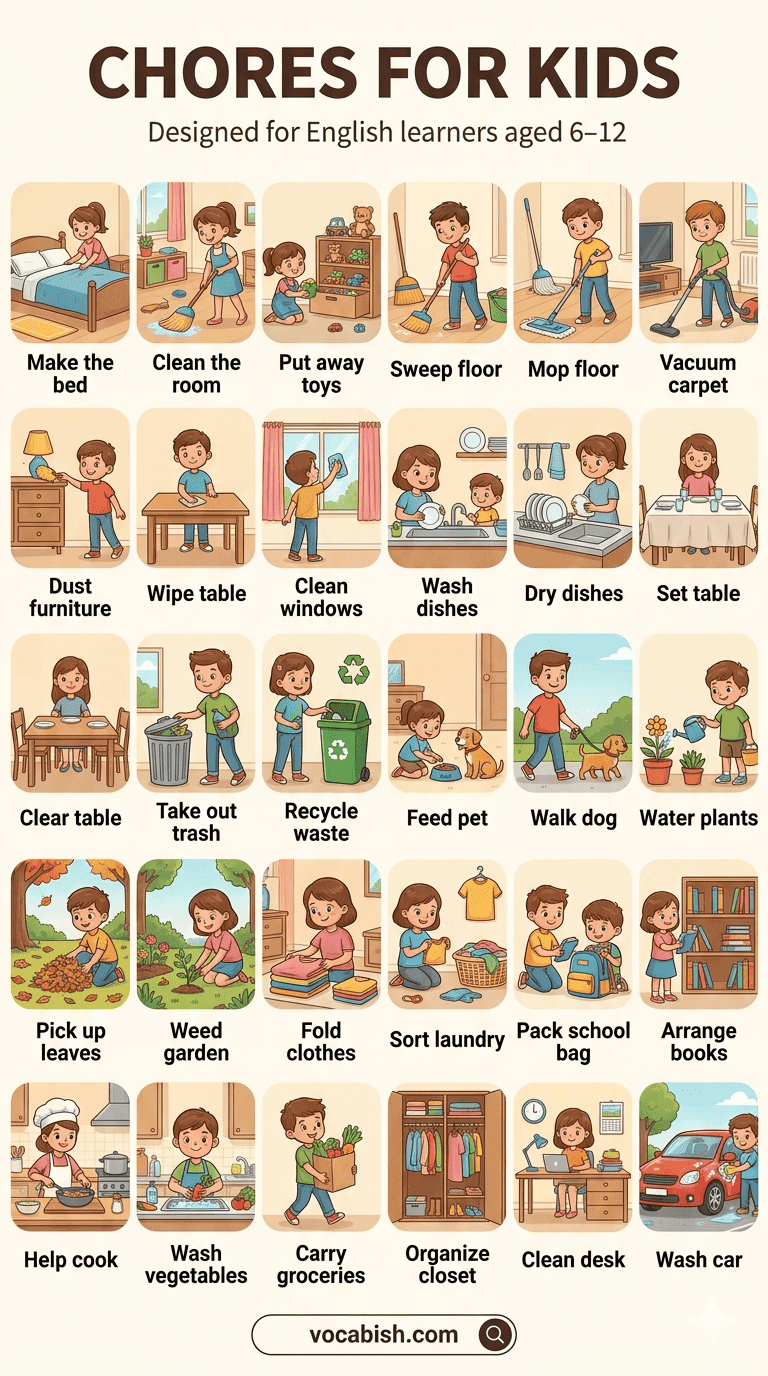
Chores for Kids to Earn Money
Chores for Kids to Earn Money are extra tasks children may do to receive a small allowance. These chores are usually separate from normal family responsibilities.
For example, making the bed may be a regular duty, but washing the car or helping clean the garage may be a paid task. This teaches children the difference between helping at home and earning money through extra work.
Paid Chore Ideas:
Chore | Why It Can Be Paid |
|---|---|
Wash the car | Takes more time and effort |
Rake leaves | Outdoor work and physical effort |
Help clean garage | Bigger task with adult help |
Organize bookshelves | Takes focus and care |
Pull weeds | Outdoor task that may take longer |
Clean windows safely | Needs attention and supervision |
Help sort old clothes | Takes time and decision-making |
Good English Phrases About Paid Chores:
- I earned money by washing the car.
- My parents gave me an allowance.
- I saved my chore money.
- This is an extra chore.
- I helped clean the garage on Saturday.
Summer Chores for Kids
Summer Chores for Kids are tasks children can do during school holidays. Since kids often have more free time in summer, chores can include outdoor work, room organization, and family help.
Summer Chore Ideas:
- Water garden plants
- Pick up outdoor toys
- Help wash bicycles
- Clean school bag before the new term
- Organize books and notebooks
- Help pack picnic items
- Sort summer clothes
- Sweep the patio
- Feed pets in the morning
- Help prepare fruit snacks
Best Chores for Kids
The Best Chores for Kids are safe, useful, and easy to understand. A good chore teaches responsibility without making the child feel stressed or confused.
Best First Chores for Young Kids
- Put toys in a box
- Match socks
- Put books on a shelf
- Water one plant
- Place napkins on the table
- Put shoes together
- Throw paper in the trash bin
Chores for Older Kids
- Wash dishes
- Vacuum a room
- Fold laundry
- Prepare a snack
- Pack lunch
- Clean desk
- Take out trash
- Help cook dinner
What Makes a Chore Good for Kids?
A good chore is:
- Safe
- Clear
- Short enough for the child’s age
- Easy to repeat
- Useful for the family
- Connected to everyday English
- Positive, not used as punishment
Printable Chore Chart for Kids
A Printable Chore Chart for Kids helps children see their tasks clearly. It also helps parents and teachers track progress without repeating instructions many times.
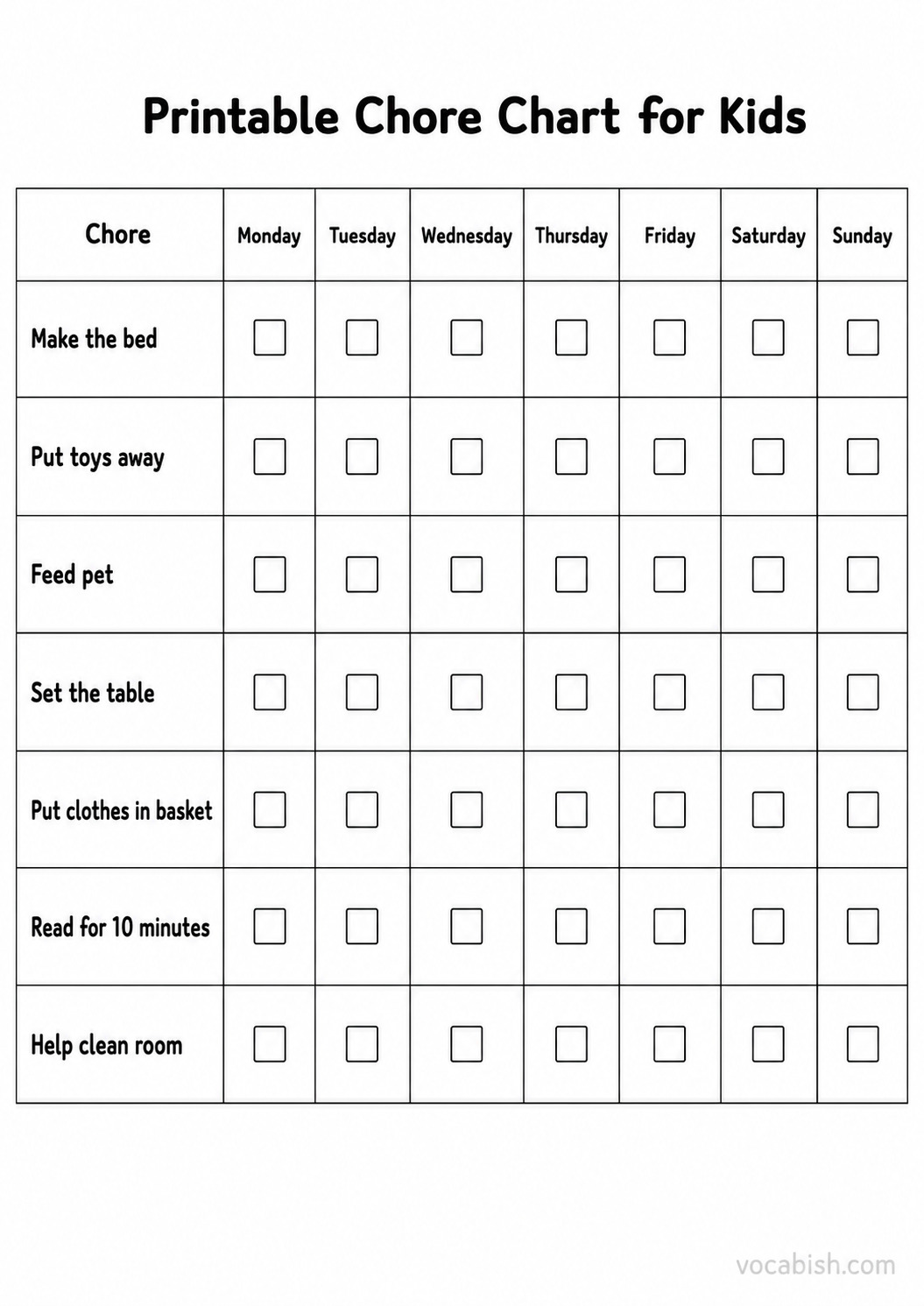
How to Use the Chart:
- Choose 3–6 chores for the week.
- Read each chore aloud with the child.
- Show the action first if the word is new.
- Let the child tick the box after finishing.
- Review the chart at the end of the week.
- Use kind feedback and clear praise.
A chart works well when it feels encouraging. It should not feel like a test.
Useful Chore Verbs in English
Chore vocabulary often begins with action verbs. When children learn verbs first, they can make many useful sentences quickly.
For example, the verb “put” appears in many chores: put toys away, put clothes in the basket, put books on the shelf, and put dishes in the sink.
Common Chore Verbs
Verb | Meaning | Chore Example |
|---|---|---|
Make | Arrange or prepare something | Make the bed |
Put | Move something to a place | Put toys away |
Clean | Remove dirt or mess | Clean your desk |
Wash | Clean with water | Wash dishes |
Wipe | Clean a surface with a cloth | Wipe the table |
Sweep | Clean the floor with a broom | Sweep the floor |
Fold | Bend neatly | Fold clothes |
Sort | Put things into groups | Sort laundry |
Feed | Give food | Feed the dog |
Water | Give water | Water the plants |
Carry | Hold and move something | Carry grocery bags |
Organize | Put things in order | Organize books |
Easy Verb Pattern
Use this structure:
Subject + chore verb + object
Examples:
- I wash dishes.
- She folds clothes.
- We clean the room.
- He feeds the cat.
- They water the plants.
Example Sentences About Chores
Example sentences help students understand how chore words sound in normal English. They also make vocabulary easier to remember.
Teachers can use these sentences for speaking practice, writing practice, matching activities, or classroom role-play.
Daily Chore Sentences
- I make my bed every morning.
- My sister puts her toys away.
- We set the table before dinner.
- He feeds the dog after school.
- I put my dirty clothes in the basket.
- My brother sweeps the floor.
- She waters the plants in the evening.
- We clean our room on Saturday.
- I fold my shirts and socks.
- They take out the trash at night.
Question and Answer Practice
Question | Answer |
|---|---|
What chore do you do every day? | I make my bed every day. |
Who feeds the pet? | My brother feeds the dog. |
When do you clean your room? | I clean my room on Saturday. |
Do you help at home? | Yes, I help set the table. |
What chore do you like? | I like watering the plants. |
What chore is difficult? | Washing dishes is difficult for me. |
Short Conversation
Parent: Can you help me set the table?
Child: Yes, I can. Where are the plates?
Parent: They are in the kitchen cabinet.
Child: Okay. I will put them on the table.
Parent: Thank you for helping.
Child: You’re welcome.
Tips for Teaching Chores Vocabulary
Teaching chore words becomes easier when children can see, hear, say, and do the action. A child remembers “sweep” faster when they hold a broom than when they only read the word.
Parents and teachers can use pictures, gestures, home objects, and short routines to make learning natural.
Teaching Ideas for Parents
- Say the chore while doing it: “I am folding clothes.”
- Use short commands: “Please put your shoes away.”
- Praise the effort: “Good job setting the table.”
- Repeat the same words during daily routines.
- Use a chore chart with pictures for younger kids.
Teaching Ideas for ESL Classrooms
- Use flashcards with chore pictures.
- Match verbs with objects: wash + dishes, make + bed.
- Ask students to act out chores.
- Create pair conversations about home tasks.
- Let students write their own daily chore list.
- Use a weekly chart for speaking practice.
Common Mistakes to Correct Gently
Mistake | Better Sentence |
|---|---|
I do my bed. | I make my bed. |
I clean my teeth. | I brush my teeth. |
I wash the floor with broom. | I sweep the floor with a broom. |
I give food the dog. | I feed the dog. |
I put off my toys. | I put away my toys. |
I wash the plants. | I water the plants. |
You May Also Like:
- Names of Body Parts for Kids with Pictures
- Family Tree for Kids with Worksheet
- List of Bad Habits for Kids with Pictures
FAQs About Chores for Kids
Chores for kids are safe household tasks children do to help at home, such as making the bed, feeding pets, or putting toys away.
A good daily list includes making the bed, putting toys away, feeding pets, clearing plates, packing bags, and placing clothes in the basket.
A 5-year-old can make the bed, water plants, feed a pet, wipe tables, put toys away, and help set the table.
Kids can earn money from extra chores like washing cars, raking leaves, organizing shelves, helping clean the garage, or sorting old clothes.
Chore charts help children see tasks clearly, build routines, track progress, and feel proud when they finish their responsibilities.
Weekly chores include cleaning desks, changing bedsheets, organizing toys, dusting shelves, sorting laundry, vacuuming rooms, and helping with grocery bags.
Yes, kids can do a few small chores daily, but the tasks should match their age, energy, safety, and school routine.
Final Thoughts
Chores help children learn responsibility, teamwork, and useful English at the same time. Words like make, wash, clean, fold, put, sweep, and feed appear often in daily conversations, so they are valuable for English learners.
The best way to teach chores is through short routines, clear examples, and kind practice. Start with a few easy tasks, use a chart, and let children grow their vocabulary step by step while helping at home.