
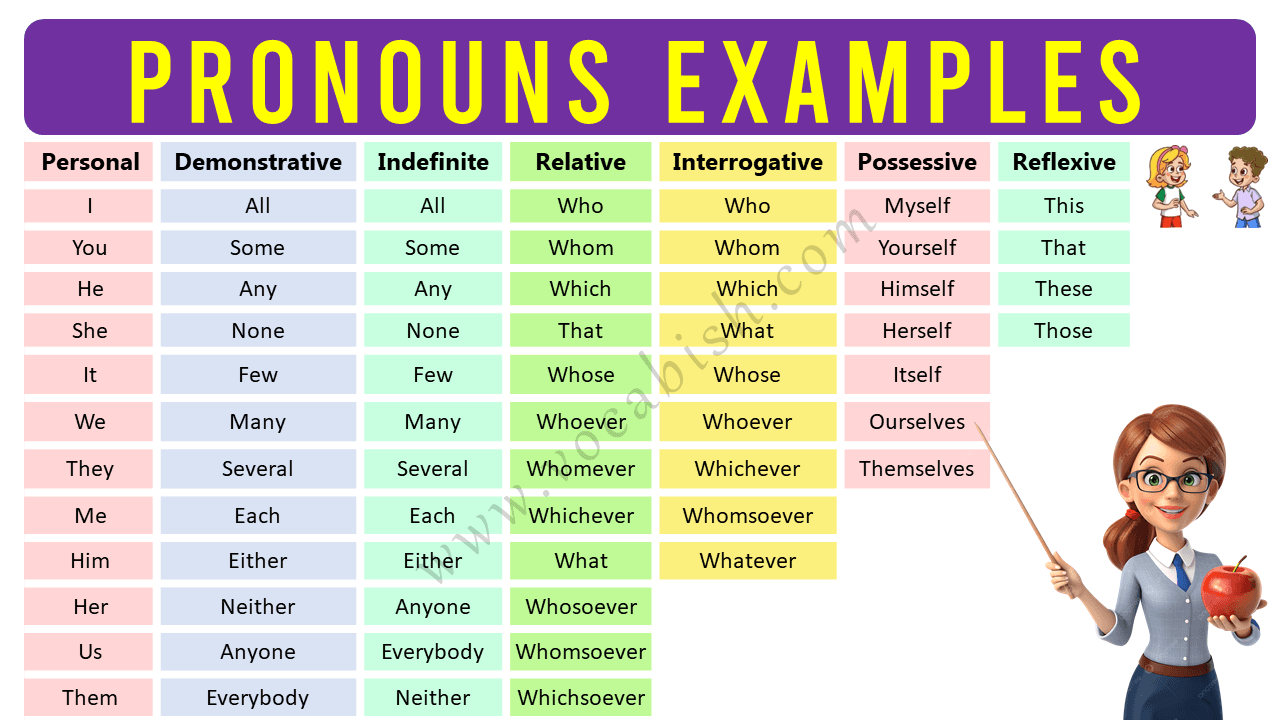
Pronouns are words we use instead of nouns. They help avoid repetition and make sentences smoother and easier to follow. Words like he, she, it, they, and which are common examples. In this blog post, you will learn 250+ A to Z pronouns in English with pictures to help you see how they are used in real sentences. When you understand pronouns, you can speak more naturally and write more clearly. With regular practice, you will master different types of pronouns and use them correctly in daily communication. Keep reading to explore the full A to Z list and build stronger grammar skills step by step.
Here’s the list of 250+ A to Z list of pronouns in English:
A to Z List of Pronouns in English
List of Personal Pronouns
These pronouns refer to specific people or things.
- I
- You
- He
- She
- It
- We
- They
- Me
- Him
- Her
- Us
- Them
- My
- Your
- His
- Her
- Its
- Our
- Their
- Myself
- Yourself
- Himself
- Herself
- Itself
- Ourselves
- Yourselves
- Themselves
List of Possessive Pronouns
These pronouns show ownership.
- Mine
- Yours
- His
- Hers
- Its
- Ours
- Theirs
- My
- Your
- His
- Her
- Its
- Our
- Their
List of Reflexive Pronouns
These pronouns refer back to the subject of the sentence.
- Myself
- Yourself
- Himself
- Herself
- Itself
- Ourselves
- Yourselves
- Themselves
List of Demonstrative Pronouns
These pronouns point to specific things.
- This
- That
- These
- Those

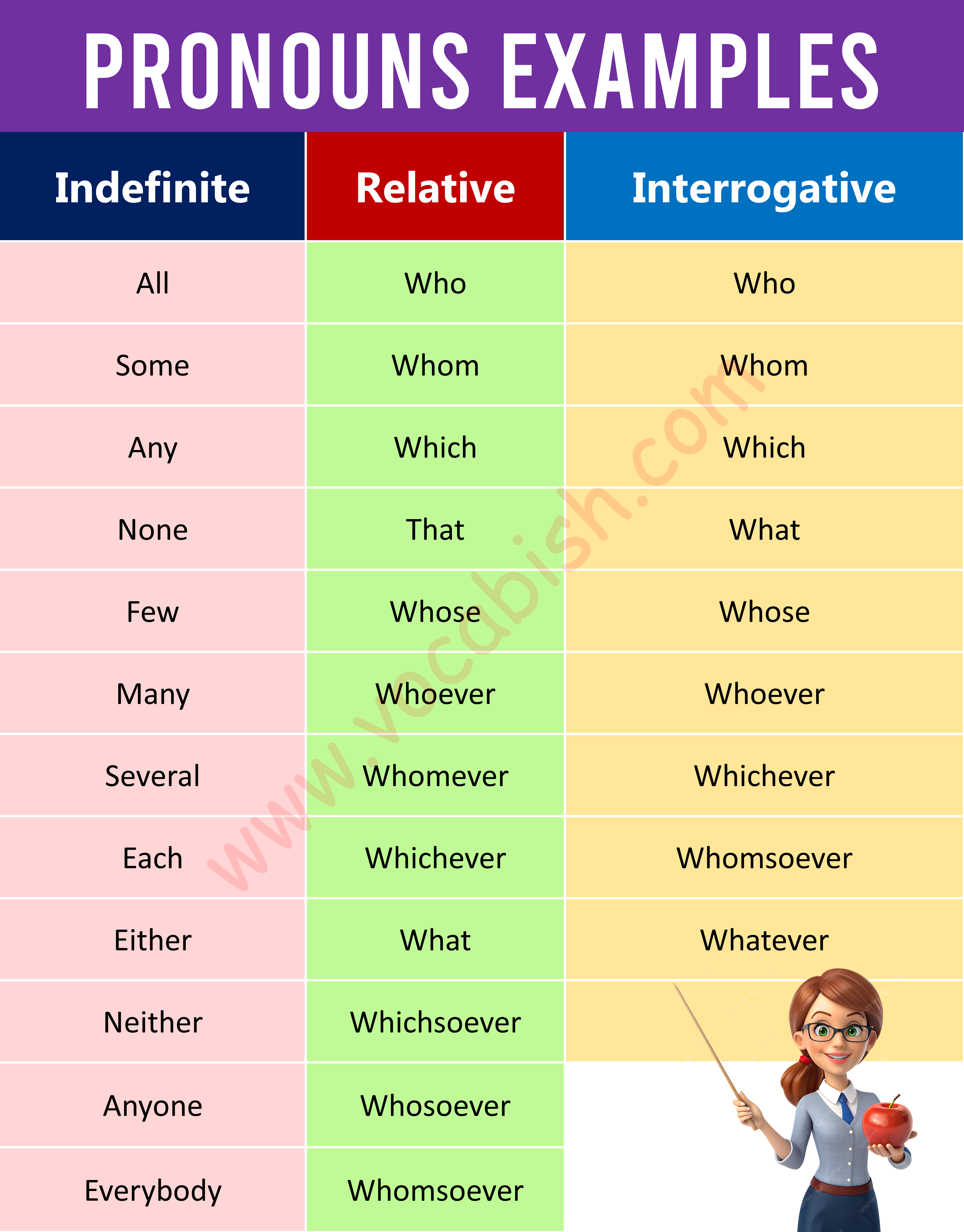
List of Indefinite Pronouns
These pronouns refer to non-specific people or things.
- All
- Some
- Any
- None
- Few
- Many
- Several
- Each
- Either
- Neither
- Anyone
- Everybody
- Nobody
- Somebody
- Something
- Anything
- Nothing
- Everything
- Each one
- Every one
- Either one
- Neither one
- Another
- Both
- One
- Other
- Such
- Whoever
- Whomever
- Whatever
List of Relative Pronouns
These pronouns introduce a dependent clause.
- Who
- Whom
- Which
- That
- Whose
- Whoever
- Whomever
- Whichever
- What
- Whichsoever
- Whosoever
- Whomsoever
- Whosever
List of Interrogative Pronouns
These pronouns are used to ask questions.
- Who
- Whom
- Which
- What
- Whose
- Whoever
- Whichever
- Whomsoever
- Whatever
Pronouns are small but very important words in English. They make your sentences shorter, clearer, and more natural. By learning different types of pronouns with examples, you can improve both your writing and speaking skills.
Keep practising with examples, and soon pronouns will become an easy and natural part of your English!
FAQs
What is a pronoun in English grammar?
A pronoun is a word that is used in place of a noun to avoid repetition. It makes sentences shorter and smoother.
Example: he, she, it, they, we, you, I.
What are examples of pronouns in sentences?
She is my friend.
They are playing football.
I like this book.
We went to the market.
It is raining outside.
What are the main types of pronouns?
The main types of pronouns include:
- Personal Pronouns → I, you, he, she, they
- Possessive Pronouns → mine, yours, theirs
- Reflexive Pronouns → myself, herself
- Demonstrative Pronouns → this, that, these, those
- Relative Pronouns → who, which, that
- Interrogative Pronouns → who, what, whose
- Indefinite Pronouns → someone, anything, everyone
Why are pronouns important in English?
Pronouns make sentences clear, natural, and less repetitive. Without them, sentences would sound long and awkward.
Example: Instead of saying Maria likes Maria’s dress, you can say Maria likes her dress.
What is the difference between a noun and a pronoun?
A noun names a person, place, or thing (Alex, London, book), while a pronoun replaces the noun to avoid repeating it (he, there, it).
Read More