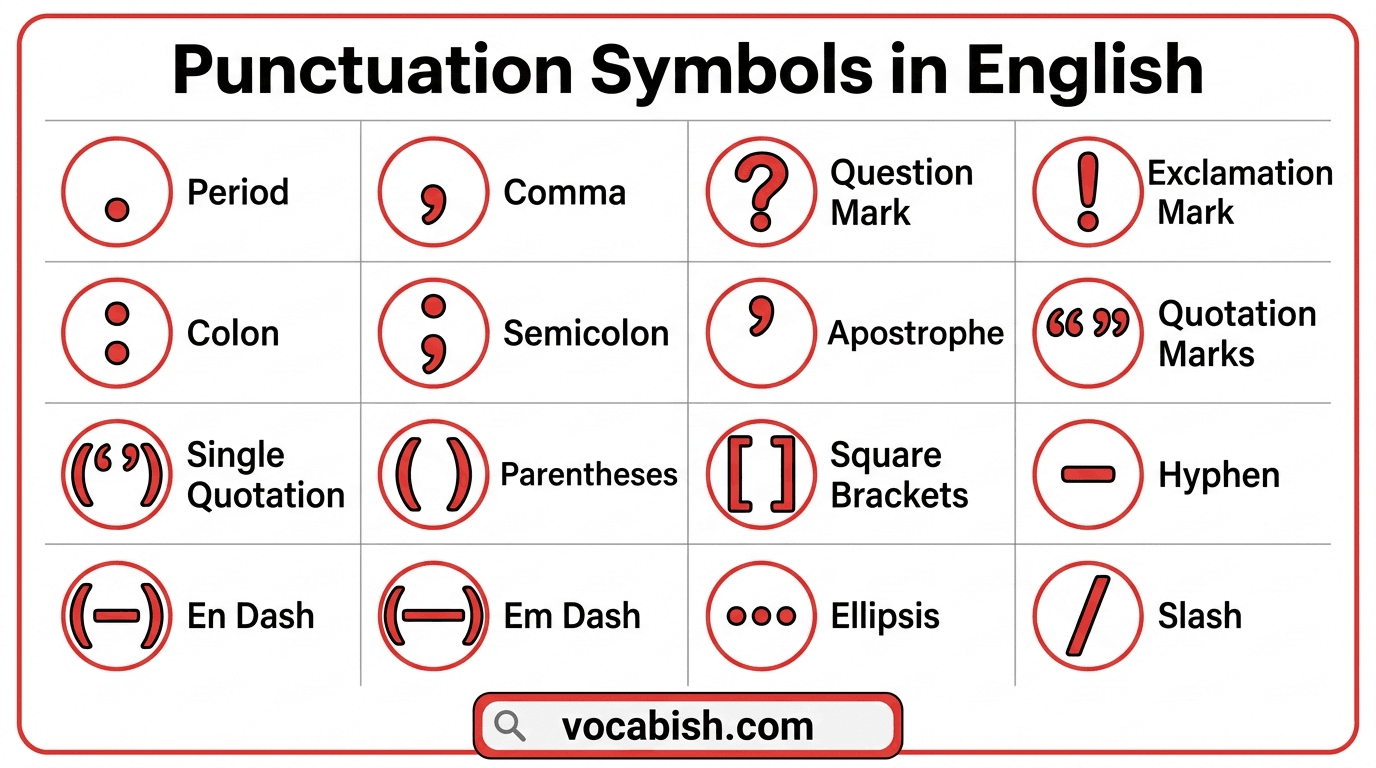

Punctuation marks are small signs used in writing to organize words and sentences. These signs are called punctuation, and they help readers know when to pause, stop, ask questions, or show strong feelings. Without them, sentences can look confusing and difficult to follow. In this blog post, you will learn the most common symbols, their names, and how writers use them in everyday English sentences. When learners recognize punctuation marks such as the period, comma, and question mark, they begin to read with better understanding and write with greater accuracy.
Punctuation Symbols: Definitions and Examples
Punctuation symbols are special marks used in writing to organize words and sentences.
They help readers understand:
- where a sentence ends
- where to pause
- how ideas connect
- how to show questions or emotions
Without punctuation, sentences can change meaning or become difficult to read.
Example:
- Let’s eat, Grandma.
- Let’s eat Grandma.
The comma changes the meaning completely.
Why Punctuation Is Important in English
Punctuation plays an important role in communication.
It helps learners:
- read sentences smoothly
- understand meaning quickly
- express ideas clearly in writing
- avoid confusion in communication
Strong punctuation skills also improve writing accuracy and reading comprehension.
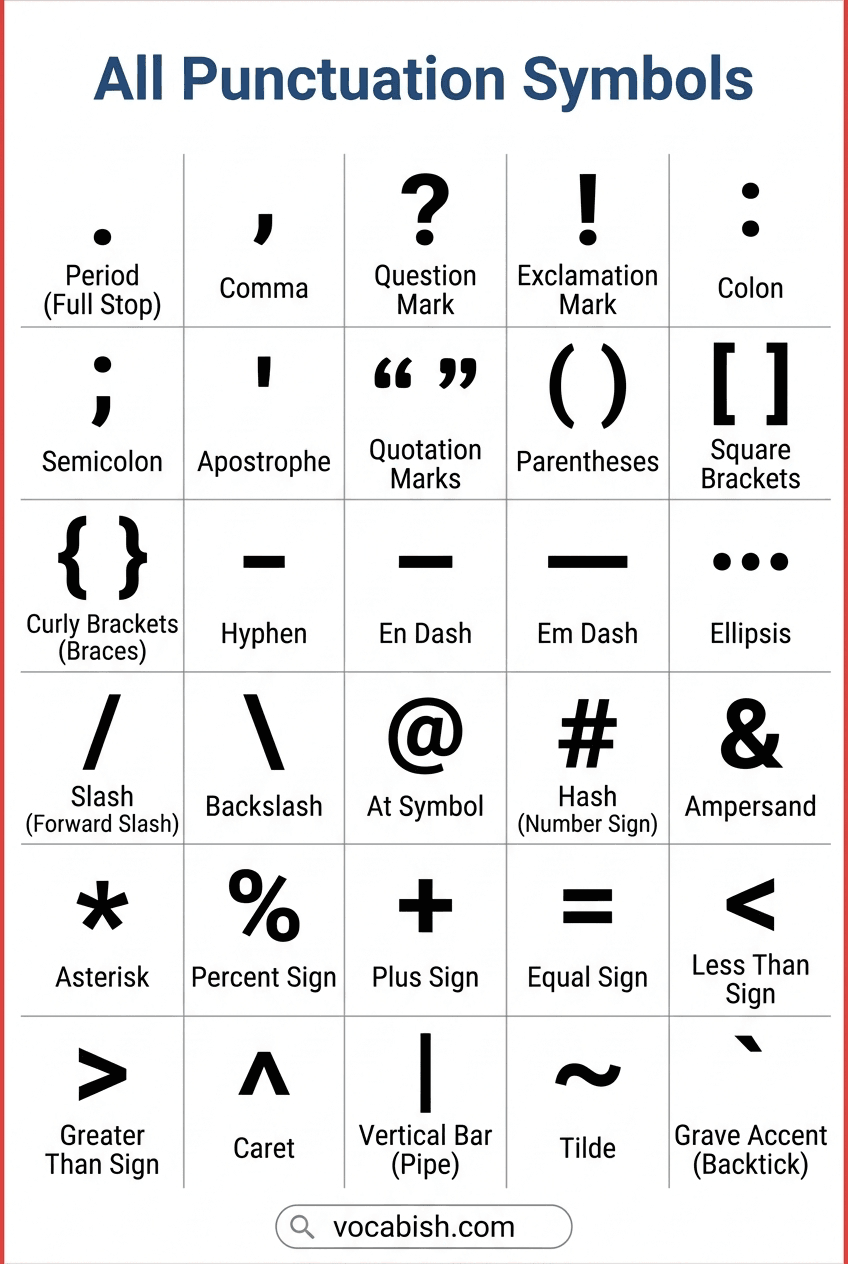
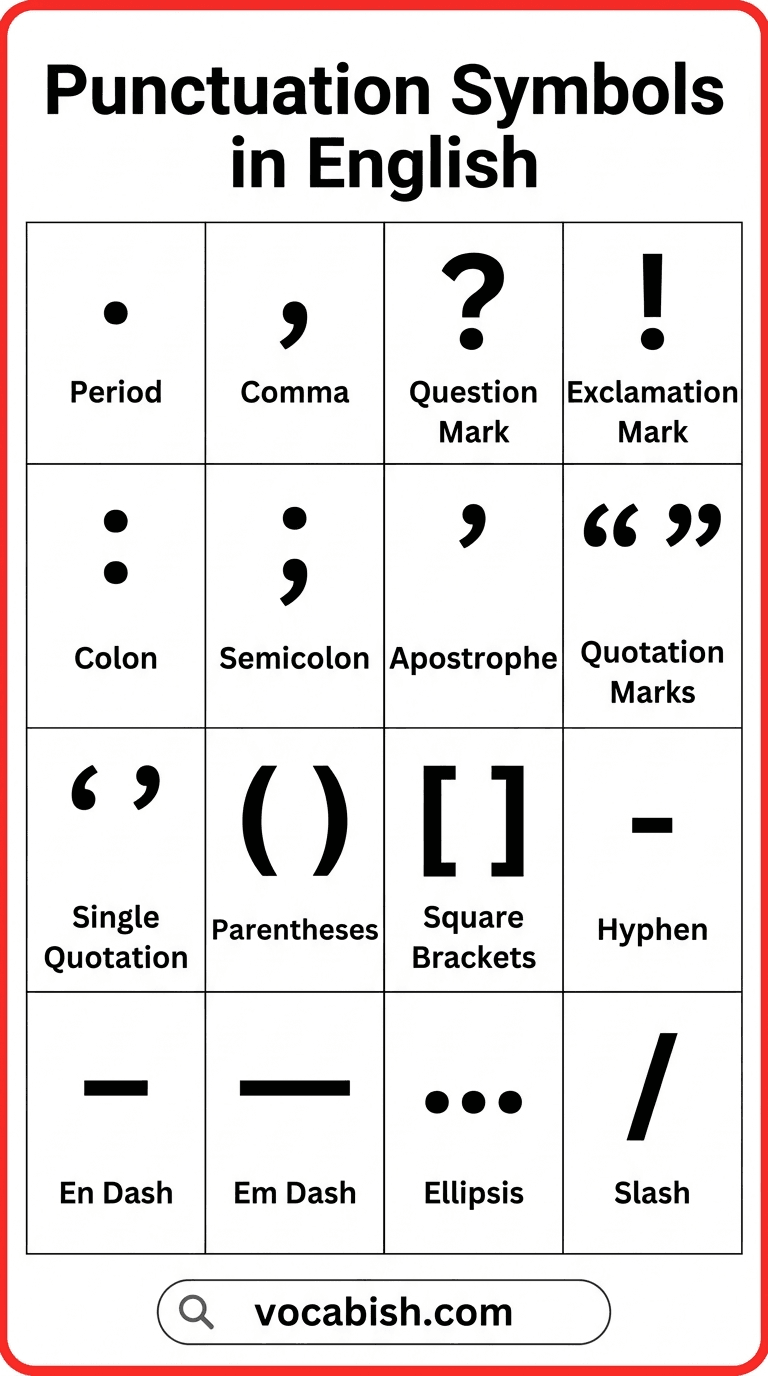
List of All Punctuation Symbols with Names and Pictures
- . — Period (Full Stop)
- , — Comma
- ? — Question Mark
- ! — Exclamation Mark
- : — Colon
- ; — Semicolon
- ’ — Apostrophe
- “ ” — Quotation Marks (Double Quotes)
- ‘ ’ — Quotation Marks (Single Quotes)
- ( ) — Parentheses (Round Brackets)
- [ ] — Square Brackets
- { } — Curly Brackets (Braces)
- – — Hyphen
- – — En Dash
- — — Em Dash
- … — Ellipsis
- / — Slash (Forward Slash)
- \ — Backslash
- @ — At Symbol
- # — Hash (Number Sign / Pound Sign)
- & — Ampersand
- * — Asterisk
- % — Percent Sign
- + — Plus Sign
- = — Equal Sign
- < — Less Than Sign
- > — Greater Than Sign
- ^ — Caret
- | — Vertical Bar (Pipe)
- ~ — Tilde
- ` — Grave Accent (Backtick)
Names for Punctuation Symbols with Their Uses
Below are common punctuation symbols with their names, uses, and examples, which helps you know the right usage in everyday life.
1. Period (.)
A period marks the end of a complete statement. It is also used in some abbreviations and decimal numbers.
Examples:
- She works from home.
- The price is $12.50.
- Dr. Khan is here.
2. Comma (,)
A comma creates a short pause and separates items, phrases, or parts of a sentence. It can also make sentence meaning clearer.
Examples:
- We bought apples, oranges, and bananas.
- After dinner, we went outside.
- Yes, I understand.
3. Question Mark (?)
A question mark is used at the end of a direct question. It shows that the speaker is asking for information.
Examples:
- Where do you live?
- Did you finish the work?
- What time is the meeting?
4. Exclamation Mark (!)
An exclamation mark shows strong feeling, excitement, surprise, or emphasis. It is usually used in short, expressive sentences.
Examples:
- What a beautiful view!
- Watch out!
- I finally passed the test!
5. Colon (:)
A colon introduces a list, explanation, example, or important detail. The words before it should normally form a complete thought.
Examples:
- Bring three things: water, food, and a map.
- She had one goal: to win.
- Remember this rule: practice matters.
6. Semicolon (;)
A semicolon connects closely related complete sentences. It is stronger than a comma but lighter than a full stop.
Examples:
- I was tired; I kept working.
- She loves tea; her brother prefers coffee.
- The road was closed; we took another route.
7. Apostrophe (‘)
An apostrophe shows possession or missing letters in contractions. Its position can change the meaning of a word.
Examples:
- Sara’s book is new.
- Don’t open the door.
- It’s raining outside.
8. Quotation Marks (” “)
Quotation marks show exact spoken words, quoted text, or sometimes titles and special terms. They help readers see which words are being quoted.
Examples:
- He said, “I am ready.”
- “Stop!” she shouted.
- The word “freedom” has several uses.
9. Parentheses ( )
Parentheses add extra information that is useful but not central to the sentence. The main sentence can usually stand without the words inside them.
Examples:
- Maria (my neighbor) owns the shop.
- The meeting starts at 9 a.m. (sharp).
- He moved to Canada (in 2022).
10. Hyphen (-)
A hyphen joins words or word parts that work together. It is common in compound words and some number expressions.
Examples:
- She is a well-known writer.
- This is a five-year-old car.
- Please read pages twenty-one to twenty-five.
11. Dash (—)
A dash creates a stronger break than a comma and can add emphasis or extra information. It is useful when a writer wants a noticeable pause.
Examples:
- He finally arrived—two hours late.
- There was only one problem—the door was locked.
- My brother—the one in blue—called me.
12. Ellipsis (…)
An ellipsis shows omitted words, a trailing thought, or a pause. It can make writing sound unfinished, hesitant, or reflective.
Examples:
- I thought you were going to…
- Well… I am not sure.
- She opened the box and then…
13. Slash (/)
A slash separates alternatives, related terms, dates, or parts of an expression. Its meaning depends on the context.
Examples:
- Please bring your ID/passport.
- The meeting is on 08/18/2026.
- He works part-time.
14. Brackets ([ ])
Brackets add information inside quoted or edited text. They are often used to clarify words without changing the original quotation.
Examples:
- She said, “He [John] called yesterday.”
- The report states that “they [the workers] agreed.”
- He wrote, “I saw her [at the station].”
To read in depth about each and every punctuation mark or symbol, you may visit our complete category, where we provide a detailed explanation for each symbol and mark.
Common Punctuation Symbols Used Daily
These punctuation marks appear frequently in everyday communication:
- Period (.) – ends statements
- Comma (,) – separates ideas and items
- Question mark (?) – asks questions
- Exclamation mark (!) – shows emotion
- Apostrophe (’) – indicates possession or contractions
Understanding these marks helps learners read emails, books, and online content more easily.
How to Use Punctuation
Punctuation helps you organize sentences, show meaning, and make your writing easy to read. Each mark has a specific purpose.
- Period (.) – ends a statement
Example: She likes reading. - Comma (,) – shows a short pause or separates items
Example: I bought apples, oranges, and bananas. - Question Mark (?) – ends a question
Example: Where are you going? - Exclamation Mark (!) – shows strong feeling
Example: That is wonderful! - Apostrophe (’) – shows possession or short forms
Example: This is John’s book. / don’t = do not - Quotation Marks (“ ”) – show exact words someone says
Example: She said, “I am ready.”
Tips to Use Punctuation Correctly
End Every Sentence Properly
Always finish a sentence with:
- a period
- a question mark
- or an exclamation mark
Use Commas for lists.
Example:
She bought bread, milk, eggs, and rice.
Avoid Too Many Exclamation Marks
Use them only when strong emotion is necessary.
Practice with Short Sentences
Writing simple sentences helps learners master punctuation step by step.
FAQs about Punctuation Symbols
Punctuation symbols are special marks used in writing to organize sentences and clarify meaning. Common examples include the period, comma, question mark, and apostrophe. They guide readers on pauses, tone, and sentence structure.
The most common punctuation symbols include the period (.), comma (,), question mark (?), exclamation mark (!), apostrophe (’), and quotation marks (“ ”). These marks appear frequently in everyday English writing.
A period ends a complete sentence and signals a full stop. A comma creates a short pause within a sentence and separates items, phrases, or clauses.
A colon (:) is the punctuation symbol used to introduce an explanation, list, or emphasis. Writers place it after a complete statement to present related information. Example: She bought three items: bread, milk, and eggs.
Symbols and punctuation are special marks used to organize and clarify written language. Punctuation marks like periods and commas structure sentences, while symbols such as @, $, and % represent specific meanings or concepts.
Related Articles:
Conclusion
Punctuation symbols play a key role in English writing. They organize sentences, clarify meaning, and guide readers through ideas.
By learning the names of punctuation symbols and their uses, English learners can improve their reading, writing, and overall communication skills. Start with common punctuation marks such as the period, comma, and question mark, then practice using them in everyday sentences.