
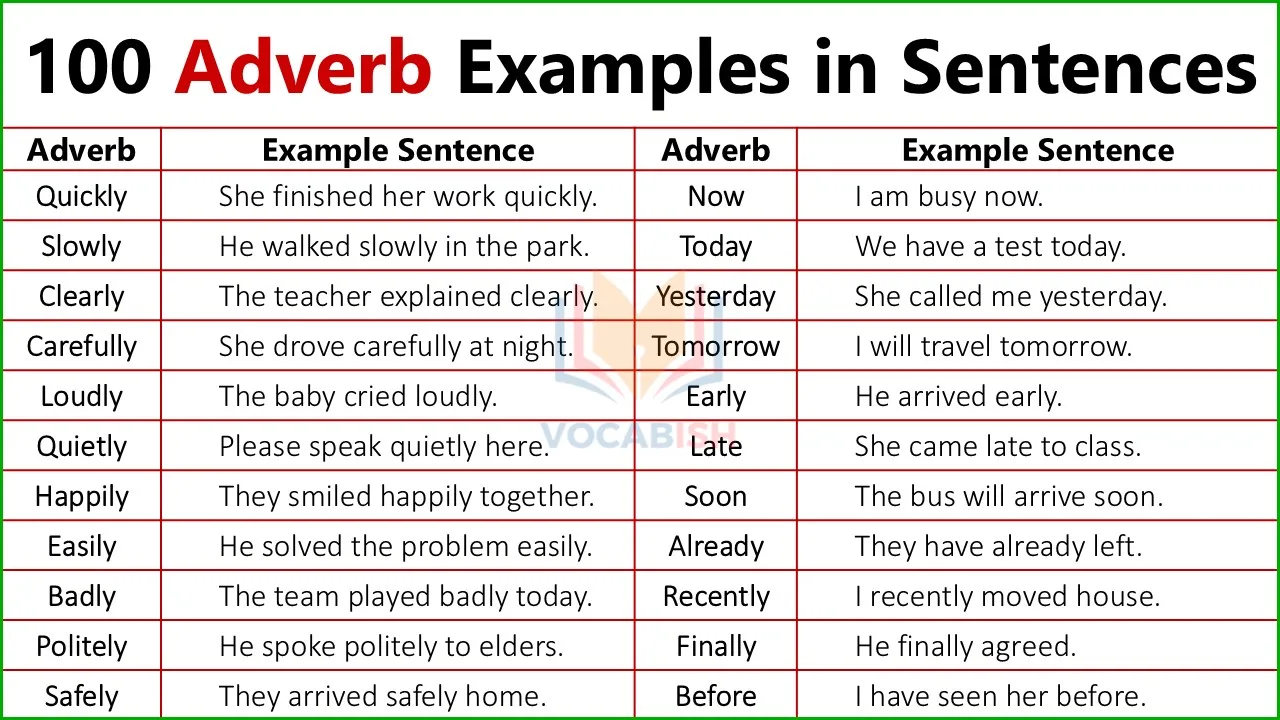
Adverbs are words that describe verbs, adjectives, or other adverbs. They tell us how, when, where, or how often something happens. Words like quickly, always, very, and here are common examples. In this blog post, you will learn 100 adverb examples in sentences with PDF to see how they are used in real English. When you understand adverbs, you can make your speaking and writing more detailed and accurate. With regular practice, you will master the correct use of adverbs in reading, writing, listening, and daily conversations. Keep reading to explore practical examples and improve your English step by step.
What Are Adverbs?
Adverbs are words that describe or give more information about a verb, adjective, or another adverb. They usually answer questions like how, when, where, how often, or how much.
Example:
- She speaks clearly.
- They arrived early.
Why Adverbs Are Important
Adverbs help you:
- Speak more clearly
- Write more naturally
- Add details and meaning
- Sound more fluent
Without adverbs, sentences feel short and incomplete.
100 Adverb Examples in Sentences
Adverbs are used in different contexts in English. Below are the main types with example sentences you need to know.
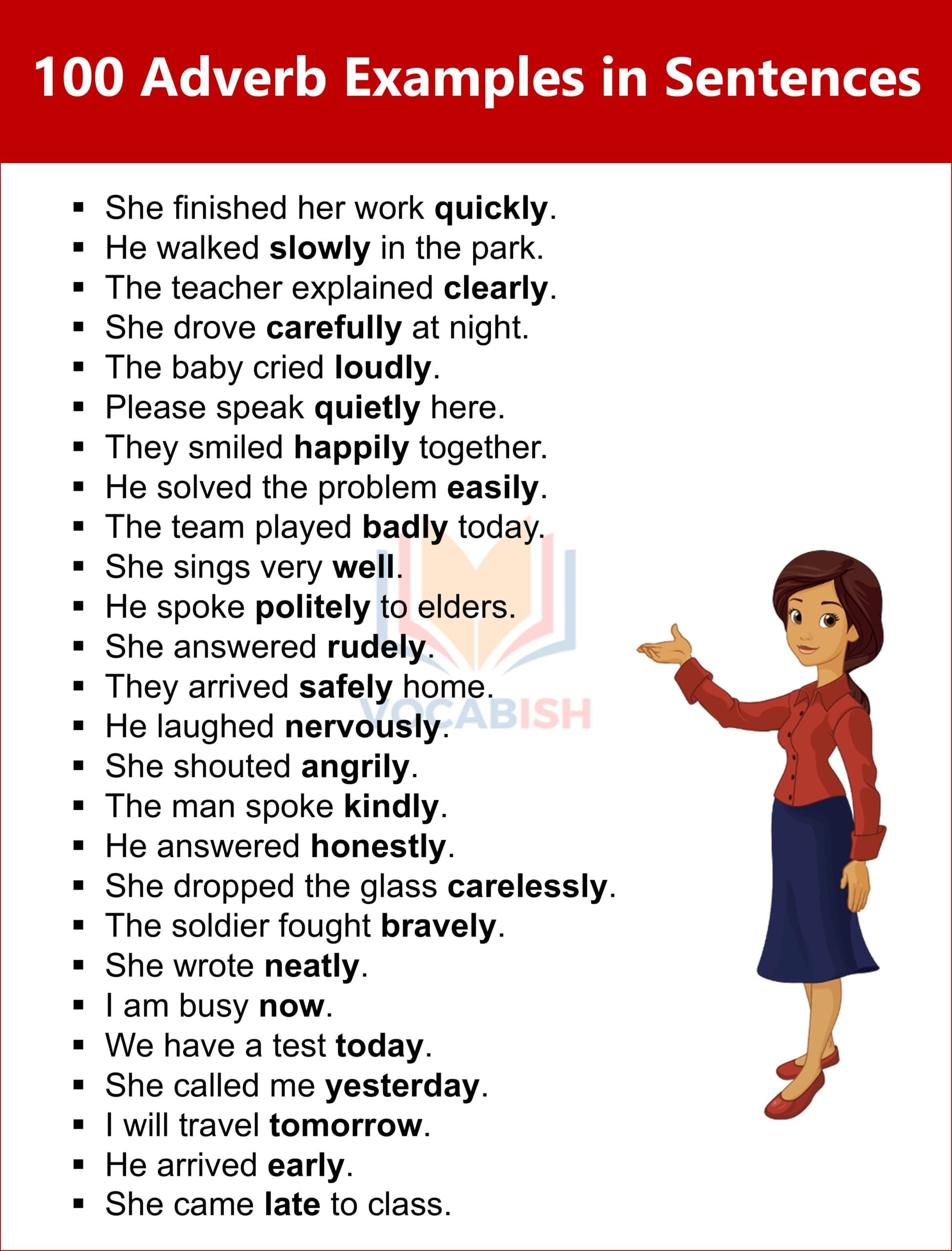
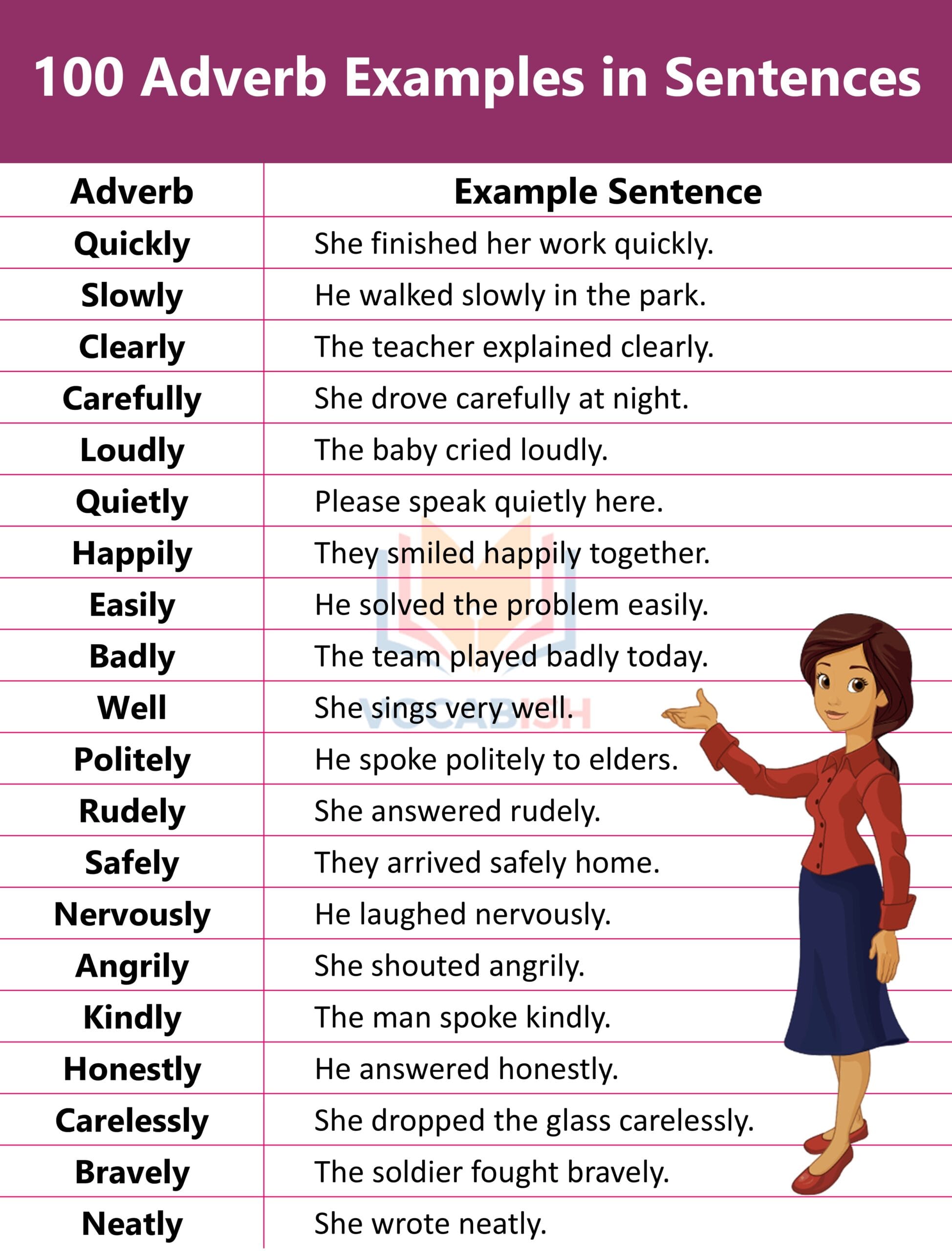
Adverbs of Manner Examples in Sentences
They tell how something happens.
Examples:
| No. | Adverb | Example Sentence |
|---|---|---|
| 1 | quickly | She finished her work quickly. |
| 2 | slowly | He walked slowly in the park. |
| 3 | clearly | The teacher explained clearly. |
| 4 | carefully | She drove carefully at night. |
| 5 | loudly | The baby cried loudly. |
| 6 | quietly | Please speak quietly here. |
| 7 | happily | They smiled happily together. |
| 8 | easily | He solved the problem easily. |
| 9 | badly | The team played badly today. |
| 10 | well | She sings very well. |
| 11 | politely | He spoke politely to elders. |
| 12 | rudely | She answered rudely. |
| 13 | safely | They arrived safely home. |
| 14 | nervously | He laughed nervously. |
| 15 | angrily | She shouted angrily. |
| 16 | kindly | The man spoke kindly. |
| 17 | honestly | He answered honestly. |
| 18 | carelessly | She dropped the glass carelessly. |
| 19 | bravely | The soldier fought bravely. |
| 20 | neatly | She wrote neatly. |
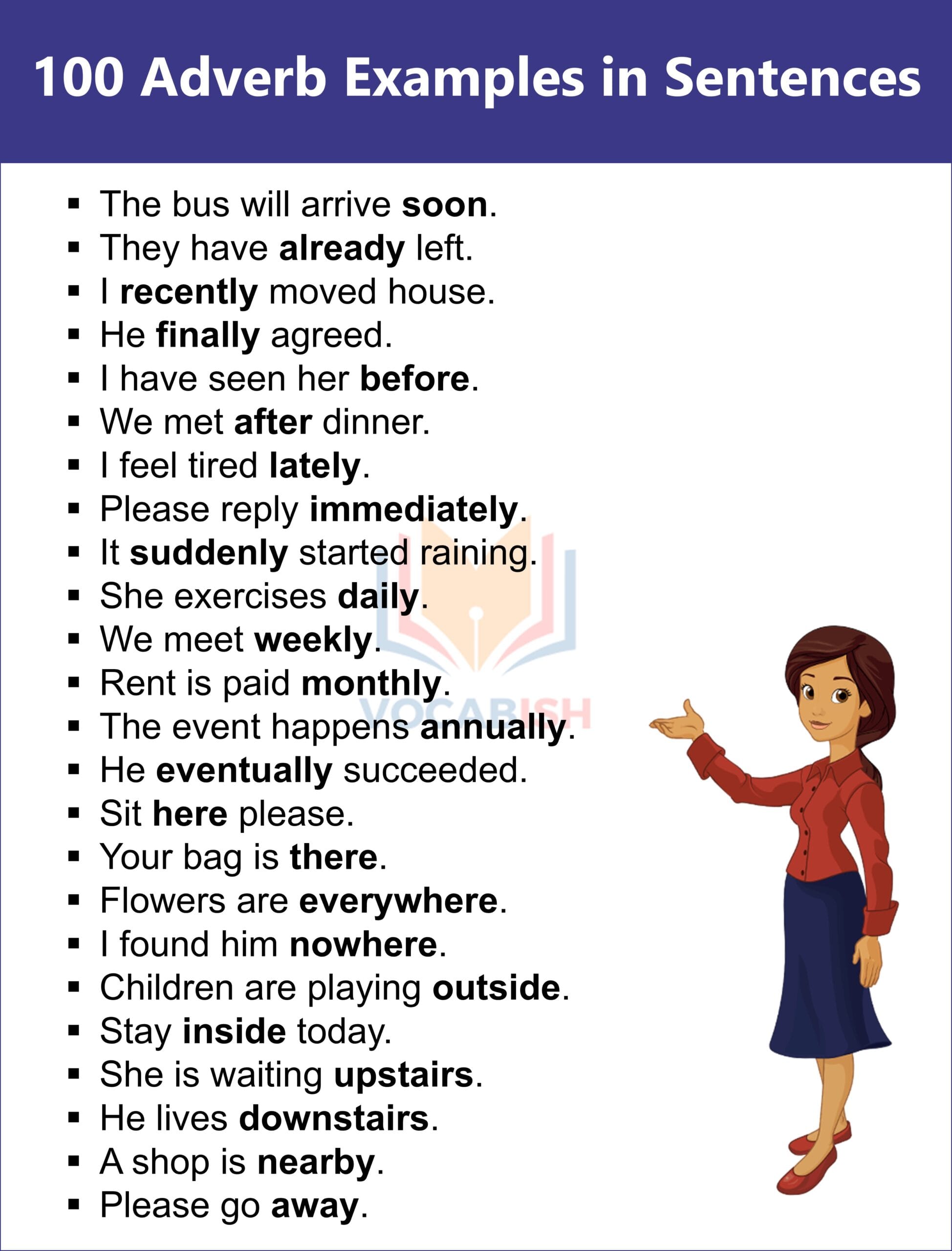
Adverbs of Time Examples in Sentences
They tell when something happens.
Examples:
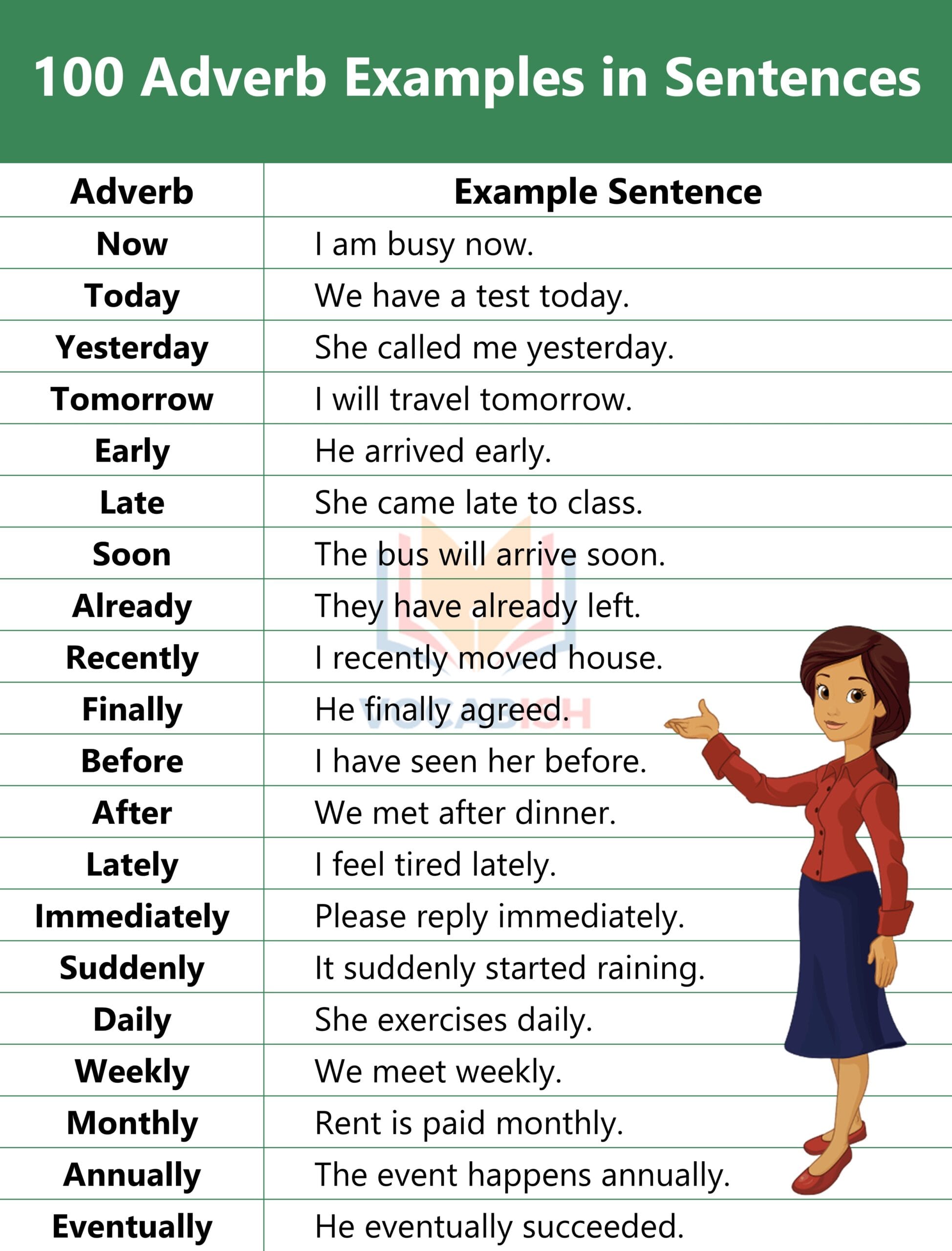
| No. | Adverb | Example Sentence |
|---|---|---|
| 21 | now | I am busy now. |
| 22 | today | We have a test today. |
| 23 | yesterday | She called me yesterday. |
| 24 | tomorrow | I will travel tomorrow. |
| 25 | early | He arrived early. |
| 26 | late | She came late to class. |
| 27 | soon | The bus will arrive soon. |
| 28 | already | They have already left. |
| 29 | recently | I recently moved house. |
| 30 | finally | He finally agreed. |
| 31 | before | I have seen her before. |
| 32 | after | We met after dinner. |
| 33 | lately | I feel tired lately. |
| 34 | immediately | Please reply immediately. |
| 35 | suddenly | It suddenly started raining. |
| 36 | daily | She exercises daily. |
| 37 | weekly | We meet weekly. |
| 38 | monthly | Rent is paid monthly. |
| 39 | annually | The event happens annually. |
| 40 | eventually | He eventually succeeded. |
Adverbs of Place Examples in Sentences
They tell where something happens.
Examples:
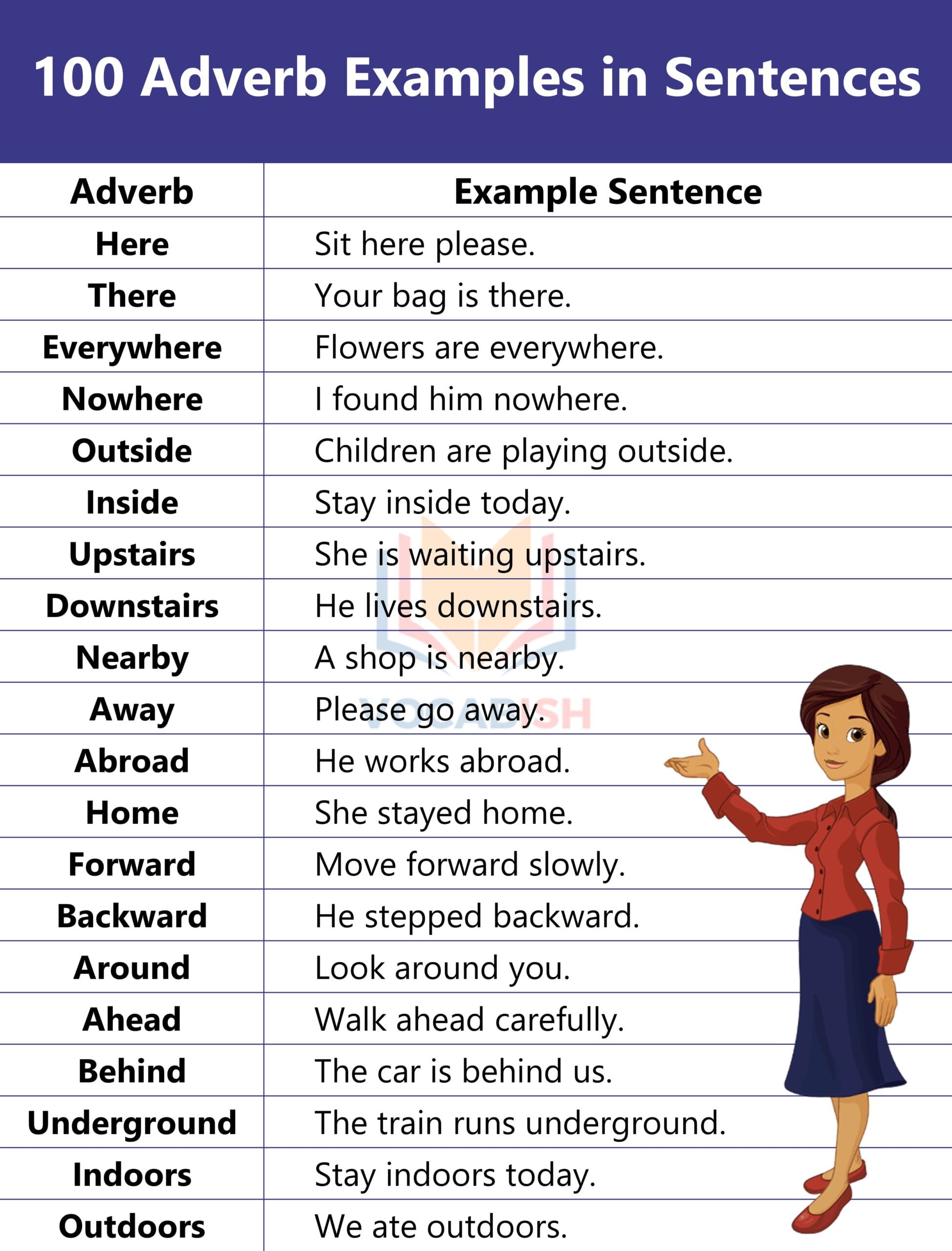
| No. | Adverb | Example Sentence |
|---|---|---|
| 41 | here | Sit here please. |
| 42 | there | Your bag is there. |
| 43 | everywhere | Flowers are everywhere. |
| 44 | nowhere | I found him nowhere. |
| 45 | outside | Children are playing outside. |
| 46 | inside | Stay inside today. |
| 47 | upstairs | She is waiting upstairs. |
| 48 | downstairs | He lives downstairs. |
| 49 | nearby | A shop is nearby. |
| 50 | away | Please go away. |
| 51 | abroad | He works abroad. |
| 52 | home | She stayed home. |
| 53 | forward | Move forward slowly. |
| 54 | backward | He stepped backward. |
| 55 | around | Look around you. |
| 56 | ahead | Walk ahead carefully. |
| 57 | behind | The car is behind us. |
| 58 | underground | The train runs underground. |
| 59 | indoors | Stay indoors today. |
| 60 | outdoors | We ate outdoors. |
Adverbs of Frequency Examples in Sentences
They tell how often something happens.
Examples:
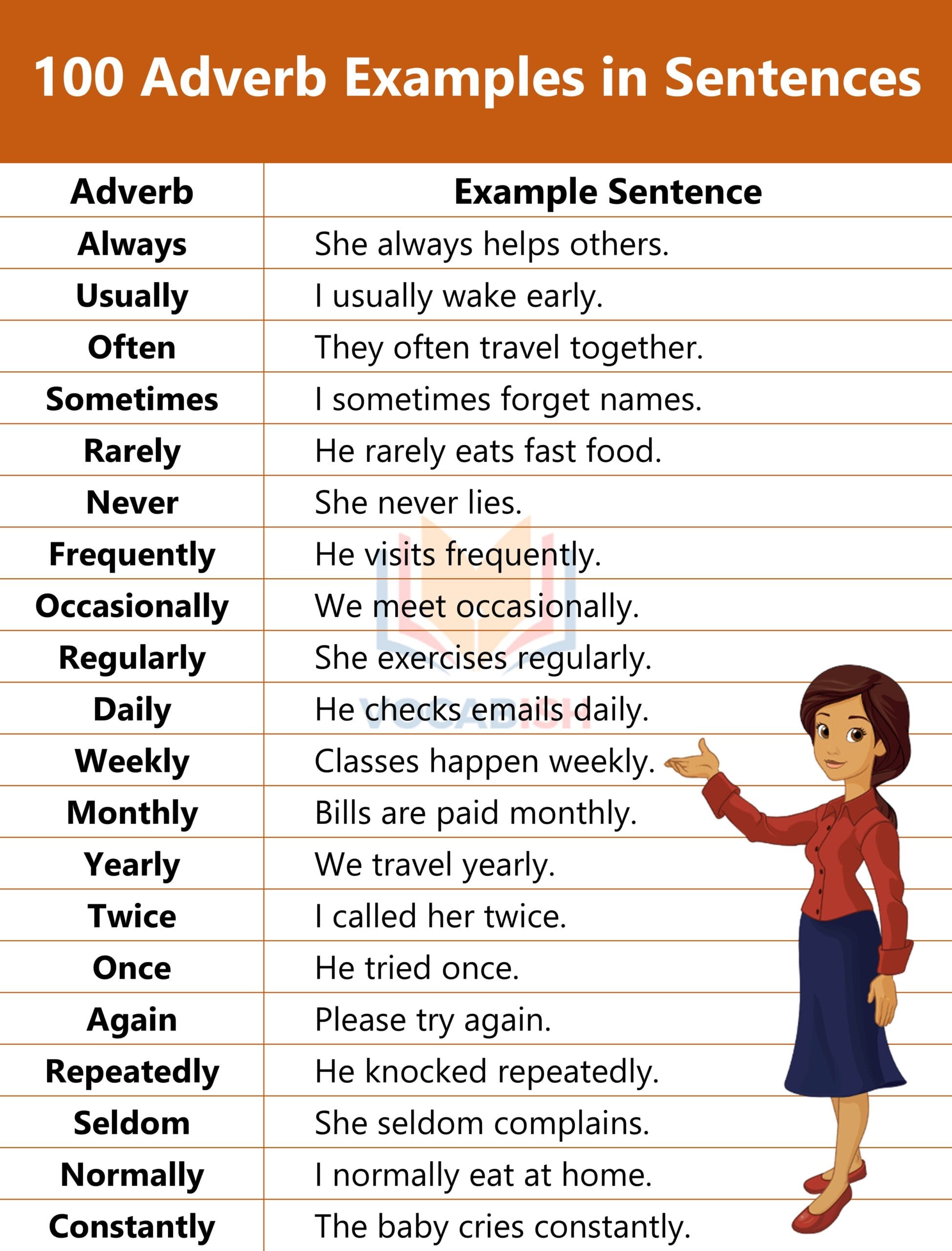
| No. | Adverb | Example Sentence |
|---|---|---|
| 61 | always | She always helps others. |
| 62 | usually | I usually wake early. |
| 63 | often | They often travel together. |
| 64 | sometimes | I sometimes forget names. |
| 65 | rarely | He rarely eats fast food. |
| 66 | never | She never lies. |
| 67 | frequently | He visits frequently. |
| 68 | occasionally | We meet occasionally. |
| 69 | regularly | She exercises regularly. |
| 70 | daily | He checks emails daily. |
| 71 | weekly | Classes happen weekly. |
| 72 | monthly | Bills are paid monthly. |
| 73 | yearly | We travel yearly. |
| 74 | twice | I called her twice. |
| 75 | once | He tried once. |
| 76 | again | Please try again. |
| 77 | repeatedly | He knocked repeatedly. |
| 78 | seldom | She seldom complains. |
| 79 | normally | I normally eat at home. |
| 80 | constantly | The baby cries constantly. |
Adverbs of Degree Examples in Sentences
They tell how much or to what extent.
Examples:
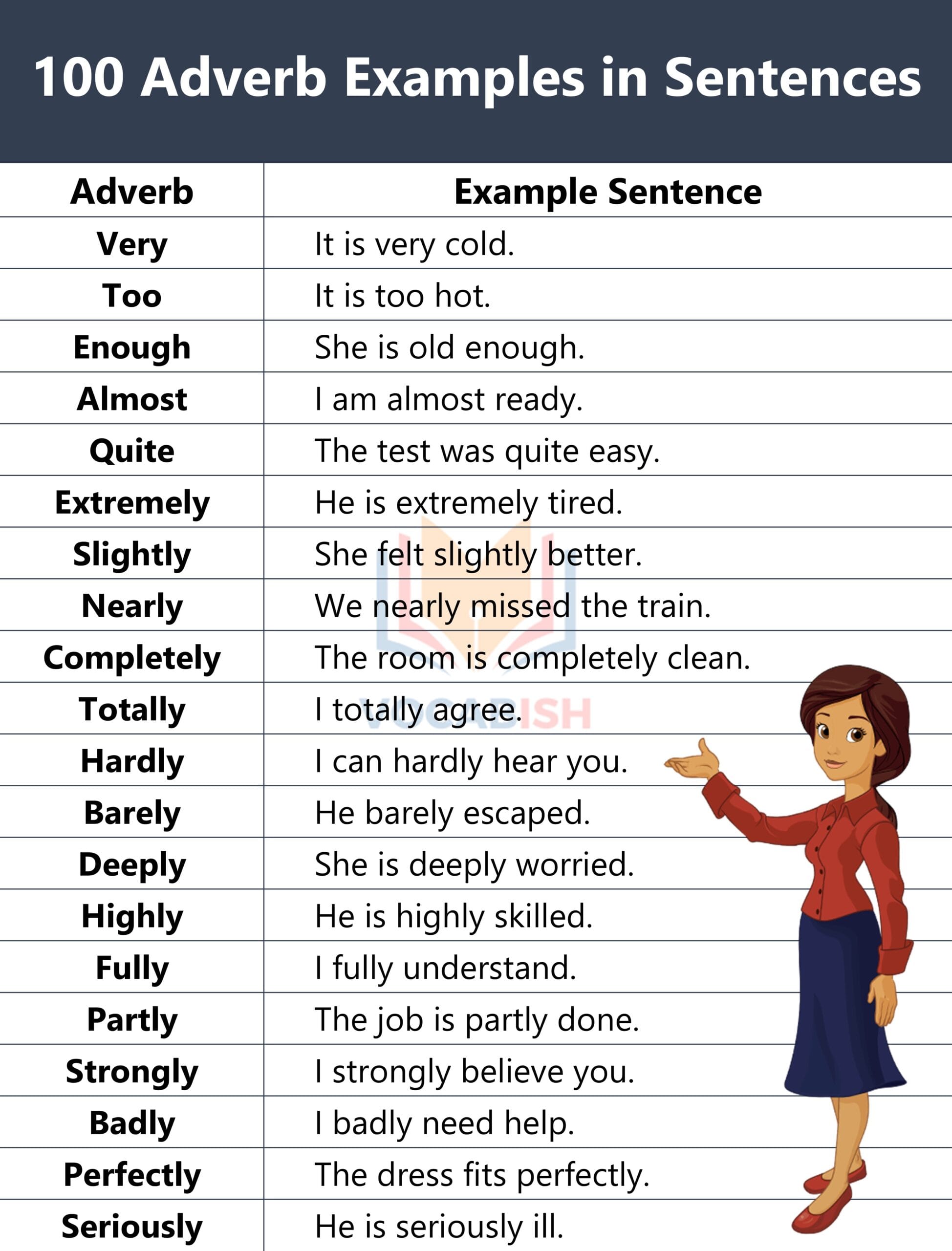
| No. | Adverb | Example Sentence |
|---|---|---|
| 81 | very | It is very cold. |
| 82 | too | It is too hot. |
| 83 | enough | She is old enough. |
| 84 | almost | I am almost ready. |
| 85 | quite | The test was quite easy. |
| 86 | extremely | He is extremely tired. |
| 87 | slightly | She felt slightly better. |
| 88 | nearly | We nearly missed the train. |
| 89 | completely | The room is completely clean. |
| 90 | totally | I totally agree. |
| 91 | hardly | I can hardly hear you. |
| 92 | barely | He barely escaped. |
| 93 | deeply | She is deeply worried. |
| 94 | highly | He is highly skilled. |
| 95 | fully | I fully understand. |
| 96 | partly | The job is partly done. |
| 97 | strongly | I strongly believe you. |
| 98 | badly | I badly need help. |
| 99 | perfectly | The dress fits perfectly. |
| 100 | seriously | He is seriously ill. |
How Adverbs Are Used in Different Contexts
Adverbs are used in:
Speaking – to sound natural
Example: She speaks clearly.
Writing – to add detail
Example: He carefully planned the trip.
Daily conversation – to explain actions
Example: I usually wake early.
Learning Tips
- Learn adverbs with sentences
- Practise daily speaking
- Read short texts
- Use adverbs in simple writing
100 Adverb Examples PDF:
100 Adverb Examples in Sentences
Summary
This guide covered 100 adverb examples in sentences using easy wording and clear categories. Adverbs help you speak and write better English by adding meaning and detail. Learn them step by step, practise often, and you will see fast improvement in your language skills.
Frequently Asked Questions
What is an adverb in a sentence?
An adverb is a word that gives more information about a verb, adjective, or another adverb. It explains how, when, where, or how often something happens. Example: She speaks clearly in class.
How do adverbs improve sentences?
Adverbs make sentences more clear and meaningful by adding extra detail. Example: He finished the work quickly, which shows how the action was done.
Can an adverb appear anywhere in a sentence?
Yes, an adverb can appear at the beginning, middle, or end of a sentence, depending on meaning. Example: Yesterday, they arrived early for the meeting.
What are common adverb examples used in daily English?
Common adverbs include always, usually, slowly, very, and here. Example: I usually wake up early on weekdays.
How do adverbs of frequency work in sentences?
Adverbs of frequency show how often something happens. They usually come before the main verb. Example: She often reads books at night.
Do all adverbs end in -ly?
No, not all adverbs end in -ly. Some common adverbs are fast, well, now, and very. Example: He runs fast during practice.
How can learners practise adverb examples in sentences?
Learners can practise by making short sentences using common adverbs. Example: She answered the question politely during the discussion.
Read More