
Many English learners get confused between assumed and presumed, because both words are about thinking something is true. However, they are used in slightly different ways. In this blog post, you will learn the difference between assumed vs presumed, with examples that show how each word is correctly used. Understanding this difference will help you speak and write more accurately, improve your reading comprehension, and make your English more confident and precise.
Meanings of Assumed and Presumed
Assumed
The word assumed comes from the verb assume, which means to accept something as true without checking all the facts.
You assume something when you guess or believe it based on what seems likely — but you don’t have solid proof.
Examples:
- I assumed he was coming to the party.
- She assumed the shop was open on Sunday.
- They assumed it would rain because the sky was dark.
Presumed
The word presumed comes from presume, which means to believe something is true because it’s likely or reasonable.
It is stronger than “assume” because it is often based on logic, experience, or evidence.
Examples:
- The police presumed he was missing.
- She is presumed innocent until proven guilty.
- We presumed the train would be late due to the weather.
Use of Assumed
We use assumed when we guess something without clear proof.
For example:
- I assumed he was busy because he didn’t reply.
- She assumed the shop was closed.
Use of Presumed
We use presumed when we believe something is true with some reason or evidence.
For example:
- The police presumed he was lost.
- I presumed you had already eaten dinner.
Difference Between Assumed and Presumed
| Point | Assumed | Presumed |
|---|---|---|
| Meaning | To believe something without checking the facts. | To believe something based on some evidence or reason. |
| Level of Certainty | Low – just a guess. | High – based on logic or likelihood. |
| Used When | You make a guess. | You have some reason or proof. |
| Example | I assumed she was tired. | I presumed she was tired because she didn’t sleep last night. |
Assumed and Presumed in Sentences
- I assumed he understood my message.
- The teacher presumed the students had done their homework.
- She assumed the box was empty.
- The judge presumed the man was innocent.
- I assumed it would be easy, but it wasn’t.
- They presumed we knew the rules already.
Trick to Remember
- Use assume when you guess without proof.
- Use presume when you believe with some reason or evidence.
Think like this:
- Assume = Guess
- Presume = Logical belief
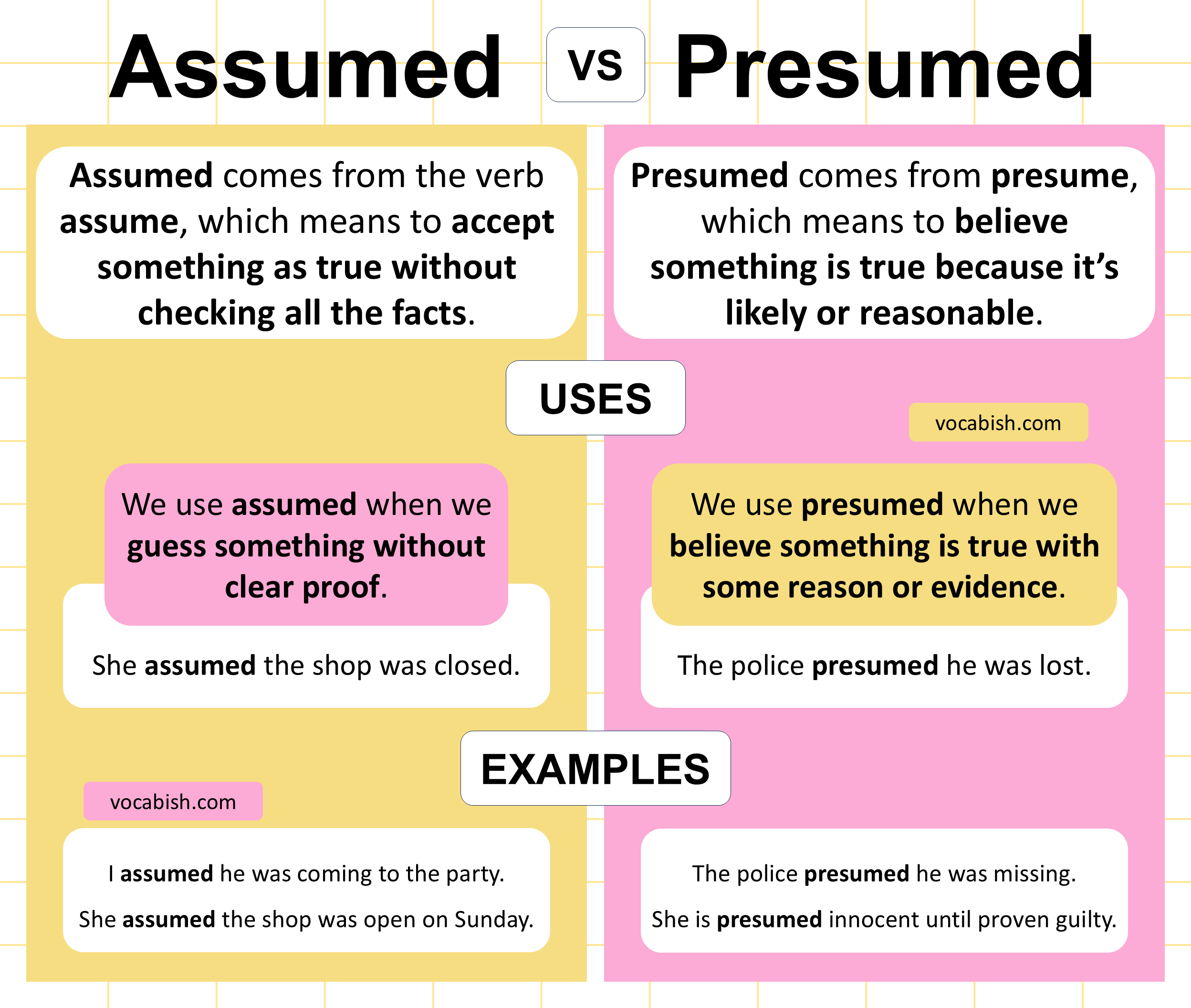
Both assumed and presumed mean believing something without full proof, but they are not the same. Use assumed for guesses and presumed for logical beliefs or reasonable conclusions.
FAQs
What is the main difference between assumed and presumed?
Assumed means to believe something without proof, while presumed means to believe something based on logic or evidence.
Can I use assumed and presumed interchangeably?
Not always. Assumed is used for guesses without facts, while presumed is used when there is some reason or likelihood behind the belief.
What does it mean when someone says “I assumed”?
It means the person guessed or believed something without confirming if it was actually true.
What is an example of presumed in a sentence?
Example: The man is presumed innocent until proven guilty. This means it’s believed true until evidence shows otherwise.
How can I easily remember the difference between assume and presume?
Think of it this way: Assume = Guess, Presume = Logical belief. Use assume when unsure and presume when you have a reason.
Read More