Skip to content
  • Home
  • Privacy Policy
  • About Us
  • Contact Us
Vocabish Logo

Vocabish

Learn English as a Second Language

  • Home
  • Basic English Learning
  • Vocabulary
    • Adjectives
    • Synonyms
    • Antonyms
    • Confusing Words
  • Sentences
    • Examples
  • Privacy Policy
  • Contact Us
  • Toggle search form
Can vs May – Learn the Difference with Easy Examples

Can vs May – Learn the Difference with Easy Examples

Posted on June 24, 2025February 22, 2026 By Muhammad Matloob No Comments on Can vs May – Learn the Difference with Easy Examples

In this blog post, you will learn the difference between can and may. These two modal verbs are often used to talk about permission and ability, but they are not always used in the same way. Many English learners feel confused about when to use each word. When you understand the difference, you can speak more politely, write more accurately, and read with better meaning. You will also improve your listening skills because you will notice how native speakers use them in daily conversations. Keep reading to master the correct use of can and may with easy examples.

Table of Contents

Toggle
  • What is Can?
    • Can for Ability
    • Can for Permission (Informal)
    • Can for Possibility
  • What is May?
    • May for Permission (Formal/Polite)
    • May for Possibility (Less Sure)
  • Differences Between Can and May
  • Example Sentences of Can and May

What is Can?

Can is used to talk about:

  • Ability
  • Permission (informal)
  • Possibility

Can for Ability

We use can when someone is able to do something.

Examples:

  • I can swim.
  • She can speak English.
  • They can drive a car.

Can for Permission (Informal)

We use can to ask or give permission in casual or friendly situations.

Examples:

  • Can I go now?
  • You can play outside.
  • Can we sit here?

Can for Possibility

We use can to show that something is possible.

Examples:

  • It can rain today.
  • This road can be dangerous.
  • He can be late sometimes.

What is May?

May is used to talk about:

  • Formal Permission
  • Possibility (less certain)

May for Permission (Formal/Polite)

May is more polite and formal than can. We use it when we ask permission in respectful or professional ways.

Examples:

  • May I come in?
  • May I ask a question?
  • You may leave early today.

May for Possibility (Less Sure)

We use may to show that something is possible, but not certain.

Examples:

  • It may rain later.
  • She may visit us tomorrow.
  • He may be at the office now.
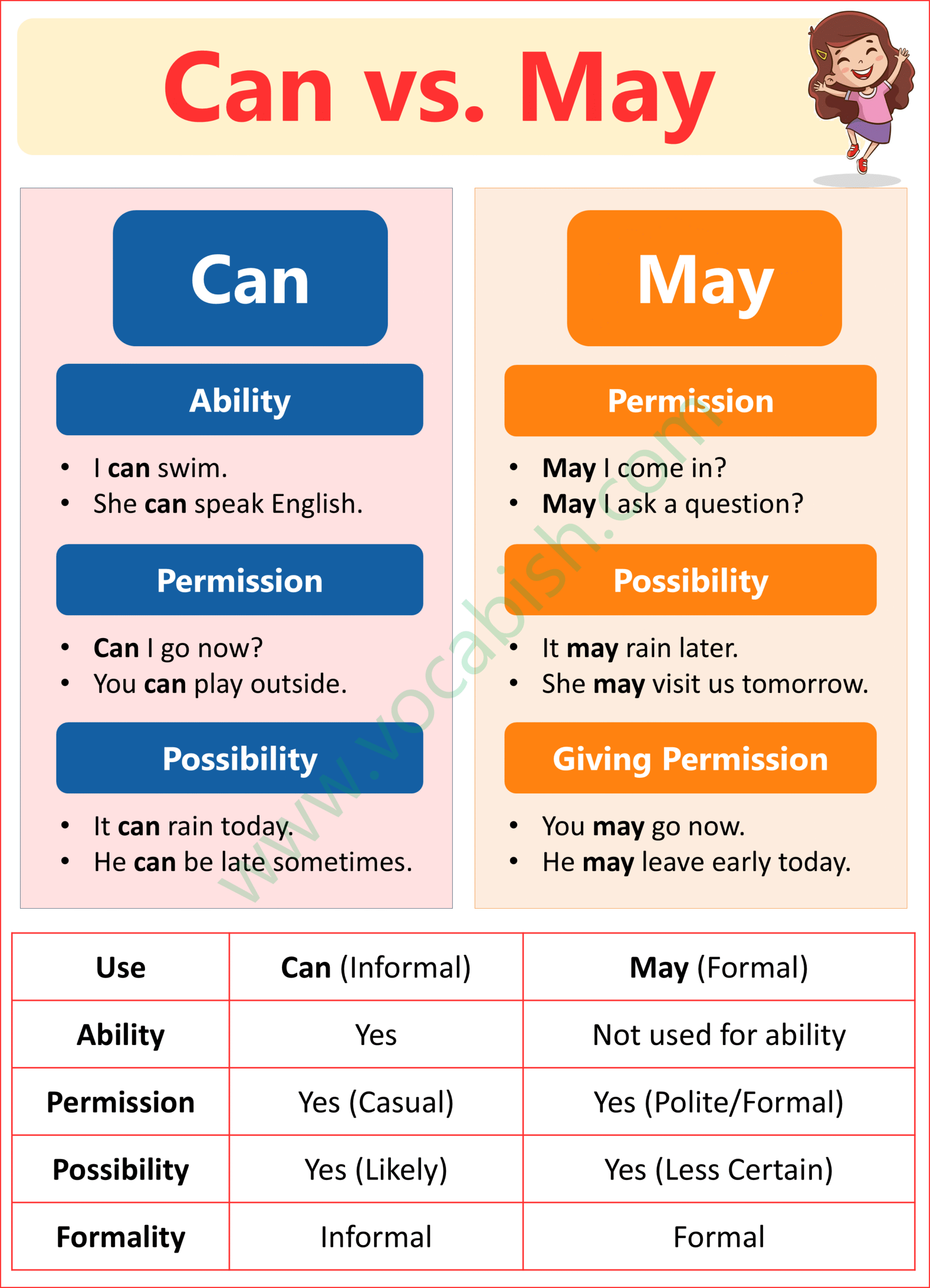
Can vs May – Learn the Difference with Easy Examples
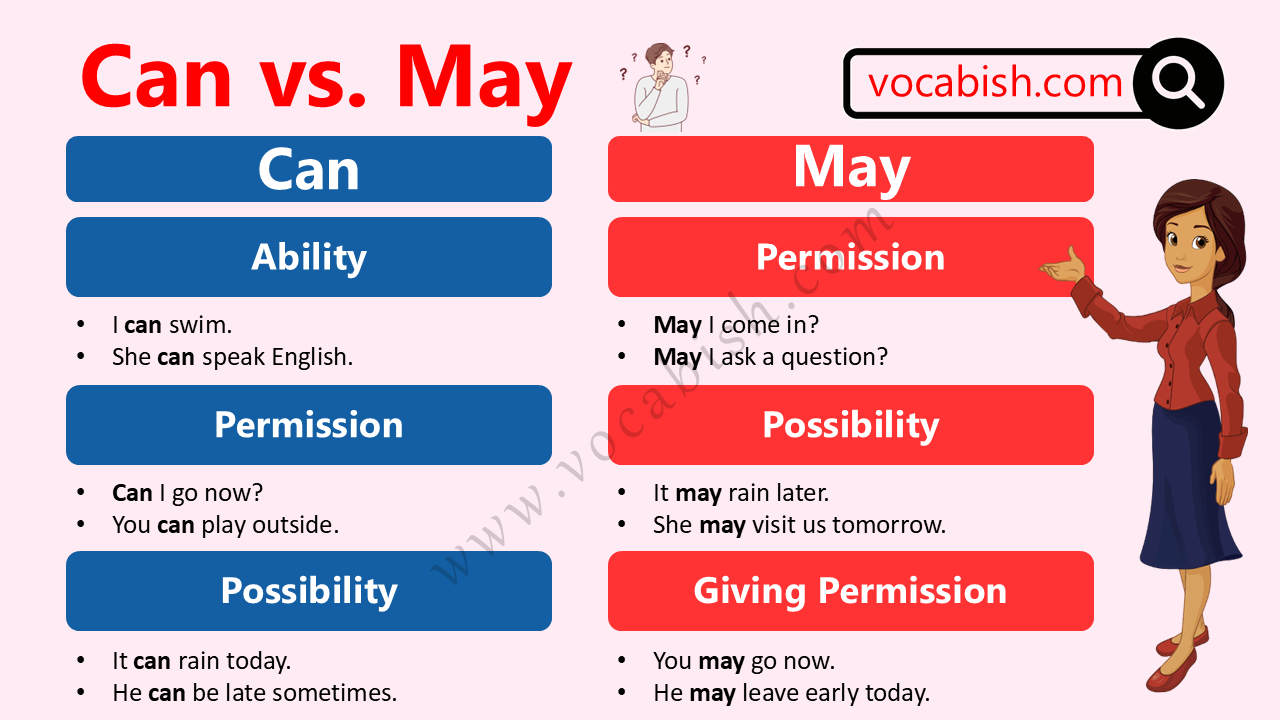
Can vs May

Differences Between Can and May

Use Can (Informal) May (Formal)
Ability Yes Not used for ability
Permission Yes (Casual) Yes (Polite/Formal)
Possibility Yes (Likely) Yes (Less Certain)
Formality Informal Formal

Example Sentences of Can and May

Can Examples May Examples
I can run fast. May I open the window?
Can I use your phone? She may come today.
You can sit here. May I borrow your pen?
It can be cold at night. It may snow this weekend.
Tips to Remember
  1. Use can when talking with friends or family.
  2. Use may in formal settings like school or office.
  3. Use can to talk about what someone is able to do.
  4. Use may when you are not 100% sure something will happen.
Read More
  • Cleft Sentences in English
  • Irregular Subjunctive Verbs​
  • Modal Verbs Definition and Examples
Confusing Words

Post navigation

Previous Post: 35+ Other Ways to Say Good Luck in English
Next Post: 10 Lines About A Day at the Park

Leave a Reply Cancel reply

Your email address will not be published. Required fields are marked *

  • Facebook
  • Pinterest

Recent Comments

  • Adeel on How to Introduce Yourself in English for Beginners
  • OmarFaruk on 200+ Action Verbs List in English with Pictures
  • Alfred Kolekou on All Types of Jobs, Professions, Careers, and Occupations
  • Batu Dube Ukke on 10 Lines About A Day at the Park
  • Batu Dube Ukke on 10 Lines About A Day at the Park

Recent Posts

  • 500+ English Vocabulary Words with Meanings and PDF
  • Hospital English Conversation Phrases and Vocabulary
  • Japanese Emoji Meanings with English and Symbols
  • Chinese Emoji Meanings with English and Symbols
  • Instagram Emoji Meanings in English with Chart

Most Popular Articles

  • Face Emoji Meanings — The Hidden Meanings Behind Emojis (5,145)
  • Unique Irregular Verbs List in English with Examples (4,323)
  • 500 Daily Used Normal vs Advanced English Words (4,262)
  • Heart Emoji Meanings : What Each Colour Heart Means (3,752)
  • Emoji Meanings: Complete List of Emojis and Their Meanings (3,697)
  • Clothes and Fashion Vocabulary in English (2,602)
  • 200+ Action Verbs List in English with Pictures (2,380)
  • 50 Basic Adjectives to Describe People in English (2,256)
  • 100 A to Z Difficult Words with Synonyms in English (1,611)

Our Topics

  • 12 Tenses (3)
  • Adjectives (44)
  • Antonyms (11)
  • Basic English Learning (5)
  • Confusing Words (35)
  • Examples (29)
  • Figure of Speech (4)
  • Other Ways to Say (11)
  • Sentences (19)
  • Synonyms (37)
  • Vocabulary (145)
  • Worksheets (7)
  • Writing (14)

Copyright © 2026 Vocabish.

Powered by PressBook WordPress theme