

In this blog post, you will learn about irregular subjunctive verbs in English, with examples to help you understand how to use them correctly. Knowing these verbs can improve your speaking, reading, writing, and listening skills. By exploring verbs like be, have, and go, you expand your vocabulary and gain confidence in forming sentences that express wishes, suggestions, or hypothetical situations in English. Let’s master these irregular subjunctive verbs and use them with confidence.
What are Irregular Subjunctive Verbs?
The subjunctive mood in English is used to express something imagined, wished, or suggested — not something real.
Example: If I were you, I would study harder.
Here, the verb “were” is an irregular subjunctive verb because we use “were” instead of “was” for all subjects (I, he, she, it).
Irregular subjunctive verbs don’t follow the normal verb rules. Instead, they change form in special cases like wishes or formal suggestions.
Main Use of Subjunctive Mood
We use the subjunctive when:
- Talking about wishes or unreal situations
- Giving advice, suggestions, or demands
- Expressing importance or necessity
Let’s understand with examples:
- I wish it were sunny today.
- The teacher suggested that he study more.
- It’s important that she be on time.
Structure of Subjunctive Sentences
Type | Structure | Example |
|---|---|---|
Wish / Unreal Situation | If + subject + were / had | If I were you, I’d apologise. |
Suggestion / Demand | Verb + that + subject + base verb | She suggested that he go home. |
Importance / Necessity | It’s + adjective + that + subject + base verb | It’s vital that she be here. |
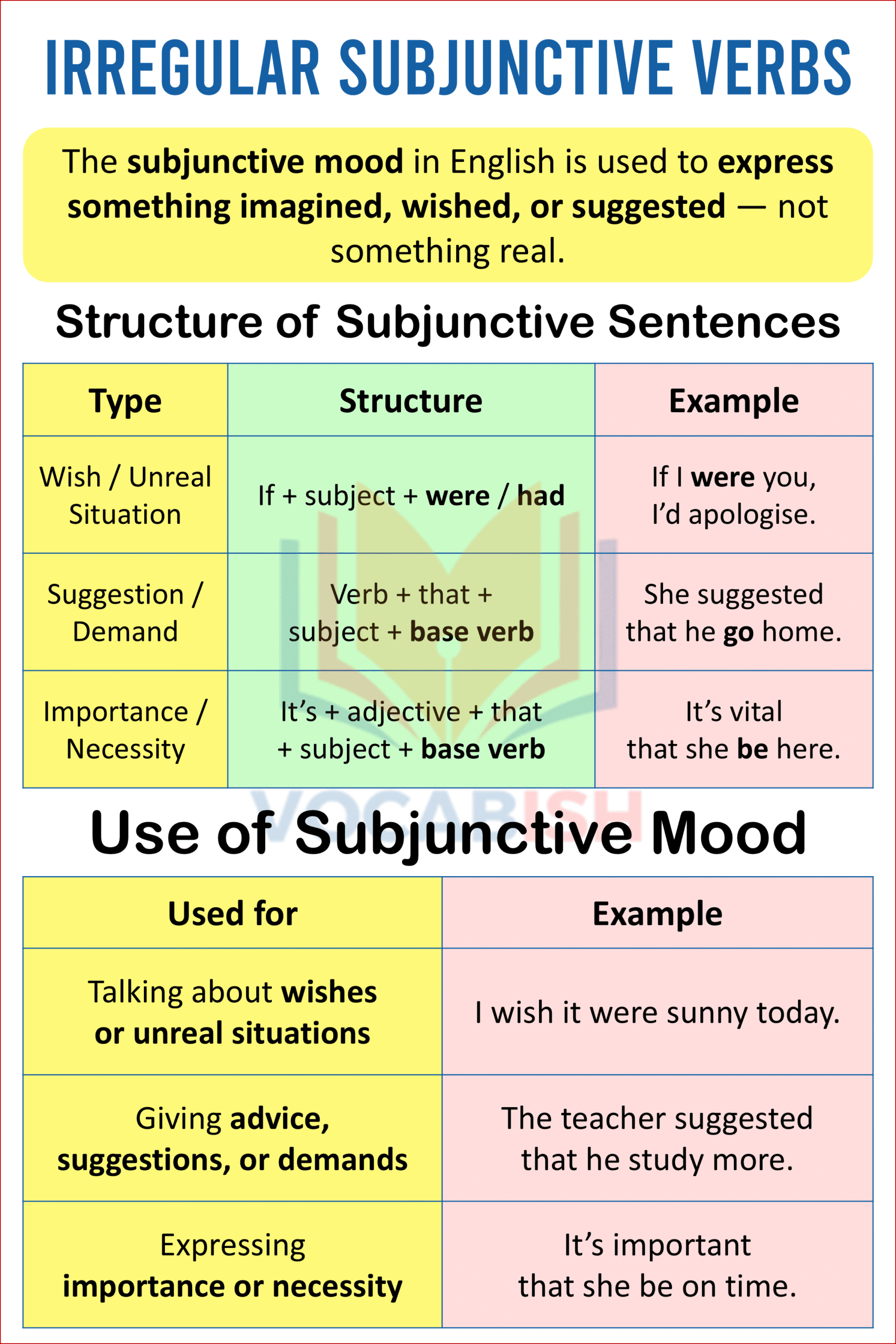
Irregular Subjunctive Verbs Structure with Examples
Common Irregular Subjunctive Verbs
Base Verb | Subjunctive Form | Example Sentence |
|---|---|---|
be | be / were | If I were rich, I’d travel the world. |
have | have | I wish I had more free time. |
go | go | It’s necessary that he go now. |
do | do | They requested that she do her best. |
see | see | I wish I saw my old friends again. |
Irregular Subjunctive Verbs in English with Examples
Base Verb | Subjunctive Form | Example Sentence |
|---|---|---|
be | be / were | If I were taller, I’d play basketball. |
have | have / had | I wish I had more time. |
do | do / did | The teacher insisted that she do her work. |
go | go / went | It’s important that he go home early. |
see | see / saw | I wish I saw my old friends. |
come | come / came | It’s necessary that he come to class. |
get | get / got | If I got a chance, I’d help. |
know | know / knew | I wish I knew the answer. |
make | make / made | If he made an effort, he’d succeed. |
take | take / took | I wish I took that opportunity. |
say | say / said | I wish he said something sooner. |
think | think / thought | I wish I thought before speaking. |
meet | meet / met | I wish I met her earlier. |
win | win / won | If I won the lottery, I’d travel. |
write | write / wrote | The boss demanded that he write the report. |
bring | bring / brought | If she brought her book, she could study. |
eat | eat / ate | I wish I ate healthier food. |
give | give / gave | It’s vital that he give an honest answer. |
speak | speak / spoke | If I spoke French, I’d visit Paris. |
find | find / found | If I found my keys, I could leave now. |
sit | sit / sat | It’s necessary that he sit quietly. |
begin | begin / began | I wish I began earlier. |
drive | drive / drove | If he drove carefully, he’d be safe. |
fall | fall / fell | I wish I fell asleep faster. |
feel | feel / felt | I wish I felt better today. |
forget | forget / forgot | I wish I forgot that mistake. |
hear | hear / heard | It’s important that you hear the news. |
keep | keep / kept | I wish I kept my promise. |
leave | leave / left | If he left earlier, he’d arrive on time. |
lose | lose / lost | I wish I lost some weight. |
pay | pay / paid | It’s important that everyone pay attention. |
run | run / ran | If I ran faster, I’d win. |
send | send / sent | It’s essential that she send the letter today. |
show | show / showed | If he showed respect, people would like him. |
sing | sing / sang | I wish I sang better. |
sleep | sleep / slept | I wish I slept longer last night. |
stand | stand / stood | It’s necessary that he stand up straight. |
teach | teach / taught | I wish I taught English abroad. |
tell | tell / told | It’s vital that she tell the truth. |
wear | wear / wore | If I wore that dress, I’d look elegant. |
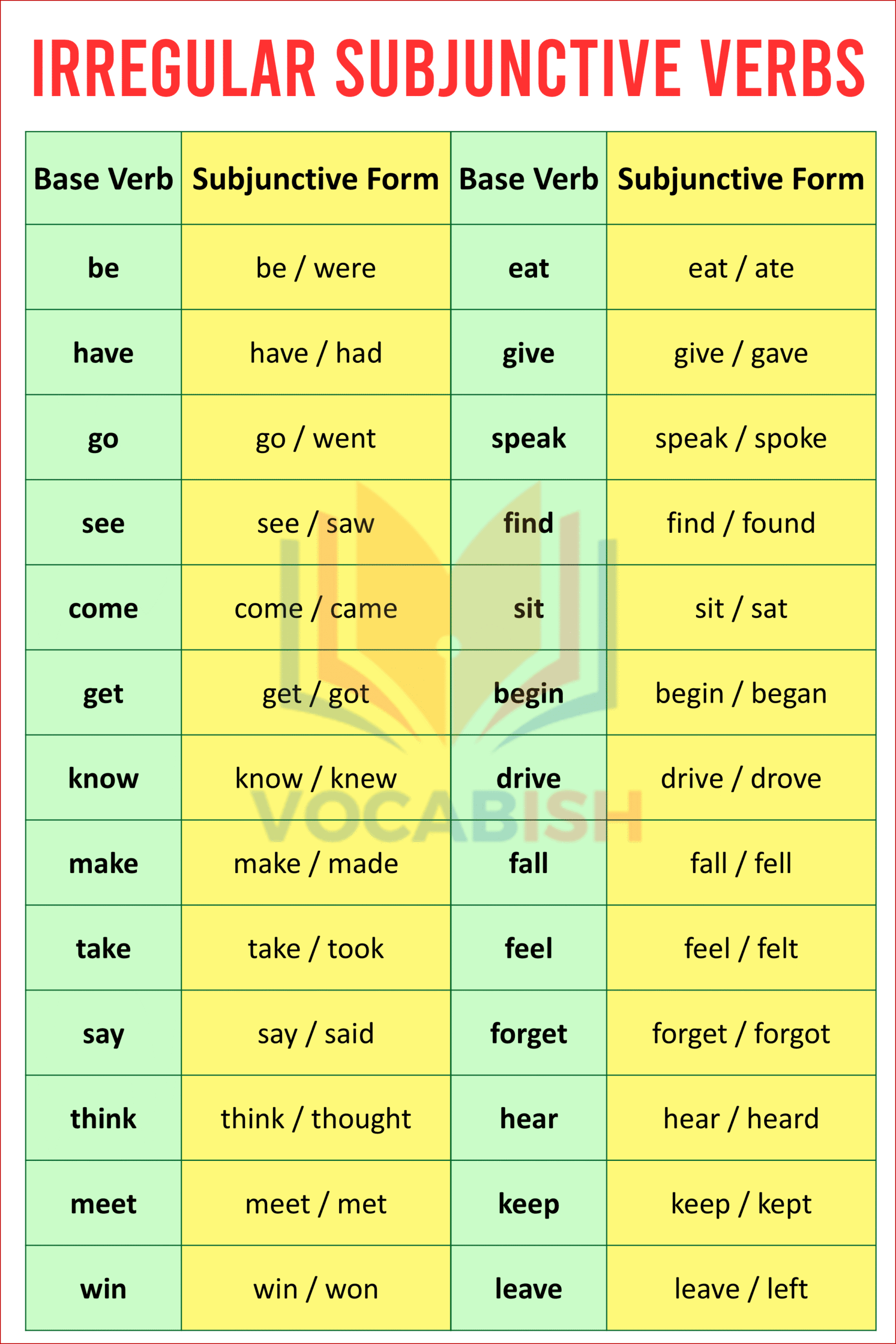
Irregular Subjunctive Verbs Examples in English
Subjunctive Verbs in Different Contexts
1. Wishes or Unreal Situations
We use it to talk about something that is not real or possible.
- If I were taller, I could play basketball.
- I wish he were here now.
2. Formal Suggestions or Requests
Used after verbs like suggest, recommend, demand, or insist.
- The manager insisted that everyone be on time.
- I suggest that she study harder.
3. Expressions of Importance
Used after phrases like It’s important that… / It’s necessary that…
- It’s important that he finish the report.
- It’s essential that you be careful.
Tips to Remember
- Always use “were” (not was) in unreal or wish sentences.
If I were rich, I’d buy a big house. - Use the base form of the verb after that in formal suggestions.
I recommend that he study more. - Don’t add “-s” for third-person singular in subjunctive form.
FAQs
What is the most common irregular subjunctive verb?
The verb “be” is the most common irregular subjunctive verb (e.g., If I were you).
Why do we use “were” instead of “was” in subjunctive sentences?
Because “were” shows an imaginary or unreal situation.
How can I identify a subjunctive verb in a sentence?
Look for verbs after “that,” or in “if” and “wish” clauses showing something not real.
Do all verbs have subjunctive forms?
No, only some verbs like be, have, go, do, and see are commonly used in the subjunctive mood.
Is the subjunctive still used in modern English?
Yes, but mostly in formal writing or polite speech — not in everyday casual talk.
Read More