

Shopping is part of everyday life. People visit stores, markets, and online shops to buy food, clothes, and many other things. To communicate well in these places, learners need shopping vocabulary. These are the words people use when they talk about products, prices, payment, and store services. When learners learn these words, they can ask questions, understand store signs, and talk with shop staff more easily. Strong daily vocabulary also supports speaking, reading, writing, and listening skills in real situations.
What is Shopping Vocabulary?
Shopping vocabulary includes the words people use when buying or selling products. These words appear in places such as:
- supermarkets
- clothing stores
- markets
- shopping malls
- online shops
Examples include words like price, cashier, receipt, cart, and discount. These words help people ask questions, understand prices, and complete purchases.
Why Learning Shopping Vocabulary Is Important
Shopping vocabulary helps learners use English in real situations.
Here are some practical benefits:
- You can ask for items in a store.
- You can understand prices and offers.
- You can talk to store workers politely.
- You can shop in English-speaking countries easily.
In short, this vocabulary supports real-life communication.
Daily Life Vocabulary for Shopping
Below is a list of important shopping vocabulary words. These words are common in everyday shopping situations.
- Store – A place where people buy goods or products.
- Shop – Another word for a store where items are sold.
- Market – A place where many sellers offer food, fruits, vegetables, or other goods.
- Mall – A large building with many stores in one place.
- Cart – A large basket on wheels used in supermarkets.
- Basket – A small container used to carry items while shopping.
- Product – An item that a company makes and sells.
- Item – A single thing you buy in a shop.
- Brand – The name of a company that makes a product.
- Price – The amount of money needed to buy something.
- Discount – A lower price offered for a product.
- Sale – A special time when stores sell items at reduced prices.
- Cashier – The person who receives payment in a store.
- Receipt – A paper that shows what you bought and how much you paid.
- Bag – A container used to carry purchased items.
- Customer – A person who buys goods from a store.
- Shelf – A flat surface where products are placed in a shop.
- Checkout – The place where customers pay for their items.
- Barcode – A printed code on products that stores scan at checkout.
- Label – A small tag that shows product information.
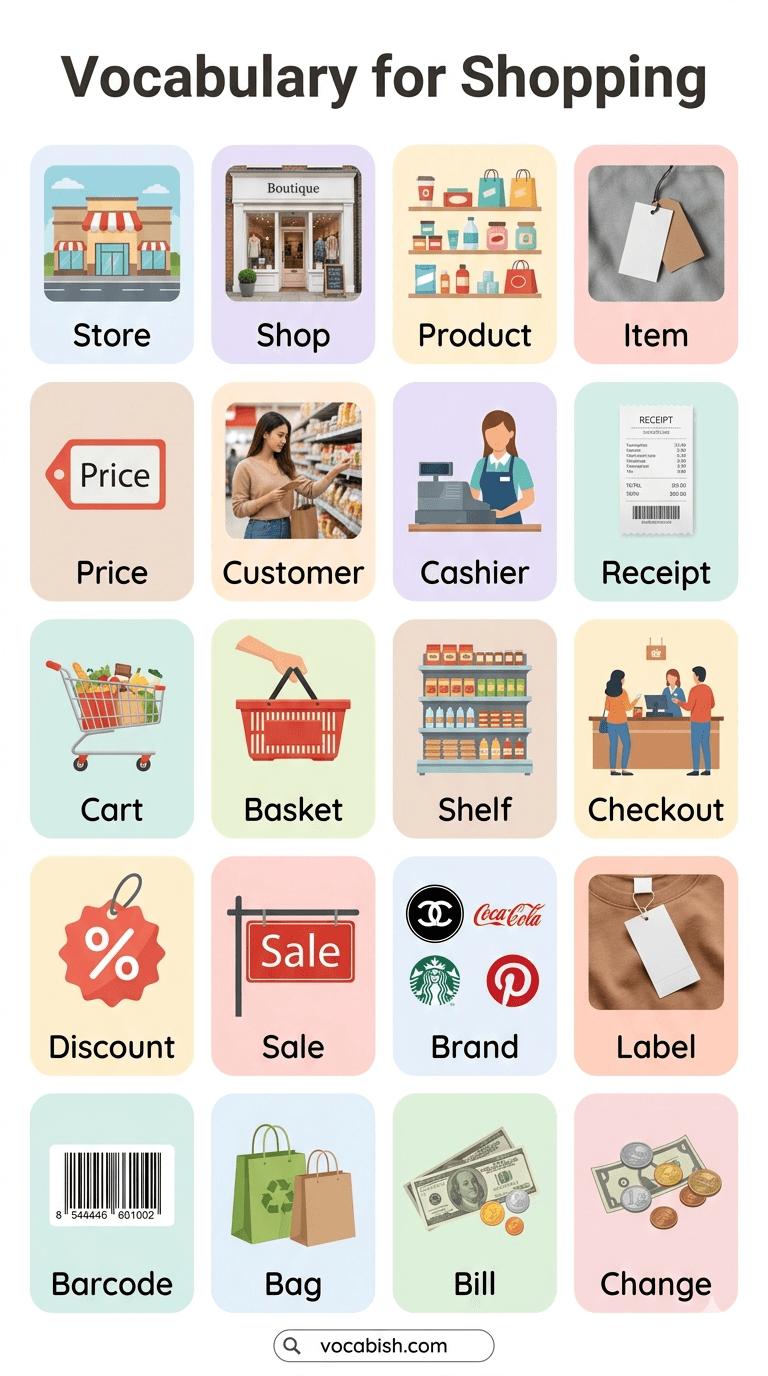
These words appear often in supermarkets, clothing shops, and retail stores.
Nouns for Shopping
Nouns are names of people, places, or things. In shopping, nouns often refer to items, places, or store workers.
- Store / Shop – A place where people buy products.
- Market – A place where many sellers offer goods.
- Mall – A large building with many stores inside.
- Product – An item that a company makes and sells.
- Item – A single thing you buy.
- Cart / Trolley – A large basket on wheels used in supermarkets.
- Basket – A small container for carrying items in a store.
- Shelf – A flat surface where products are placed.
- Cashier – The person who takes payment from customers.
- Customer – A person who buys something.
- Receipt – A paper that shows what you bought and how much you paid.
- Label – A tag that shows product information.
- Barcode – A code used to scan items at checkout.
- Checkout – The place where customers pay.
- Bag – A container used to carry purchased items.
These nouns appear frequently in supermarkets, clothing stores, and shopping centers.
Verbs and Collocations for Shopping
Verbs describe actions. Many verbs combine with other words to form collocations, which are natural word combinations in English.
Common Shopping Verbs
- Buy – To get something by paying money.
- Purchase – A more formal word for buy.
- Choose – To pick something from different options.
- Compare – To look at two or more items to see differences.
- Pay – To give money for a product.
- Order – To request a product, often online.
- Return – To take a product back to the store.
- Exchange – To replace one product with another.
- Browse – To look at products without buying immediately.
Common Shopping Collocations
- make a purchase
- pay the bill
- place an order
- compare prices
- add to cart
- check the price
Learning collocations helps learners sound more natural in English conversations.
Describing Products (Adjectives & Patterns)
Adjectives describe products. Customers often use them when comparing items.
Useful Product Adjectives
- Cheap – Low price
- Expensive – High price
- High-quality – Very good quality
- Durable – Strong and long-lasting
- New – Recently made
- Used – Not new; owned before
- Popular – Many people like it
- Lightweight – Not heavy
- Comfortable – Pleasant to use or wear
Common Description Patterns
English speakers often describe products using simple patterns:
- This product is very durable.
- These shoes are comfortable.
- This phone is expensive but high-quality.
These patterns help learners describe products clearly and simply.
Asking for Help
Customers often ask store workers for help. Simple and polite questions make communication easier.
- “Excuse me, where can I find this item?”
- “Do you have this in another size?”
- “Can you help me choose one?”
- “Is this product available?”
- “Do you have a cheaper option?”
These phrases are common in supermarkets, clothing stores, and electronics shops.
Sizes, Colours, and Variations for Shopping
Many products come in different sizes, colours, or versions.
Common Size Vocabulary
- Small (S)
- Medium (M)
- Large (L)
- Extra Large (XL)
Colour Vocabulary
- Red
- Blue
- Black
- White
- Green
- Yellow
- Gray
Variation Vocabulary
- Model – A specific version of a product.
- Style – A particular design.
- Version – A different form of the same product.
Example sentence:
- This shirt comes in three colors and two sizes.
Prices, Discounts, and Payment Vocabulary for Shopping
Understanding price vocabulary helps customers shop more easily.
- Price – The cost of a product.
- Discount – A reduced price.
- Sale – A time when items cost less than usual.
- Total – The final amount to pay.
- Tax – Extra money added to the price.
- Cash – Physical money.
- Credit card – A card used for payment.
- Debit card – A card linked to a bank account.
- Change – Money returned after payment.
Example:
- The total price is $25. Here is your change.
Online Shopping Vocabulary
Online shopping uses many special terms.
- Online store – A website where people buy products.
- Shopping cart – A list of items selected for purchase online.
- Add to cart – To place an item in the online cart.
- Checkout – The final step before payment.
- Shipping – The delivery of products.
- Delivery – The process of bringing the item to your home.
- Tracking number – A number used to track a package.
- Product review – Customer opinions about a product.
These words are common on e-commerce websites.
Returns, Exchanges, and Complaints
Sometimes customers need to return or exchange a product.
- Return – To take a product back to the store.
- Exchange – To replace it with another item.
- Refund – Money returned to the customer.
- Complaint – A statement about a problem with a product.
- Warranty – A guarantee that a product will work properly.
Example sentence:
- I would like to return this item because it is damaged.
Short Model Dialogues for Shopping
Short conversations help learners understand real shopping situations.
Dialogue 1: Asking for a Product
Customer: Excuse me, where can I find rice?
Staff: It is on aisle five.
Customer: Thank you.
Dialogue 2: Asking About Price
Customer: How much is this jacket?
Staff: It costs $40.
Customer: Is there a discount?
Dialogue 3: Paying at Checkout
Cashier: Your total is $18.
Customer: Here is my card.
Cashier: Thank you. Here is your receipt.
Types of Places Where People Shop
Understanding different types of shops also expands vocabulary.
- Supermarket – A large store that sells food and household items.
- Grocery store – A shop that mainly sells food.
- Clothing store – A shop that sells clothes.
- Bookstore – A place where books are sold.
- Pharmacy – A shop that sells medicine.
- Online store – A website where people buy products on the internet.
Useful Words for Prices and Payments
These words help learners understand payment and buying processes.
Important terms include:
- Cash – Physical money used for payment.
- Credit card – A card used to pay without cash.
- Debit card – A card that takes money directly from a bank account.
- Total – The final amount of money to pay.
- Change – Money returned after payment.
- Bill – A statement showing the amount to pay.
- Tax – Extra money added by the government to the price.
Tips to Remember Shopping Vocabulary Easily
Learning vocabulary becomes easier with regular practice.
Helpful methods include:
- Practice in real stores when possible.
- Read product labels and signs.
- Listen to conversations in supermarkets.
- Write vocabulary lists and review them often.
- Use the words in simple sentences.
Related Articles:
FAQs about Shopping Vocabulary
Shopping vocabulary in English includes common words and phrases used when buying or selling products, such as price, cashier, receipt, cart, and discount. These words help learners communicate clearly in stores and markets.
Common shopping words include product, item, price, discount, cashier, receipt, shelf, cart, customer, and checkout. These words appear often in supermarkets, clothing stores, and online shops.
Common shopping verbs include buy, purchase, compare, choose, pay, order, return, and exchange. These verbs describe actions people perform when selecting, buying, or returning products in stores.
Customers often say phrases like “How much is this?”, “Do you have this in another size?”, “Where can I find this item?”, and “Can I get a receipt?”
Online shopping vocabulary includes words used on e-commerce websites, such as add to cart, checkout, delivery, shipping, product review, and tracking number. These terms help users buy products online.
Conclusion
Shopping vocabulary is part of everyday English communication. Words such as price, receipt, cart, cashier, and discount appear in daily conversations and real-life situations.
By learning these practical terms, English learners can:
- understand stores and markets easily
- ask questions confidently
- complete purchases without confusion