
In this blog post, you will learn how to change sentences from direct to indirect speech using a helpful worksheet with a free PDF. These exercises help you understand how reported speech works in real English. Practicing this skill improves speaking, reading, writing, and listening. When you use speech correctly, you can share what others say in a natural way. Our aim is to help you master direct and indirect speech step by step. Keep reading and strengthen your English grammar skills today.
What are Direct and Indirect Speech?
Direct Speech shows the exact words spoken by someone. It uses quotation marks (” “) to show what a person said.
Indirect Speech (Reported Speech) tells what someone said without using their exact words. The quotation marks are removed, and tense, pronouns, and time expressions may change.
Examples
| Direct Speech | Indirect Speech |
|---|---|
| He said, “I am tired.” | He said that he was tired. |
| She said, “I like coffee.” | She said that she liked coffee. |
| They said, “We will come tomorrow.” | They said that they would come the next day. |
Direct and Indirect Speech Worksheet
Fill in the Blanks
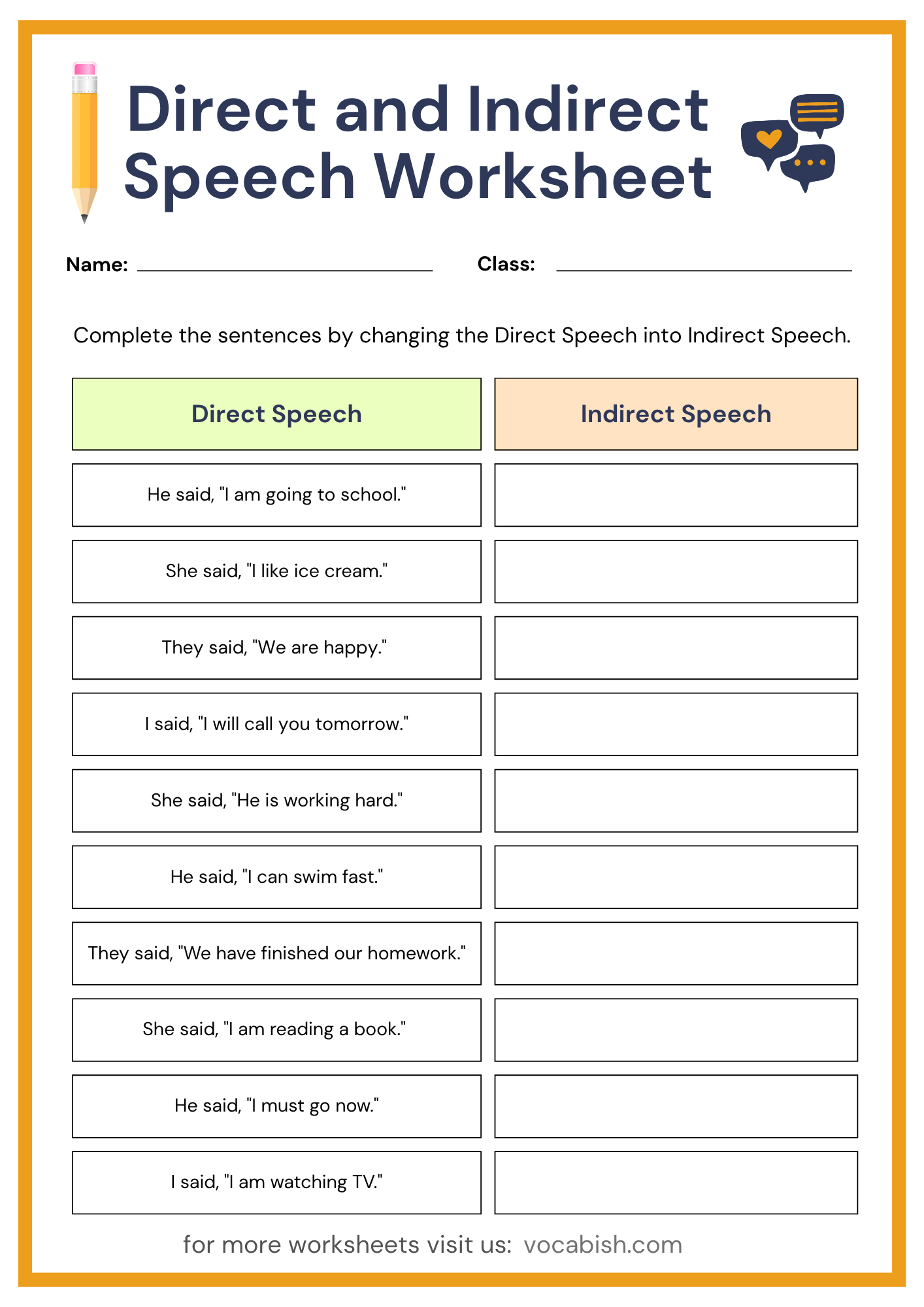
Complete the sentences by changing the Direct Speech into Indirect Speech.
- He said, “I am going to school.” → He said that he ______ going to school.
- She said, “I like ice cream.” → She said that she ______ ice cream.
- They said, “We are happy.” → They said that they ______ happy.
- I said, “I will call you tomorrow.” → I said that I ______ call you the next day.
- She said, “He is working hard.” → She said that he ______ working hard.
- He said, “I can swim fast.” → He said that he ______ swim fast.
- They said, “We have finished our homework.” → They said that they ______ finished their homework.
- She said, “I am reading a book.” → She said that she ______ reading a book.
- He said, “I must go now.” → He said that he ______ go then.
- I said, “I am watching TV.” → I said that I ______ watching TV.
Choose the Correct Answer
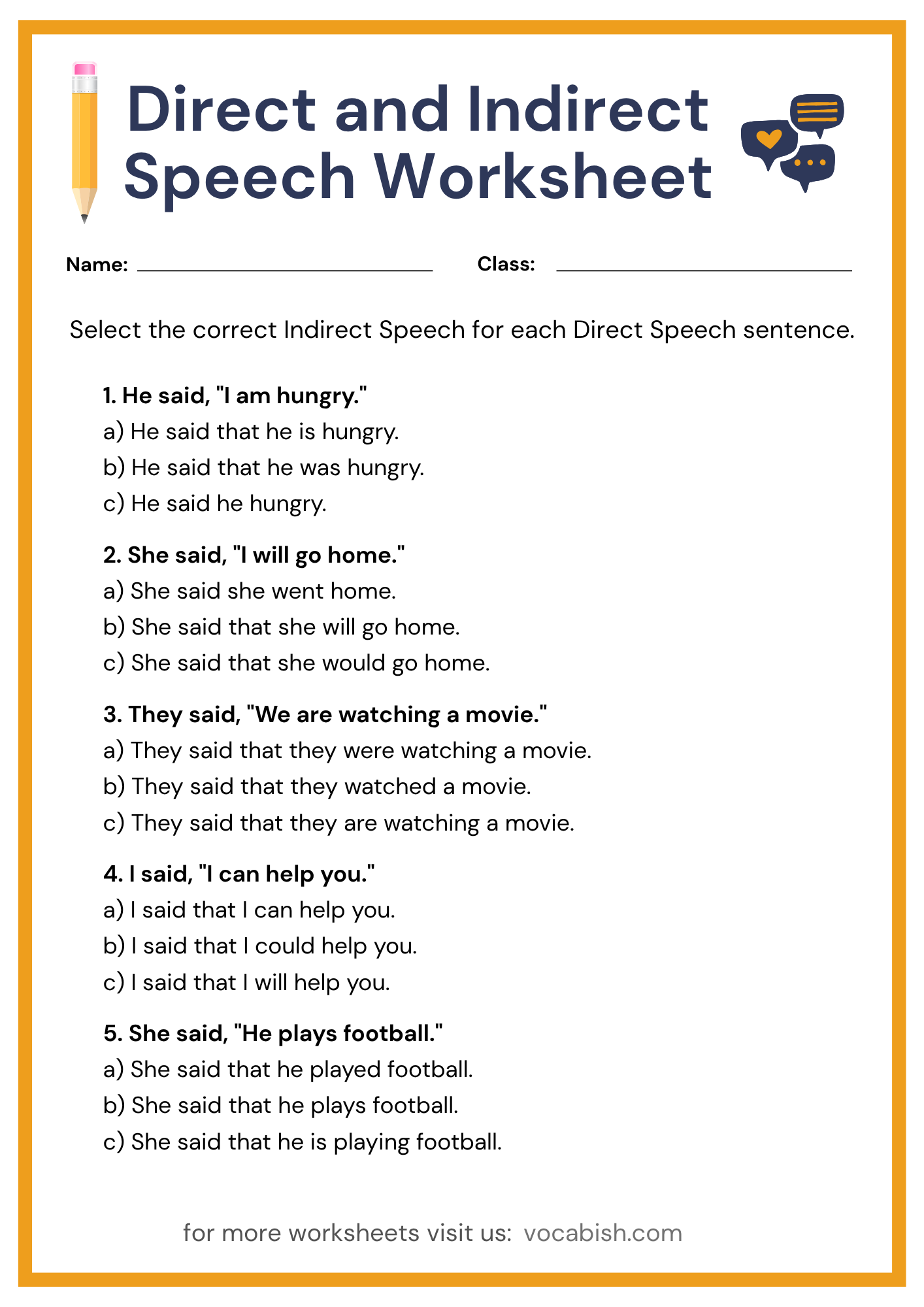
Select the correct Indirect Speech for each Direct Speech sentence.
He said, “I am hungry.”
a) He said that he is hungry.
b) He said that he was hungry.
c) He said he hungry.She said, “I will go home.”
a) She said she went home.
b) She said that she will go home.
c) She said that she would go home.They said, “We are watching a movie.”
a) They said that they were watching a movie.
b) They said that they watched a movie.
c) They said that they are watching a movie.I said, “I can help you.”
a) I said that I can help you.
b) I said that I could help you.
c) I said that I will help you.She said, “He plays football.”
a) She said that he played football.
b) She said that he plays football.
c) She said that he is playing football.
Rewrite the Sentences
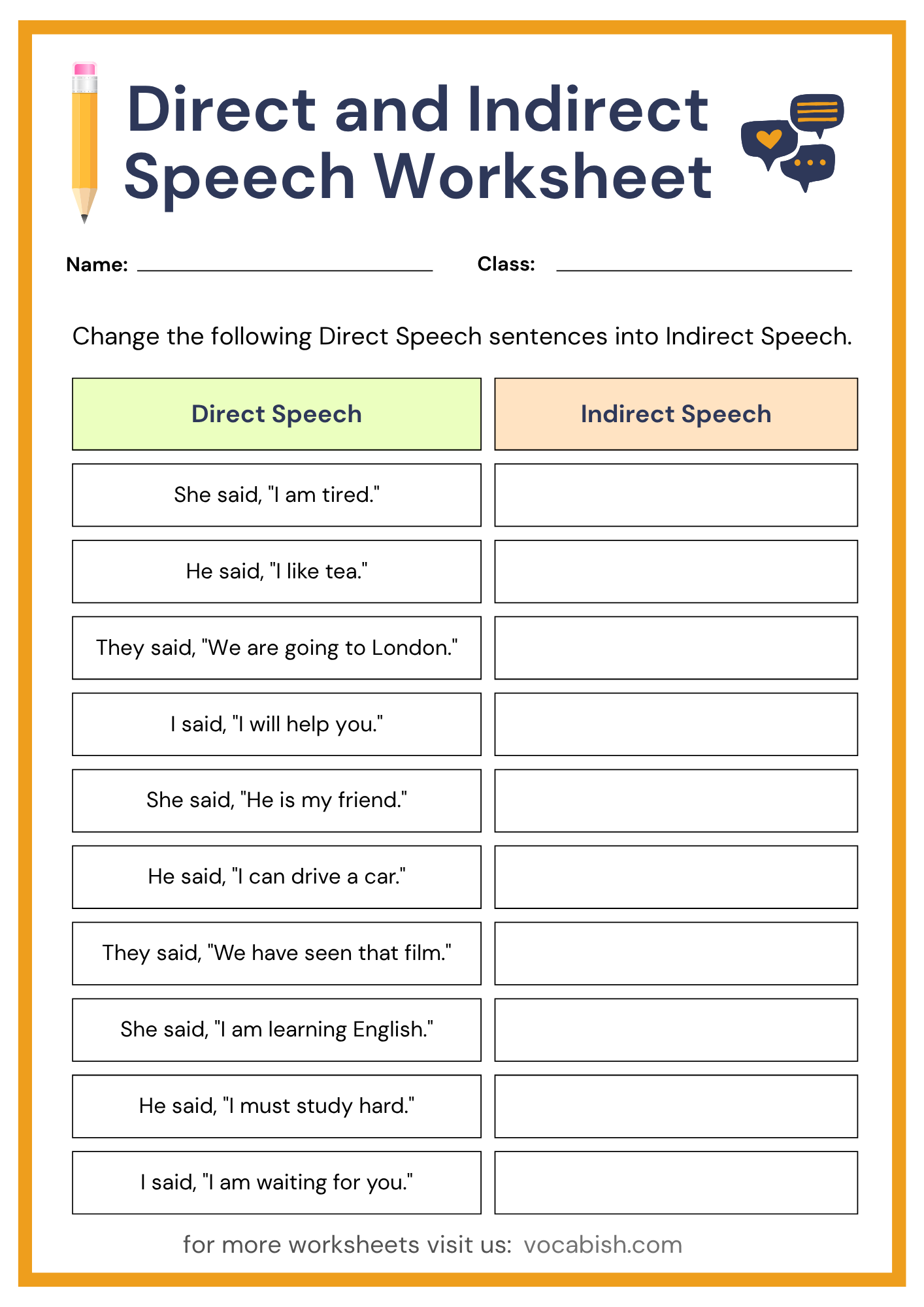
Change the following Direct Speech sentences into Indirect Speech.
- She said, “I am tired.”
- He said, “I like tea.”
- They said, “We are going to London.”
- I said, “I will help you.”
- She said, “He is my friend.”
- He said, “I can drive a car.”
- They said, “We have seen that film.”
- She said, “I am learning English.”
- He said, “I must study hard.”
- I said, “I am waiting for you.”
Answer Key
Fill in the Blanks
was 2. liked 3. were 4. would 5. was 6. could 7. had 8. was 9. had to 10. was
Choose the Correct Answer
b 2. c 3. a 4. b 5. a
Rewrite the Sentences
- She said that she was tired.
- He said that he liked tea.
- They said that they were going to London.
- I said that I would help you.
- She said that he was her friend.
- He said that he could drive a car.
- They said that they had seen that film.
- She said that she was learning English.
- He said that he had to study hard.
- I said that I was waiting for you.
Get a free PDF of these Direct and Indirect Worksheets:
Direct and Indirect Speech Worksheet PDF
Get More Worksheets