
In English, illusion and allusion are two words that look alike but have very different meanings. Knowing the difference is important for speaking, writing, reading, and listening accurately. In this blog post, you will learn how to use illusion and allusion correctly, with examples that show their meanings in everyday sentences. By mastering these words, you can express your ideas more precisely and communicate more effectively.
Meanings of Illusion and Allusion
Illusion
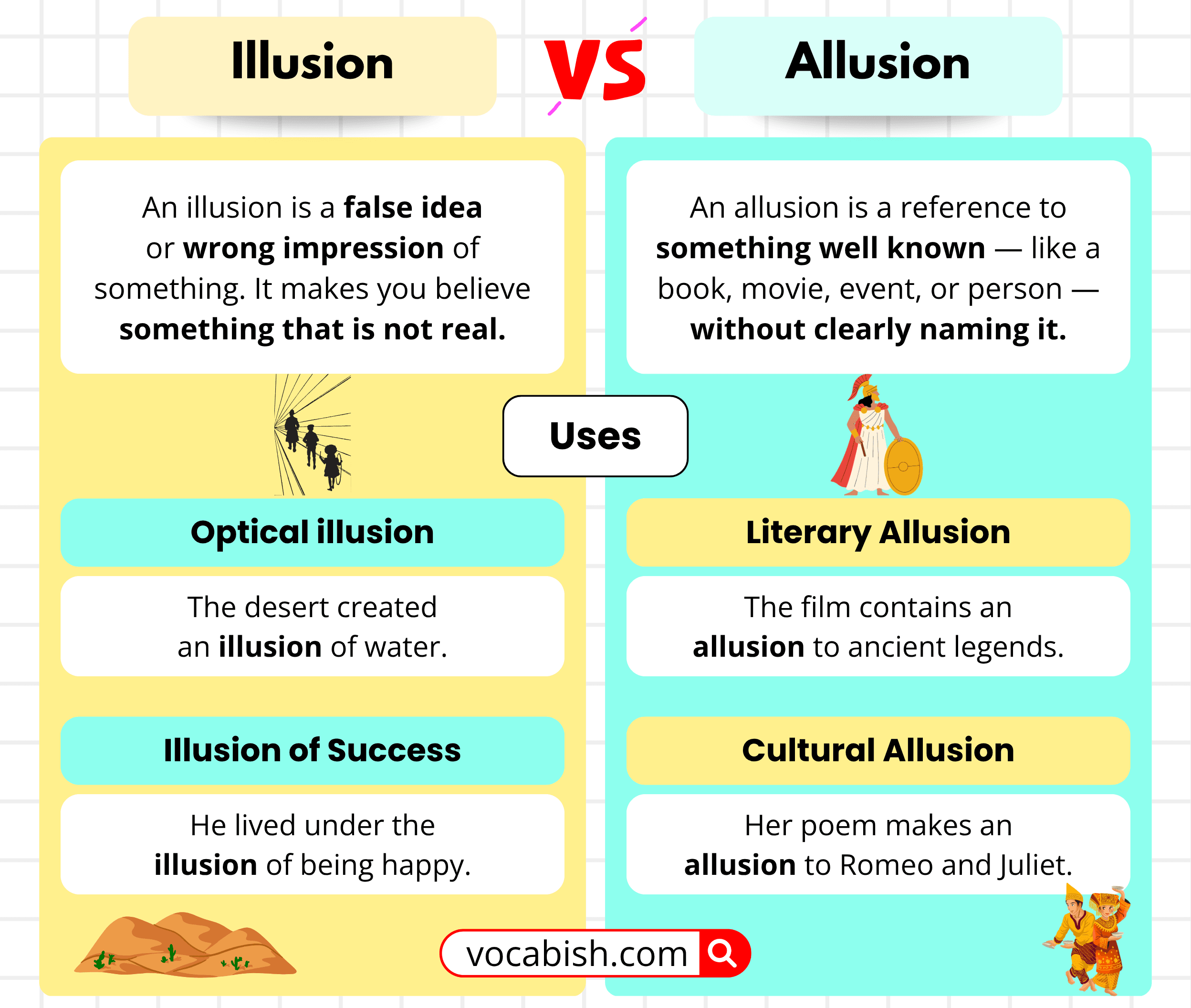
An illusion is a false idea or wrong impression of something. It makes you believe something that is not real.
Examples:
- The magician created an illusion of flying in the air.
- The lake looked close, but it was just an illusion.
In short: Illusion = Something that looks real but isn’t.
Allusion
An allusion is a reference to something well known — like a book, movie, event, or person — without clearly naming it.
Examples:
- The teacher made an allusion to Shakespeare’s plays.
- His speech had an allusion to ancient Greek myths.
In short: Allusion = An indirect reference.
Differences Between Illusion and Allusion
| Aspect | Illusion | Allusion |
|---|---|---|
| Meaning | A false idea or something that deceives the senses | A reference to a famous person, event, or work |
| Type | Visual or mental deception | Literary or speech reference |
| Example | A magician’s trick is an illusion | A writer’s allusion to history adds depth |
| Usage | Common in art, movies, and visual experiences | Common in writing, literature, and speeches |
Usage of Illusion
The word illusion is often used when talking about things that appear real but are not. It is related to vision, perception, or imagination.
- Optical illusion → something that tricks the eyes.
- Illusion of success → a false belief of being successful.
Examples:
- The desert created an illusion of water.
- He lived under the illusion of being happy.
Usage of Allusion
The word allusion is used when someone indirectly mentions something famous or known. It gives deeper meaning without explaining it fully.
- Literary allusion → reference to books or authors.
- Cultural allusion → reference to history or popular culture.
Examples:
- The film contains an allusion to ancient legends.
- Her poem makes an allusion to Romeo and Juliet.
Formal and Informal Usage
| Word | Formal Use | Informal Use |
|---|---|---|
| Illusion | Used in art, psychology, or writing → “The painting creates an illusion of depth.” | Used in everyday talk → “It’s just an illusion, not real.” |
| Allusion | Used in essays and literature → “The story includes an allusion to the Bible.” | Used in casual conversation → “He made an allusion to his favourite film.” |
Example Sentences of Illusion
- The illusion of safety can be dangerous.
- The mirror created an illusion of space.
- His smile gave an illusion of happiness.
- The magician’s illusion amazed the crowd.
- She lived in an illusion of control.
- The photo gives an illusion of movement.
- Fame can be just an illusion.
- The fog gave an illusion of mystery.
- The illusion of flying looked real.
- He broke free from the illusion of perfection.
- The lights created an illusion of warmth.
- The movie used optical illusions.
- Their success was only an illusion.
- The painting creates an illusion of light.
- He lived under an illusion of power.
- The desert heat made an illusion of water.
- The illusion disappeared when the truth came out.
- The performance was full of illusions.
- The illusion of peace didn’t last long.
- The artist played with illusions of colour and shape.
Example Sentences of Allusion
- The author made an allusion to World War II.
- His joke was an allusion to a famous movie.
- The song contains an allusion to lost love.
- The play had an allusion to ancient myths.
- Her words were an allusion to freedom.
- The poem’s allusion adds depth to its meaning.
- His speech included an allusion to history.
- The movie title is an allusion to a classic novel.
- There’s an allusion to Shakespeare in this line.
- The cartoon makes an allusion to modern politics.
- He used an allusion to a famous leader.
- Her story is full of allusions to real events.
- The painting has an allusion to religious art.
- His writing often contains biblical allusions.
- The journalist made an allusion to corruption.
- The quote is an allusion to an old proverb.
- The teacher explained the allusion in the text.
- The movie’s allusion to history is powerful.
- His comment had an allusion to love and loss.
- She smiled, understanding his allusion.
Summary on Allusion vs Illusion
- Illusion → A false image or wrong belief (not real).
- Allusion → An indirect reference to something famous.
- Illusion is visual or mental; Allusion is literary or spoken.
- Both words are useful in writing and speaking but have different meanings and uses.
FAQs
What is the difference between Illusion and Allusion?
Illusion means a false idea or appearance, while Allusion means an indirect reference to something.
What is an example of Illusion?
“The magician created an illusion of flying in the air.”
What is an example of Allusion?
“The writer made an allusion to Shakespeare’s work.”
Can Illusion and Allusion be used interchangeably?
No, they have completely different meanings and are not interchangeable.
How do you remember the difference between Illusion and Allusion?
Think of “Illusion” as seeing something false and “Allusion” as referring to something true.