
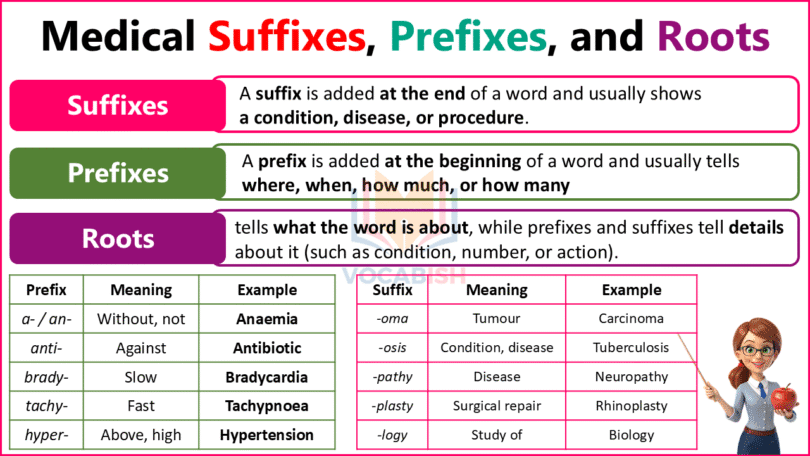

Medical prefixes, suffixes, and roots help you understand the meanings of medical terms. Each word part provides useful information about a body part, condition, disease, or medical procedure. Prefixes appear at the beginning of words, suffixes appear at the end, and roots carry the main meaning. Learning these word parts makes medical vocabulary easier to recognise, spell, and remember. This list includes common medical prefixes, suffixes, and roots with their meanings and examples. It serves as a practical reference for students, healthcare learners, and anyone studying medical terminology.
What Are Medical Prefixes and Suffixes?
In medical terminology, prefixes and suffixes are small parts added to words to change their meaning.
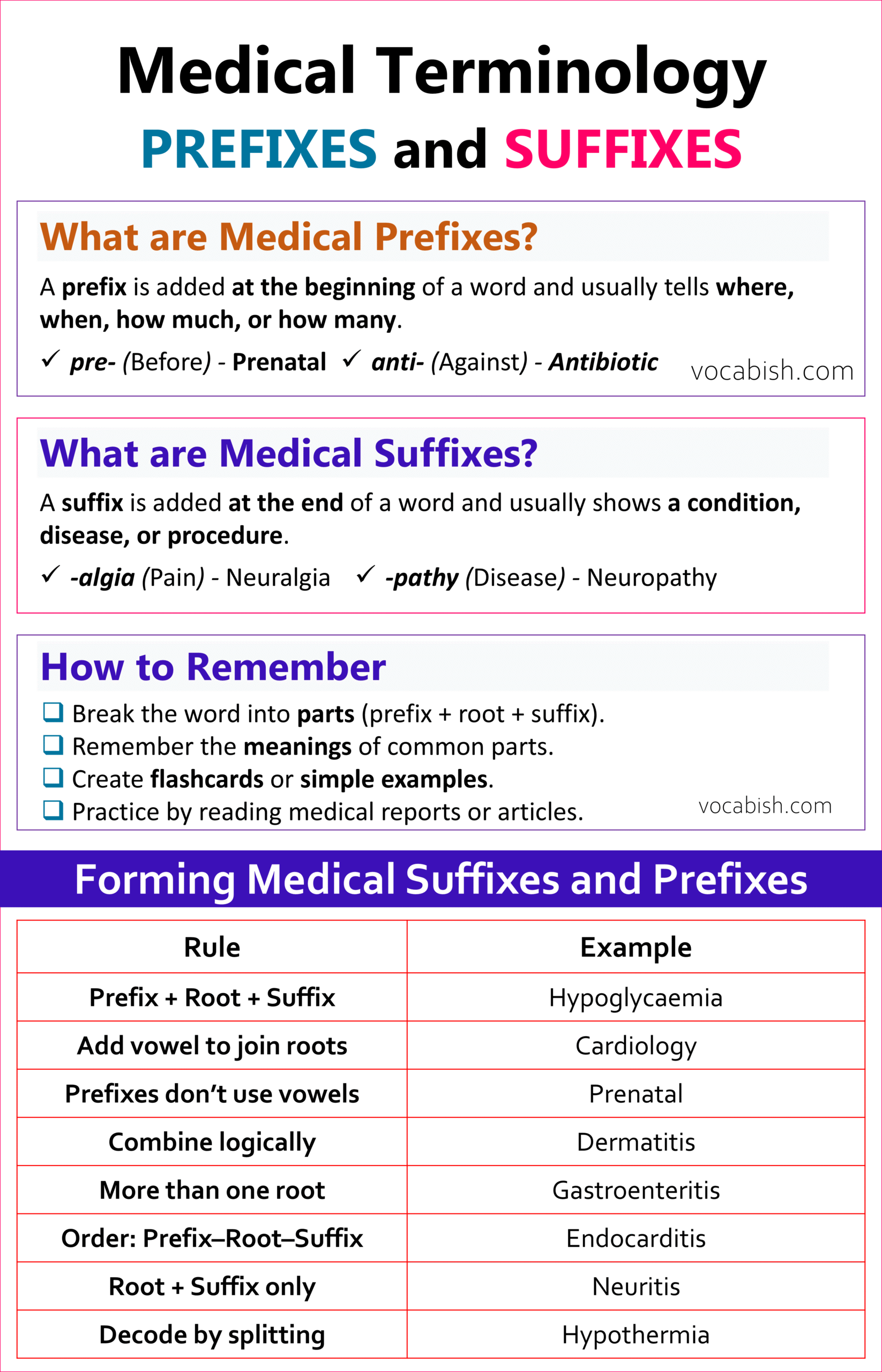
- A prefix is added at the beginning of a word and usually tells where, when, how much, or how many.
- A suffix is added at the end of a word and usually shows a condition, disease, or procedure.
Example:
Cardiology → Cardio (heart) + logy (study of) → Study of the heart
These word parts help create thousands of medical words that describe body parts, diseases, and treatments.
Why Medical Word Parts Matter
Medical words can look long and difficult at first. But many terms follow patterns. Learning these patterns helps students guess meanings without memorizing every word.
Medical prefixes and suffixes are useful for:
- ESL learners
- Nursing students
- Science learners
- Healthcare workers
- English vocabulary building
Even children can start recognizing common parts after some practice.
Rules for Forming Medical Prefixes and Suffixes
Let’s look at some easy and helpful rules to understand how these word parts join together.
Rule 1: Prefix + Root + Suffix = Complete Medical Word
Most medical terms follow this simple structure.
Example:
Hypoglycaemia → Hypo (low) + glyc (sugar) + aemia (blood) → Low blood sugar
Rule 2: Combining Vowels Are Used to Make Words Easier to Say
A combining vowel (usually “o” or sometimes “i”) is used to join word parts smoothly.
Example:
Cardi + o + logy → Cardiology → Study of the heart
Tip: Use the combining vowel when the suffix begins with a consonant, but not when it begins with a vowel.
Example:
- Gastr + o + logy ✅ (Gastroenterology)
- Gastr + itis ❌ (not Gastroitis, but Gastritis)
Rule 3: Prefixes Don’t Need Combining Vowels
Prefixes are simply added before the root word.
Example:
Pre (before) + natal (birth) → Prenatal → Before birth
Post (after) + operative (surgery) → Postoperative → After surgery
Rule 4: Keep the Meaning Logical
Each word part should make sense when combined.
Example:
Derm (skin) + itis (inflammation) → Dermatitis → Inflammation of skin
If you use the wrong combination, the meaning changes or becomes incorrect.
Rule 5: Some Words Contain More Than One Root
Sometimes, a medical word has two or more roots joined by a vowel.
Example:
Gastr (stomach) + enter (intestine) + itis (inflammation) → Gastroenteritis → Inflammation of stomach and intestines
Rule 6: The Order Matters
Prefixes come first, roots come next, and suffixes come last.
Example:
Endocarditis → Endo (inside) + card (heart) + itis (inflammation) → Inflammation inside the heart
Rule 7: Some Terms Use Only Root + Suffix
Not all medical words have prefixes.
Example:
Neur (nerve) + itis (inflammation) → Neuritis → Nerve inflammation
Rule 8: Use Word Meanings to Decode Unknown Terms
If you don’t know a medical word, split it into parts and translate each piece.
Example:
Hypo (low) + thermia (temperature) → Hypothermia → Low body temperature
Arthro (joint) + plasty (surgical repair) → Arthroplasty → Joint repair surgery
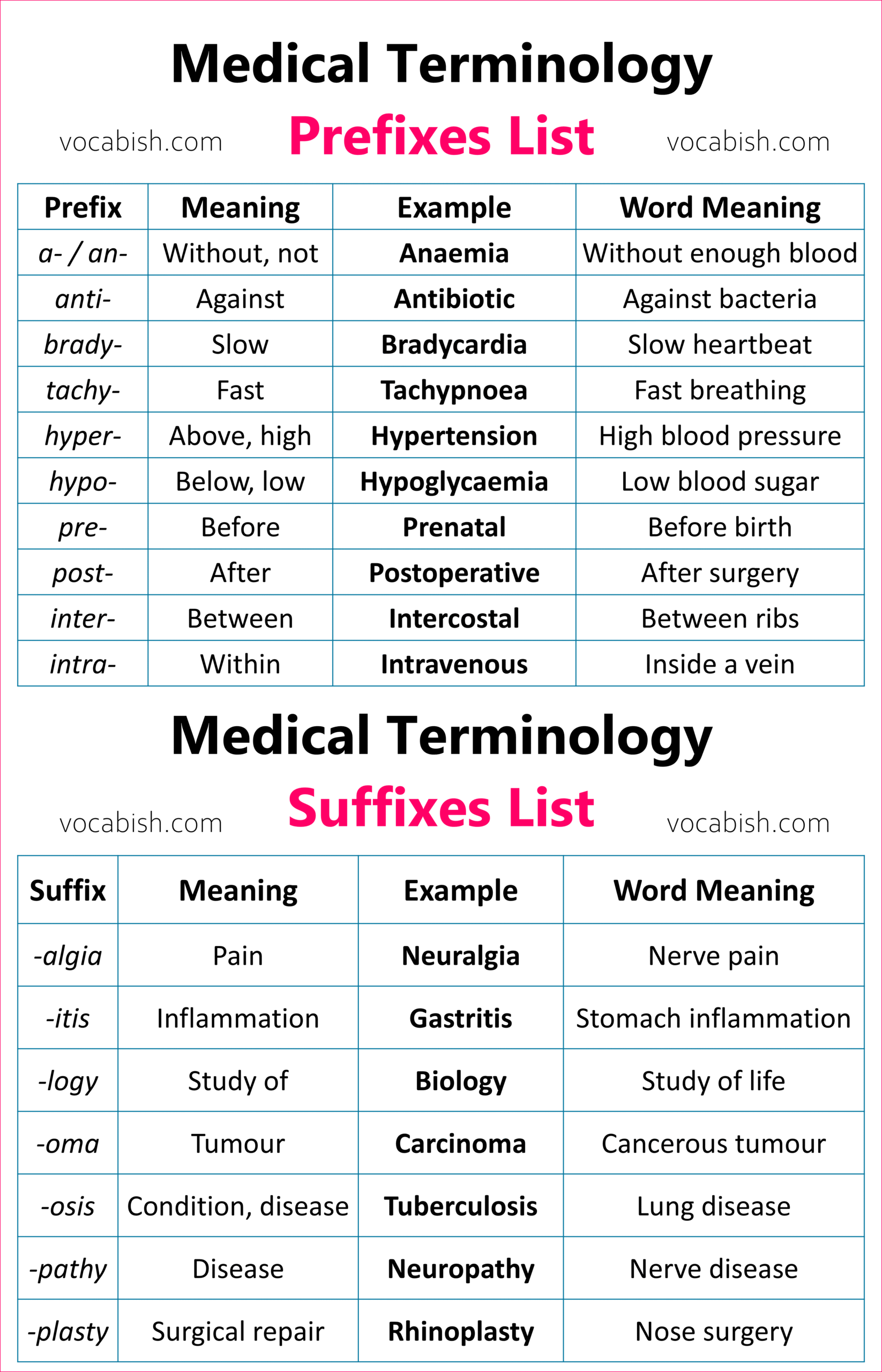
Medical Terminology Prefixes List with Meanings
Medical prefixes are word parts placed at the beginning of a medical term. They modify the term’s meaning by indicating characteristics such as absence, body parts, colour, position, direction, or quantity. Learning common prefixes helps readers recognise medical terms and understand their meanings.
The tables below organise medical prefixes into six categories, with their meanings and examples of use in medical terminology.
1. Common Prefixes
Common medical prefixes describe conditions, processes, substances, and characteristics. They help explain whether something is absent, abnormal, new, or related to a particular biological process.
Prefix | Meaning | Example of Use in Medical Terms |
|---|---|---|
A-, An- | Without; lacking | Anemia |
Andr/o- | Male | Androgen |
Anti- | Against | Anticholinergic |
Auto- | Self | Autocrine |
Bio- | Life | Biology |
Chem/o- | Chemical; chemistry | Chemotherapy |
Contra- | Against; opposite | Contraception |
Cyt/o- | Cell | Cytokine |
Dis- | Apart; separation | Dissection |
Dys- | Difficult; abnormal | Dyspnea |
Eu- | Good; normal; well | Eupnea |
Fibr/o- | Fibre | Fibrosis |
Gluco-, Glyco- | Glucose; sugar | Glycogen |
Gyn/o-, Gynec/o- | Female; woman | Gynecology |
Hydr/o- | Water; fluid | Hydrocephalus |
Idio- | Unknown; individual; one’s own | Idiopathic |
Lyso-, Lys- | Breakdown; dissolution | Lysosome |
Mal- | Bad; abnormal | Malignant |
Myc/o- | Fungus | Mycetoma |
Necr/o- | Death; dead tissue | Necrosis |
Neo- | New | Neonate |
Oxy- | Oxygen; sharp; acute | Oxytocin |
Pan-, Pant/o- | All; entire | Pancytopenia |
Pharmaco- | Drug; medicine | Pharmacology |
Re- | Again; back | Rejuvenation |
Somat/o-, Somatic/o- | Body; bodily | Somatic cell |
2. Body Part Prefixes
Body part prefixes identify organs, tissues, bones, muscles, and other anatomical structures. They help explain which part of the body a medical term refers to.
Prefix | Meaning | Example of Use in Medical Terms |
|---|---|---|
Acous/o- | Hearing | Acoustic meatus |
Aden/o- | Gland | Adenoid |
Adip/o- | Fat | Adipocyte |
Adren/o- | Adrenal gland | Adrenal cortex |
Angi/o- | Vessel; usually blood vessel | Angioplasty |
Arteri/o- | Artery | Arteriole |
Arthr/o- | Joint | Arthroplasty |
Bucc/o- | Cheek | Buccal cavity |
Bronch/o-, Bronchi/o- | Bronchus; airway | Bronchioles |
Burs/o- | Bursa; fluid-filled sac near a joint | Bursa |
Carcin/o- | Cancer | Carcinoma |
Cardi/o- | Heart | Cardiology |
Cephal/o- | Head | Cephalic |
Chol/e-, Chol- | Bile | Cholecystectomy |
Chondr/o- | Cartilage | Chondrosarcoma |
Coron/o- | Crown; coronary structures | Coronary arteries |
Cost/o- | Rib | Costal cartilage |
Crani/o- | Skull | Craniotomy |
Cutane/o- | Skin | Cutaneous |
Cyst/o-, Cysti- | Bladder; sac; cyst | Cystoscopy |
Derm/o-, Dermat/o- | Skin | Dermatologist |
Duoden/o- | Duodenum | Duodenitis |
Gastr/o- | Stomach | Gastrectomy |
Gloss/o- | Tongue | Glossectomy |
Hem/o-, Hemat/o-, Hem/o-, Hema-, Hemat-, Hem- | Blood | Hematopoiesis |
Hepat/o-, Hepatic/o- | Liver | Hepatic portal system |
Hist/o-, Histi/o- | Tissue | Histology |
Hyster/o- | Uterus | Hysterectomy |
Ile/o- | Ileum | Ileostomy |
Ischi/o- | Ischium | Ischial tuberosity |
Kerat/o- | Cornea; horny tissue | Keratitis |
Lacrim/o- | Tears; tear glands | Lacrimal fluid |
Lact/o-, Lacti- | Milk | Lactation |
Laryng/o- | Larynx; voice box | Laryngitis |
Lingu/o- | Tongue | Lingual tonsil |
Lip/o- | Fat | Lipolysis |
Lymph/o- | Lymph | Lymphocyte |
Mamm/o-, Mast/o- | Breast | Mammary gland |
Mening/o- | Meninges | Meningitis |
Muscul/o- | Muscle | Musculoskeletal |
My/o- | Muscle | Myocardium |
Myel/o- | Spinal cord; bone marrow | Myelogram |
Nephr/o- | Kidney | Nephron |
Neur/o-, Neur/i- | Nerve | Neuron |
Ocul/o- | Eye | Oculomotor nerve |
Onc/o- | Tumour; mass | Oncology |
Onych/o- | Fingernail; toenail | Onychodystrophy |
Oo- | Egg; ovum | Oocyte |
Oophor/o- | Ovary | Oophorectomy |
Opt/o-, Op- | Vision; sight | Optic nerve |
Ophthalm/o- | Eye | Ophthalmic artery |
Orchid/o-, Orchi/o- | Testis | Orchidectomy |
Orth/o- | Straight; normal; correct | Orthostatic |
Osse/o- | Bone; bony | Osseous tissue |
Ossi- | Bone | Ossification |
Ost/o-, Oste/o- | Bone | Osteoporosis |
Ot/o- | Ear | Otology |
Ovari/o-, Ovar/o-, Ovi-, Ovo- | Ovary; egg | Ovarian follicle |
Phalang/o- | Finger or toe bone | Phalanges |
Pharyng/o- | Pharynx; throat | Pharyngitis |
Phleb/o- | Vein | Phlebotomy |
Phren/o-, Phrenic/o- | Diaphragm | Phrenic nerve |
Pleur/o-, Pleura-, Pleur/a- | Pleura; membrane around the lungs | Pleural cavity |
Pneum/o-, Pneumat/o- | Air; lung | Pneumonia |
Proct/o- | Anus; rectum | Proctoscopy |
Prostat/o- | Prostate gland | Prostatectomy |
Pseud/o- | False | Pseudostratified |
Psych/o-, Psyche- | Mind | Psychiatry |
Radi/o- | Radiation; X-rays | Radiology |
Ren/o- | Kidney | Renal cortex |
Retin/o- | Retina | Retinitis |
Rhin/o- | Nose | Rhinoscopy |
Salping/o- | Tube; usually a uterine tube | Salpingectomy |
Sarc/o- | Flesh; connective tissue | Sarcoma |
Schiz/o- | Split; division | Schizophrenia |
Scler/o-, Sclera- | Hard; hardness | Sclerosis |
Sigmoid/o- | Sigmoid colon | Sigmoidoscopy |
Sperm/o-, Spermat/o-, Sperma- | Sperm; sperm cell | Spermatocyte |
Splen/o- | Spleen | Splenomegaly |
Sten/o- | Narrow; constricted | Stenosis |
Stern/o- | Sternum; breastbone | Sternoclavicular joint |
Stomat/o-, Stom/a- | Mouth | Stomatitis |
Thorac/o-, Thoracic/o- | Chest | Thoracic cavity |
Thromb/o- | Blood clot | Thrombolytic |
Thyr/o- | Thyroid gland | Thyroiditis |
Trache/o- | Trachea; windpipe | Tracheostomy |
Tympan/o- | Eardrum; middle ear | Tympanic membrane |
Ur/o- | Urine; urinary tract | Urology |
Vagin/o- | Vagina | Vaginitis |
Varic/o- | Dilated or twisted vein | Varicose veins |
Vascul/o- | Blood vessel | Vasculitis |
Ven/o- | Vein | Venous circulation |
Vertebr/o- | Vertebra; spine | Vertebral column |
3. Colour Prefixes
Colour prefixes describe colours or changes in colour observed in tissues, cells, blood, and other biological structures. They frequently appear in medical diagnoses and laboratory terminology.
Prefix | Meaning | Example of Use in Medical Terms |
|---|---|---|
Chlor/o- | Green | Chloroma |
Chrom/o-, Chromat/o- | Colour | Chromosome |
Cyan/o- | Blue | Cyanosis |
Erythr/o- | Red | Erythrocyte |
Leuk/o- | White | Leukocyte |
Melan/o- | Black; dark pigment | Melanin |
4. Physical Property and Shape Prefixes
These prefixes describe physical characteristics such as temperature, movement, shape, light, and electrical activity. They help explain processes and structures in anatomy, physiology, and clinical terminology.
Prefix | Meaning | Example of Use in Medical Terms |
|---|---|---|
Cry/o- | Cold | Cryotherapy |
Electr/o- | Electricity; electrical activity | Electrocardiogram |
Kin/o-, Kine-, Kinesi/o- | Movement; motion | Kinesiology |
Kyph/o- | Hump; curved spine | Kyphosis |
Rhabd/o- | Rod-shaped; striated | Rhabdomyosarcoma |
Phot/o- | Light | Photoreceptor |
Reticul/o- | Net; network | Reticulocyte |
Scoli/o- | Twisted; curved | Scoliosis |
Therm/o- | Heat | Thermotherapy |
5. Direction and Position Prefixes
Direction and position prefixes describe where a structure is located or how it relates to another structure. They can indicate movement, position, depth, or a relationship in time.
Prefix | Meaning | Example of Use in Medical Terms |
|---|---|---|
Ab-, Abs- | Away from | Abduction |
Ad- | Toward | Adduction |
Ante- | Before; forward | Antenatal |
Circum- | Around | Circumcision |
Cycl/o- | Circle; cycle | Cyclic neutropenia |
De- | Down; away; removal | Dehydration |
Dia- | Through; across | Dialysis |
Ect/o-, Ex/o- | Outside; outer | Ectopic |
End/o-, Ent/o- | Within; inside | Endocrine |
Enter/o- | Intestine, especially the small intestine | Enteritis |
Epi- | Upon; on; above | Epidermis |
Ex-, Extra- | Out; outside; beyond | Extracellular |
Infra- | Below; beneath | Infratemporal fossa |
Inter- | Between | Interstitial fluid |
Intra- | Within | Intracellular |
Mes/o- | Middle | Mesoderm |
Meta- | Beyond; change; after | Metabolism |
Para- | Beside; alongside; abnormal | Parathyroid |
Path/o- | Disease | Pathology |
Peri- | Around | Pericardium |
Post- | After; behind | Postpartum |
Pre- | Before; in front of | Precancerous |
Retro- | Behind; backward | Retroperitoneum |
Sub- | Under; below | Subcutaneous |
Super- | Above; over | Superficial |
Supra- | Above; upon | Supraglottis |
Sy-, Syl-, Sym-, Syn-, Sys- | Together; joined | Syndrome |
Trans- | Across; through | Transdermal |
6. Quantity Prefixes
Quantity prefixes indicate number, amount, size, speed, or degree. They help describe how many structures are present, whether a process is excessive or deficient, and how quickly a physiological activity occurs.
Prefix | Meaning | Example of Use in Medical Terms |
|---|---|---|
Bi- | Two; double | Biceps |
Brady- | Slow | Bradycardia |
Diplo- | Double; paired | Diploid |
Hemi- | Half; one side | Hemihypertrophy |
Hetero- | Different; other | Heterogeneous |
Homo- | Same; alike | Homozygous |
Hyper- | Excessive; above normal | Hypertension |
Hypo- | Below normal; deficient | Hypotension |
Iso- | Equal; same | Isointense |
Macro- | Large | Macrophage |
Micr/o-, Micro- | Small | Microglia |
Mon/o-, Mono- | One; single | Monocyte |
Olig/o- | Few; little | Oliguria |
Poly- | Many; excessive | Polyuria |
Quadri- | Four | Quadriceps |
Semi- | Half; partial | Semilunar valve |
Tachy- | Fast; rapid | Tachycardia |
Tetra- | Four | Tetralogy of Fallot |
Tri- | Three | Triceps |
Uni- | One; single | Unicellular |
Terminology note: Some word parts in these tables are combining forms or roots rather than prefixes in the strict linguistic sense. For example, cardi/o- refers to the heart, while hyper- means excessive or above normal. Recognising this distinction helps learners interpret medical terms more accurately.
Medical Terminology Suffixes List
Medical suffixes are word parts added to the end of medical terms. They indicate conditions, diseases, symptoms, physical changes, and medical procedures. Learning common suffixes helps readers understand medical vocabulary and interpret clinical terminology more accurately.
1. Common Suffixes
Common medical suffixes describe diseases, symptoms, bodily conditions, cell types, growth, and physiological processes. They help explain the meaning of medical terms and identify the conditions or changes they describe.
Suffix | Meaning | Example of Use in Medical Terms |
|---|---|---|
-ac | Pertaining to | Cardiac |
-blast, -blasto, -blastic | Immature cell; developing cell | Myeloblast |
-cyte, -cytic | Cell | Thrombocyte |
-dynia | Pain | Thoracodynia |
-eal, -ial | Pertaining to | Esophageal |
-ectasis | Dilation; expansion | Bronchiectasis |
-emia | Blood condition | Anemia |
-ia | Condition; state | Hemophilia |
-iasis | Condition; formation or presence | Psoriasis |
-ism | Condition; process | Hypothyroidism |
-itis | Inflammation | Arthritis |
-ity | State; condition; quality | Immunity |
-ium | Structure; tissue | Epithelium |
-lysis, -lytic | Breakdown; destruction; dissolution | Osteolytic |
-malacia | Abnormal softening | Osteomalacia |
-megaly | Enlargement | Acromegaly |
-oid | Resembling; like | Arachnoid |
-oma | Tumour; mass | Lymphoma |
-osis | Condition; often abnormal | Endometriosis |
-ous | Pertaining to; characterised by | Aqueous |
-pathy | Disease; disorder | Neuropathy |
-penia | Deficiency; lack | Thrombocytopenia |
-phagia, -phagy | Eating; swallowing | Dysphagia |
-phasia | Speech | Aphasia |
-plasia, -plastic | Formation; development; growth | Hyperplasia |
-plegia | Paralysis | Hemiplegia |
-pnea | Breathing | Apnea |
-poiesis | Production; formation | Hematopoiesis |
-ptosis | Drooping; downward displacement | Blepharoptosis |
-rrhage, -rrhagic | Excessive bleeding; bursting forth | Hemorrhage |
-rrhea | Flow; discharge | Diarrhea |
-sclerosis | Hardening | Arteriosclerosis |
-sis | State; condition; process | Agranulocytosis |
-stasis | Stopping; controlling; maintaining a state | Hemostasis |
-trophy | Growth; development; nourishment | Hypertrophy |
-uria | Urine condition | Anuria |
2. Procedure Suffixes
Procedure suffixes describe medical examinations, surgical operations, diagnostic tests, and methods of recording or measuring bodily functions. They help identify the type of procedure or instrument referred to in a medical term.
Suffix | Meaning | Example of Use in Medical Terms |
|---|---|---|
-centesis | Surgical puncture to remove fluid | Thoracentesis |
-desis | Surgical binding or fixation | Pleurodesis |
-ectomy | Surgical removal | Mastectomy |
-gram | Record; image | Electrocardiogram |
-graph | Instrument that records or produces an image | Electrocardiograph |
-graphy | Process of recording or imaging | Echocardiography |
-meter | Measuring instrument | Sphygmomanometer |
-opsy | Viewing; examination | Biopsy |
-ostomy | Surgical creation of an opening | Colostomy |
-otomy | Surgical incision | Laparotomy |
-pexy | Surgical fixation | Oophoropexy |
-plasty | Surgical repair or reconstruction | Vertebroplasty |
-scope | Instrument used for examination | Endoscope |
-scopy | Visual examination using an instrument | Endoscopy |
Terminology note: A suffix can have different meanings depending on the medical term in which it appears. For example, -oma often refers to a tumour or mass, but the exact meaning depends on the term. Similarly, -stasis can refer to stopping, controlling, or maintaining a state. Always interpret suffixes in the context of the complete medical term.
Medical Prefixes, Suffixes, and Roots List
Medical prefixes, suffixes, and roots are word parts that help explain the meanings of medical terms. Prefixes appear at the beginning of a word, suffixes appear at the end, and roots carry the central meaning, often identifying a body part, organ, or bodily process. Learning these word parts makes medical vocabulary easier to recognise and interpret.
The following table combines common medical prefixes, suffixes, and roots with their meanings and examples. It provides a practical reference for understanding medical terminology.
Prefix, Suffix, or Root | Meaning | Example of Use in Medical Terms |
|---|---|---|
A-, An- (Prefix) | Without; lacking | Anemia |
Ab- (Prefix) | Away from | Abduction |
Ad- (Prefix) | Toward | Adduction |
Anti- (Prefix) | Against | Antibiotic |
Auto- (Prefix) | Self | Autoimmune |
Bi- (Prefix) | Two | Bilateral |
Brady- (Prefix) | Slow | Bradycardia |
Dys- (Prefix) | Difficult; abnormal | Dyspnea |
Endo- (Prefix) | Within; inside | Endoscopy |
Epi- (Prefix) | Upon; above | Epidermis |
Hemi- (Prefix) | Half | Hemiplegia |
Hyper- (Prefix) | Excessive; above normal | Hypertension |
Hypo- (Prefix) | Below normal; deficient | Hypoglycemia |
Inter- (Prefix) | Between | Intercostal |
Intra- (Prefix) | Within | Intravenous |
Macro- (Prefix) | Large | Macrocephaly |
Micro- (Prefix) | Small | Microcephaly |
Neo- (Prefix) | New | Neonatal |
Pan- (Prefix) | All | Pancytopenia |
Peri- (Prefix) | Around | Pericardium |
Poly- (Prefix) | Many; excessive | Polyuria |
Post- (Prefix) | After | Postoperative |
Pre- (Prefix) | Before | Prenatal |
Sub- (Prefix) | Under; below | Subcutaneous |
Tachy- (Prefix) | Fast; rapid | Tachycardia |
Trans- (Prefix) | Across; through | Transdermal |
Uni- (Prefix) | One | Unilateral |
Cardi/o (Root) | Heart | Cardiology |
Cephal/o (Root) | Head | Cephalic |
Cerebr/o (Root) | Cerebrum; brain | Cerebrovascular |
Cyt/o (Root) | Cell | Cytology |
Derm/o (Root) | Skin | Dermatology |
Enter/o (Root) | Intestine | Enteritis |
Gastr/o (Root) | Stomach | Gastritis |
Glyc/o (Root) | Sugar; glucose | Glycogen |
Hemat/o (Root) | Blood | Hematology |
Hepat/o (Root) | Liver | Hepatitis |
Hist/o (Root) | Tissue | Histology |
Nephr/o (Root) | Kidney | Nephrology |
Neur/o (Root) | Nerve | Neurology |
Oste/o (Root) | Bone | Osteoporosis |
Ophthalm/o (Root) | Eye | Ophthalmology |
Ot/o (Root) | Ear | Otitis |
Path/o (Root) | Disease | Pathology |
Pulmon/o (Root) | Lung | Pulmonology |
Rhin/o (Root) | Nose | Rhinitis |
Thorac/o (Root) | Chest | Thoracotomy |
Ur/o (Root) | Urine; urinary tract | Urology |
-algia (Suffix) | Pain | Neuralgia |
-ectomy (Suffix) | Surgical removal | Appendectomy |
-emia (Suffix) | Blood condition | Anemia |
-itis (Suffix) | Inflammation | Bronchitis |
-logy (Suffix) | Study of | Cardiology |
-lysis (Suffix) | Breakdown; destruction | Hemolysis |
-megaly (Suffix) | Enlargement | Hepatomegaly |
-oma (Suffix) | Tumour; mass | Lymphoma |
-osis (Suffix) | Condition; often abnormal | Cyanosis |
-pathy (Suffix) | Disease; disorder | Neuropathy |
-penia (Suffix) | Deficiency; lack | Leukopenia |
-phobia (Suffix) | Fear; aversion | Hydrophobia |
-plasty (Suffix) | Surgical repair or reconstruction | Rhinoplasty |
-plegia (Suffix) | Paralysis | Paraplegia |
-pnea (Suffix) | Breathing | Apnea |
-scope (Suffix) | Instrument for examination | Endoscope |
-scopy (Suffix) | Visual examination | Colonoscopy |
-tomy (Suffix) | Surgical incision | Tracheotomy |
-uria (Suffix) | Urine condition | Hematuria |
Note: The combining vowel o in forms such as cardi/o and gastr/o usually connects a root to another word part. The same root may appear in different forms depending on spelling and pronunciation. Medical terms should be interpreted as complete words because individual word parts can have different meanings in different contexts.
Medical Prefixes and Suffixes Quiz
Test your knowledge of medical word parts, their meanings, and how they are used in medical terminology.
Quiz Complete!
You have finished the medical terminology quiz.
Review Your Answers
How Prefixes and Suffixes Change Meaning
A small word part can completely change the meaning of a medical term.
Example 1:
Word | Meaning |
|---|---|
tension | pressure |
hypertension | high pressure |
hypotension | low pressure |
Example 2:
Word | Meaning |
|---|---|
gastritis | stomach inflammation |
gastroenteritis | stomach and intestine inflammation |
Students often understand long medical terms faster when they separate each part step by step
Easy Tips to Learn Medical Vocabulary
Medical words become easier with regular exposure and pattern recognition.
Helpful Study Ideas:
- Learn 5 prefixes each week
- Group words by body systems
- Use flashcards
- Practice word breakdowns
- Watch medical videos with subtitles
- Read health articles slowly
Memory Trick:
Focus on the suffix first.
For example:
- -itis → inflammation
- -ectomy → removal surgery
- -ology → study of
The ending often tells you the type of medical condition immediately.
FAQs
What are medical prefixes, suffixes, and roots?
Medical prefixes, suffixes, and roots are the main parts that form medical words.
- A prefix appears at the beginning and changes the meaning.
- A root gives the basic meaning of the word.
- A suffix comes at the end and often shows a condition or process.
Example: Cardiology → Cardi (heart) + logy (study of)
Why are prefixes, suffixes, and roots important in medical terminology?
They help explain complex medical terms easily. By understanding them, you can quickly guess the meaning of unfamiliar medical words and communicate more clearly in healthcare.
What are some common medical prefixes and their meanings?
Here are a few examples:
→ Hyper- = high or above
→ Hypo- = low or below
→ Brady- = slow
→ Tachy- = fast
→ Pre- = before
How do you form medical words using roots and suffixes?
You can create a medical word by combining a root and a suffix, sometimes with a combining vowel (o).
Example: Neur (nerve) + itis (inflammation) → Neuritis → Nerve inflammation
What is the difference between a root and a prefix in medical terms?
A root shows the main meaning (usually a body part or system), while a prefix adds extra information such as time, place, or number.
Example: Prenatal → Pre (before) + natal (birth)
Related Articles: