

Laboratory equipment includes tools and instruments used for experiments, testing, and scientific observations. Items like beakers, test tubes, microscopes, and pipettes are common examples. In this blog post, you will learn laboratory equipment names and their uses with pictures to understand how each tool works. When you understand these tools, you can describe experiments clearly, follow science instructions accurately, and improve your technical vocabulary. With regular practice, you will master the names and functions of laboratory equipment and use them confidently in experiments, reports, and classroom activities.
List of Laboratory Equipment Names in English
- Beaker
- Erlenmeyer Flask
- Volumetric Flask
- Test Tube
- Test Tube Rack
- Pipette
- Burette
- Graduated Cylinder
- Funnel
- Watch Glass
- Balance
- Thermometer
- Ruler
- Stopwatch
- pH Meter
- Spectrophotometer
- Hydrometer
- Microscale
- Bunsen Burner
- Hot Plate
- Water Bath
- Ice Bath
- Heating Mantle
- Oven
- Autoclave
- Stirring Rod
- Magnetic Stirrer
- Shaker
- Mortar and Pestle
- Vortex Mixer
- Lab Coat
- Gloves
- Safety Goggles
- Face Shield
- Fume Hood
- Fire Extinguisher
- First Aid Kit
- Emergency Shower
- Eye Wash Station
- Microscope
- Petri Dish
- Slide
- Cover Slip
- Dissecting Kit
- Centrifuge
- Incubator
- Multimeter
- Voltmeter
- Ammeter
- Stopwatch
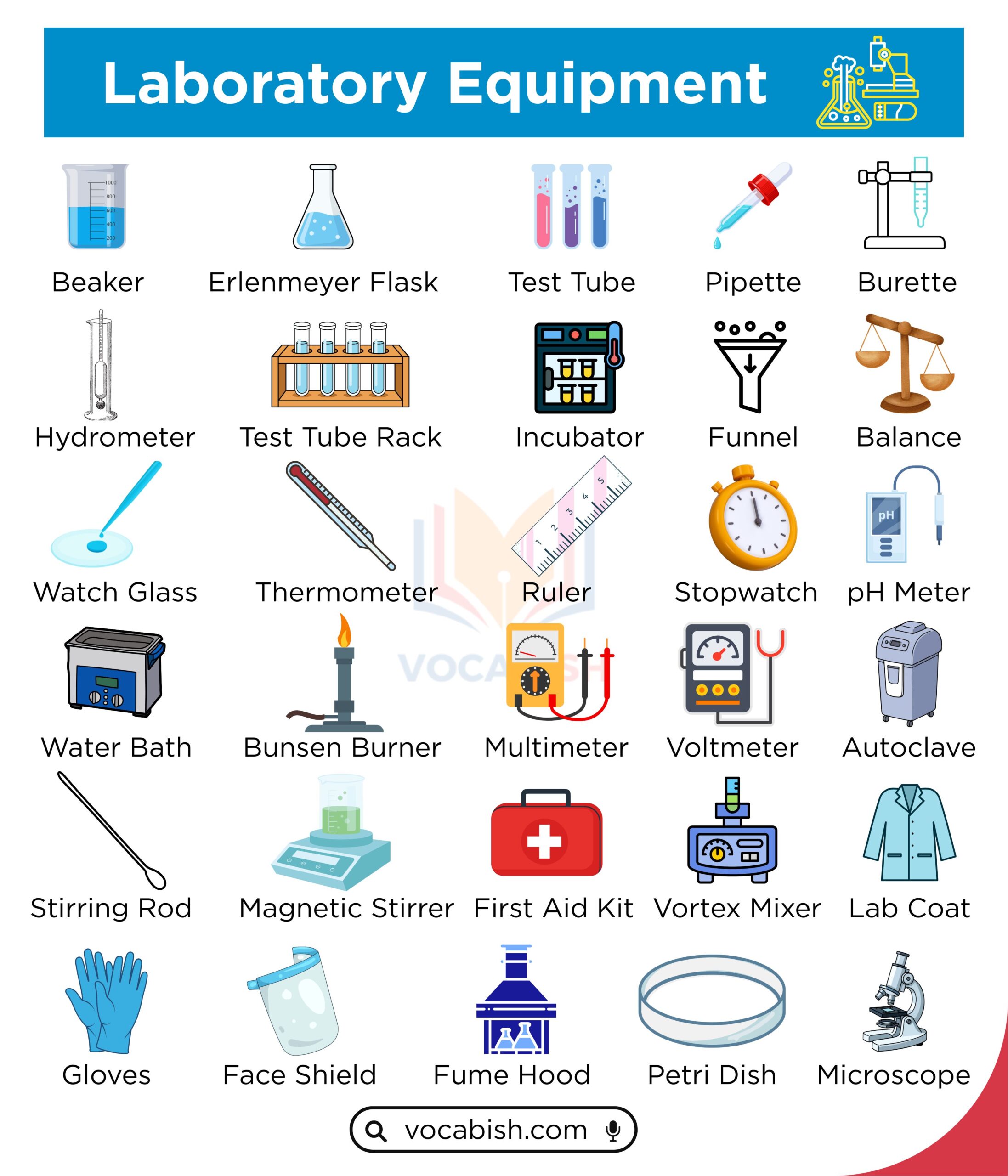
Glassware/Chemistry Lab Tools
Glassware is the most common laboratory equipment. It is used for holding, measuring, and mixing chemicals.
Beaker
A cylindrical glass container used to mix, heat, and hold liquids during experiments in science labs.
Erlenmeyer Flask
Cone-shaped flask with narrow neck used for mixing, heating, and storing chemical solutions safely.
Volumetric Flask
Flask with precise volume marking for preparing accurate solutions and dilutions in laboratories.
Test Tube
Small cylindrical glass tube used to hold, mix, or heat small quantities of liquids or samples.
Test Tube Rack
Stand that holds multiple test tubes upright, preventing spills and organising experiments efficiently.
Pipette
Narrow tube used to measure and transfer small, precise amounts of liquid in experiments.
Burette
Long, graduated tube used for accurately dispensing liquids, commonly during titration experiments.
Graduated Cylinder
Tall, cylindrical container with volume markings to measure liquid volumes accurately.
Funnel
Cone-shaped device used to pour liquids safely into containers with narrow openings.
Watch Glass
Concave glass dish used to hold small samples, evaporate liquids, or cover beakers.
Measuring Instruments
Measuring equipment is used to check size, weight, and temperature of substances.
Balance
Device used to measure the mass of solids, liquids, or chemicals with high precision.
Thermometer
Measures the temperature of substances accurately in Celsius or Fahrenheit for experiments.
Ruler
Used to measure length, width, or height of objects in experiments.
Stopwatch
Measures time intervals during experiments, especially in physics and reaction studies.
pH Meter
Electronic device used to measure the acidity or alkalinity of solutions accurately.
Spectrophotometer
Measures light absorption of samples to determine concentration of chemicals or compounds.
Hydrometer
Instrument used to measure the density or specific gravity of liquids.
Microscale
Highly precise balance used to measure very small quantities of chemicals accurately.
Heating and Cooling Equipment
Some experiments need heat or cold to react properly.
Bunsen Burner
Gas-powered device used to heat chemicals, boil liquids, and sterilise equipment safely.
Hot Plate
Electric heating device used to warm liquids without an open flame.
Water Bath
Container with heated water used to warm samples gently and maintain stable temperature.
Ice Bath
Container filled with ice and water used to cool substances quickly during experiments.
Heating Mantle
Electric device that safely heats round-bottom flasks for chemical reactions.
Oven
Used to dry, heat, or sterilise laboratory equipment and chemical samples.
Autoclave
Sterilises laboratory tools and equipment using high-pressure steam for safe usage.
Mixing Equipment
Mixing equipment helps in combining chemicals safely and efficiently.
Stirring Rod
Glass rod used to manually stir liquids or solutions in beakers and flasks.
Magnetic Stirrer
Device that uses a rotating magnetic field to mix solutions automatically and uniformly.
Shaker
Machine used to mix liquids or solids by shaking continuously and evenly.
Mortar and Pestle
Tool used to crush, grind, or mix solid chemicals into fine powder.
Vortex Mixer
Rapidly mixes small liquid samples by creating a vortex, ideal for biology labs.
Safety Equipment
Safety equipment is essential in every laboratory. It protects the user from accidents.
Lab Coat
Protects clothes and skin from chemical spills, heat, and contamination in laboratories.
Gloves
Protect hands from chemicals, heat, or harmful substances while performing experiments.
Safety Goggles
Protects eyes from chemical splashes, flying particles, or harmful radiation.
Face Shield
Full-face protection during experiments that may cause splashes or debris.
Fume Hood
Ventilated cabinet that removes harmful fumes, vapors, or dust during experiments.
Fire Extinguisher
Used to put out small fires safely in laboratory settings.
First Aid Kit
Contains essential supplies for treating minor injuries in the lab.
Emergency Shower
Used to wash off chemicals or hazardous substances from the body immediately.
Eye Wash Station
Flushes eyes with water in case of chemical exposure or irritation.
Biology Lab Apparatus
Microscope
Magnifies small objects, cells, or microorganisms for detailed observation and study.
Petri Dish
Shallow dish used to grow bacteria, fungi, or cell cultures in biology labs.
Slide
Thin glass plate used to place specimens for viewing under a microscope.
Cover Slip
Small, thin piece of glass used to cover specimens on slides.
Dissecting Kit
Tools including scissors, forceps, and scalpels used to dissect biological specimens.
Centrifuge
Spins samples at high speed to separate components based on density.
Incubator
Provides controlled temperature and humidity for growing cell cultures or microorganisms.
Physics Lab Instruments
Multimeter
Measures voltage, current, and resistance in electrical circuits accurately.
Voltmeter
Measures electrical potential difference between two points in a circuit.
Ammeter
Measures electric current flowing through a circuit.
Stopwatch
Used to measure precise time intervals in physics experiments or motion studies.
FAQs
What is a Bunsen Burner used for in a laboratory?
A Bunsen Burner is used to heat chemicals, boil liquids, and sterilise equipment safely in science labs.
How do you use a pipette in experiments?
A pipette is used to measure and transfer small, precise amounts of liquid accurately during experiments.
What is the purpose of a microscope in biology labs?
A microscope magnifies small objects, cells, or microorganisms for detailed observation and study in biology.
Why is a fume hood important in a laboratory?
A fume hood removes harmful fumes, vapors, and dust, protecting scientists from inhaling dangerous chemicals.
What does a balance measure in a laboratory?
A balance measures the mass of solids, liquids, or chemicals accurately for experiments and chemical preparation.
How is a test tube used in chemistry experiments?
A test tube holds, mixes, or heats small quantities of liquids or samples safely during experiments.
Why are safety goggles necessary in laboratories?
Safety goggles protect eyes from chemical splashes, flying particles, or harmful radiation during experiments.
Read More