
In this blog post, you will learn the difference between let’s and lets. These two forms look similar, but they have different meanings and grammar rules. Many learners feel confused about the apostrophe and how it changes the meaning of the word. When you understand the difference, you can avoid common writing mistakes and use correct grammar in sentences. Knowing how to use these forms properly will improve your grammar skills in speaking, writing, reading, and listening. Keep reading to master their correct use with helpful examples.
Meanings of Let’s and Lets
Let’s
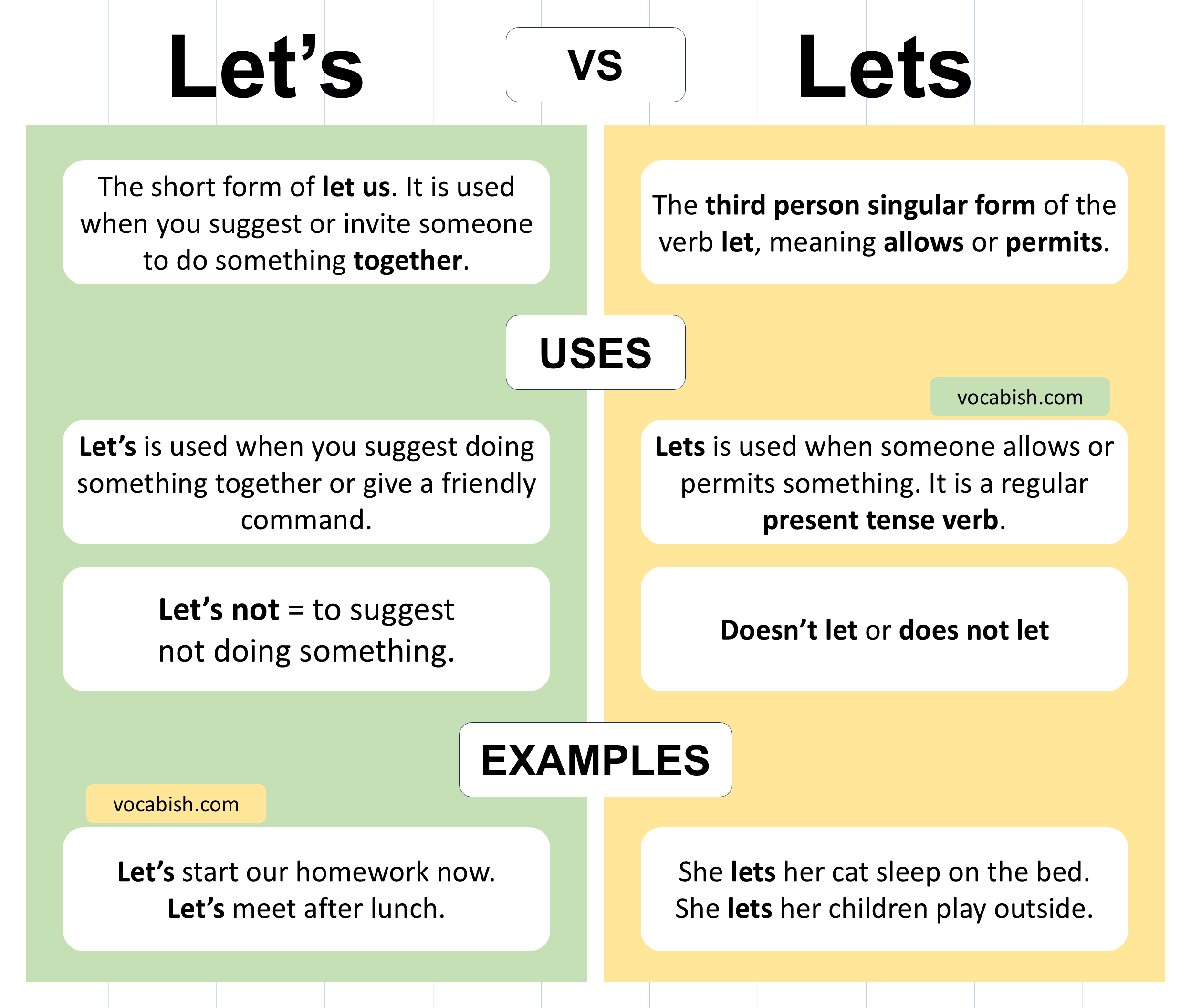
The short form (contraction) of let us. It is used when you suggest or invite someone to do something together.
Example:
- Let’s go for a walk. (= Let us go for a walk.)
- Let’s have dinner outside tonight.
Lets
The third person singular form of the verb let, meaning allows or permits. It is used when someone gives permission or allows something to happen.
Example:
- She lets her children play outside.
- My teacher lets us ask questions in class.
Differences Between Let’s and Lets
| Feature | Let’s | Lets |
|---|---|---|
| Full Form | Let us | Allows / Permits |
| Part of Speech | Contraction | Verb |
| Used For | Making suggestions or invitations | Giving permission or allowing |
| Example | Let’s watch a movie tonight. | He lets his dog sleep on the sofa. |
| Pronunciation | Sounds like “lets” | Same sound, but different meaning |
- If you can replace it with “let us,” use let’s.
- If you can replace it with “allows,” use lets.
Usage of Let’s
Let’s is used when you suggest doing something together or give a friendly command. It is often used in spoken English and informal writing.
- Let’s start our homework now.
- Let’s meet after lunch.
- Let’s not be late for the meeting.
Negative Form: Let’s not = to suggest not doing something.
- Let’s not waste time.
- Let’s not argue about it.
Usage of Lets
Lets is used when someone allows or permits something. It is a regular present tense verb.
- She lets her cat sleep on the bed.
- He lets me borrow his car sometimes.
- My boss lets us leave early on Fridays.
Negative Form: Doesn’t let or does not let
- He doesn’t let anyone touch his phone.
Formal and Informal Uses of Let’s and Lets
| Formality | Example | Usage |
|---|---|---|
| Formal | Let’s discuss this matter professionally. | Used in meetings, polite requests, or teamwork. |
| Informal | Let’s go to the park! | Common in everyday speech with friends and family. |
| Formal | The manager lets employees work from home. | Used in official writing or business context. |
| Informal | My mom lets me stay up late on weekends. | Common in casual, everyday talk. |
Summary on Let’s vs Lets
- Let’s = Let us → Used for suggestions or invitations.
Example: Let’s play football. - Lets = Allows / Permits → Used to show permission.
Example: She lets her dog run in the garden.
In short:
- Use let’s when you want to do something together.
- Use lets when someone gives permission to another person.
FAQs
What is the main difference between let’s and lets?
Let’s means let us, used to make suggestions. Lets means allows, used to give permission.
Is let’s a contraction?
Yes, let’s is a contraction of let us.
When should I use lets?
Use lets when talking about someone allowing something. Example: She lets her brother use her phone.
Can I use let’s in formal writing?
Yes, but sparingly. It’s better suited for friendly or spoken communication.
How can I easily remember the difference?
If it means “allow”, use lets.
If it means “let us”, use let’s.
Let’s and lets may sound the same, but their meanings are different.
- Use let’s when inviting or suggesting something.
- Use lets when showing that someone allows something.
Once you understand this simple rule, you’ll never confuse them again!
Read More