
In this blog post, you will learn about oxymorons in English, which are phrases made of two opposite words used together. Understanding oxymorons helps you master English expressions and see how writers and speakers make ideas more interesting. By studying oxymorons, you can improve your reading, speaking, writing, and listening skills. You will see examples like “bittersweet” or “deafening silence,” and learn how to use them in everyday English to communicate more naturally.
Oxymoron Definition and Examples
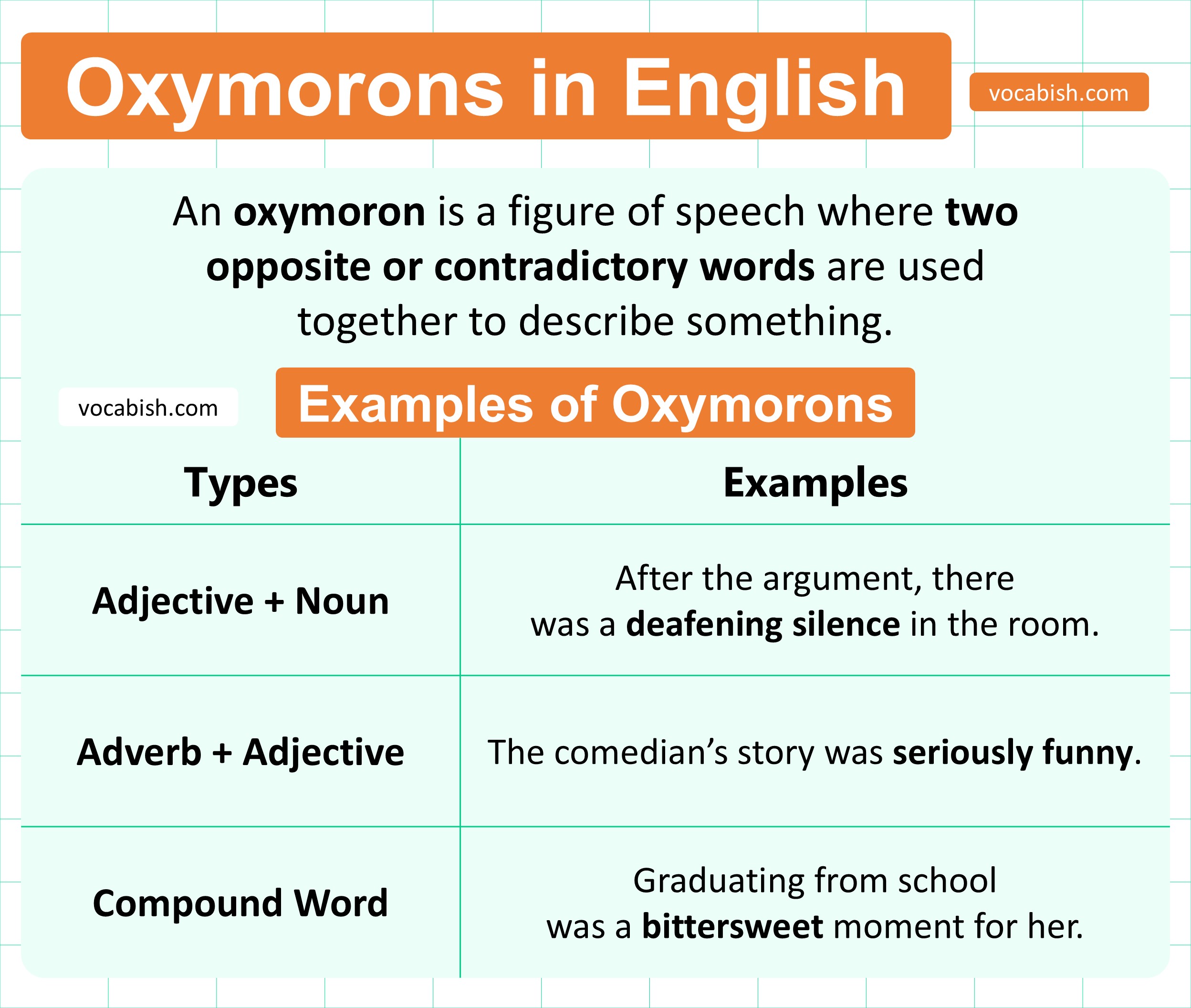
An oxymoron is a figure of speech where two opposite or contradictory words are used together to describe something. The goal is often to create emphasis, humour, or a deeper meaning.
For example:
- Bittersweet – Something that is both happy and sad.
- Living dead – A creature that is both alive and dead (like in stories or films).
The word oxymoron comes from Greek: oxy meaning “sharp” and moros meaning “foolish.” So, the word itself is a combination of opposites!
Types of Oxymorons in English
Different kinds of oxymorons appear in English. Understanding these types helps learners recognize them easily.
1. Adjective + Noun Oxymorons
This is the most common type. An adjective with an opposite meaning describes a noun.
Examples:
- deafening silence
- cruel kindness
- original copy
2. Adverb + Adjective Oxymorons
An adverb changes an adjective to create a contradictory meaning.
Examples:
- seriously funny
- awfully good
3. Compound Word Oxymorons
Sometimes two opposite words combine into a single word.
Examples:
- bittersweet
- sleepwalk
Rules and Usage of Oxymorons
Using oxymorons correctly can make your English more expressive. Here are some simple rules and tips:
- Combine opposites
Always pair words with opposite or contrasting meanings.- Correct: Bittersweet
- Incorrect: Happy joy
- Use for emphasis or creativity
Oxymorons are often used in writing or speech to grab attention. - Keep it short
Most oxymorons are two words, but sometimes three. Avoid long combinations. - Context matters
The meaning depends on the situation. For example, “virtual reality” is clear in tech, but confusing if used literally. - Don’t overuse
Too many oxymorons in a sentence can make your writing hard to understand.
List of Popular Oxymorons and Their Meanings
Below are common oxymorons that English learners should know.
- Deafening Silence – a silence that feels extremely noticeable
- Bittersweet – something both happy and sad
- Open Secret – something many people know but do not talk about
- Living Dead – someone who feels lifeless or exhausted
- Pretty Ugly – surprisingly ugly
- Clearly Confused – very confused but aware of it
- Original Copy – the first version of something
- Awfully Good – extremely good
- Seriously Funny – very funny
- Jumbo Shrimp – something small described as large
- Alone Together – being together but feeling lonely
- Passive Aggressive – showing anger indirectly
- Exact Estimate – a guess that tries to be accurate
- Random Order – an order that appears unplanned
- Small Crowd – a limited number of people
- Cruel Kindness – kindness that causes pain
- Only Choice – the single available option
- Virtual Reality – computer-generated reality
These phrases show how English uses opposite ideas to create strong meaning.
Oxymoron in a Sentence
- Bittersweet – Graduating from school was a bittersweet moment for her.
- Deafening silence – After the argument, there was a deafening silence in the room.
- Jumbo shrimp – We ordered jumbo shrimp at the seafood restaurant.
- Living dead – In the movie, zombies are the living dead creatures roaming the town.
- Seriously funny – The comedian’s story was seriously funny.
- Open secret – Everyone knew about the promotion; it was an open secret.
- Act naturally – The director told the actors to act naturally in front of the camera.
- Small crowd – Despite the festival, only a small crowd showed up.
- Original copy – Please submit the original copy of your passport.
- Alone together – They sat alone together, both lost in their thoughts.
- Clearly misunderstood – Her instructions were clearly misunderstood by the students.
- Pretty ugly – The painting was pretty ugly, but it had a unique style.
- Passive aggressive – He gave a passive aggressive reply instead of being honest.
- Only choice – Moving to a new city was my only choice at that time.
- Dark light – The cave had a strange dark light coming from the crystals.
Common Mistakes to Avoid
Even experienced learners sometimes misuse oxymorons. Here are a few common mistakes and how to avoid them:
- Using non-opposites
- Mistake: Happy joy (both positive)
- Correct: Bittersweet (positive + negative)
- Forgetting context
- Mistake: Virtual reality used in daily physical tasks
- Correct: Use it when talking about technology or games
- Overcomplicating
- Mistake: A large tiny small group
- Correct: Keep it simple: Small crowd
- Mixing with clichés
Avoid combining oxymorons with overused phrases that don’t make sense.
Oxymoron vs Paradox vs Idiom
Oxymorons are sometimes confused with paradoxes and idioms. Here is a comparison:
| Concept | Definition | Example | Difference |
|---|---|---|---|
| Oxymoron | Two opposite words used together | Deafening silence | Short, word-level contrast |
| Paradox | A statement that contradicts itself but may be true | Less is more | Longer phrase, idea-level contrast |
| Idiom | A phrase with figurative meaning | Break a leg | Meaning is not literal; may not use opposites |
Tips to Use Oxymorons Correctly
Follow these easy tips when using oxymorons in English.
Understand the meaning first
Always learn what the phrase actually means.
Use them naturally
Add them where they fit the situation.
Avoid overusing them
Too many oxymorons can confuse readers.
Learn common phrases first
Many oxymorons are fixed expressions in English.
Conclusion
Oxymorons are a fun and useful part of English. They combine opposite words to create meaning, humour, or emphasis. There are different types: literal, humorous, dramatic, and self-contradictory. Remember the rules: keep them short, context-appropriate, and avoid overuse. With practice, you can make your English more creative, expressive, and engaging. Try to spot oxymorons in books, movies, and conversations, and use them in your writing and speaking.
FAQs
An oxymoron is a figure of speech where two opposite words are used together to create meaning, humour, or emphasis in English.
An example of an oxymoron is “bittersweet”, which combines opposite words to describe something that is both happy and sad.
Oxymoron is pronounced /ˌɒk.sɪˈmɔː.rɒn/ in British English and /ˌɑːk.sɪˈmɔː.rɑːn/ in American English.
No, an oxymoron is different from a paradox. Oxymorons are short word pairs with opposite meanings, while paradoxes are longer statements that may seem contradictory.
No, happily married is not an oxymoron because the words are not opposite. Oxymorons require two contradictory terms together.
The purpose of an oxymoron is to create emphasis, humour, or contrast, making English writing and speech more expressive and interesting.
When used for a person, an oxymoron describes someone with opposite traits at the same time, like a “friendly enemy” or “seriously funny” individual.
An oxymoron is two opposite words used together, while a paradox is a longer statement that seems contradictory but can be true.
Related Articles: