
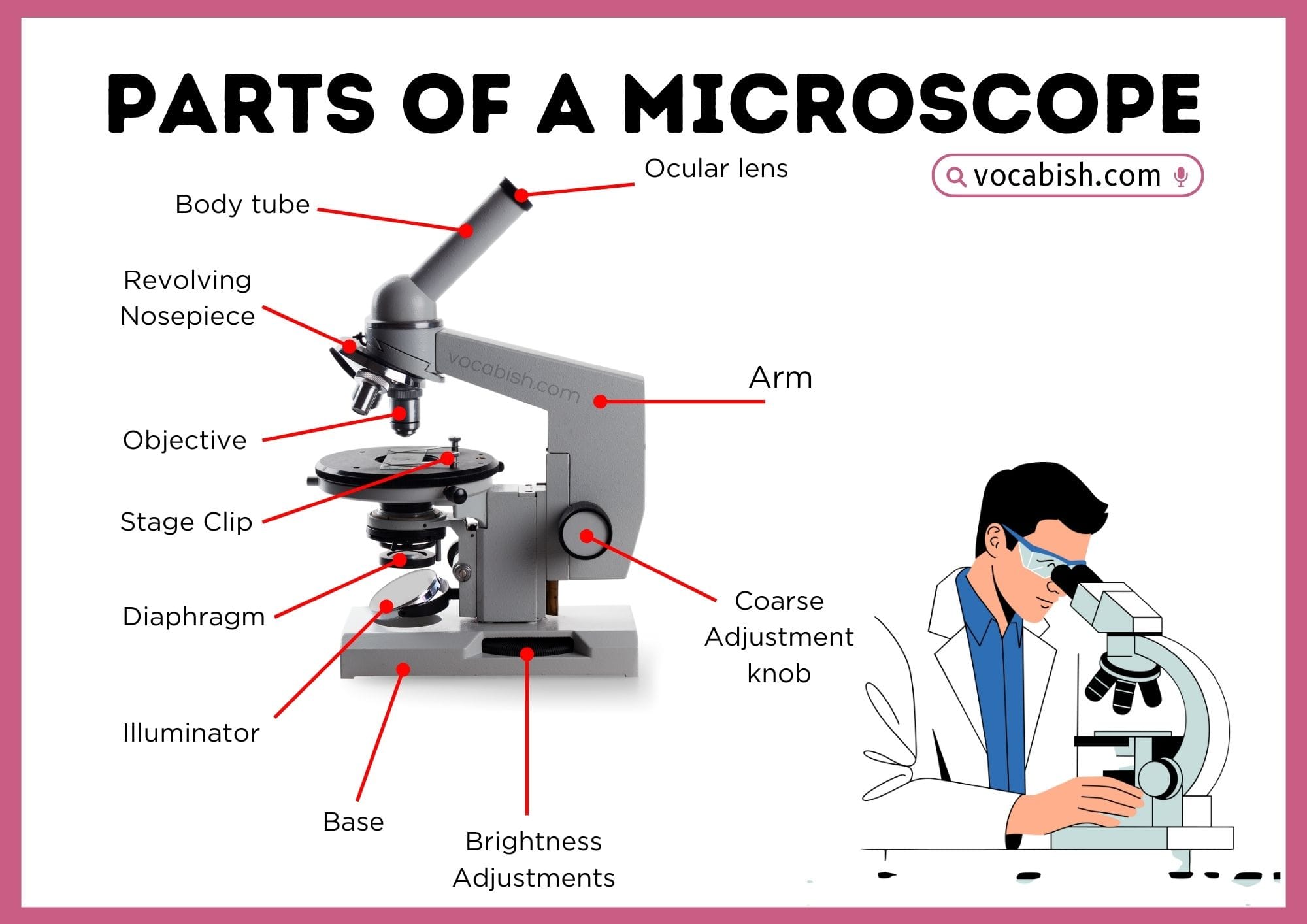
In this blog post, you will learn the different Parts of a Microscope, their Functions, and how they work together to help us see tiny objects clearly. Understanding these parts makes it easier to use a microscope correctly for studying plants, animals, and other small specimens. When you know the function of each part, your practical skills improve, and your science learning becomes more effective. You also improve your reading and understanding because you can follow diagrams, instructions, and experiments with confidence. Step by step, you will master the microscope and explore the microscopic world clearly.
What is a Microscope?
A microscope is a device that magnifies small objects so they can be seen clearly. It is widely used in science labs, schools, and research centres.
Main Parts of a Microscope
1. Eyepiece (Ocular Lens)
- Top viewing lens
- Function: Allows the user to see the image
2. Objective Lenses
- Lenses near the specimen
- Function: Provide different magnification levels
3. Nosepiece
- Rotating part holding objective lenses
- Function: Changes magnification
4. Stage
- Flat platform for slides
- Function: Holds the specimen
5. Stage Clips
- Small metal clips
- Function: Keep slide in place
6. Light Source
- Lamp or mirror below stage
- Function: Illuminates the specimen
7. Diaphragm
- Controls light amount
- Function: Adjusts brightness
8. Coarse Adjustment Knob
- Large focus knob
- Function: Moves stage quickly
9. Fine Adjustment Knob
- Small focus knob
- Function: Sharpens image
10. Arm
- Curved support part
- Function: Holds upper parts together
11. Base
- Bottom support
- Function: Keeps microscope stable
Parts of a Microscope and Their Functions
| Part | Function |
|---|---|
| Eyepiece | View image |
| Objective Lenses | Magnify object |
| Nosepiece | Switch lenses |
| Stage | Hold slide |
| Stage Clips | Secure slide |
| Light Source | Provide light |
| Diaphragm | Control light |
| Coarse Knob | Rough focus |
| Fine Knob | Sharp focus |
| Arm | Support structure |
| Base | Stability |
Types of Microscopes
1. Compound Microscope
A compound microscope is the most commonly used microscope in schools and laboratories. It uses two sets of lenses to magnify very small objects such as cells and bacteria. This microscope provides high magnification and is mainly used to study thin specimens placed on glass slides.
2. Stereo Microscope
A stereo microscope is also called a dissecting microscope. It gives a three-dimensional view of larger objects. This type of microscope is used to examine insects, plants, and small tools. It has lower magnification but shows more surface detail.
3. Digital Microscope
A digital microscope uses a camera and screen instead of an eyepiece. The image is shown on a computer or built-in display. It allows easy viewing, image capture, and sharing. This microscope is useful for learning, presentations, and detailed inspection.
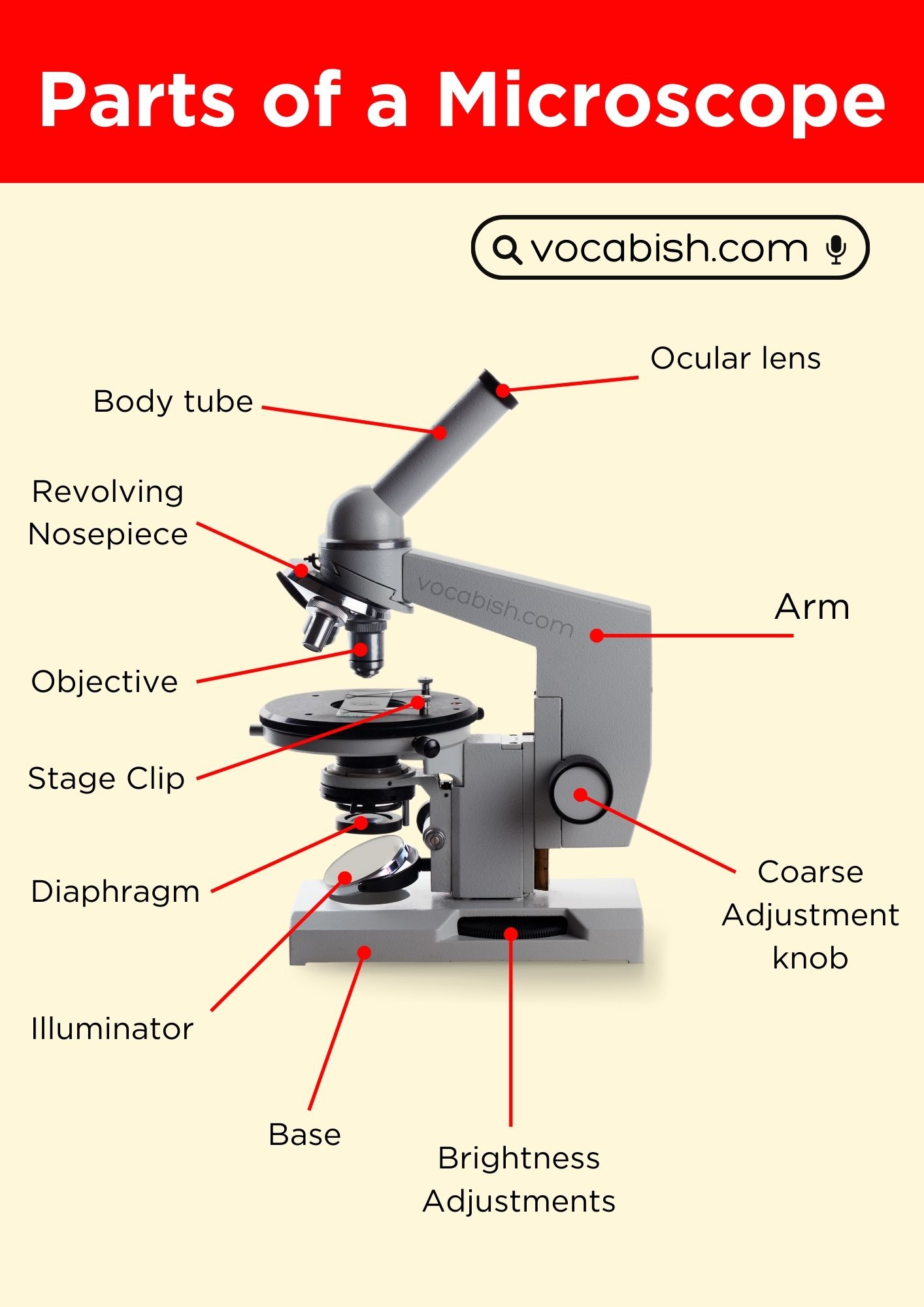
Microscope Parts Diagram
FAQs
What are the main parts of a microscope?
Main parts include eyepiece, objective lenses, stage, diaphragm, light source, and adjustment knobs.
What is the function of objective lenses?
They magnify the specimen at different levels.
Why is the stage important?
It holds the slide securely for viewing.
What does the diaphragm do?
It controls the amount of light.
What is the base of a microscope used for?
It provides balance and support.
Read More