
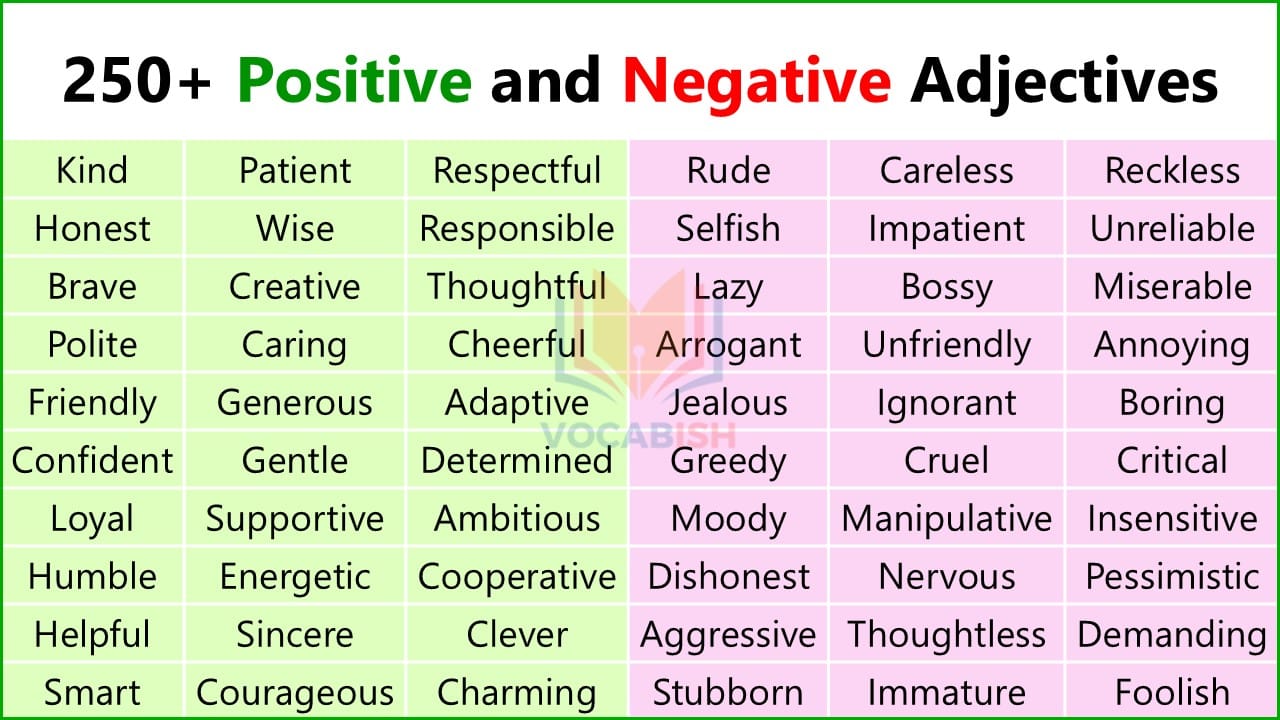
In this blog post, you will learn 250+ of the best positive and negative adjectives in English with meanings and how to use them in sentences. These words help you understand how to describe people, places, things, and situations clearly and accurately. A strong vocabulary of adjectives improves speaking, reading, writing, and listening skills. When you know the right words, you can express opinions and emotions confidently. Our aim is to help you master both positive and negative adjectives step by step. Keep reading and strengthen your English communication today.
Positive Adjectives with Meanings and Examples
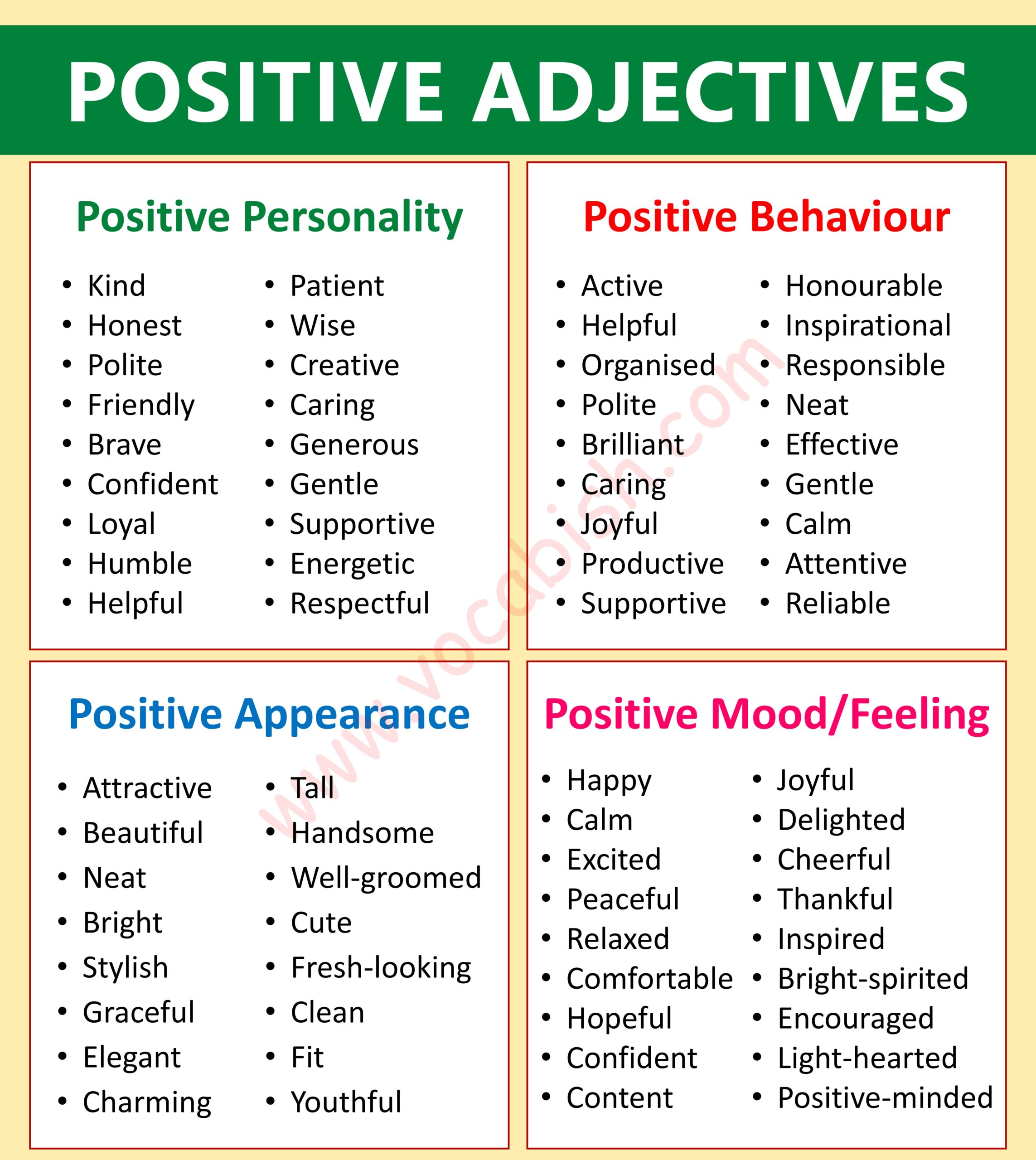
Positive Personality Adjectives
Kind
Caring and considerate towards others.
Example: “She was kind and helped the elderly woman cross the street.”
Honest
Tells the truth and is sincere.
Example: “He was honest about breaking the vase.”
Polite
Shows good manners and respect.
Example: “The polite boy said thank you after receiving the gift.”
Friendly
Kind and pleasant to others.
Example: “She was friendly and greeted everyone warmly.”
Brave
Shows courage in difficult situations.
Example: “The brave boy rescued the kitten from the tree.”
Confident
Believes in oneself and abilities.
Example: “She felt confident before giving her presentation.”
Loyal
Faithful and supportive to friends or family.
Example: “He was loyal and always defended his friend.”
Humble
Not proud or arrogant; modest.
Example: “The humble student thanked everyone for their help.”
Helpful
Willing to assist others.
Example: “He was helpful and carried the heavy bag for her.”
Patient
Able to wait calmly without getting upset.
Example: “She was patient while teaching the younger children.”
Wise
Shows good judgment and understanding.
Example: “The wise teacher gave valuable advice to the students.”
Creative
Able to think of new ideas or make art.
Example: “The creative child painted a beautiful picture.”
Caring
Shows concern and kindness for others.
Example: “She was caring and looked after her sick friend.”
Generous
Willing to give or share with others.
Example: “He was generous and donated toys to the orphanage.”
Gentle
Kind, soft, and careful in actions.
Example: “The gentle boy petted the small puppy carefully.”
Supportive
Provides help or encouragement to others.
Example: “She was supportive and cheered for her friend during the game.”
Energetic
Full of energy and lively.
Example: “The energetic children ran around the playground happily.”
Respectful
Shows consideration and politeness to others.
Example: “He was respectful and listened to the teacher attentively.”
Responsible
Takes care of duties and actions.
Example: “She was responsible and completed all her homework on time.”
Sincere
Genuine and honest in feelings or words.
Example: “He gave a sincere apology for breaking the window.”
Courageous
Faces danger or challenges without fear.
Example: “The courageous firefighter entered the burning building.”
Thoughtful
Shows care and consideration for others.
Example: “She was thoughtful and brought flowers for her friend.”
Cheerful
Happy and optimistic in mood.
Example: “The cheerful girl smiled at everyone she met.”
Smart
Shows intelligence and good understanding.
Example: “The smart student solved the puzzle quickly.”
Adaptive
Able to adjust to new situations easily.
Example: “She was adaptive and quickly learned the new rules.”
Determined
Strongly motivated to achieve goals.
Example: “He was determined to finish the marathon.”
Ambitious
Has strong desire to succeed or achieve.
Example: “The ambitious boy wanted to become a scientist.”
Cooperative
Works well with others.
Example: “She was cooperative and helped her classmates with the project.”
Open-minded
Willing to consider new ideas or opinions.
Example: “He was open-minded and listened to different viewpoints.”
Hard-working
Puts in effort and works diligently.
Example: “The hard-working student studied late into the night.”
Affectionate
Shows love and care openly.
Example: “She was affectionate and hugged her little brother.”
Faithful
Loyal and true to promises or relationships.
Example: “He was faithful and always supported his friend.”
Warm
Kind, friendly, and comforting.
Example: “The warm teacher welcomed all the students with a smile.”
Positive
Optimistic and hopeful about situations.
Example: “She stayed positive even after failing the test.”
Clever
Quick to understand and solve problems.
Example: “The clever boy figured out the puzzle easily.”
Charming
Pleasant and attractive in personality.
Example: “The charming girl made everyone smile with her jokes.”
Calm
Not easily upset; relaxed.
Example: “He stayed calm during the noisy fire drill.”
Honest-hearted
Always truthful and sincere in actions.
Example: “The honest-hearted student returned the lost wallet.”
Dedicated
Committed to a task or purpose.
Example: “She was dedicated and practiced the piano every day.”
Hopeful
Feeling optimistic about the future.
Example: “He was hopeful that he would pass the exam.”
Motivated
Eager and ready to achieve something.
Example: “The motivated boy completed all his assignments early.”
Mature
Acts responsibly and with good judgment.
Example: “The mature student helped settle the argument calmly.”
Dependable
Reliable and trustworthy.
Example: “She was dependable and always delivered work on time.”
Forgiving
Willing to pardon others’ mistakes.
Example: “He was forgiving and let his friend borrow his book again.”
Grateful
Shows thankfulness and appreciation.
Example: “She was grateful for the help from her teacher.”
Balanced
Maintains stability in emotions and actions.
Example: “The balanced student managed studies and sports well.”
Purposeful
Acts with clear goals or intentions.
Example: “He was purposeful and focused on finishing his painting.”
Focused
Concentrates fully on a task or goal.
Example: “She was focused and completed the assignment quickly.”
Self-disciplined
Controls oneself to achieve goals or follow rules.
Example: “The self-disciplined boy practiced piano every day without skipping.”
Optimistic
Looks at situations positively and expects good results.
Example: “She stayed optimistic even when the project was difficult.”
Positive Behaviour Adjectives
Active
Energetic and always ready to do tasks.
Example: “She was active during the school sports day.”
Helpful
Willing to assist others when needed.
Example: “He was helpful and carried the groceries for his neighbour.”
Organised
Arranged and planned in an orderly way.
Example: “The organised student kept all his notes in folders.”
Polite
Shows good manners and respect to everyone.
Example: “She was polite and greeted her teacher with a smile.”
Brilliant
Very intelligent or impressive.
Example: “The brilliant student solved the tricky puzzle quickly.”
Caring
Shows concern and kindness for others.
Example: “He was caring and helped his friend when he fell.”
Joyful
Feeling happy and cheerful.
Example: “The joyful children played games in the park.”
Productive
Achieves a lot in a given time.
Example: “She was productive and finished all her homework early.”
Supportive
Provides help and encouragement to others.
Example: “He was supportive and cheered for his teammate during the match.”
Honourable
Shows honesty and high moral standards.
Example: “The honourable boy returned the lost wallet to its owner.”
Inspirational
Encourages others to do their best.
Example: “The inspirational teacher motivated students to study hard.”
Responsible
Takes care of duties and actions seriously.
Example: “She was responsible and completed all her chores on time.”
Neat
Clean and well-organised in appearance or work.
Example: “He kept a neat desk with everything in place.”
Effective
Produces good results in work or actions.
Example: “The effective student used his time wisely to study.”
Gentle
Kind, soft, and careful in actions.
Example: “She was gentle while holding the small puppy.”
Calm
Not easily upset; relaxed and peaceful.
Example: “He stayed calm during the loud fire drill.”
Attentive
Pays close attention and listens carefully.
Example: “The attentive student noted everything the teacher said.”
Reliable
Can be trusted to do tasks properly.
Example: “He was reliable and always delivered his homework on time.”
Tidy
Clean and organised in appearance or space.
Example: “The tidy room made it easy to find books.”
Purposeful
Acts with clear intention or goal.
Example: “She was purposeful and focused on finishing the project.”
Sharp-minded
Quick to understand and think clearly.
Example: “The sharp-minded boy solved the puzzle easily.”
Quick-thinking
Able to react and make decisions fast.
Example: “She was quick-thinking and helped during the emergency.”
Cooperative
Works well with others to achieve a goal.
Example: “The cooperative students completed the group project together.”
Positive Appearance Adjectives
Attractive
Pleasant to look at or appealing in appearance.
Example: “She looked attractive in her new dress.”
Beautiful
Very pleasing to see or admire.
Example: “The sunset was beautiful over the mountains.”
Neat
Clean, tidy, and well-organised.
Example: “His neat room made it easy to find books.”
Bright
Full of light or vivid in colour.
Example: “She wore a bright scarf that caught everyone’s attention.”
Stylish
Having fashionable appearance or design.
Example: “He looked stylish in his new jacket.”
Graceful
Shows smooth and elegant movements.
Example: “The dancer was graceful on stage.”
Elegant
Refined, classy, and pleasing in style.
Example: “She wore an elegant dress to the party.”
Charming
Pleasant and attractive in personality or looks.
Example: “The charming boy made everyone smile with his jokes.”
Healthy
Strong, well, and full of energy.
Example: “She looked healthy after exercising daily.”
Tall
Above average in height.
Example: “The tall basketball player reached the hoop easily.”
Handsome
Good-looking, usually for men.
Example: “He looked handsome in his formal suit.”
Well-groomed
Clean, tidy, and carefully maintained in appearance.
Example: “The well-groomed man impressed everyone at the meeting.”
Cute
Attractive in a sweet or charming way.
Example: “The cute puppy made the children laugh.”
Fresh-looking
Appears lively, clean, and healthy.
Example: “She looked fresh-looking after a good night’s sleep.”
Clean
Free from dirt and well-kept.
Example: “He wore clean clothes to school.”
Fit
Healthy and strong in body.
Example: “The fit runner finished the marathon easily.”
Youthful
Looks young or full of energy.
Example: “She had a youthful smile that lit up the room.”
Positive Work and Study Adjectives
Efficient
Works quickly and effectively without wasting time.
Example: “The efficient worker completed the task before the deadline.”
Skilled
Has expertise or ability in a specific area.
Example: “The skilled carpenter made a beautiful wooden table.”
Professional
Shows competence and proper behaviour at work.
Example: “She gave a professional presentation to the clients.”
Talented
Has a natural ability or skill.
Example: “The talented musician played the piano beautifully.”
Focused
Concentrates fully on a task or goal.
Example: “He was focused and finished his homework quickly.”
Innovative
Creates new ideas or methods.
Example: “The innovative student designed a new app for learning.”
Capable
Has the ability to do something well.
Example: “She is capable of managing the team efficiently.”
Sharp
Quick to notice or understand things.
Example: “The sharp student answered all the questions correctly.”
Consistent
Performs reliably in the same way over time.
Example: “He is consistent in completing his daily exercises.”
Organised
Arranged neatly and methodically.
Example: “The organised manager kept all files in order.”
Logical
Uses clear and reasonable thinking.
Example: “Her logical approach solved the problem efficiently.”
Quick
Able to do things fast.
Example: “He was quick to respond to the emergency call.”
Accurate
Correct and free from mistakes.
Example: “The accountant was accurate in all financial records.”
Intelligent
Shows good understanding or learning ability.
Example: “The intelligent student quickly grasped the difficult concept.”
Creative
Able to produce original ideas or work.
Example: “The creative artist painted a unique mural.”
Hard-working
Puts in effort and works diligently.
Example: “The hard-working student studied late into the night.”
Expert
Has a high level of skill or knowledge.
Example: “She is an expert in computer programming.”
Disciplined
Follows rules and maintains self-control.
Example: “The disciplined athlete trained every morning without fail.”
Analytical
Able to examine details carefully to understand or solve problems.
Example: “The analytical student studied the experiment data thoroughly.”
Productive
Achieves a lot in a given time.
Example: “The productive employee completed all tasks before lunch.”
Positive Mood and Feeling Adjectives
Happy
Feeling good and pleased with something.
Example: “She was happy to receive a gift from her friend.”
Calm
Peaceful and relaxed, not worried or upset.
Example: “He stayed calm during the noisy fire drill.”
Excited
Feeling very happy and eager about something.
Example: “The children were excited to go on the school trip.”
Peaceful
Free from disturbance; quiet and relaxed.
Example: “The park was peaceful in the early morning.”
Relaxed
Feeling comfortable and at ease.
Example: “She felt relaxed after a warm bath.”
Comfortable
Feeling physically or mentally at ease.
Example: “He was comfortable sitting by the fireplace.”
Hopeful
Feeling optimistic about the future.
Example: “She was hopeful that she would pass the exam.”
Confident
Believes in oneself and abilities.
Example: “He felt confident before giving his speech.”
Content
Satisfied with what one has or feels.
Example: “She was content with her simple lunch.”
Joyful
Feeling very happy and cheerful.
Example: “The joyful children played in the garden.”
Delighted
Extremely pleased or happy about something.
Example: “He was delighted to see his favourite book arrive.”
Cheerful
Happy and positive in mood.
Example: “The cheerful girl greeted everyone with a smile.”
Thankful
Feeling gratitude for something received.
Example: “She was thankful for her friend’s help with homework.”
Inspired
Motivated to do something good or creative.
Example: “He was inspired by the teacher’s story.”
Bright-spirited
Full of energy and a positive attitude.
Example: “The bright-spirited team finished the project quickly.”
Encouraged
Given confidence or support to continue.
Example: “She was encouraged by her teacher’s kind words.”
Light-hearted
Carefree and cheerful in mood.
Example: “He remained light-hearted even after the long day.”
Positive-minded
Thinks optimistically and focuses on good things.
Example: “She stayed positive-minded despite the challenges.”
Negative Adjectives Meanings and Examples
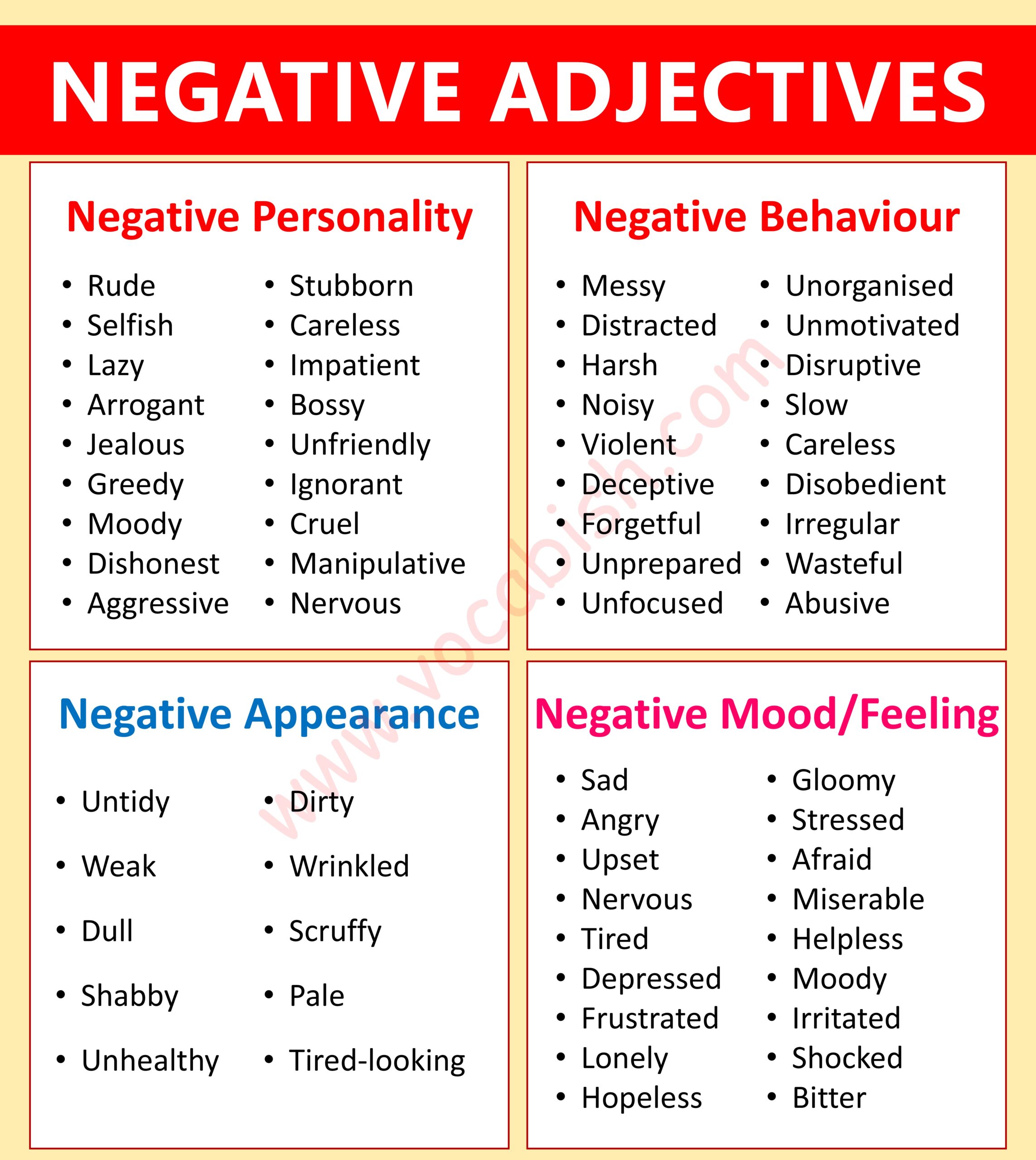
Negative Personality Adjectives
Rude
Behaves impolitely or disrespectfully towards others.
Example: “It was rude to interrupt the teacher during class.”
Selfish
Cares only about oneself and not others.
Example: “He was selfish and didn’t share his lunch.”
Lazy
Avoids work or effort.
Example: “The lazy boy stayed in bed all morning.”
Arrogant
Thinks one is better than others.
Example: “She was arrogant and refused to listen to advice.”
Jealous
Wants what others have and feels envious.
Example: “He felt jealous when his friend got a new bike.”
Greedy
Wants more than needed, especially food or money.
Example: “The greedy man took extra pieces of cake.”
Moody
Changes emotions quickly and often.
Example: “She was moody and quiet one moment, laughing the next.”
Dishonest
Does not tell the truth.
Example: “He was dishonest about breaking the vase.”
Aggressive
Uses force or anger in words or actions.
Example: “The aggressive player pushed others during the game.”
Stubborn
Refuses to change one’s mind or opinion.
Example: “She was stubborn and didn’t apologise.”
Careless
Does things without attention and makes mistakes.
Example: “He was careless and spilled juice on the floor.”
Impatient
Cannot wait calmly or tolerate delays.
Example: “She was impatient while waiting in the long queue.”
Bossy
Gives orders in an unpleasant way.
Example: “The bossy student told everyone what to do.”
Unfriendly
Not kind or welcoming towards others.
Example: “He was unfriendly and did not greet anyone.”
Ignorant
Lacks knowledge or awareness about something.
Example: “It was ignorant to ignore the safety rules.”
Cruel
Hurts others intentionally, physically or emotionally.
Example: “The cruel boy teased the puppy.”
Manipulative
Tries to control or influence others unfairly.
Example: “She was manipulative and made others do her work.”
Nervous
Feeling worried or anxious.
Example: “He was nervous before his speech.”
Thoughtless
Does not consider others’ feelings or needs.
Example: “It was thoughtless to borrow without asking.”
Immature
Behaves childishly or without maturity.
Example: “The immature student laughed during the serious meeting.”
Reckless
Acts without thinking about danger or consequences.
Example: “He was reckless while riding his bike on the road.”
Unreliable
Cannot be depended on.
Example: “The unreliable friend forgot to pick me up.”
Weak-minded
Easily influenced and lacks mental strength.
Example: “The weak-minded student copied answers from others.”
Annoying
Causes irritation or trouble.
Example: “His constant humming was annoying in class.”
Boring
Not interesting or exciting.
Example: “The lecture was boring and many students dozed off.”
Critical
Often points out faults or mistakes.
Example: “The critical teacher always highlighted errors in the essays.”
Insensitive
Does not notice or care about others’ feelings.
Example: “It was insensitive to laugh at her mistake.”
Pessimistic
Always expects the worst outcomes.
Example: “He was pessimistic and worried the plan would fail.”
Demanding
Asks for too much or insists strongly.
Example: “The demanding manager expected reports immediately.”
Foolish
Shows poor judgment or lacks sense.
Example: “It was foolish to play near the busy road.”
Harsh
Severe or strict in actions or words.
Example: “The teacher’s harsh comment upset the student.”
Short-tempered
Gets angry quickly.
Example: “He was short-tempered and shouted at small mistakes.”
Argumentative
Likes to argue or disagree.
Example: “The argumentative student challenged every idea in class.”
Overconfident
Too sure of oneself, often ignoring risks.
Example: “She was overconfident and failed to prepare properly.”
Disrespectful
Shows rudeness or lack of respect.
Example: “He was disrespectful and interrupted the speaker.”
Unkind
Not caring or considerate towards others.
Example: “The unkind boy teased his classmates.”
Troublesome
Causes problems or difficulty.
Example: “The troublesome child kept breaking toys.”
Distrusting
Does not trust others easily.
Example: “She was distrusting and checked everyone’s work twice.”
Cold-hearted
Lacks sympathy or compassion.
Example: “The cold-hearted man ignored the homeless person.”
Irresponsible
Does not take responsibility for actions.
Example: “He was irresponsible and forgot to lock the door.”
Uncaring
Does not care about others’ needs or feelings.
Example: “The uncaring student ignored the crying classmate.”
Miserable
Very unhappy or uncomfortable.
Example: “He felt miserable during the rainy, cold day.”
Clueless
Having no knowledge or understanding.
Example: “She was clueless about the maths problem.”
Hostile
Unfriendly or aggressive towards others.
Example: “The hostile dog barked at everyone passing by.”
Unstable
Not steady physically or emotionally.
Example: “He was unstable and couldn’t balance on the ladder.”
Dramatic
Overreacts or behaves in an exaggerated way.
Example: “She was dramatic when she spilled water on her dress.”
Tense
Feeling nervous or worried.
Example: “He felt tense before the exam.”
Ungrateful
Does not show thanks or appreciation.
Example: “The ungrateful child ignored the gift.”
Negative Behaviour Adjectives
Messy
Untidy and disorganised in actions or surroundings.
Example: “His desk was messy with papers everywhere.”
Distracted
Unable to focus because attention is elsewhere.
Example: “She was distracted by her phone during class.”
Harsh
Severe or strict in words or actions.
Example: “The teacher gave harsh criticism about the essay.”
Noisy
Making a lot of loud sounds.
Example: “The children were noisy while playing in the park.”
Violent
Using physical force to harm someone.
Example: “The violent storm broke windows in the town.”
Deceptive
Misleading or not truthful.
Example: “His smile was deceptive; he was hiding the truth.”
Forgetful
Often fails to remember things.
Example: “She was forgetful and left her homework at home.”
Unprepared
Not ready or lacking necessary materials.
Example: “He was unprepared for the test and forgot his notes.”
Unfocused
Unable to concentrate on tasks.
Example: “She was unfocused and kept looking out the window.”
Unorganised
Not arranged or planned properly.
Example: “The unorganised files made it hard to find information.”
Unmotivated
Lacking desire or drive to work.
Example: “He felt unmotivated and did not complete the project.”
Disruptive
Causes interruptions or problems in activities.
Example: “The disruptive student kept talking during the lesson.”
Slow
Takes longer than usual to complete tasks.
Example: “He was slow to finish the homework.”
Careless
Not paying enough attention; making mistakes.
Example: “She was careless and spilled water on the papers.”
Disobedient
Does not follow rules or instructions.
Example: “The disobedient child refused to clean his room.”
Irregular
Not consistent or happening at unusual times.
Example: “His irregular attendance affected his grades.”
Wasteful
Uses resources carelessly or unnecessarily.
Example: “She was wasteful and left the water running.”
Abusive
Hurts others with words or actions.
Example: “He was abusive to the small animals.”
Annoying
Causes irritation or trouble to others.
Example: “His constant humming was annoying to everyone nearby.”
Inactive
Not participating or taking action.
Example: “The inactive student didn’t join any class activities.”
Dependent
Relies on others for help or support.
Example: “The child was dependent on his parents for everything.”
Irresponsible
Does not take responsibility for actions or duties.
Example: “He was irresponsible and forgot to lock the door.”
Negative Appearance Adjectives
Untidy
Not neat or organised in appearance.
Example: “His room was untidy with clothes all over the floor.”
Weak
Lacking physical strength or energy.
Example: “She felt weak after being sick for a week.”
Dull
Not bright, interesting, or lively.
Example: “The paint on the wall looked dull and faded.”
Shabby
Old, worn out, or in poor condition.
Example: “He wore a shabby coat with torn sleeves.”
Unhealthy
Not in good physical or mental condition.
Example: “Eating too much junk food is unhealthy for children.”
Dirty
Covered with dirt or unclean.
Example: “Her hands were dirty after gardening.”
Wrinkled
Having lines or folds, usually in skin or clothes.
Example: “The old shirt was wrinkled and needed ironing.”
Scruffy
Messy and untidy in appearance.
Example: “The scruffy dog wandered around the park.”
Pale
Having a light or weak colour in skin.
Example: “She looked pale after staying indoors all week.”
Tired-looking
Appearing exhausted or lacking energy.
Example: “He looked tired-looking after the long journey.”
Rough
Not smooth; coarse or uneven.
Example: “The rope felt rough in my hands.”
Skinny
Very thin, sometimes unhealthy.
Example: “The skinny cat ate all its food quickly.”
Messy-looking
Appearing untidy or disorderly.
Example: “His messy-looking hair needed a comb.”
Negative Work and Study Adjectives
Unskilled
Lacking ability or training to do a task properly.
Example: “The unskilled worker struggled to operate the machine.”
Unprofessional
Behaving in a way that is not suitable for work.
Example: “It was unprofessional to arrive late to the meeting.”
Careless
Not paying enough attention and making mistakes.
Example: “He was careless and spilled coffee on the documents.”
Inexperienced
Not having enough knowledge or practice in a task.
Example: “The inexperienced driver needed guidance on busy roads.”
Confused
Unable to understand or think clearly.
Example: “She was confused by the new instructions at work.”
Incompetent
Not able to do a job correctly.
Example: “The manager said the employee was incompetent at handling reports.”
Disruptive
Causing problems or interruptions in work or activities.
Example: “The disruptive student kept talking during the lesson.”
Unproductive
Not achieving much or wasting time.
Example: “The team felt unproductive without a clear plan.”
Slow
Takes a long time to complete tasks.
Example: “He was slow in finishing the project.”
Irregular
Not consistent or happening at unexpected times.
Example: “Her attendance at work was irregular this month.”
Disorganised
Messy or lacking order in work or surroundings.
Example: “The disorganised desk made it hard to find papers.”
Poor-performing
Doing a job badly or below expectations.
Example: “The poor-performing student failed the exam.”
Clumsy
Awkward or prone to accidents.
Example: “He was clumsy and dropped the glass.”
Forgetful
Often fails to remember things.
Example: “She was forgetful and left her notebook at home.”
Unaware
Not knowing what is happening around.
Example: “He was unaware of the meeting schedule.”
Unfocused
Unable to concentrate on tasks.
Example: “She was unfocused and kept checking her phone.”
Inattentive
Not paying attention or noticing details.
Example: “The inattentive student missed important instructions.”
Unprepared
Not ready or lacking necessary materials.
Example: “He was unprepared for the exam and forgot his notes.”
Negative Mood and Feeling Adjectives
Sad
Feeling unhappy or sorrowful.
Example: “She felt sad when her friend moved away.”
Angry
Feeling strong displeasure or frustration.
Example: “He was angry when someone broke his toy.”
Upset
Feeling unhappy or disturbed.
Example: “She was upset after losing her favourite book.”
Nervous
Feeling worried or anxious about something.
Example: “He was nervous before his first school presentation.”
Tired
Feeling exhausted or needing rest.
Example: “I felt tired after walking all day.”
Depressed
Feeling very sad or hopeless for a long time.
Example: “She felt depressed after failing the exam.”
Frustrated
Feeling annoyed due to problems or obstacles.
Example: “He was frustrated when the computer kept crashing.”
Lonely
Feeling alone or isolated.
Example: “She felt lonely during the long vacation.”
Hopeless
Feeling without hope or optimism.
Example: “He felt hopeless after losing the competition.”
Gloomy
Feeling sad or pessimistic.
Example: “The rainy weather made her feel gloomy.”
Stressed
Feeling pressure or tension.
Example: “He was stressed before submitting the big project.”
Afraid
Feeling fear or worry.
Example: “She was afraid of the dark room.”
Miserable
Feeling very unhappy or uncomfortable.
Example: “He felt miserable during the long, rainy day.”
Helpless
Feeling unable to do anything.
Example: “She felt helpless when she couldn’t fix the broken vase.”
Moody
Changes feelings quickly and often.
Example: “He was moody and didn’t want to talk today.”
Irritated
Feeling annoyed or bothered.
Example: “She was irritated by the loud noise outside.”
Shocked
Feeling surprised or upset suddenly.
Example: “He was shocked to hear the unexpected news.”
Bitter
Feeling angry or hurt about something unfair.
Example: “She felt bitter after losing the competition unfairly.”
Confused
Unable to think clearly or understand.
Example: “He was confused by the difficult instructions.”
Discouraged
Feeling less confident or hopeful.
Example: “She felt discouraged after failing the first test.”
Mixed or Neutral Adjectives
Serious
Focused and thoughtful in behaviour.
Example: “She was serious about completing her homework.”
Quiet
Speaks little; calm and peaceful.
Example: “He stayed quiet during the meeting.”
Shy
Nervous around strangers or crowds.
Example: “The shy girl hid behind her friend.”
Strong-willed
Determined and does not give up easily.
Example: “He was strong-willed and finished the project alone.”
Emotional
Shows feelings clearly.
Example: “She became emotional when reading the letter.”
Simple
Modest and easy-going.
Example: “He wore simple clothes to school.”
Direct
Speaks clearly and honestly.
Example: “She was direct about her opinion.”
Bold
Confident and brave.
Example: “The bold boy answered first in class.”
Soft-spoken
Speaks gently and quietly.
Example: “The soft-spoken teacher explained slowly.”
Reserved
Keeps thoughts and feelings private.
Example: “He was reserved and rarely shared personal stories.”
Examples in Sentences
- She is a kind and helpful student.
- The weather today is gloomy.
- He is lazy and never finishes his work.
- The girl looked elegant in the dress.
- His idea was creative and useful.
- The service was slow and unprofessional.
Adjectives make your English more descriptive, natural, and powerful. With these 250+ positive and negative adjectives, you can speak and write with more confidence. Use the lists, tables, and examples to practise daily. The more adjectives you learn, the clearer and stronger your communication becomes.
FAQs about Positive and Negative Adjectives
What are positive and negative adjectives?
Positive and negative adjectives are describing words that show good or bad qualities. Positive adjectives express good traits, while negative adjectives show unpleasant or difficult traits.
What are negative adjectives?
Negative adjectives are words that describe bad, unpleasant, or unwanted qualities in a person, thing, or situation. Examples include rude, lazy, selfish, and careless.
What is a positive adjective example?
A positive adjective example is kind.
Example sentence: “She is a kind person.”
The word kind shows a good and pleasant quality.
What are 10 positive words?
Here are 10 simple positive adjectives:
- Kind
- Honest
- Helpful
- Friendly
- Happy
- Creative
- Calm
- Polite
- Confident
- Brave
How do I use positive adjectives in sentences?
Use positive adjectives to show good qualities.
Example: “She is a kind person.” The adjective kind describes the person directly.
Read More