
In this blog post, you will learn the difference between your and you’re. These two words sound the same, but they have different meanings and grammar uses. Many learners confuse them because one shows possession, while the other is a contraction of you are. When you understand the difference, you can write more accurately and avoid common mistakes in messages, essays, and conversations. Knowing how to use them correctly will also improve your speaking, reading, and listening skills. Keep reading to master their correct use with helpful examples.
You can explore our 100 confusing words list to expand your vocabulary skills!
Meanings of Your and You’re
Your
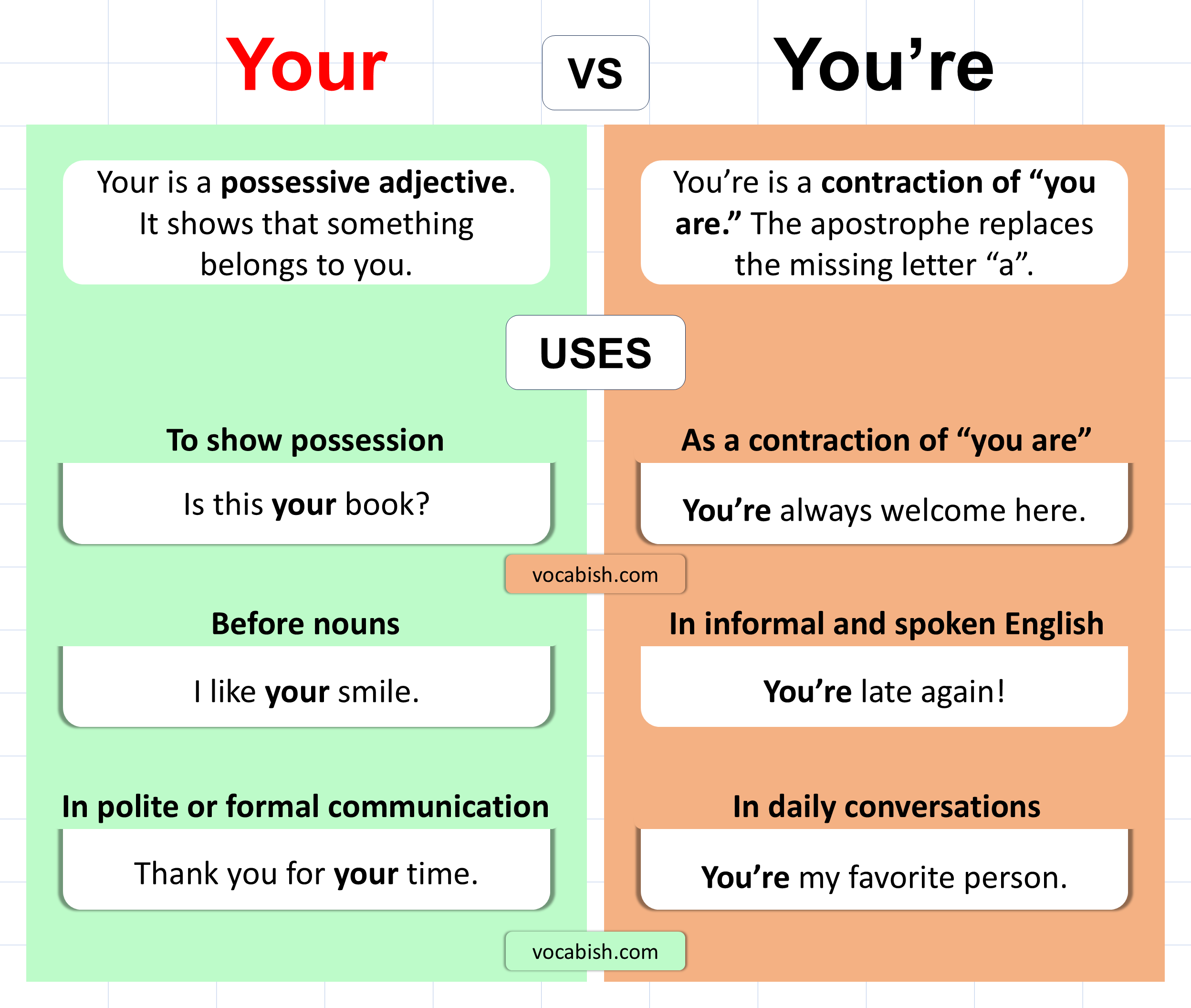
Your is a possessive adjective. It shows that something belongs to you.
Example:
- Your bag is on the chair.
- I like your idea.
You’re
You’re is a contraction of “you are.” The apostrophe replaces the missing letter “a”.
Example:
- You’re my best friend.
- You’re doing a great job.
Differences Between Your and You’re
| Word | Type | Meaning | Example |
|---|---|---|---|
| Your | Possessive adjective | Shows ownership or belonging | Your phone is ringing. |
| You’re | Contraction | Short form of you are | You’re very kind. |
- If you can replace the word with “you are,” use you’re.
- If it shows possession, use your.
Usage of Your
1. To show possession
- Please take your seat.
- Is this your book?
2. Before nouns
- I like your smile.
- Don’t forget your keys.
3. In polite or formal communication
- Thank you for your time.
- We appreciate your support.
Usage of You’re
1. As a contraction of “you are”
- You’re always welcome here.
- You’re learning English fast.
2. In informal and spoken English
- You’re late again!
- I think you’re right.
3. In daily conversations
- You’re my favorite person.
- You’re so funny today.
Formal and Informal Uses of Your and You’re
| Type | Your | You’re |
|---|---|---|
| Formal | “We value your cooperation.” | “You’re invited to the annual meeting.” |
| Informal | “Is that your phone?” | “You’re awesome!” |
Example Sentences with Your
- Don’t forget your umbrella.
- I love your handwriting.
- Is this your notebook?
- Please bring your ID card.
- Your voice is beautiful.
- I saw your brother at the park.
- Take care of your health.
- That’s your decision to make.
- What’s your favorite color?
- Remember to close your door.
- Your help means a lot to me.
- Did you do your homework?
- I like your new shoes.
- Keep your phone on silent.
- Enjoy your weekend!
- Thank you for your kindness.
- Your plan sounds great.
- Don’t forget your lunch.
- How is your family?
- Your time is valuable.
Example Sentences with You’re
- You’re my best friend.
- You’re very smart.
- You’re doing great work.
- You’re welcome anytime.
- You’re late for class again!
- You’re right about that.
- You’re always so positive.
- You’re going to love this movie.
- You’re amazing at cooking.
- You’re not listening to me.
- You’re really kind-hearted.
- You’re learning English fast.
- You’re the reason I’m smiling.
- You’re such a good friend.
- You’re not allowed to enter.
- You’re very funny today.
- You’re tired after work.
- You’re always on time.
- You’re too generous.
- You’re absolutely correct!
FAQs on Your vs You’re
What is the main difference between “your” and “you’re”?
Your shows ownership, while you’re means you are.
How can I check if I’m using the right word?
Replace the word with you are. If the sentence still makes sense, use you’re.
Can “your” ever mean “you are”?
No, your only shows possession — never use it as a contraction.
Is “you’re” used in formal writing?
It can be, but in very formal writing, it’s better to use you are instead of you’re.
What are some common mistakes with “your” and “you’re”?
Example of a mistake: Your welcome.
Correct: You’re welcome.
Read More