
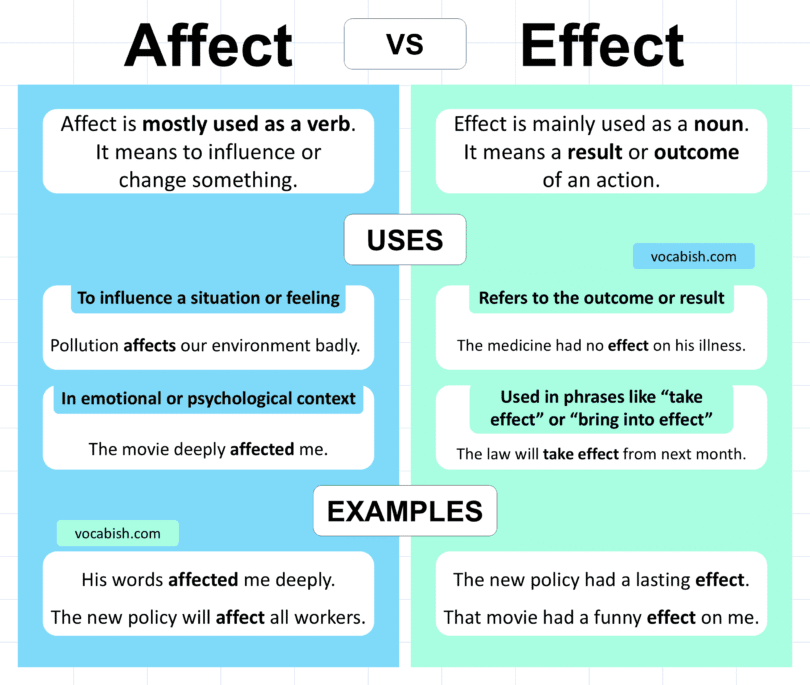

Many English learners confuse Affect vs Effect because both words are connected to change, influence, and results. They sound similar, but they are used differently in sentences. Understanding the difference can improve your grammar accuracy and make your speaking and writing clearer.
In most situations, affect is used as a verb, while effect is used as a noun. This is the easiest way to remember them, although there are a few advanced exceptions.
Let’s look at the meanings, uses, and sentence patterns of both words in simple English.
Meanings of Affect and Effect
Affect
The word affect usually means to influence, change, or have an impact on someone or something.
It describes an action.
Simple meaning:
- to influence
- to change
- to impact
Examples:
- Lack of sleep can affect your concentration.
- Bad weather affected our travel plans.
- Stress affects mental health.
In all these examples, something is causing a change or influence.
Effect
The word effect usually means the result, outcome, or consequence of an action or situation.
It refers to what happens after something changes.
Simple meaning:
- result
- outcome
- consequence
Examples:
- The medicine had a positive effect.
- One effect of pollution is poor air quality.
- The new policy produced good effects.
Here, effect is the result of something else.
Difference between Affect and Effect
A simple comparison can help ESL learners remember these two confusing words.
Word | Part of Speech | Basic Meaning | Example |
|---|---|---|---|
Affect | Usually a verb | To influence or change | Noise affects my sleep. |
Effect | Usually a noun | A result or outcome | The effect was noticeable. |
Easy Memory Tip:
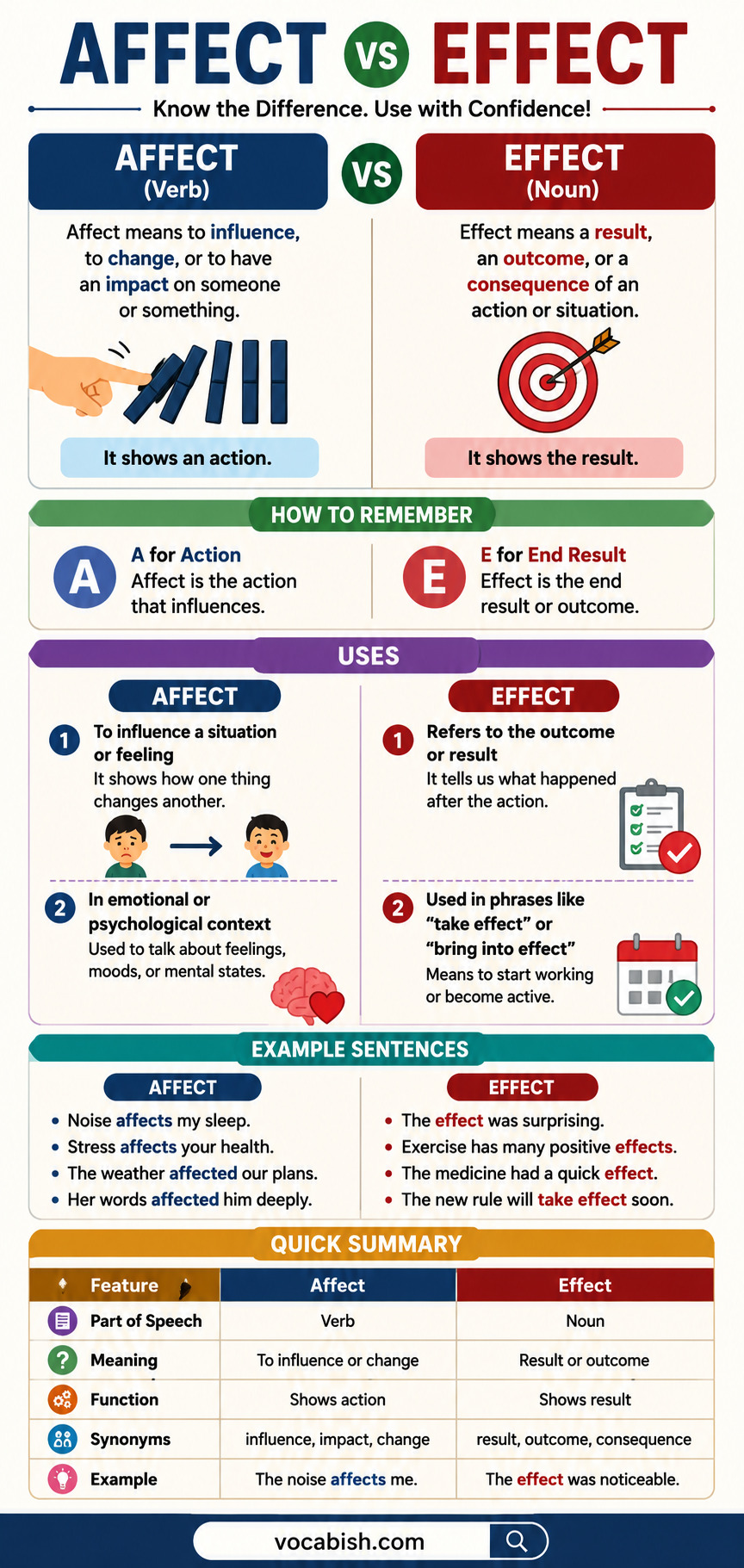
- Affect = Action
- Effect = End result
First, something affects a situation. Then, an effect appears.
Example:
- Heavy rain affected traffic.
- The effect was long delays.
Usage of Affect
1. To influence a situation or feeling
This is the most common use of affect in English.
It shows that one thing changes another thing in some way.
Examples:
- Social media can affect teenagers’ behavior.
- Rising prices affect small businesses.
- His words affected her confidence.
- Climate change affects many countries.
In each sentence, the subject causes influence or impact.
Common patterns:
- affect + person
- affect + situation
- affect + decision
- affect + performance
More examples:
- The loud music affected my ability to study.
- Poor communication affects teamwork.
- The injury affected his performance in the match.
2. In emotional or psychological context
Affect is also common when talking about emotions, moods, and mental conditions.
Examples:
- The sad movie affected me deeply.
- Anxiety can affect sleep quality.
- Her criticism affected his self-esteem.
- Emotional stress affects relationships.
This usage is especially common in conversations about health, feelings, and behavior.
Usage of Effect
1. Refers to the outcome or result
Effect is commonly used to describe what happens because of an action, event, or cause.
Examples:
- The effect of exercise is improved health.
- The new law had little effect on crime.
- One side effect of the medicine is dizziness.
- The advertising campaign produced a strong effect.
Notice that effect usually follows:
- the effect of
- a positive effect
- a negative effect
- side effect
More examples:
- Technology has had a major effect on communication.
- The teacher’s encouragement had a positive effect on students.
- Lack of practice can have a negative effect on progress.
2. Used in phrases like “take effect” or “bring into effect”
Some English expressions commonly use effect.
Take effect:
Means “to start working” or “become active.”
- The new rules will take effect next month.
- The medicine took effect quickly.
Bring into effect:
Means “to officially start” something such as a law or system.
- The government brought the policy into effect last year.
- The school plans to bring new regulations into effect soon.
These phrases are more common in formal or official English.
Formal and Informal Uses of Affect and Effect
Both words appear in formal and informal English, but their frequency changes depending on the context.
Formal Uses of Affect and Effect
Word | Formal Use | Example |
|---|---|---|
Affect | Used in academic, business, medical, and professional writing | Economic changes affect global markets. |
Effect | Used in reports, research, laws, and official communication | The new rule had a positive effect. |
Informal Uses of Affect and Effect
Word | Informal Use | Example |
|---|---|---|
Affect | Used in everyday speech about feelings or influence | That song affected me emotionally. |
Effect | Used in casual conversations about results | The medicine had a quick effect. |
Example Sentences with Affect
- Noise pollution affects city residents.
- Lack of confidence can affect performance.
- Smoking affects lung health.
- The teacher’s advice affected my decision.
- Financial problems affected their lifestyle.
- Hot weather affects energy levels.
- Negative comments can affect children emotionally.
- Internet speed affects online learning.
Example Sentences with Effect
- The effect of sunlight on plants is important.
- The medicine had an immediate effect.
- The policy produced positive effects.
- Stress can have a harmful effect on the body.
- The special effects in the movie looked realistic.
- The changes will take effect tomorrow.
- Her speech had a strong effect on the audience.
- Exercise has long-term effects on health.
Common Mistakes Learners Make
Incorrect:
- The weather had a bad affect on us.
Correct:
- The weather had a bad effect on us.
Why?
Because the sentence needs a noun meaning “result.”
Incorrect:
- Pollution effects marine life.
Correct:
- Pollution affects marine life.
Why?
Because the sentence needs a verb meaning “influences.”
Summary on Effect vs Affect
Feature | Affect | Effect |
|---|---|---|
Usual Part of Speech | Verb | Noun |
Main Meaning | To influence or change | Result or outcome |
Function in Sentence | Shows action | Shows result |
Common Synonyms | influence, impact, change | result, consequence, outcome |
Example | Stress affects sleep. | The effect was serious. |
Common Usage | Emotional, social, physical influence | Results, consequences, reactions |
FAQs about Affect vs Effect
Affect usually means to influence something as a verb, while effect usually refers to the result or outcome as a noun.
In most everyday English, affect works as a verb meaning influence. Rare formal uses exist, but ESL learners usually only need the common usage.
Effect is commonly used as a noun meaning result or consequence. In advanced English, it can sometimes act as a verb in formal contexts.
Remember this simple idea: affect is the action that changes something, and effect is the final result that appears afterward.
English commonly uses “take effect,” which means something starts working, becoming active, or officially beginning after a certain time.
Yes, even native speakers sometimes mix them up because the pronunciation is similar and both words relate to change and results.
You May Also Like:
