

In this blog post, you will learn 100 examples of masculine and feminine words. These are words that tell us if someone or something is male or female. For example, boy is masculine, and girl is feminine. Knowing these words is very important for English learners. It helps you understand what people are talking about, read books more easily, write sentences correctly, and speak English with confidence. By studying these 100 examples, you will be able to describe people, animals, and objects clearly. You will also master using these words in real life, which makes learning English faster and more effective.
100 Examples of Masculine and Feminine
Here are common words you will hear or use every day:
- Man ↔ Woman – Adult male / adult female
- Boy ↔ Girl – Male child / female child
- Brother ↔ Sister – Male sibling / female sibling
- Husband ↔ Wife – Married man / married woman
- Father ↔ Mother – Male parent / female parent
- Son ↔ Daughter – Male child / female child
- Gentleman ↔ Lady – Polite man / polite woman
- King ↔ Queen – Male / female ruler
- Prince ↔ Princess – Male / female royal child
- Actor ↔ Actress – Male / female performer
- Sir ↔ Madam – Polite form of address for men / women
- Boyfriend ↔ Girlfriend – Male / female partner
- Nephew ↔ Niece – Male / female child of sibling
- Uncle ↔ Aunt – Male / female sibling of parent
- Grandfather ↔ Grandmother – Male / female grandparent
Masculine and Feminine Words in School
These words are often used in a school environment:
- Teacher ↔ Teacher (Female) – Male / female instructor (some schools use “teacher” for both)
- Headmaster ↔ Headmistress – Male / female school principal
- Student ↔ Student (Female) – Male / female learner
- Captain ↔ Captain (Female) – Leader of a sports team or class
- Chairman ↔ Chairwoman – Male / female in charge of a committee
- Prefect ↔ Prefect (Female) – Student leader or monitor
- Professor ↔ Professor (Female) – Male / female university teacher
- Doctor ↔ Doctor (Female) – Male / female medical professional
- Engineer ↔ Engineer (Female) – Male / female in engineering roles
Note: Many modern English words, especially professions, are now gender-neutral, but traditional masculine/feminine forms still appear in formal texts.
Masculine and Feminine for Family Members
Family vocabulary is essential for conversations:
- Father ↔ Mother – Male / female parent
- Brother ↔ Sister – Male / female sibling
- Son ↔ Daughter – Male / female child
- Grandfather ↔ Grandmother – Male / female grandparent
- Uncle ↔ Aunt – Male / female sibling of parent
- Nephew ↔ Niece – Male / female child of sibling
- Cousin (Male) ↔ Cousin (Female) – Male / female cousin
- Husband ↔ Wife – Married male / married female
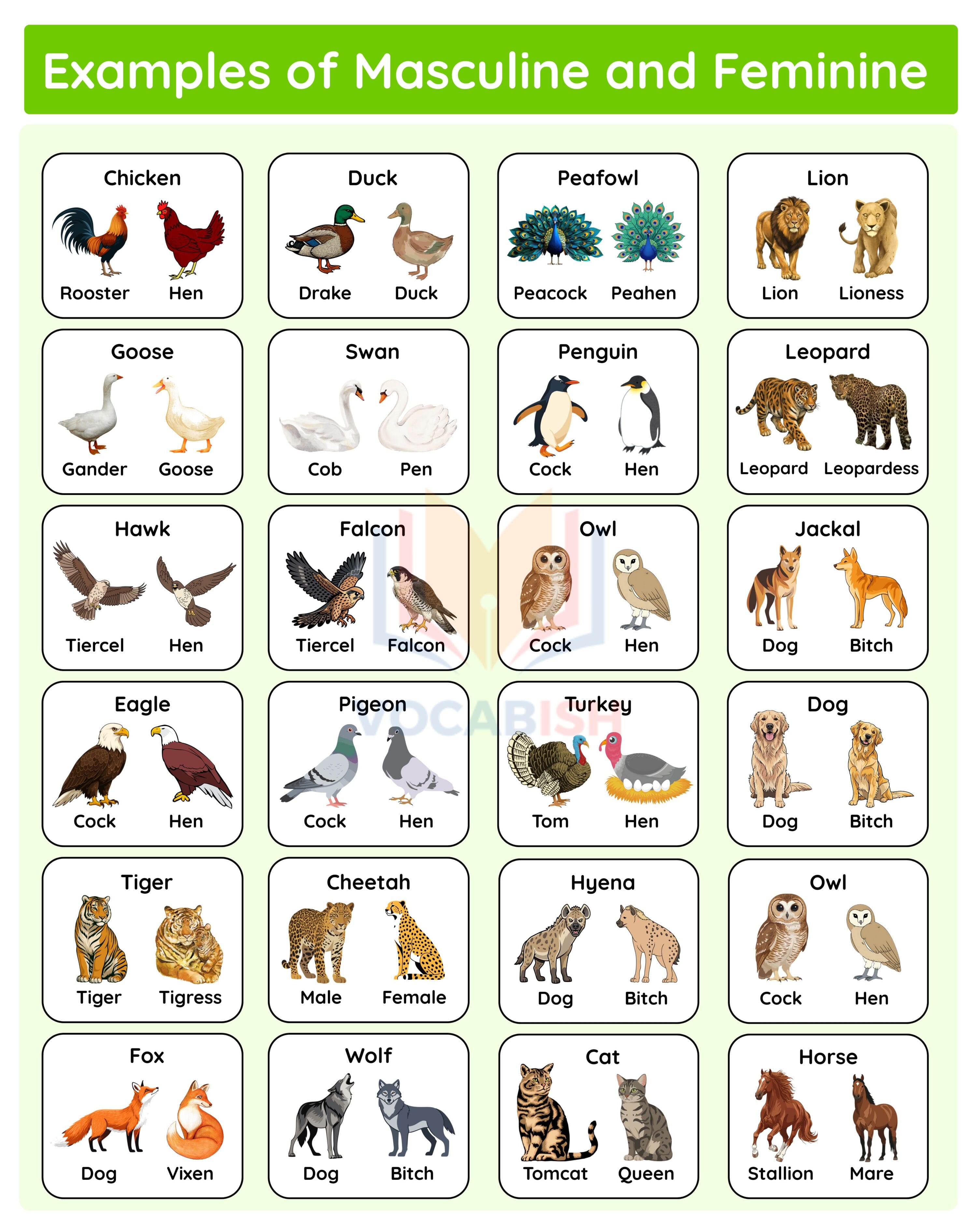
Masculine and Feminine Words for Animals
Animals also have masculine and feminine names:
- Lion ↔ Lioness – Male / female lion
- Tiger ↔ Tigress – Male / female tiger
- Rooster ↔ Hen – Male / female chicken
- Dog ↔ Bitch – Male / female dog
- Bull ↔ Cow – Male / female cattle
- Stallion ↔ Mare – Male / female horse
- Drake ↔ Duck – Male / female duck
- Ram ↔ Ewe – Male / female sheep
- Gander ↔ Goose – Male / female goose
- Cock ↔ Hen – Male / female bird
Masculine and Feminine Words for Emotions and Personality
Some words describe male and female traits:
- Gentleman ↔ Lady – Polite, well-mannered man / woman
- Hero ↔ Heroine – Male / female hero
- Widower ↔ Widow – Male / female whose spouse has died
- Bachelor ↔ Spinster – Unmarried man / unmarried woman
- Prince Charming ↔ Princess – Romantic or noble male / female
Tips for Remembering Masculine and Feminine Words
- Group words by category – Family, school, animals, daily life.
- Use real-life examples – Speak sentences aloud using new words.
- Make flashcards – Write masculine on one side, feminine on the other.
- Practice with friends – Ask each other questions using these words.
- Read simple stories – Notice masculine and feminine words in context.
Conclusion
Learning masculine and feminine words strengthens your English vocabulary. It helps you describe people, animals, and situations accurately. By practicing these 100 common words, you can improve your speaking, reading, and writing skills.
Start with small groups, use them daily, and soon you will feel confident and fluent in English conversations.
FAQs
Masculine and feminine words show whether a person, animal, or object is male or female. For example, boy/girl, actor/actress, or lion/lioness.
Common words include father/mother, brother/sister, son/daughter, uncle/aunt, and nephew/niece.
Animals have gender-specific words such as lion/lioness, rooster/hen, bull/cow, and stallion/mare.
Yes. Some traditional professions use masculine and feminine forms, like actor/actress, waiter/waitress, and headmaster/headmistress.
Many older forms, like spinster/bachelor or headmaster/headmistress, are less common today. However, basic words like boy/girl, father/mother, and animal terms are still essential for learners to speak and write English correctly.
Related Articles: