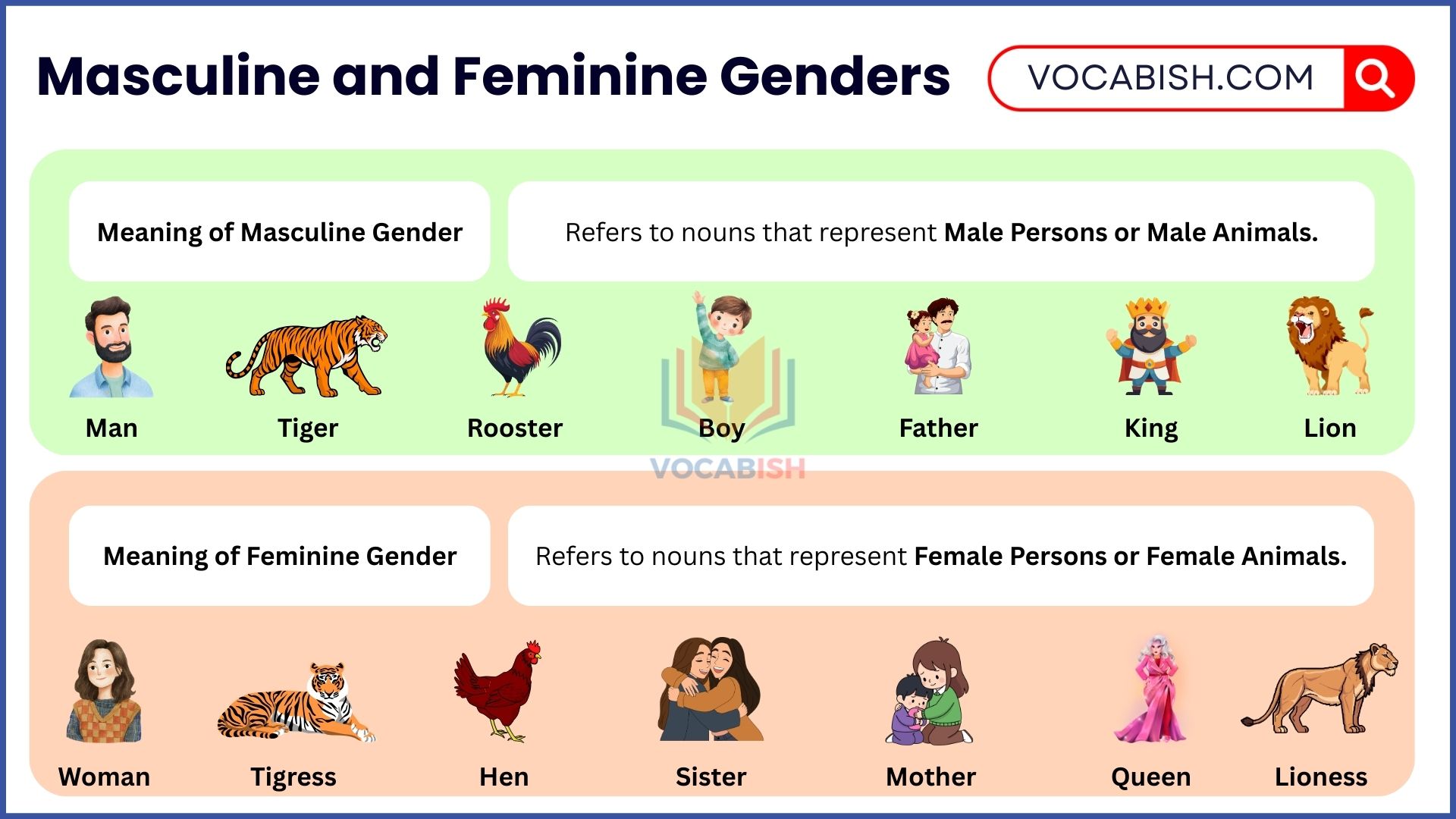
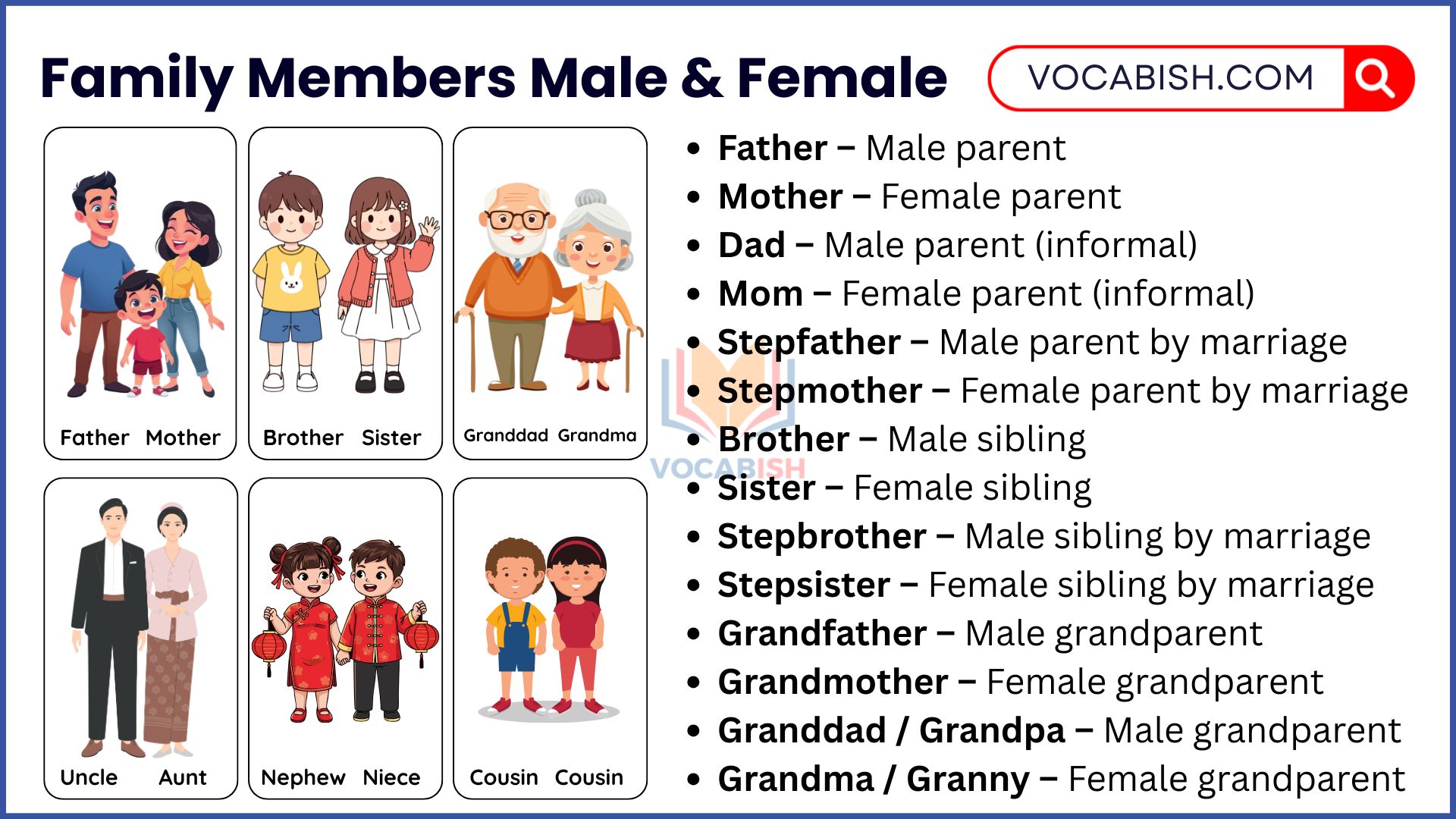

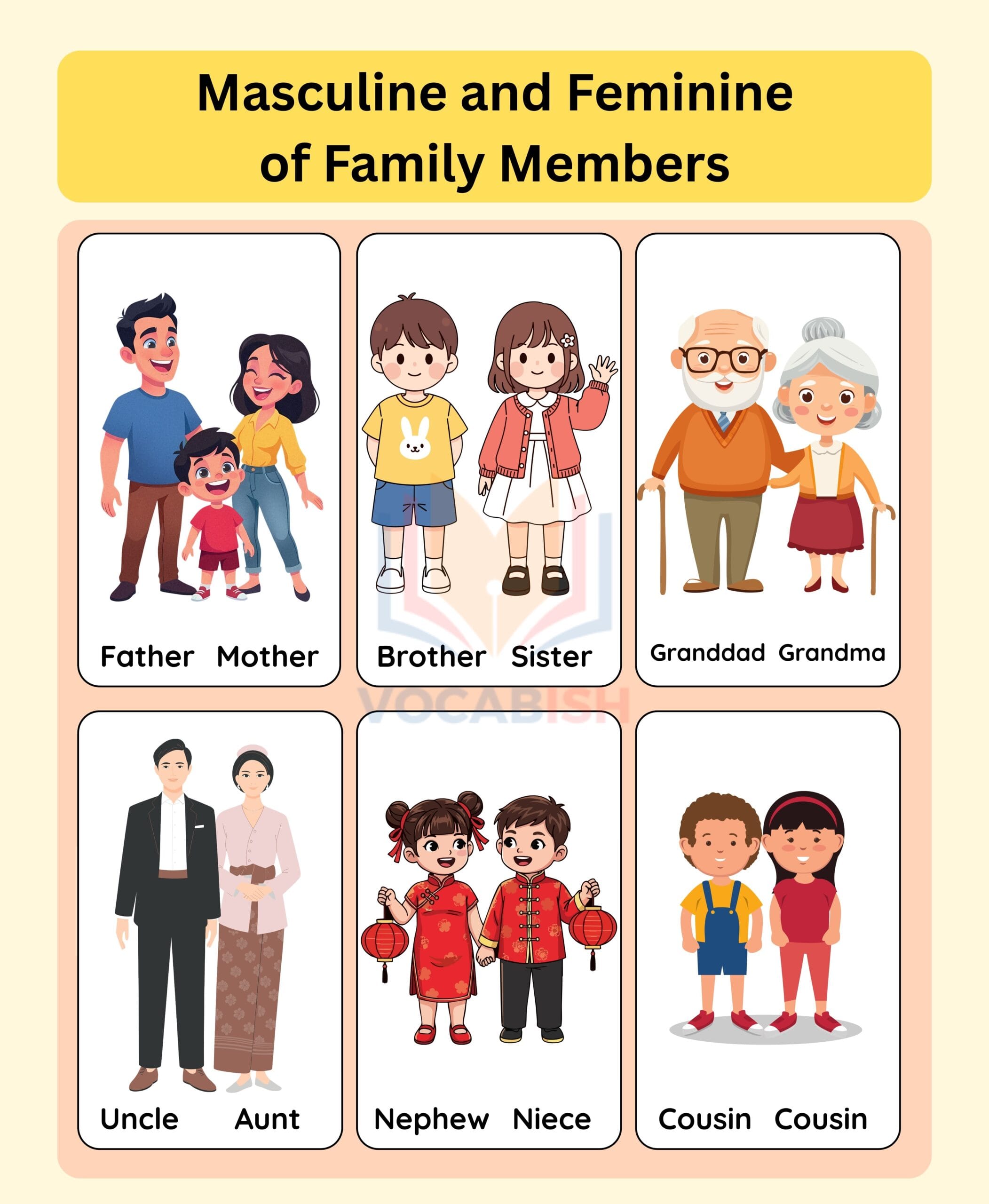
Have you ever confused a nephew with a cousin or a father-in-law with a stepfather? Learning the masculine and feminine of family members makes family vocabulary easier to understand. This guide covers male and female family names, family relationships, and gender-neutral terms with simple examples.
Masculine and Feminine Family Members at a Glance
Masculine | Feminine | Gender-Neutral |
|---|---|---|
father | mother | parent |
son | daughter | child |
brother | sister | sibling |
husband | wife | spouse |
uncle | aunt | relative |
nephew | niece | nibling |
grandfather | grandmother | grandparent |
grandson | granddaughter | grandchild |
father-in-law | mother-in-law | parent-in-law |
stepfather | stepmother | stepparent |
40+ Masculine and Feminine Family Member Names
Immediate Family Relationships
No. | Masculine | Feminine |
|---|---|---|
1 | father | mother |
2 | son | daughter |
3 | brother | sister |
4 | husband | wife |
5 | male parent | female parent |
6 | eldest son | eldest daughter |
7 | youngest son | youngest daughter |
8 | twin brother | twin sister |
9 | adopted son | adopted daughter |
10 | foster son | foster daughter |
Extended Family Relationships
No. | Masculine | Feminine |
|---|---|---|
11 | uncle | aunt |
12 | nephew | niece |
13 | great-uncle | great-aunt |
14 | granduncle | grandaunt |
15 | great-nephew | great-niece |
16 | male cousin | female cousin |
17 | first male cousin | first female cousin |
18 | second male cousin | second female cousin |
19 | paternal uncle | paternal aunt |
20 | maternal uncle | maternal aunt |
Relationships Through Marriage
No. | Masculine | Feminine |
|---|---|---|
21 | father-in-law | mother-in-law |
22 | son-in-law | daughter-in-law |
23 | brother-in-law | sister-in-law |
24 | husband | wife |
25 | bridegroom | bride |
26 | widower | widow |
27 | fiancé | fiancée |
28 | ex-husband | ex-wife |
29 | uncle by marriage | aunt by marriage |
30 | male spouse | female spouse |
Step-Family and Blended Family Relationships
No. | Masculine | Feminine |
|---|---|---|
31 | stepfather | stepmother |
32 | stepson | stepdaughter |
33 | stepbrother | stepsister |
34 | half-brother | half-sister |
35 | foster father | foster mother |
36 | foster brother | foster sister |
37 | adoptive father | adoptive mother |
38 | adopted brother | adopted sister |
39 | male guardian | female guardian |
40 | co-father | co-mother |
Grandfamily Relationships
No. | Masculine | Feminine |
|---|---|---|
41 | grandfather | grandmother |
42 | grandson | granddaughter |
43 | great-grandfather | great-grandmother |
44 | great-grandson | great-granddaughter |
45 | paternal grandfather | paternal grandmother |
46 | maternal grandfather | maternal grandmother |
47 | step-grandfather | step-grandmother |
48 | step-grandson | step-granddaughter |
49 | grandfather-in-law | grandmother-in-law |
50 | adoptive grandfather | adoptive grandmother |
Male and Female Family Terms with Different Words
Some family terms use completely different words for males and females.
Male Term | Female Term |
|---|---|
father | mother |
son | daughter |
brother | sister |
husband | wife |
uncle | aunt |
nephew | niece |
bridegroom | bride |
widower | widow |
grandfather | grandmother |
grandson | granddaughter |
These pairs must be learned separately because the feminine word is not formed by adding an ending to the masculine word.
Gender-Neutral Family Member Names
Gender-neutral family terms can refer to people of any gender.
Gendered Terms | Gender-Neutral Term |
|---|---|
father or mother | parent |
son or daughter | child |
brother or sister | sibling |
husband or wife | spouse |
grandfather or grandmother | grandparent |
grandson or granddaughter | grandchild |
stepfather or stepmother | stepparent |
stepson or stepdaughter | stepchild |
fiancé or fiancée | partner |
uncle or aunt | relative |
nephew or niece | nibling |
father-in-law or mother-in-law | parent-in-law |
son-in-law or daughter-in-law | child-in-law |
brother-in-law or sister-in-law | sibling-in-law |
“Nibling” is an informal gender-neutral word for a nephew or niece. It is becoming more familiar but is not yet used everywhere.
Traditional and Modern Family Relationship Terms
Traditional Term | Modern or Neutral Alternative |
|---|---|
husband or wife | spouse or partner |
son or daughter | child |
brother or sister | sibling |
grandfather or grandmother | grandparent |
grandson or granddaughter | grandchild |
bridegroom or bride | person getting married |
househusband or housewife | homemaker |
unmarried couple | partners |
stepfamily | blended family |
adopted child | child or adopted child when relevant |
Traditional terms remain correct when gender or the exact relationship matters. Neutral terms are useful when gender is unknown or unnecessary.
Family Tree Showing Masculine and Feminine Names
Great-Grandfather ─── Great-Grandmother
                 │
       Grandfather ─── Grandmother
                   │
             Father ─── Mother
                    │
        ┌───────────┼───────────┐
      Brother      You        Sister
        │                       │
     Nephew                   Niece
Another side of the family may include:
Father’s Brother = Uncle
Father’s Sister  = Aunt

Mother’s Brother = Uncle
Mother’s Sister  = Aunt

Uncle’s Son      = Cousin
Aunt’s Daughter  = Cousin
The word cousin is used for both males and females.
Examples of Family Member Names in Sentences
- My father and mother work together.
- Ali has one brother and two sisters.
- Her son is younger than her daughter.
- My uncle lives near my aunt.
- Their nephew is playing with his niece.
- My grandfather tells interesting stories.
- Her grandmother makes delicious food.
- The bride stood beside the bridegroom.
- My father-in-law is a retired teacher.
- Her mother-in-law visits every weekend.
- His stepson and stepdaughter attend the same school.
- My half-brother lives in another city.
- Their grandson is five years old.
- Her granddaughter loves reading.
- Every parent attended the school meeting.
- I have three siblings.
- Their eldest child is studying medicine.
- She introduced her spouse to the guests.
Commonly Confused Family Relationship Words
Nephew and Niece
A nephew is the son of your brother or sister. A niece is their daughter.
Uncle and Cousin
An uncle is the brother of your father or mother. A cousin is the child of your uncle or aunt.
Brother-in-Law and Stepbrother
A brother-in-law is related to you through marriage. A stepbrother becomes part of your family when one of your parents marries one of his parents.
Half-Brother and Stepbrother
A half-brother shares one biological parent with you. A stepbrother does not necessarily share a biological parent with you.
Father-in-Law and Stepfather
A father-in-law is the father of your spouse. A stepfather is married to one of your parents but is not your biological father.
Grandfather and Great-Grandfather
A grandfather is the father of one of your parents. A great-grandfather is the father of one of your grandparents.
Fiancé and Fiancée
A fiancé traditionally refers to a man who is engaged. A fiancée traditionally refers to a woman who is engaged.
Worksheet and Quiz for English Learners
Fill in the Blanks
- The feminine form of father is __________.
- The masculine form of sister is __________.
- The daughter of your brother is your __________.
- The son of your sister is your __________.
- The father of your spouse is your __________.
- The feminine form of grandson is __________.
- A gender-neutral word for brother or sister is __________.
- A gender-neutral word for husband or wife is __________.
- The feminine form of widower is __________.
- The masculine form of bride is __________.
Choose the Correct Answer
- Your mother’s brother is your:
- cousin
- uncle
- nephew
- Your brother’s daughter is your:
- niece
- aunt
- granddaughter
- Your father’s mother is your:
- mother-in-law
- grandmother
- stepmother
- Your spouse’s sister is your:
- stepsister
- sister-in-law
- half-sister
- A person who shares one biological parent with you is your:
- cousin
- sibling-in-law
- half-sibling
Answers
- mother
- brother
- niece
- nephew
- father-in-law
- granddaughter
- sibling
- spouse
- widow
- bridegroom
Multiple Choice: 1. uncle, 2. niece, 3. grandmother, 4. sister-in-law, 5. half-sibling
Frequently Asked Questions
Masculine family terms refer to males, while feminine family terms refer to females, such as father and mother or brother and sister.
The feminine form of father is mother.
The gender-neutral word for brother and sister is sibling.
A nephew is your sibling’s son. A grandson is your son’s or daughter’s son.
The feminine form of nephew is niece.
“Cousin” is gender-neutral. Use male cousin or female cousin when gender needs to be mentioned.
The gender-neutral terms are spouse and partner.
The masculine form of widow is widower.
Conclusion
Masculine and feminine family member names include father and mother, son and daughter, brother and sister, uncle and aunt, and nephew and niece. Gender-neutral terms such as parent, child, sibling, spouse, and grandparent are useful when gender is unknown or unimportant.
You May Also Like