
Small words often carry big meaning in English. The word “in” is one of the most common words used in daily communication. It usually works as a preposition, but it also appears in sentence structures that connect ideas and describe time, place, or condition.
Many learners search for sentences with “in” conjunction because they want to understand how this word works inside real sentences. When used correctly, “in” helps make sentences clearer and more natural.
This article explains the meaning, usage, and examples of sentences with “in.” The explanations are simple, practical, and useful for everyday English learning.
What Is the Word “In” in English?
The word “in” is usually a preposition in English. A preposition shows the relationship between words in a sentence. It often connects nouns or pronouns to other parts of the sentence.
“In” commonly shows:
- location
- time
- situation
- condition
Example sentences:
- She is in the room.
- The meeting is in the morning.
These examples show how “in” connects ideas clearly.
Meaning and Function of “In” in Sentences
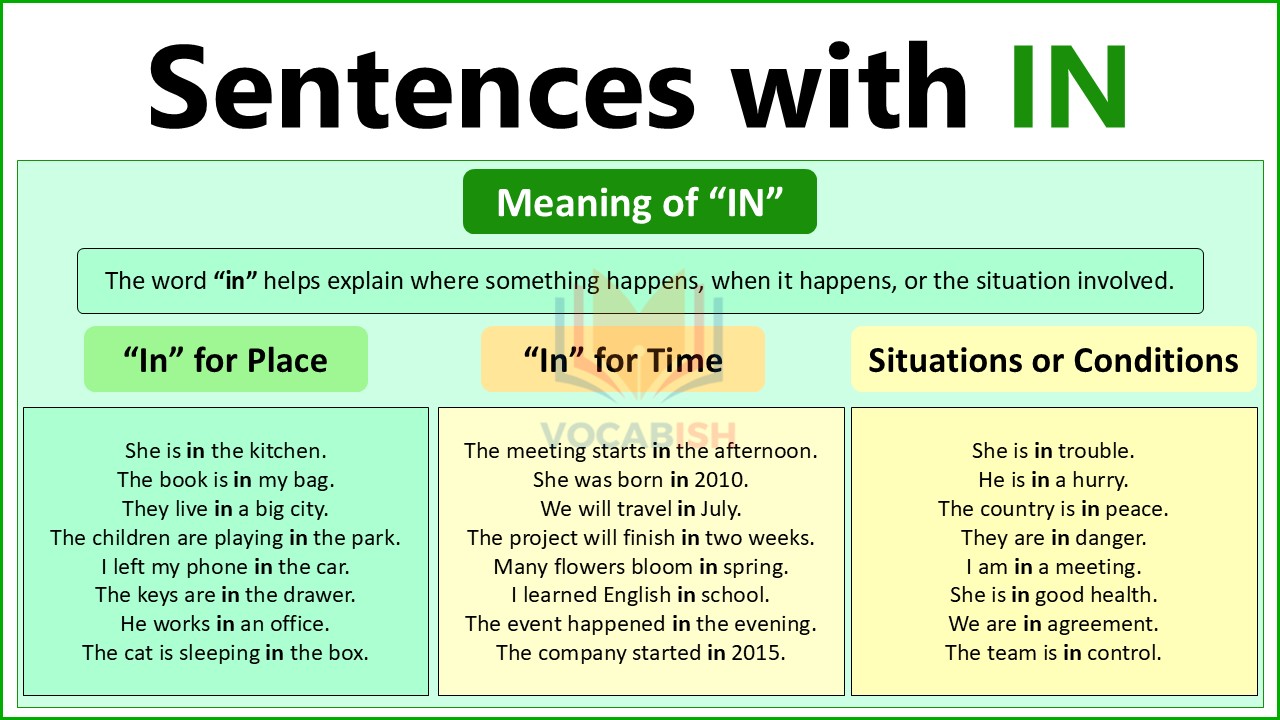
The word “in” helps explain where something happens, when it happens, or the situation involved.
Common meanings include:
- Place – inside something
- Time – during a period
- Situation – part of an activity or condition
Examples:
- The keys are in my bag.
- I will finish the work in an hour.
- She works in a hospital.
Each sentence uses “in” to show a relationship between words.
Why “In” Is Important in Daily English
English speakers use “in” very often in conversation and writing. Learning this word helps learners describe location, time, and situations correctly.
Benefits of learning sentences with “in”:
- improves sentence clarity
- strengthens daily vocabulary
- helps create natural conversations
- builds grammar confidence
Understanding simple usage makes communication easier.
Common Vocabulary Used with “In”
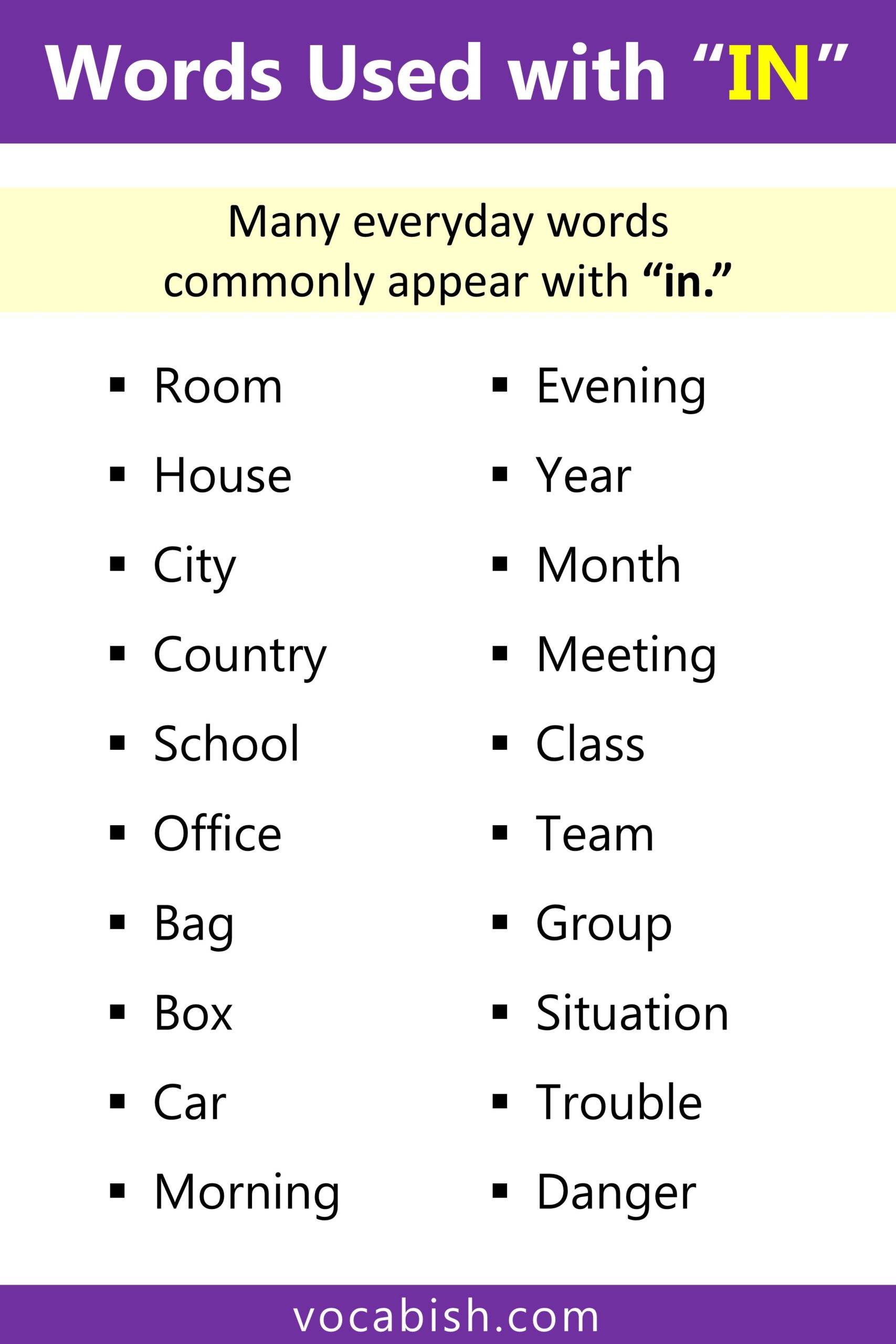
Many everyday words commonly appear with “in.” Knowing these combinations helps learners form natural sentences.
Important vocabulary words used with “in”:
- Room
- House
- City
- Country
- School
- Office
- Bag
- Box
- Car
- Morning
- Evening
- Year
- Month
- Meeting
- Class
- Team
- Group
- Situation
- Trouble
- Danger
These words frequently appear in daily English expressions.
Sentences with “In” for Place
When “in” describes place, it usually means inside something or within an area.
Examples:
- She is in the kitchen.
- The book is in my bag.
- They live in a big city.
- The children are playing in the park.
- I left my phone in the car.
- The keys are in the drawer.
- He works in an office.
- The cat is sleeping in the box.
- She studies in the library.
- My friend lives in Canada.
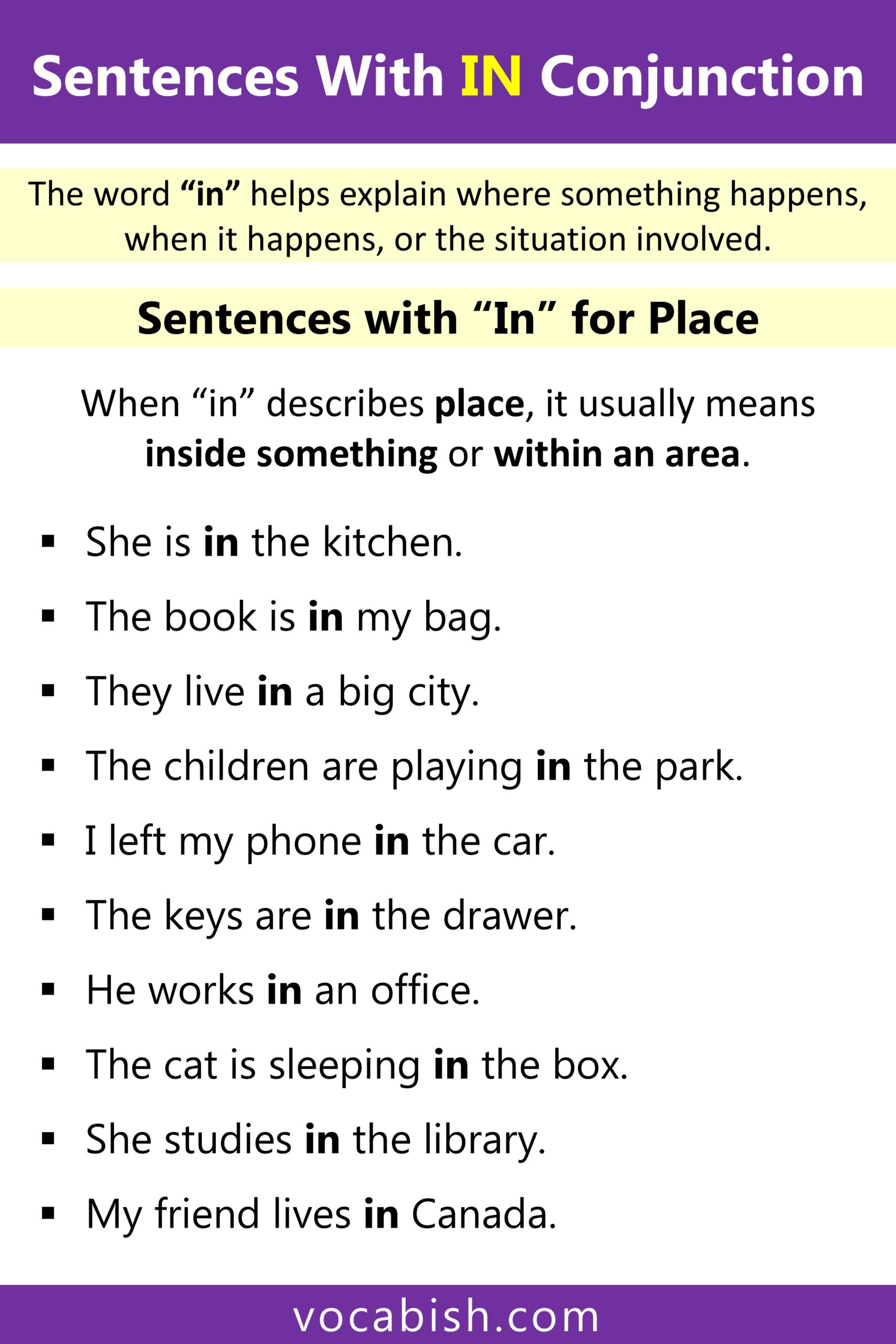
These sentences describe where something or someone is located.
Sentences with “In” for Time
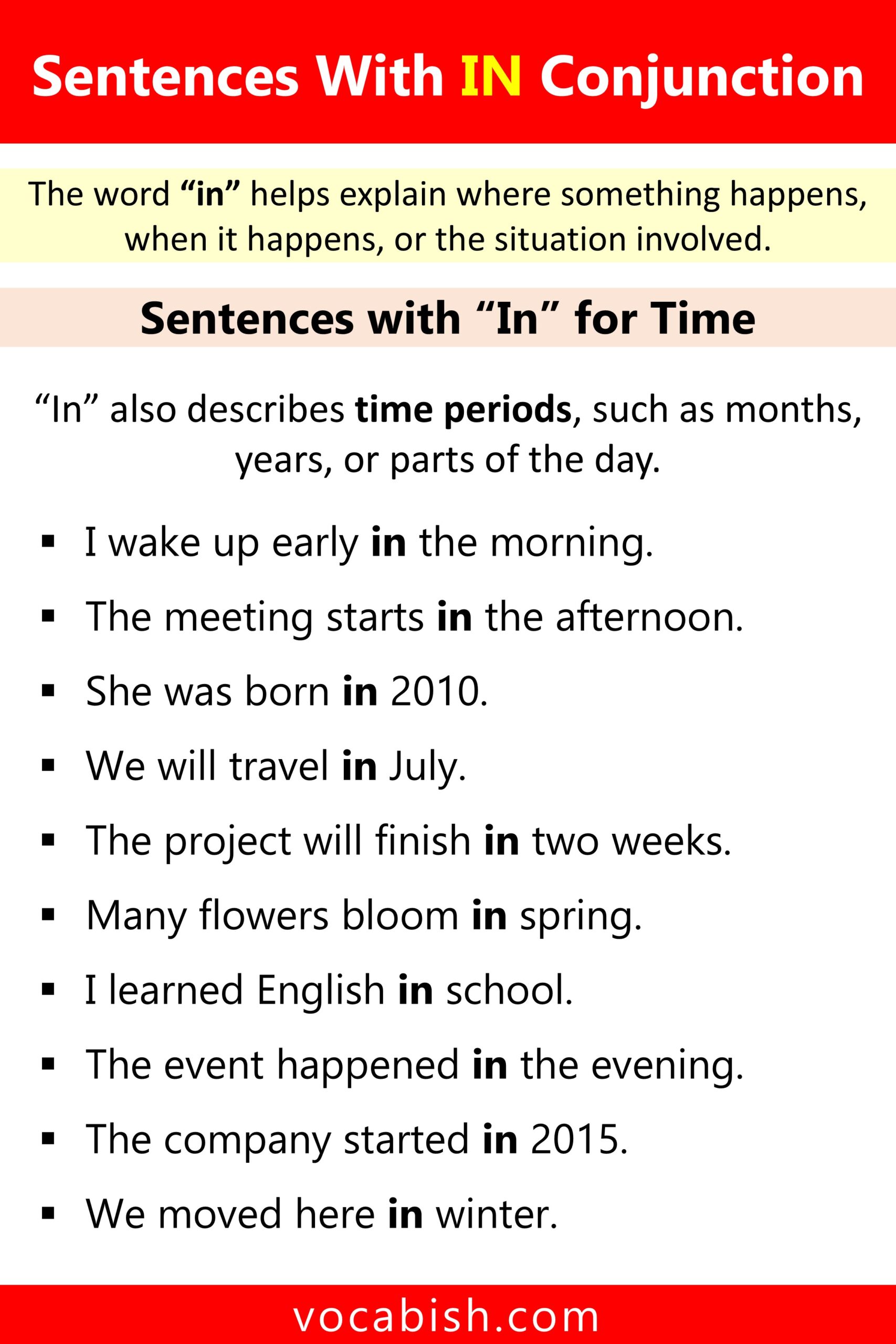
“In” also describes time periods, such as months, years, or parts of the day.
Examples:
- I wake up early in the morning.
- The meeting starts in the afternoon.
- She was born in 2010.
- We will travel in July.
- The project will finish in two weeks.
- Many flowers bloom in spring.
- I learned English in school.
- The event happened in the evening.
- The company started in 2015.
- We moved here in winter.
These examples show how “in” describes time periods.
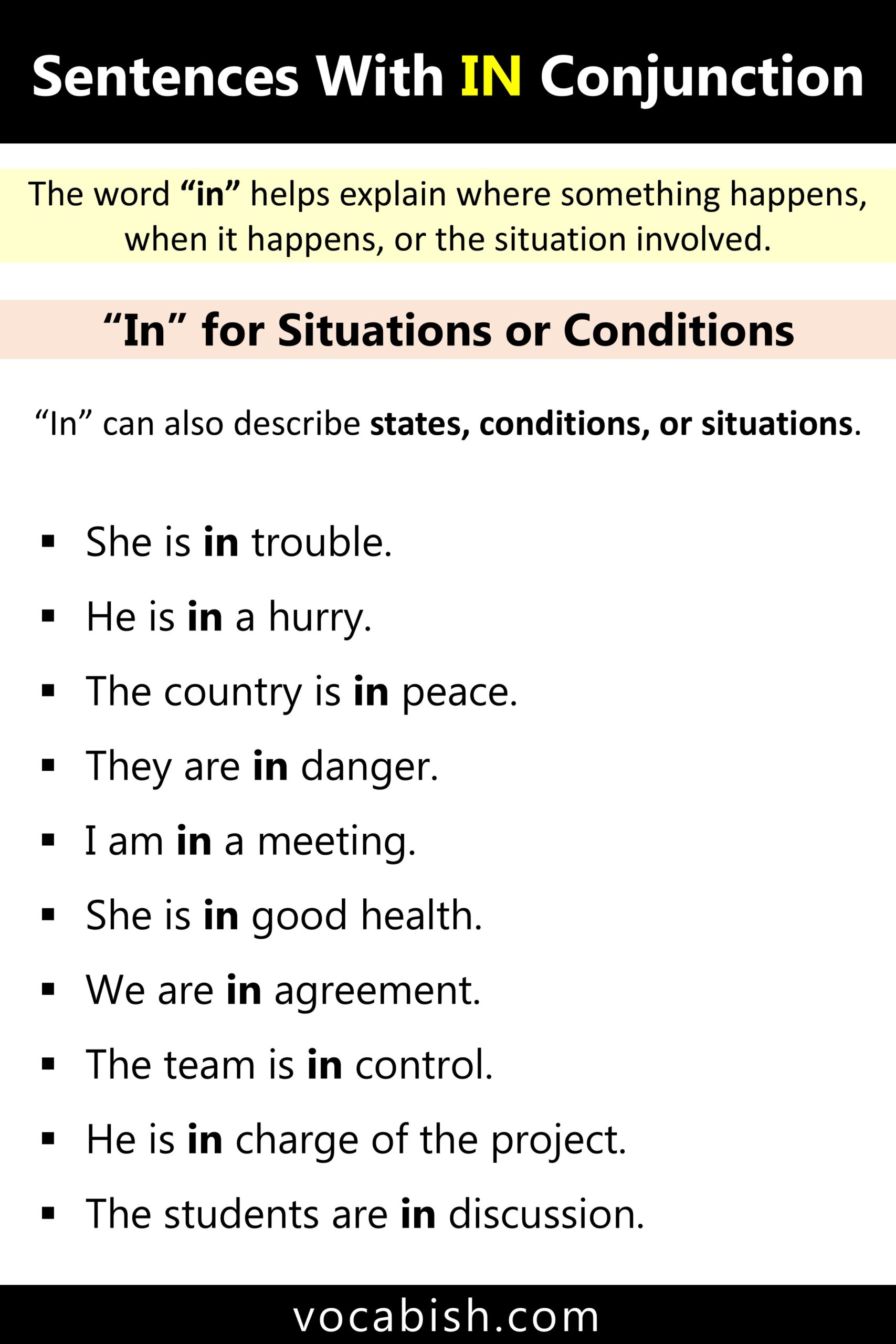
Sentences with “In” for Situations or Conditions
“In” can also describe states, conditions, or situations.
Examples:
- She is in trouble.
- He is in a hurry.
- The country is in peace.
- They are in danger.
- I am in a meeting.
- She is in good health.
- We are in agreement.
- The team is in control.
- He is in charge of the project.
- The students are in discussion.
These expressions appear frequently in professional and social conversations.
Everyday Expressions Using “In”
Some common English expressions use the word “in.”
Examples:
- In fact – used to add extra information
- In general – speaking about something broadly
- In detail – explaining something clearly
- In public – in front of people
- In private – not in public
- In time – before it is too late
- In the end – finally
These expressions help make communication more natural.
Tips to Learn Sentences with “In” Easily
Learners can master the use of “in” with regular practice.
Helpful strategies include:
Read simple English texts
Notice how “in” appears in real sentences.
Practice speaking daily
Create your own sentences using “in.”
Write short examples
Writing helps learners remember correct structures.
Listen to conversations
Movies, podcasts, and conversations show natural usage.
Regular practice builds confidence and accuracy.
Conclusion
The word “in” is a small but essential part of English sentences. It helps explain place, time, and situations, making communication clearer and more precise.
By learning simple examples and practicing regularly, English learners can use sentences with “in” naturally in everyday conversation.
Mastering common words like “in” is an important step toward stronger vocabulary, better grammar, and confident English communication.
FAQs
Sentences with “in” conjunction usually show how the word “in” connects ideas related to place, time, or situation. In most cases, “in” works as a preposition inside a sentence structure.
Use “in” to show location, time period, or situation. For example: She is in the room, The meeting is in the morning, or He is in trouble.
“In” is mainly a preposition, not a conjunction. However, learners often search for “sentences with in conjunction” when they want examples of sentences where “in” connects ideas.
Common examples include: She lives in London, The book is in my bag, We met in the evening, and He works in a hospital.
Learners often confuse “in” with “on” or “at.” For example, saying in Monday is incorrect. The correct form is on Monday because “in” usually describes longer time periods.
“In” appears frequently in daily communication when talking about places, time periods, or situations, such as in the room, in the morning, in school, or in a meeting.
Related Articles: