
In this blog post, you will learn about conjunctions, the small but powerful words that connect ideas in English. Words like and, but, and because help you join sentences and express your thoughts more naturally. When you understand how conjunctions work, your sentences become smoother and easier to follow. This helps you speak more clearly, write better, and understand what you read and hear with less confusion. Many learners struggle because they don’t know how to connect ideas correctly, but once you practice using conjunctions, your grammar improves quickly and your English feels more complete.
If you want a complete learning path for grammar basics, check our ultimate guide to English parts of speech.
Introduction to Conjunctions
Conjunctions are small words, but they do a big job. They connect ideas, words, phrases, and clauses so your sentences flow naturally.
Without conjunctions, your English would sound very basic:
- I like coffee. I like tea.
With conjunctions, you sound more natural:
- I like coffee and tea.
You’re not just adding words—you’re connecting meaning.
What is a Conjunction? (Definition and Meaning)
A conjunction is a word that joins words, phrases, or clauses together in a sentence.
It acts like a bridge between ideas.
Simple Definition
A conjunction connects:
- Word + word
- Phrase + phrase
- Clause + clause
Examples
- I bought apples and oranges.
- She was tired but happy.
- I stayed home because it was raining.
Why Conjunctions are Important in English
Conjunctions are essential because they help you express more complex thoughts clearly.
What they help you do
- Combine ideas smoothly
- Avoid repeating words
- Show relationships (cause, contrast, choice)
- Sound more natural in both speaking and writing
Examples
- I was tired, so I went to bed early. (result)
- She studied hard, but she didn’t pass. (contrast)
- We can go now or wait until later. (choice)
Functions of Conjunctions in Sentences
Conjunctions don’t just connect—they show how ideas relate to each other.
Main functions
- Addition (and, also)
- Contrast (but, although)
- Cause/Reason (because, since)
- Result (so, therefore)
- Choice (or, either…or)
Examples
- He is smart and hardworking. (addition)
- I wanted to go, but I was busy. (contrast)
- She stayed home because she was sick. (reason)
- It was late, so we left. (result)
Types of Conjunctions with Definition and Examples
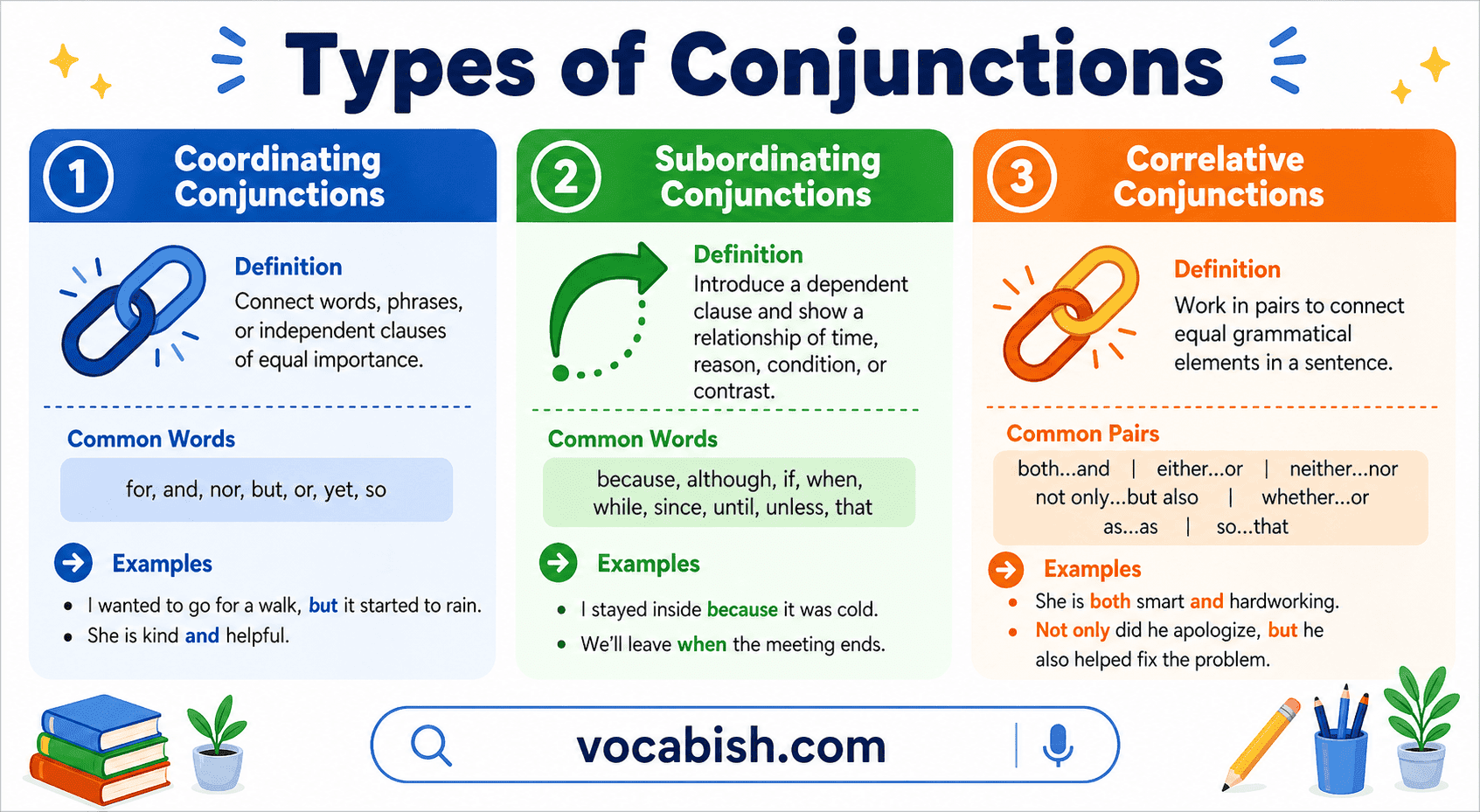
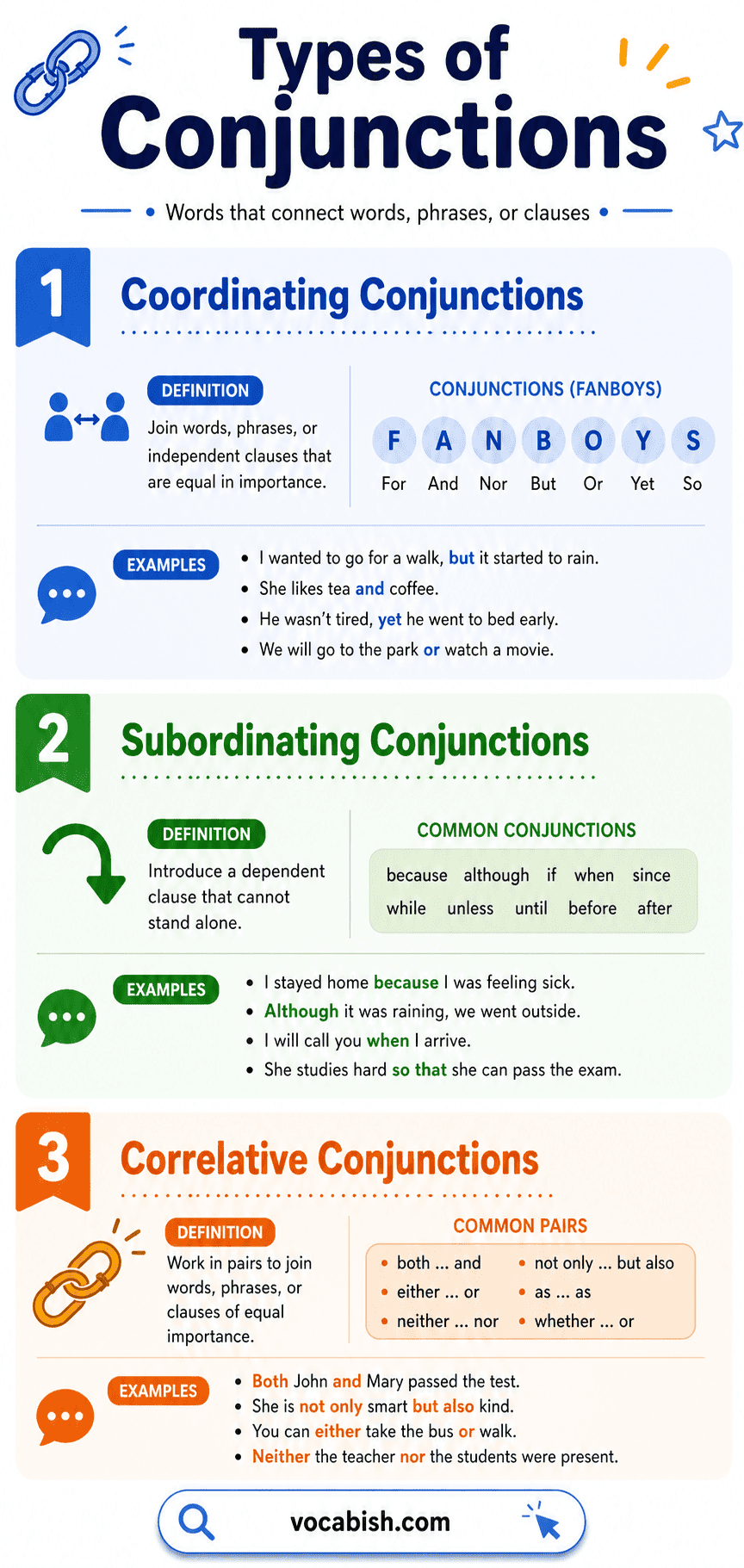
There are three main types of conjunctions in English. Each one works a little differently.
1. Coordinating Conjunctions
Coordinating conjunctions connect equal parts of a sentence (same grammatical level).
They join:
- word + word
- phrase + phrase
- independent clause + independent clause
Examples
- I like tea and coffee.
- She called me, but I didn’t answer.
- We can walk or take a taxi.
2. Subordinating Conjunctions
Subordinating conjunctions connect a main clause with a dependent clause.
They show relationships like time, reason, condition, or contrast.
Examples
- I stayed home because it was raining.
- Although she was tired, she kept working.
- If you study, you will improve.
3. Correlative Conjunctions
Correlative conjunctions work in pairs to connect equal elements.
Common pairs:
- either…or
- neither…nor
- both…and
- not only…but also
Examples
- Either you call me or send a message.
- She is both smart and kind.
- Not only did he apologize, but he also fixed the problem.
FANBOYS Conjunctions
The most common coordinating conjunctions are remembered with FANBOYS.
Letter | Conjunction | Meaning |
|---|---|---|
F | For | Reason |
A | And | Addition |
N | Nor | Negative addition |
B | But | Contrast |
O | Or | Choice |
Y | Yet | Contrast (unexpected) |
S | So | Result |
Examples
- I was hungry, so I ate.
- She tried, but she failed.
- We can stay or leave now.
Rules for Using Conjunctions
Key rules to remember
- Use a comma before coordinating conjunctions (when joining full sentences)
- Don’t start fragments with subordinating conjunctions
- Keep structure parallel with correlative conjunctions
Examples
- I wanted to go, but I had work.
- Although it was late, we continued.
- He is both funny and intelligent.
Position of Conjunctions in Sentences
Conjunctions usually appear in the middle, but not always.
Common positions
- Between two ideas
- At the beginning (especially subordinating conjunctions)
Examples
- I stayed home because it was raining.
- Because it was raining, I stayed home.
How to Identify a Conjunction in a Sentence
Simple method
Ask: Is this word connecting two parts of a sentence?
Look for:
- Two ideas being linked
- Words like and, but, because, although
Examples
- She was late because of traffic.
- I called him, but he didn’t answer.
Coordinating vs Subordinating vs Correlative Conjunctions
Type | Function | Structure | Example |
|---|---|---|---|
Coordinating | Connect equal ideas | Clause + conjunction + clause | I was tired, but I worked. |
Subordinating | Connect dependent clause | Main clause + dependent clause | I stayed home because it rained. |
Correlative | Work in pairs | Pair + parallel structure | Either call me or text me. |
Common Mistakes with Conjunctions
Here are the mistakes I see most often in class.
1. Using “and” for everything
Wrong:
I was tired and I went to sleep.
Correct:
I was tired, so I went to sleep.
Why: Use so for results, not just and.
2. Sentence fragments
Wrong:
Because I was late.
Correct:
I missed the bus because I was late.
Why: A dependent clause cannot stand alone.
3. Missing commas
Wrong:
She was hungry but she didn’t eat.
Correct:
She was hungry, but she didn’t eat.
Why: Use a comma before coordinating conjunctions joining two clauses.
4. Incorrect correlative pairs
Wrong:
Either you can call me and send a message.
Correct:
Either you can call me or send a message.
Why: Use the correct pair (either…or).
5. Unbalanced structure
Wrong:
She likes reading and to swim.
Correct:
She likes reading and swimming.
Why: Keep forms parallel.
Conjunctions Exercise
1. Identify the Conjunction
Find the conjunction in each sentence:
- I stayed home because I was sick.
- She tried hard but failed.
- You can come or stay home.
- Although it was late, we continued.
2. Fill in the Blanks
Choose the correct conjunction:
- I was tired, ___ I went to bed.
- She didn’t call ___ send a message.
- ___ it was raining, we went out.
- You can have tea ___ coffee.
3. Multiple Choice Questions
- Which is correct?
a) Because I was tired.
b) I slept because I was tired. - Choose the correct pair:
a) either…and
b) either…or - Which shows contrast?
a) and
b) but
Answer Key
1.
- because
- but
- or
- although
2.
- so
- nor
- although
- or
3.
- b
- b
- b
FAQs about Conjunctions
A conjunction is a word that connects words, phrases, or clauses. Common examples include and, but, because, and or. It helps combine ideas and makes sentences clearer and more natural.
There are three main types of conjunctions: coordinating, subordinating, and correlative. Each type connects ideas differently, depending on whether the sentence parts are equal, dependent, or paired.
Conjunctions are important because they connect ideas and show relationships like cause, contrast, and choice. Without them, sentences sound short, repetitive, and less natural in both speaking and writing.
Yes. It’s a subordinating conjunction used to show reason.
FANBOYS stands for for, and, nor, but, or, yet, so. These are coordinating conjunctions used to connect equal parts of a sentence, especially two independent clauses.
Use conjunctions to connect related ideas and choose the correct type based on meaning. Add a comma before coordinating conjunctions when joining two complete sentences to avoid errors.
Yes, you can start a sentence with a conjunction, especially subordinating ones like although or because. Just make sure the sentence includes a complete main clause.
Coordinating conjunctions join equal ideas, while subordinating conjunctions connect a dependent clause to a main clause. The dependent clause cannot stand alone as a complete sentence.
Common mistakes include using and instead of more precise conjunctions, creating sentence fragments, missing commas before coordinating conjunctions, and mixing structures in correlative conjunction pairs.
Conclusion
Conjunctions help you connect ideas clearly and naturally. Once you understand the three main types—coordinating, subordinating, and correlative—you can build stronger, more fluent sentences.
Focus on using the right conjunction for the meaning, not just the easiest one. Practice a little every day, and you’ll notice your English becoming smoother and more expressive.
You May Also Like: