
Pronouns are small words, but they play a big role in English sentences. Instead of repeating the same noun again and again, we use pronouns like he, she, it, they, this, and someone to make our writing and speaking smoother. For example, instead of saying “Sarah is a teacher. Sarah loves Sarah’s students,” we can say, “Sarah is a teacher. She loves her students.” In this article, you will learn the definition of pronouns, their main types, and clear examples that show how pronouns work in everyday English.
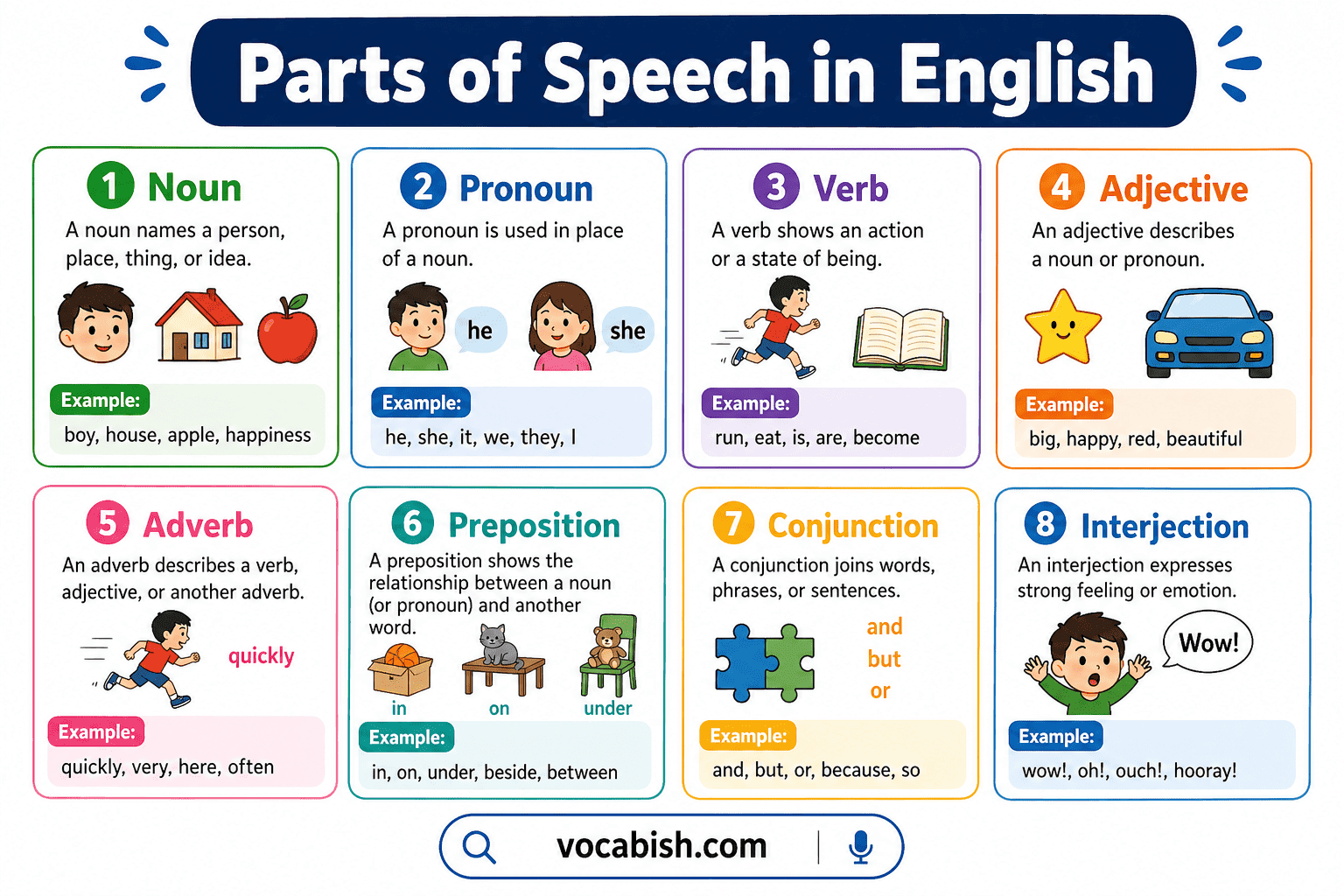
Here’s a comprehensive guide on: 8 Parts of Speech in English Grammar
Pronoun Definition and Examples
A pronoun is a word used in place of a noun or noun phrase.
Examples of pronouns include:
- I
- you
- he
- she
- it
- we
- they
- me
- him
- her
- us
- them
Example sentences:
- She is reading a book.
- They are playing football.
- It is raining.
- Please give the pen to me.
In these examples, the pronouns help us talk about people, animals, things, or ideas without repeating their names.
The Nine Types of Pronoun in English
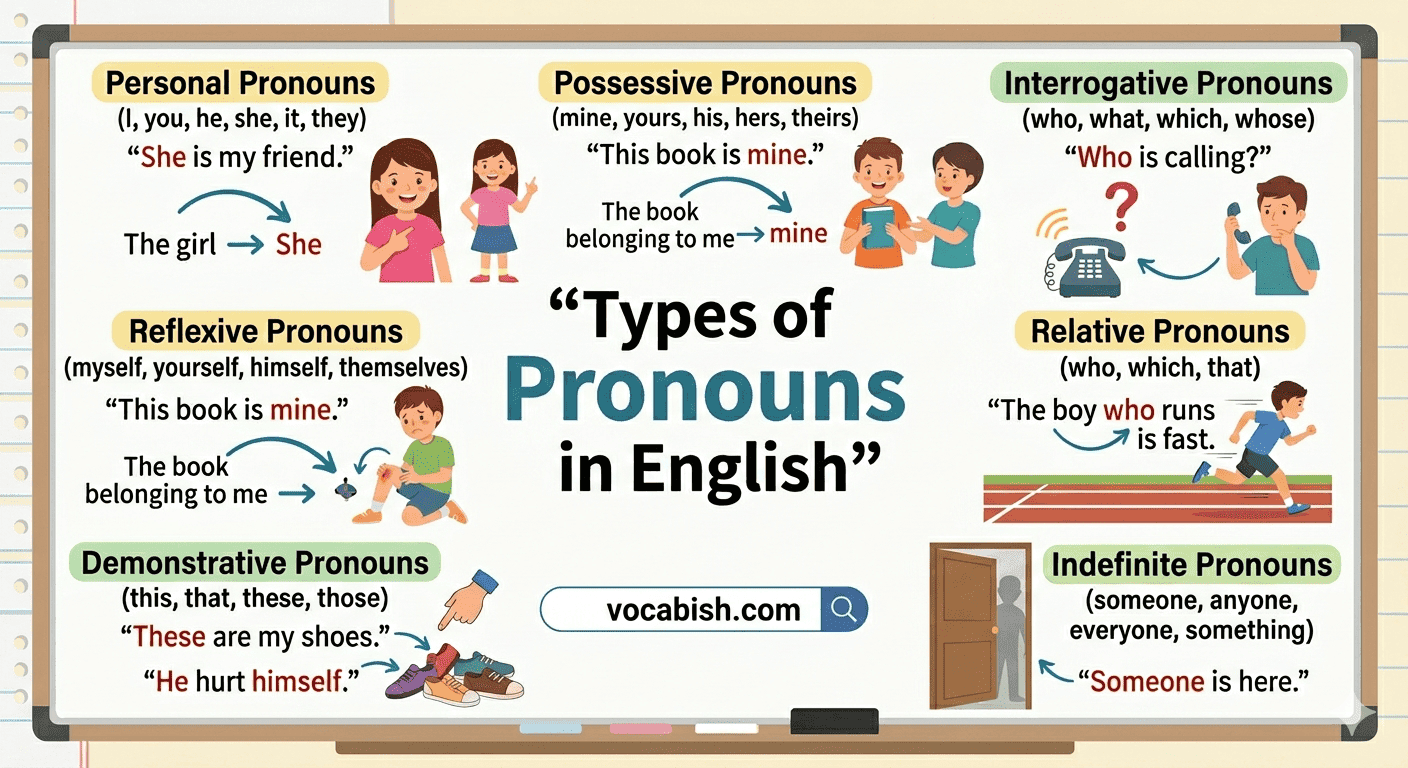
There are different types of pronouns in English. Each type has a different job in a sentence. Some pronouns replace people or things, some show ownership, some ask questions, and some point to specific nouns.
- Personal Pronouns: Words that replace specific people, animals, or things.
Examples include I, you, he, she, it, we, and they. - Possessive Pronouns: Words that show ownership or possession.
Examples include mine, yours, his, hers, ours, and theirs. - Reflexive Pronouns: Words used when the subject and object are the same person or thing.
Examples incude myself, yourself, himself, herself, and themselves. - Demonstrative Pronouns: Words that point to specific people or things.
Examples include this, that, these, and those. - Interrogative Pronouns: Words used to ask questions.
Examples include who, whom, whose, which, and what. - Relative Pronouns: Words that connect a noun with more information about it. Examples include who, whom, whose, which, and that.
- Indefinite Pronouns: Words that refer to people or things in a general way.
Examples include someone, anyone, everyone, nobody, and something. - Reciprocal Pronouns: Words that show a shared action between two or more people.
Examples include each other and one another. - Distributive Pronouns: Words that refer to members of a group separately.
Examples include each, either, and neither.
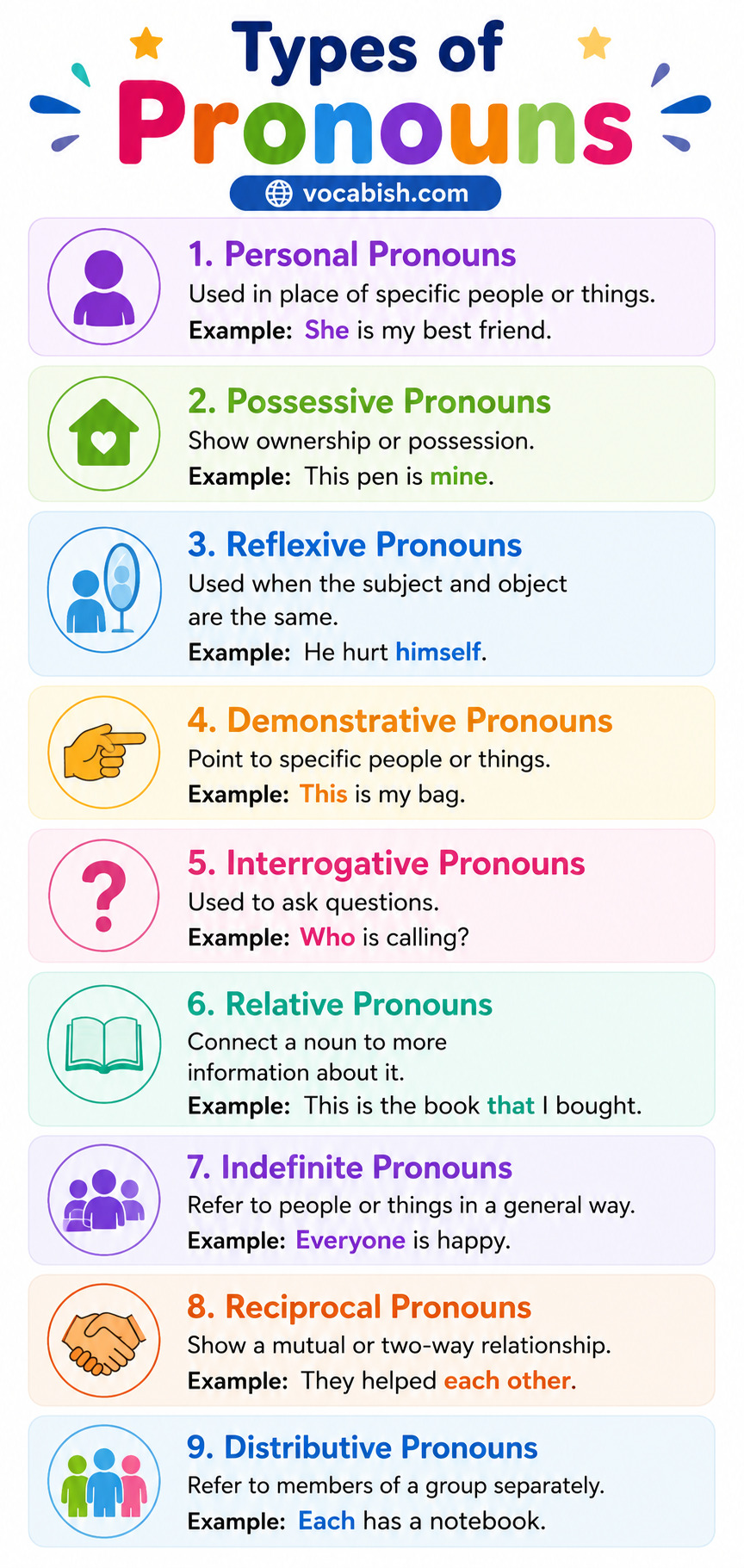
Let’s learn the main types of pronouns with simple definitions, uses, and examples.
1. Personal Pronouns
Personal pronouns refer to specific people, animals, or things. They change form depending on whether they are used as the subject or object of a sentence.
Subject Pronouns
Subject pronouns do the action in a sentence.
Examples:
- I
- you
- he
- she
- it
- we
- they
Sentences:
- I like English.
- She is my sister.
- They are watching TV.
- We study every day.
Object Pronouns
Object pronouns receive the action in a sentence.
Examples:
- me
- you
- him
- her
- it
- us
- them
Sentences:
- The teacher helped me.
- I called him yesterday.
- She invited us to dinner.
- We saw them at the park.
Quick comparison:
- He called me.
- I called him.
In the first sentence, he is the subject. In the second sentence, him is the object.
2. Possessive Pronouns
Possessive pronouns show ownership. They tell us that something belongs to someone.
Examples:
- mine
- yours
- his
- hers
- ours
- theirs
Sentences:
- This book is mine.
- That phone is hers.
- The house is theirs.
- This classroom is ours.
Do not confuse possessive pronouns with possessive adjectives.
Compare:
- This is my bag.
- This bag is mine.
Here, my comes before a noun, so it is a possessive adjective. Mine stands alone, so it is a possessive pronoun.
3. Reflexive Pronouns
Reflexive pronouns are used when the subject and object are the same person or thing.
Examples:
- myself
- yourself
- himself
- herself
- itself
- ourselves
- yourselves
- themselves
Sentences:
- I taught myself English.
- She looked at herself in the mirror.
- They prepared the food themselves.
- He hurt himself while playing.
In these sentences, the action returns to the same person.
4. Demonstrative Pronouns
Demonstrative pronouns point to specific people, places, or things.
Examples:
- this
- that
- these
- those
Use this and these for things that are near.
- This is my pen.
- These are my shoes.
Use that and those for things that are far.
- That is your car.
- Those are old buildings.
Difference:
- This is a book.
- These are books.
This is singular, and these are plural.
5. Interrogative Pronouns
Interrogative pronouns are used to ask questions.
Examples:
- who
- whom
- whose
- which
- what
Sentences:
- Who is at the door?
- What is your name?
- Which is your favorite color?
- Whose bag is this?
- Whom did you call?
In daily English, many people use who instead of whom, especially in speaking. However, whom is still used in formal English.
6. Relative Pronouns
Relative pronouns connect a noun to more information about it. They help combine ideas in one sentence.
Examples:
- who
- whom
- whose
- which
- that
Sentences:
- The man who helped me was kind.
- This is the book that I bought yesterday.
- She has a dog which loves children.
- I met a girl whose brother is a doctor.
Relative pronouns usually come after the noun they describe.
7. Indefinite Pronouns
Indefinite pronouns refer to people, places, or things in a general way. They do not name a specific person or thing.
Examples:
- someone
- anyone
- everyone
- nobody
- something
- anything
- everything
- few
- many
- several
- all
Sentences:
- Someone is knocking at the door.
- Everyone enjoyed the party.
- I need something to drink.
- Nobody knew the answer.
- Many were absent yesterday.
Some indefinite pronouns are singular, some are plural, and some can be both depending on the sentence.
Examples:
- Everyone is ready.
- Many are ready.
8. Reciprocal Pronouns
Reciprocal pronouns show a two-way relationship. They are used when two or more people do the same action to each other.
Examples:
- each other
- one another
Sentences:
- Ali and Ahmed helped each other.
- The students talked to one another.
- The two friends trusted each other.
Use each other mostly for two people or things. Use one another for more than two, although in modern English both are often used naturally.
9. Distributive Pronouns
Distributive pronouns refer to members of a group separately, not all together.
Examples:
- each
- either
- neither
Sentences:
- Each of the students received a certificate.
- Either of the two answers is correct.
- Neither of them came to class.
These pronouns are usually singular, so they often take singular verbs.
Example:
- Each student has a book.
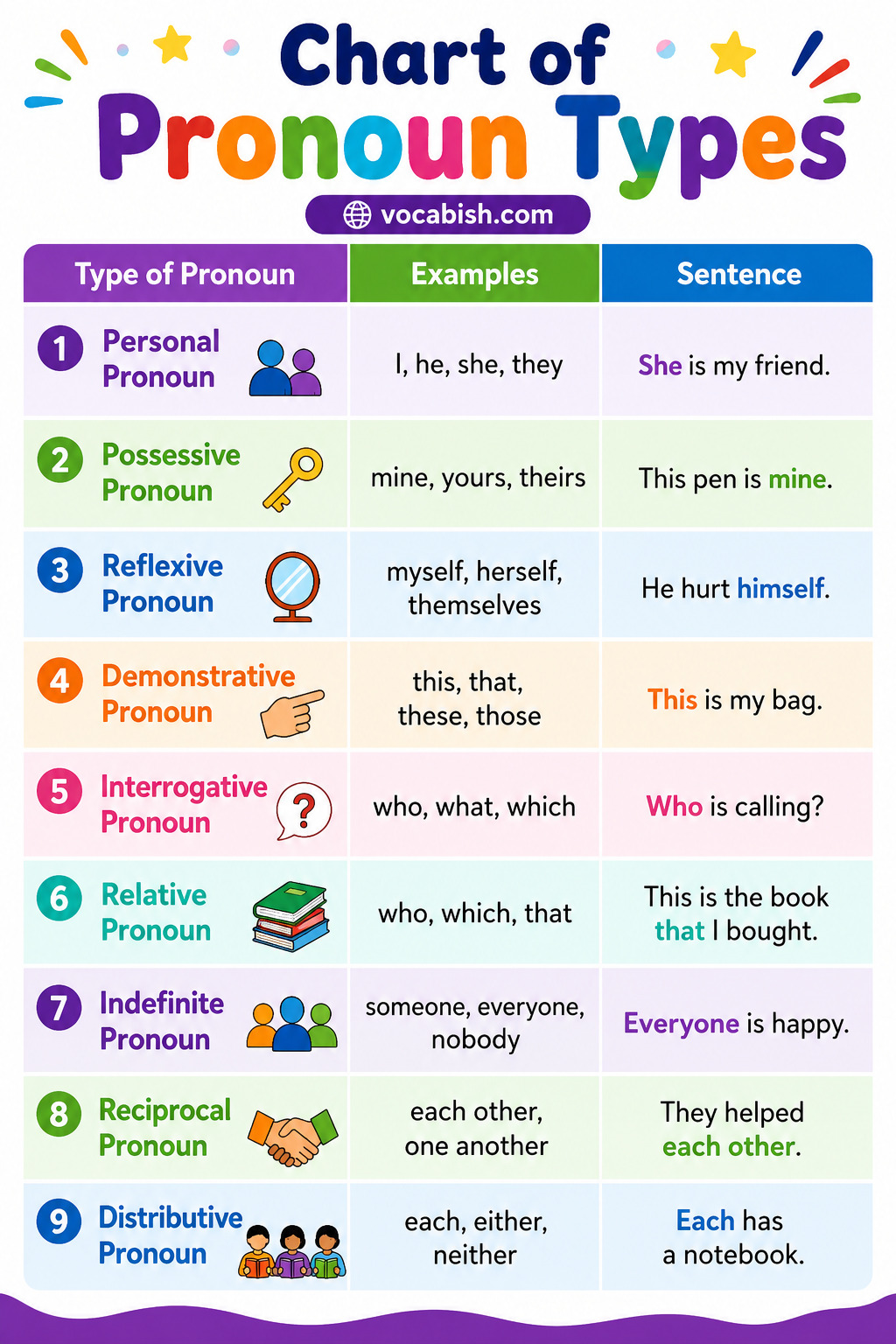
Chart of Pronoun Types and Examples
Type of Pronoun | Examples | Sentence |
|---|---|---|
Personal Pronoun | I, he, she, they | She is my friend. |
Possessive Pronoun | mine, yours, theirs | This pen is mine. |
Reflexive Pronoun | myself, herself, themselves | He hurt himself. |
Demonstrative Pronoun | this, that, these, those | This is my bag. |
Interrogative Pronoun | who, what, which | Who is calling? |
Relative Pronoun | who, which, that | This is the book that I bought. |
Indefinite Pronoun | someone, everyone, nobody | Everyone is happy. |
Reciprocal Pronoun | each other, one another | They helped each other. |
Distributive Pronoun | each, either, neither | Each has a notebook. |
Pronoun and Antecedent
The noun that a pronoun refers to is called its antecedent.
Example:
- Maria is tired because she worked all day.
Here, Maria is the antecedent, and she is the pronoun.
Another example:
- The boys are happy because they won the match.
Here, boys is the antecedent, and they is the pronoun.
A pronoun should clearly match the noun it replaces.
Common Mistakes When Using Pronoun
1: Using the wrong subject or object pronoun
Incorrect:
- Me am going to school.
Correct:
- I am going to school.
Incorrect:
- The teacher helped I.
Correct:
- The teacher helped me.
Use subject pronouns before verbs and object pronouns after verbs or prepositions.
2: Confusing possessive pronouns and contractions
Incorrect:
- This book is her’s.
Correct:
- This book is hers.
Incorrect:
- Its my bag.
Correct:
- It’s my bag.
Remember:
- Its shows possession.
- It’s means it is.
3: Using an unclear pronoun
Unclear:
- Ali told Ahmed that he was late.
Who was late, Ali or Ahmed? The sentence is not clear.
Clear:
- Ali told Ahmed, “You are late.”
- Ali was late, so he told Ahmed the reason.
A pronoun should clearly refer to one noun.
How to Identify a Pronoun in a Sentence
To identify a pronoun, ask:
- Does this word replace a noun?
- Does it refer to a person, place, thing, or idea already mentioned?
- Does it show ownership, ask a question, or point to something?
Example:
- Sarah lost her pencil, but she found it later.
Pronouns in the sentence:
- her refers to Sarah
- she refers to Sarah
- it refers to pencil
Practice Exercise
Identify the pronouns in each sentence.
- She is my best friend.
- This is my new phone.
- Everyone enjoyed the picnic.
- The boy hurt himself.
- They helped each other.
- Who is standing outside?
- This is the house that we bought.
Answers:
- She, my
- This, my
- Everyone
- himself
- They, each other
- Who
- This, that, we
You May Also Need to Learn:
- Adjectives in English with Definition and Examples
- Types of Adverbs with Definitions and Examples
- Verbs Definition and Their Types with Examples
FAQs about Types of Pronoun
A pronoun is a word used in place of a noun. It helps avoid repeating the same noun again and again. For example, instead of saying Ali is kind. Ali helps people, we can say Ali is kind. He helps people.
Common examples of pronouns are I, you, he, she, it, we, they, me, him, her, us, and them.
Example: She is reading a book.
The main types of pronouns include personal, possessive, reflexive, demonstrative, interrogative, relative, indefinite, reciprocal, and distributive pronouns. Each type has a different use in a sentence.
We use pronouns to make sentences shorter, smoother, and less repetitive. Pronouns help us refer to people, places, things, or ideas without repeating their names many times.
A noun names a person, place, thing, animal, or idea, while a pronoun replaces a noun.
Example: Sarah is a noun, but she is a pronoun that can replace Sarah.
Subject pronouns do the action in a sentence, while object pronouns receive the action.
Example: He called me.
Here, he is the subject pronoun, and me is the object pronoun.
To identify a pronoun, look for a word that replaces a noun or refers to someone or something already mentioned.
Example: Maria lost her bag, but she found it later.
Here, her, she, and it are pronouns.
Final Thoughts
A pronoun is a word that replaces a noun and helps make sentences smoother and less repetitive. Learning the pronoun definition and its types gives you a stronger understanding of English sentence structure.
Start with common pronouns like I, you, he, she, it, we, and they, then slowly learn other types such as possessive, reflexive, demonstrative, relative, and indefinite pronouns. With regular practice, you will begin to use pronouns naturally in both speaking and writing.