
In this blog post, you will learn about the different types of verbs in English, what they mean, and how to use them in real sentences. Verbs are action, state, and helping words that tell us what is happening or what someone is doing. Without verbs, we cannot make complete sentences or share our ideas clearly. When you understand verb types, you can speak more naturally, read with better understanding, write stronger sentences, and follow conversations more easily. Many learners feel confused because verbs change form and have different roles, but once you learn how each type works, English starts to make more sense.
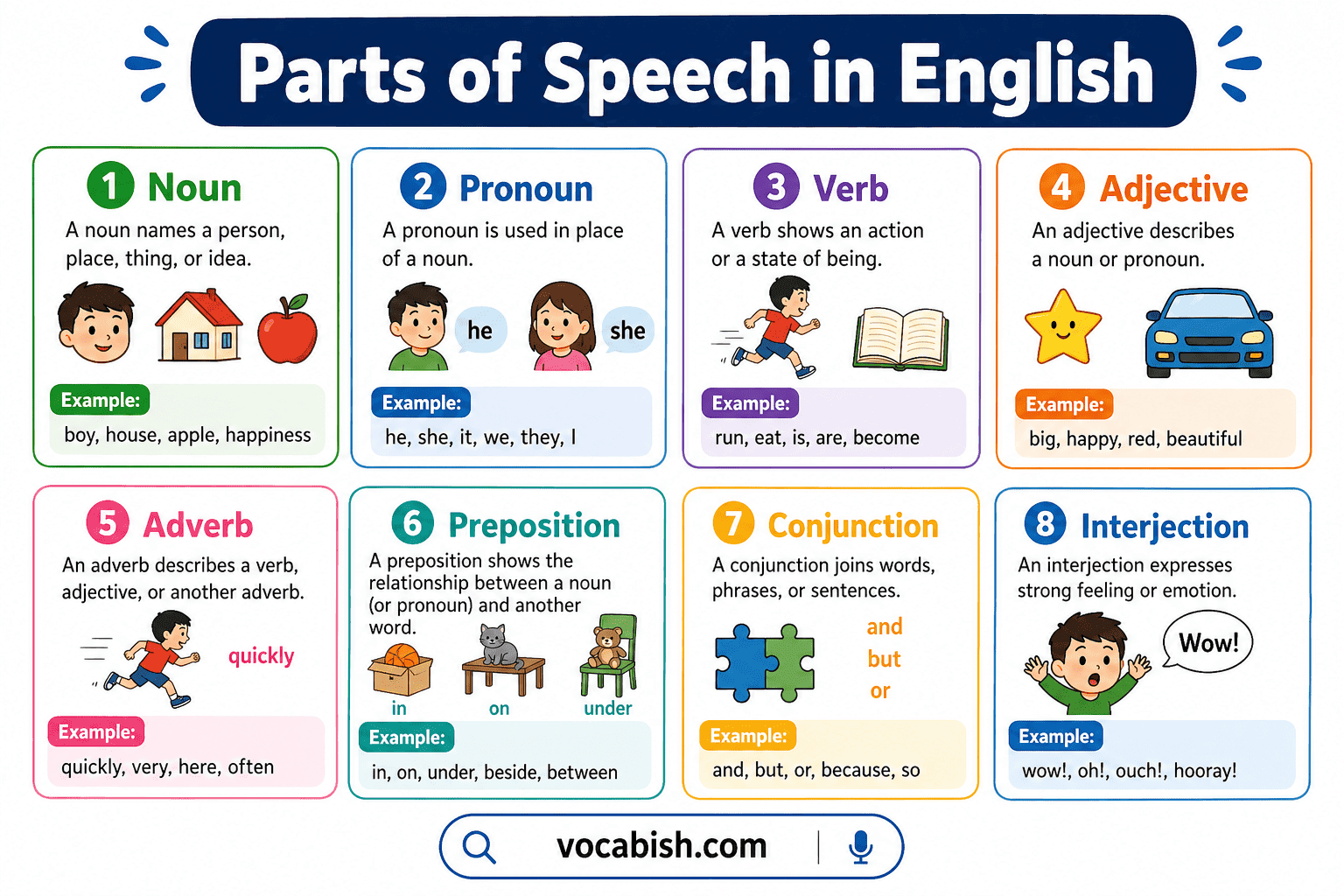
If you want to clear confusion about grammar roles, read our breakdown of how words work in English grammar.
Verb Definition and Examples
A verb is a word that shows an action, a state, or an occurrence. Without a verb, a sentence isn’t complete.
Verbs give meaning to your sentence. They tell us what the subject is doing or experiencing.
Examples:
- She runs every morning.
- They are happy.
- The baby cried loudly.
- We have finished the work.
Main Types of Verbs in English
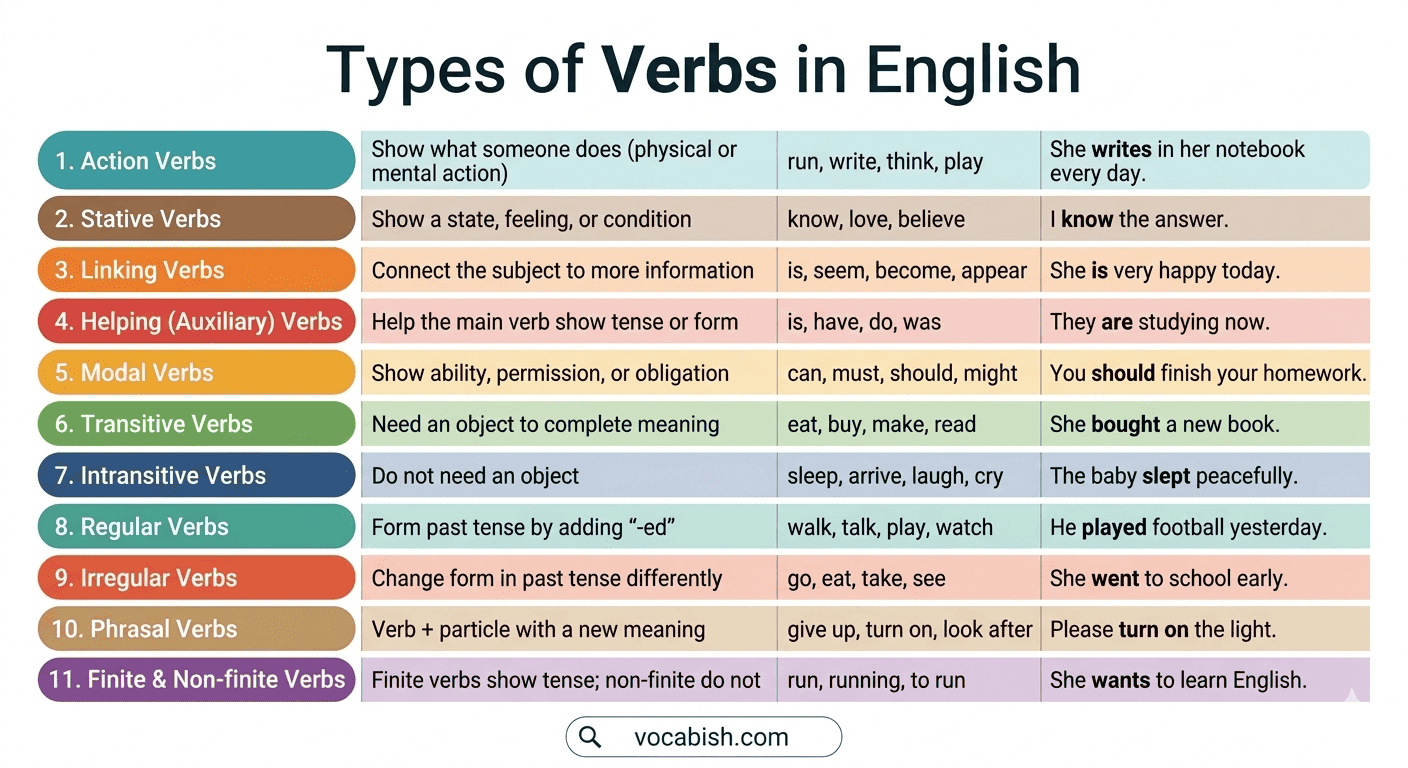
English verbs can be grouped into several types based on their function. Let’s break them down clearly.
Action Verbs (Dynamic Verbs)
Action verbs describe physical or mental actions.
Examples:
- She writes a letter.
- They play football after school.
- He thinks about the problem.
- We watched a movie last night.
- I am learning English.
Stative Verbs (State Verbs)
Stative verbs describe a state, condition, or feeling—not an action.
Examples
- I know the answer.
- She loves chocolate.
- They own a car.
- He believes your story.
- We understand the lesson.
Linking Verbs
Linking verbs connect the subject to more information about it. They don’t show action.
Common linking verbs are
- be (am, is, are, was, were)
- seem
- become
- feel
- look
- appear
Examples
- She is a teacher.
- The soup tastes good.
- He became angry.
- They seem tired.
- The sky looks clear.
Helping Verbs (Auxiliary Verbs)
Helping verbs work with main verbs to form tenses, questions, negatives, or emphasis.
Common helping verbs are
- be (am, is, are)
- have (has, have, had)
- do (do, does, did)
- modal verbs (can, will, must, etc.)
Examples
- She is studying now.
- They have finished their homework.
- Do you like coffee?
- He does not understand the question.
- We are going to travel tomorrow.
Modal Verbs
Modal verbs are a special type of helping verb that show ability, possibility, permission, or obligation.
Common modal verbs are
Modal | Use |
|---|---|
can | ability / permission |
must | obligation |
should | advice |
may | possibility |
will | future |
might | weak possibility |
Examples
- She can swim very well.
- You must finish your homework.
- They might come later.
- We should leave early.
- He will call you tomorrow.
Transitive verbs
A transitive verb needs an object to complete its meaning.
Examples:
- She reads a book.
- They built a house.
- He bought a car.
Intransitive verbs
An intransitive verb does not need an object.
Examples:
- She sleeps.
- They arrived late.
- The baby cried.
Transitive vs Intransitive Verbs
Type | Needs Object? | Example |
|---|---|---|
Transitive | Yes | She eats an apple. |
Intransitive | No | She eats. |
Regular Verbs
Regular verbs follow a standard pattern when forming the past tense.
Examples
- work → worked
- play → played
- watch → watched
Irregular Verbs
Irregular verbs do not follow a fixed pattern.
Examples
- go → went
- eat → ate
- take → took
Finite Verbs
A finite verb changes according to tense and subject.
Examples:
- She runs every day.
- They are playing now.
Non-finite Verbs
A non-finite verb does not change based on tense or subject.
Types include:
- infinitives (to eat)
- gerunds (eating)
- participles (eaten, eating)
Examples
- She wants to learn English.
- Eating healthy is important.
- The broken window needs repair.
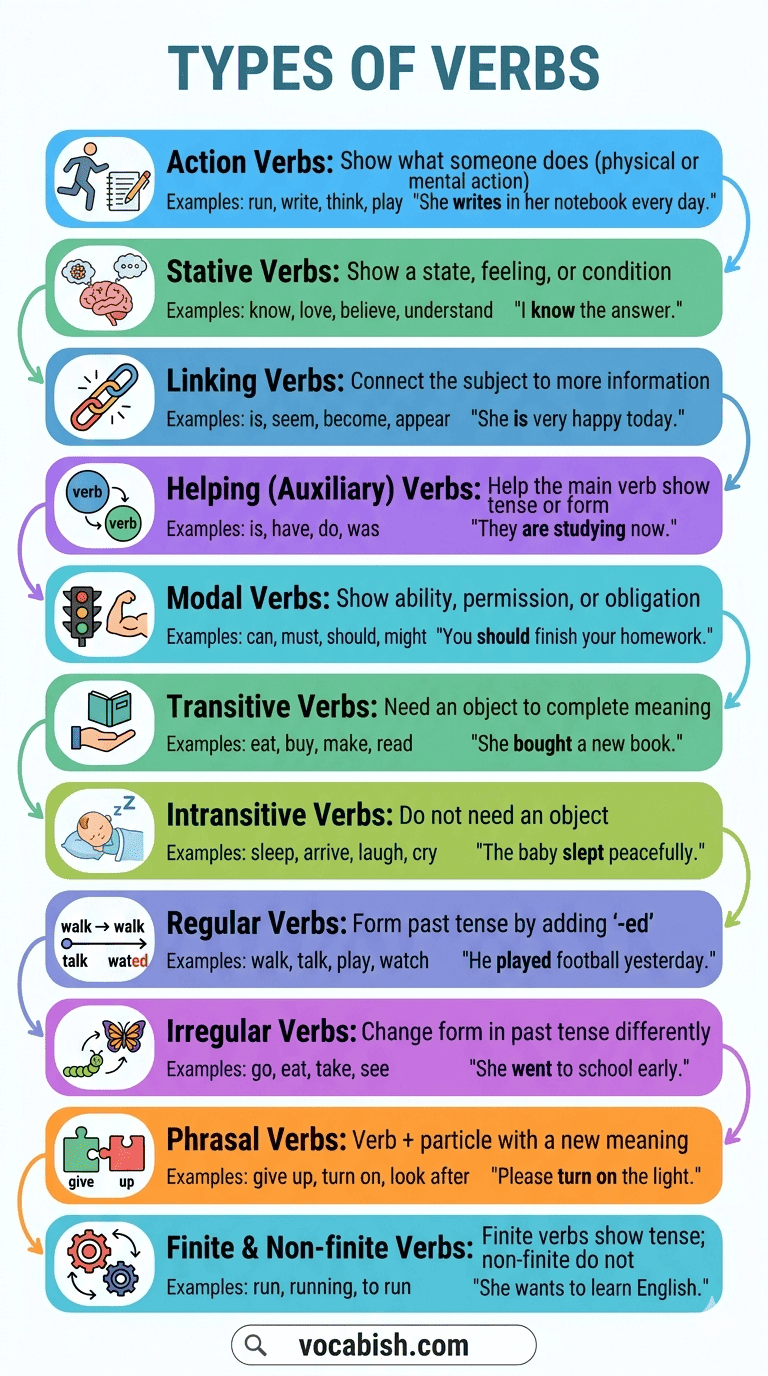
20 Types of Verbs Chart with Examples
Types of Verbs | Words | Example Sentence |
|---|---|---|
Regular Verbs Form past tense by adding “-ed” to the base verb. | walk, talk, play, watch | She walked to school yesterday. |
Irregular Verbs Do not follow a fixed pattern in past forms. | go, eat, sing, take | He went to the market early. |
Transitive Verbs Need an object to complete meaning. | eat, buy, make, read | She bought a new phone. |
Intransitive Verbs Do not need an object. | sleep, arrive, cry, laugh | The baby slept peacefully. |
Ditransitive Verbs Take two objects (direct and indirect). | give, send, show, tell | She gave me a gift. |
Main Verbs Show the main action or meaning in a sentence. | run, write, speak, learn | They are learning English. |
Auxiliary Verbs Help the main verb show tense or form. | is, have, do, was | She is reading a book. |
Modal Verbs Show ability, possibility, or obligation. | can, must, should, might | You should drink more water. |
Semi-modal Verbs Work like modals but have more structure. | have to, need to, ought to | I have to finish this work. |
Finite Verbs Change based on tense and subject. | runs, ate, is, were | She runs every morning. |
Infinite Verbs Do not show tense or subject. | go, eat, to run, to sleep | I want to learn English. |
Stative Verbs Show state, feeling, or condition. | know, love, believe, understand | I know the answer. |
Dynamic Verbs Show actions or processes. | run, dance, write, play | They are playing outside. |
Phrasal Verbs Verb + particle with new meaning. | give up, turn on, bring up | Don’t give up so easily. |
Linking Verbs Connect subject to more information. | is, seem, become, appear | She is very happy today. |
Bare Infinitive Base verb without “to”. | go, eat, play, make | She made him cry. |
To-Infinitive Base verb with “to”. | to go, to eat, to learn | I want to sleep early. |
Present Participle “-ing” form of the verb. | running, eating, singing | She is singing a song. |
Past Participle Third form used in perfect tenses. | eaten, gone, written, taken | They have finished the work. |
Lexical Verbs Carry full meaning independently. | jump, cry, live, work | He works in a bank. |
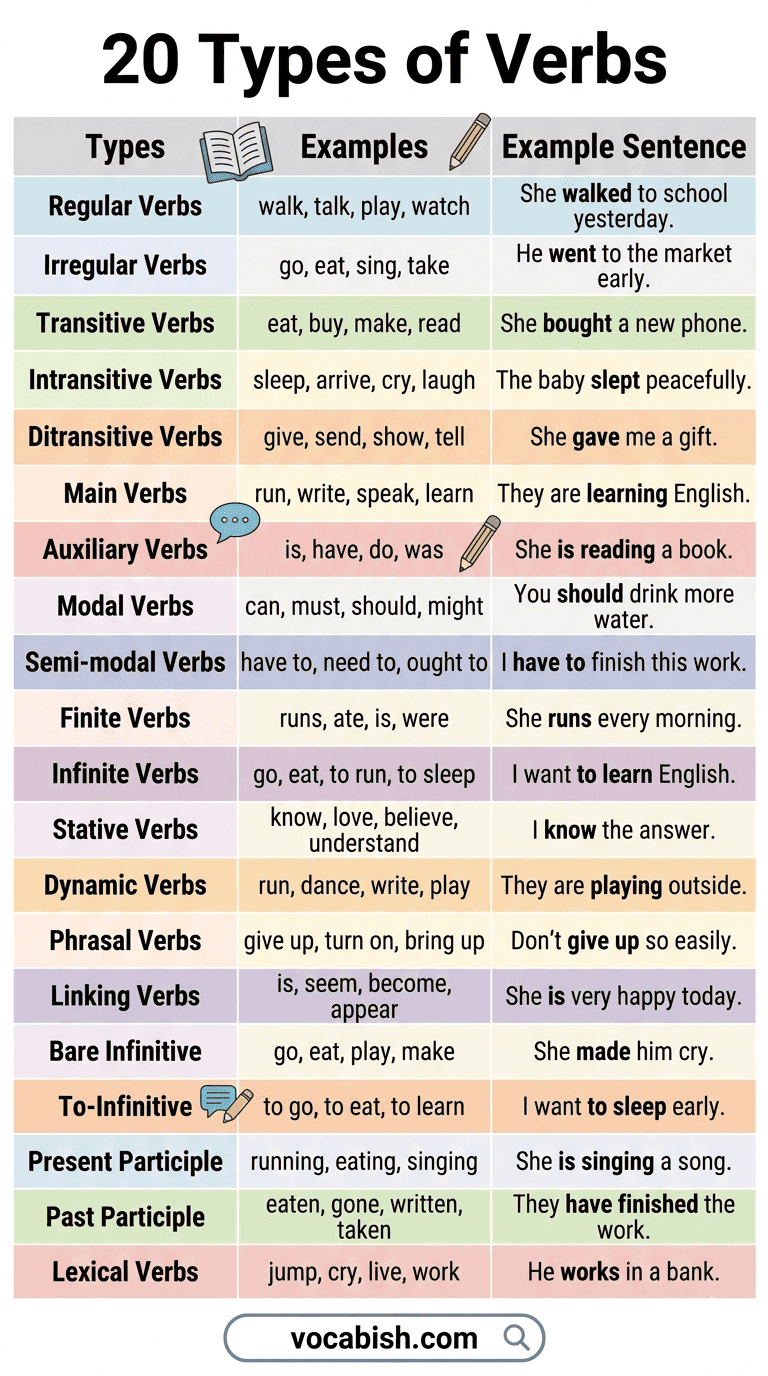
Verb Examples in Sentences
Here’s a practical list of 30 of the most common verbs in English, used in natural, conversational sentences. These are the kinds of sentences learners actually use in real life, so you can practice speaking more confidently.
Verb | Example Sentence |
|---|---|
be | I’m really tired today. |
have | I have a meeting at 10 a.m. |
do | What do you usually do on weekends? |
say | She said she’ll call you later. |
go | I’m going to the store—do you need anything? |
get | I got your message this morning. |
make | Can you make some coffee, please? |
know | I know how to fix this problem. |
think | I think this is the right answer. |
take | Take your time, there’s no rush. |
see | I see what you mean now. |
come | Can you come over after work? |
want | I want to learn English fluently. |
look | You look really happy today. |
use | I use this app to study every day. |
find | I can’t find my keys anywhere. |
give | I’ll give you a call later. |
tell | Can you tell me the truth? |
work | I work from home most days. |
call | I’ll call you when I arrive. |
try | I’ll try to finish it tonight. |
ask | Can I ask you a quick question? |
need | I need some help with this task. |
feel | I feel much better today. |
become | He became very successful over time. |
leave | What time are you leaving? |
put | Put your phone on silent, please. |
mean | What do you mean by that? |
keep | Keep going—you’re doing great. |
let | Let me explain this again. |
Common Mistakes with Verbs
Here are the mistakes I see most often in class.
1. Wrong verb form
Wrong: She go to school every day.
Correct: She goes to school every day.
Why: Third-person singular needs “-s”.
2. Using stative verbs in continuous form
Wrong: I am liking this movie.
Correct: I like this movie.
Why: “Like” is a stative verb.
3. Missing helping verbs
Wrong: You coming today?
Correct: Are you coming today?
Why: Questions need auxiliary verbs.
4. Incorrect past tense
Wrong: He buyed a new phone.
Correct: He bought a new phone.
Why: “Buy” is irregular.
5. Misusing modal verbs
Wrong: She must to go now.
Correct: She must go now.
Why: Modals don’t use “to”.
Verb Exercises
Try these exercises to test your understanding.
Fill in the blanks
- She ______ (go) to the gym every day.
- They ______ (be) watching a movie now.
- He ______ (can / swim) very fast.
- I ______ (know) the answer.
- She ______ (buy) a new dress yesterday.
Identify the verb type
- She feels happy. (What type of verb?)
- They are playing outside.
- He has finished his work.
- We slept early.
Answer Key
- goes
- are
- can swim
- know
- bought
- Linking verb
- Action verb (with helping verb)
- Helping verb + main verb
- Intransitive verb
Understanding the different types of verbs gives you real control over your English. Instead of guessing, you start making clear, correct sentences on purpose. Focus on one type at a time, notice how it appears in real conversations, and practice regularly. The more you see verbs in action, the more natural they’ll feel in your own speaking and writing.
FAQs about Types of Verbs
A verb is a word that shows an action, a state, or an event. It tells what the subject does or what happens in a sentence.
The main types of verbs include action verbs, stative verbs, linking verbs, helping verbs, and modal verbs. Each type has a different role in forming correct sentences.
Action verbs show what someone does physically or mentally. For example: She runs daily, He thinks carefully, They play football after school.
Linking verbs connect the subject to more information, not an action. Common examples include is, are, seem, and become, as in She is happy.
Helping verbs support the main verb to show tense, questions, or negatives. Examples include is, have, and do, as in She is studying now.
Transitive verbs need an object to complete meaning, like She reads a book. Intransitive verbs do not need an object, like She sleeps peacefully.
Practice using verbs in daily sentences, read simple texts, and listen to conversations. Focus on verb forms and sentence patterns to improve accuracy and confidence.
You May Also Like: