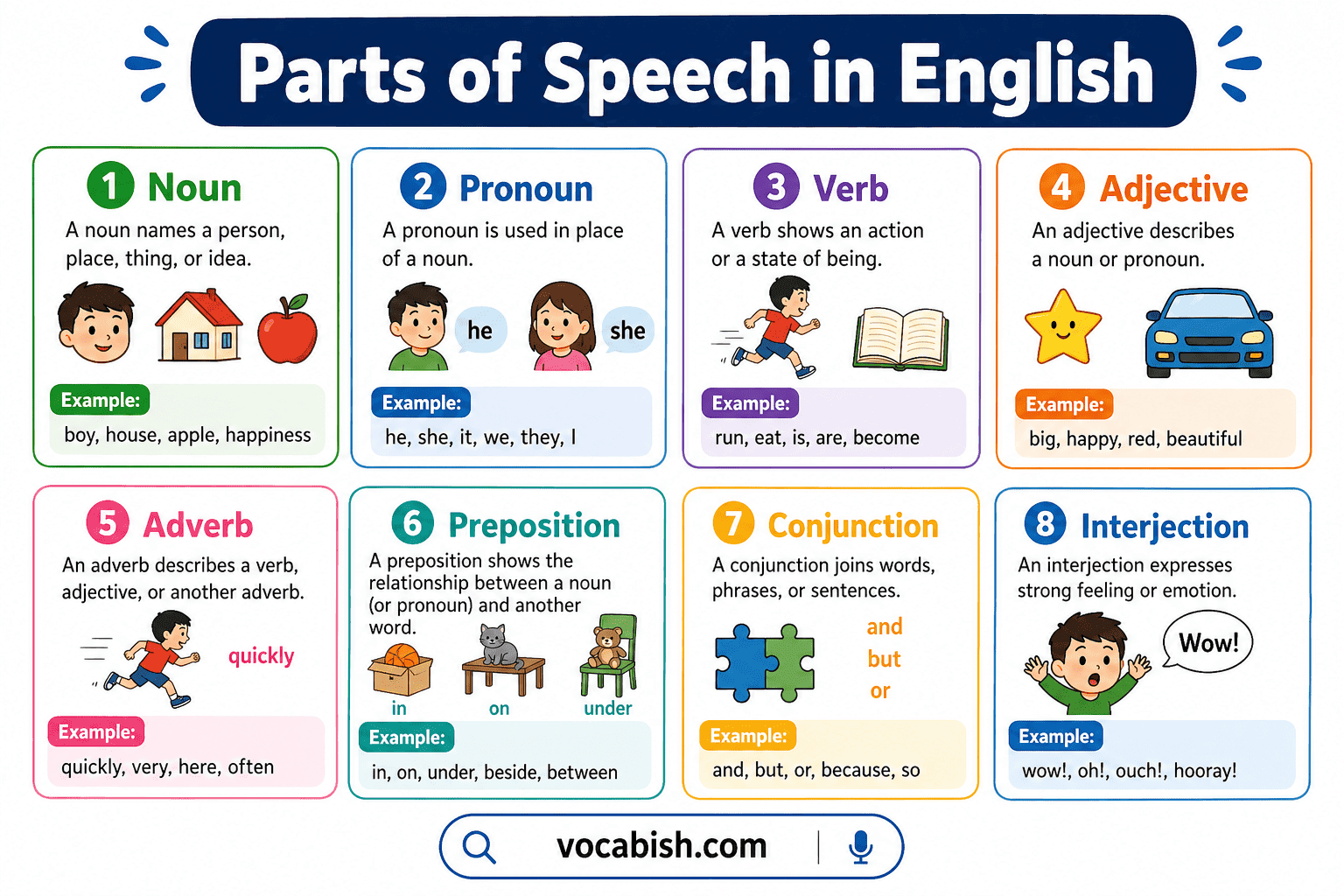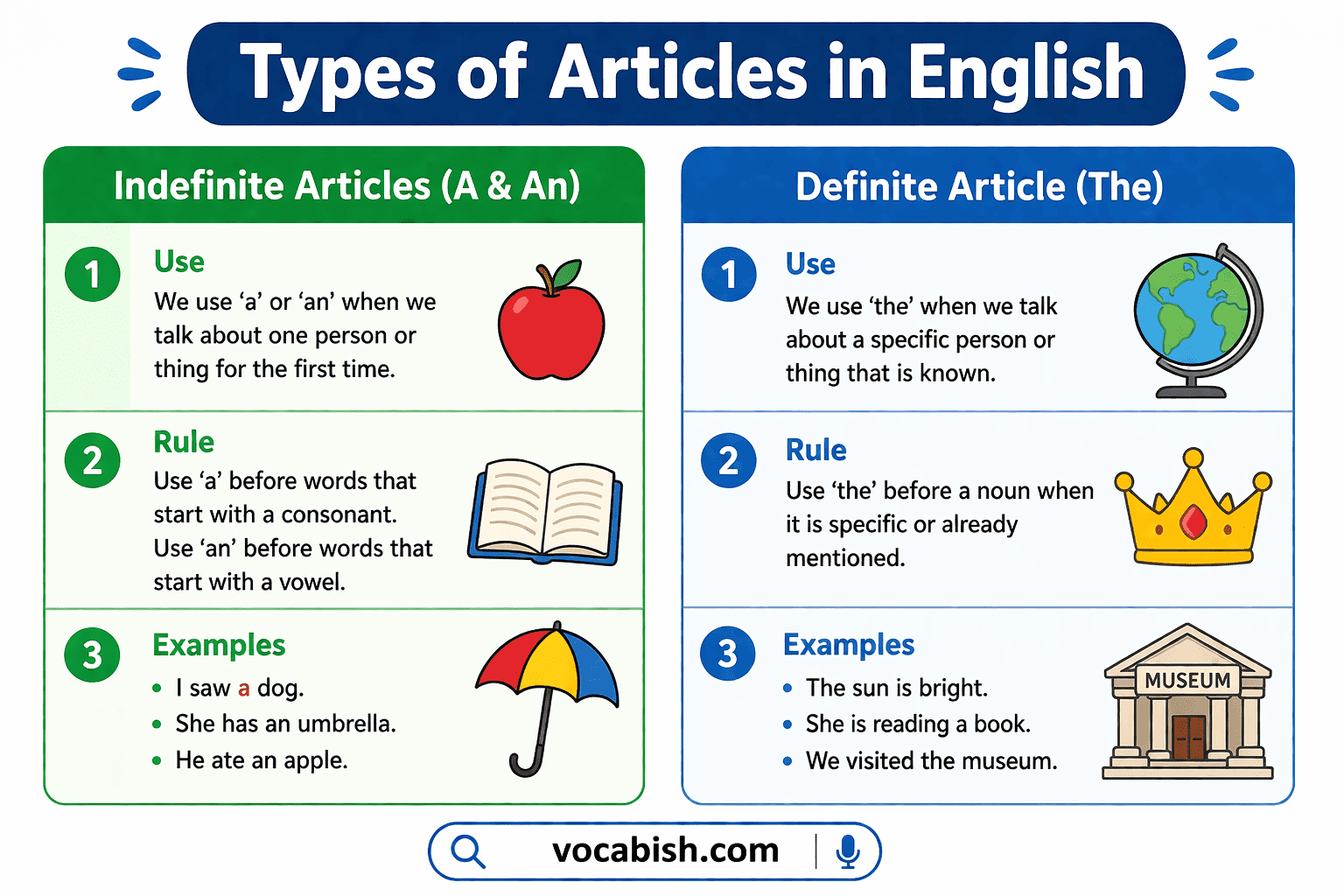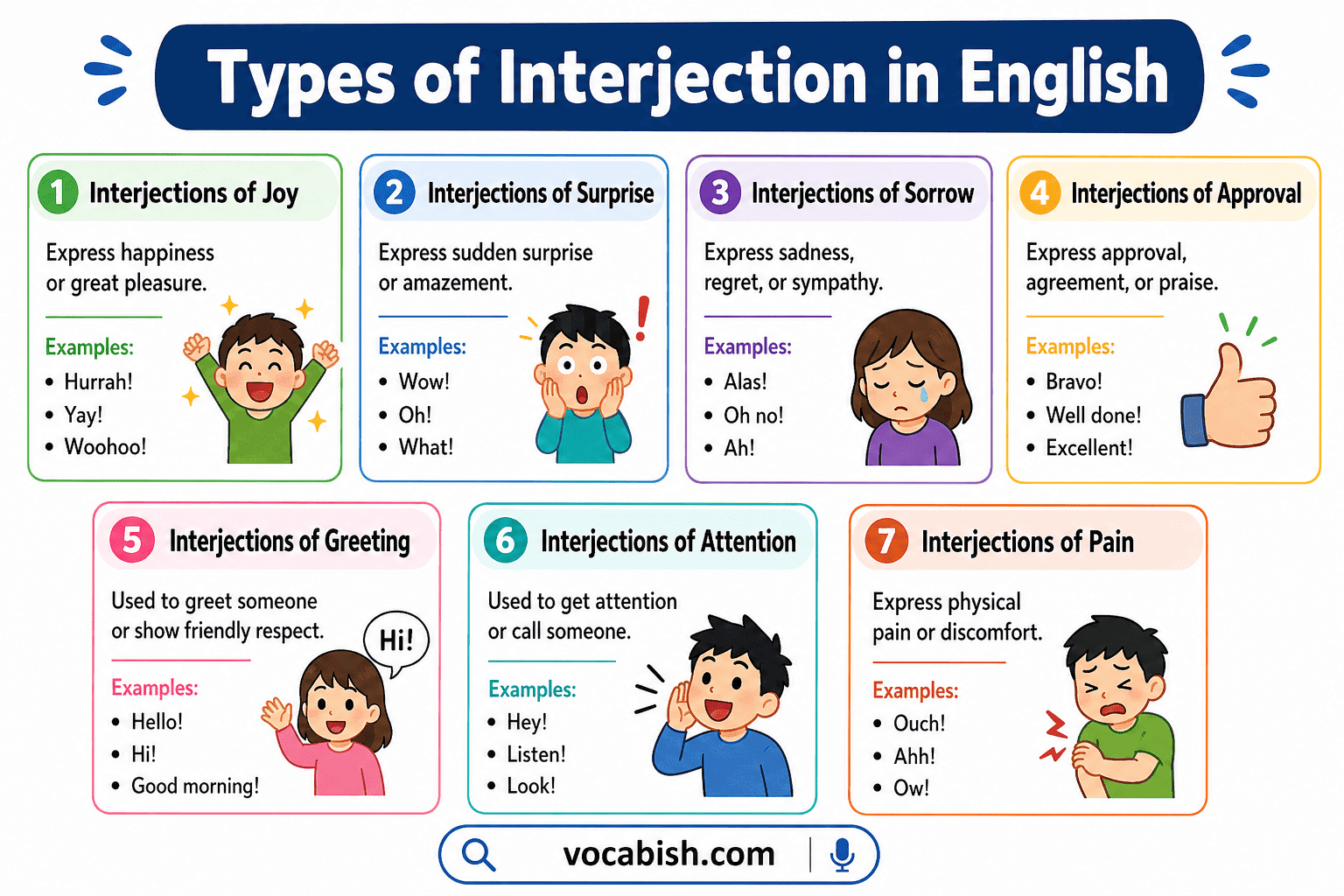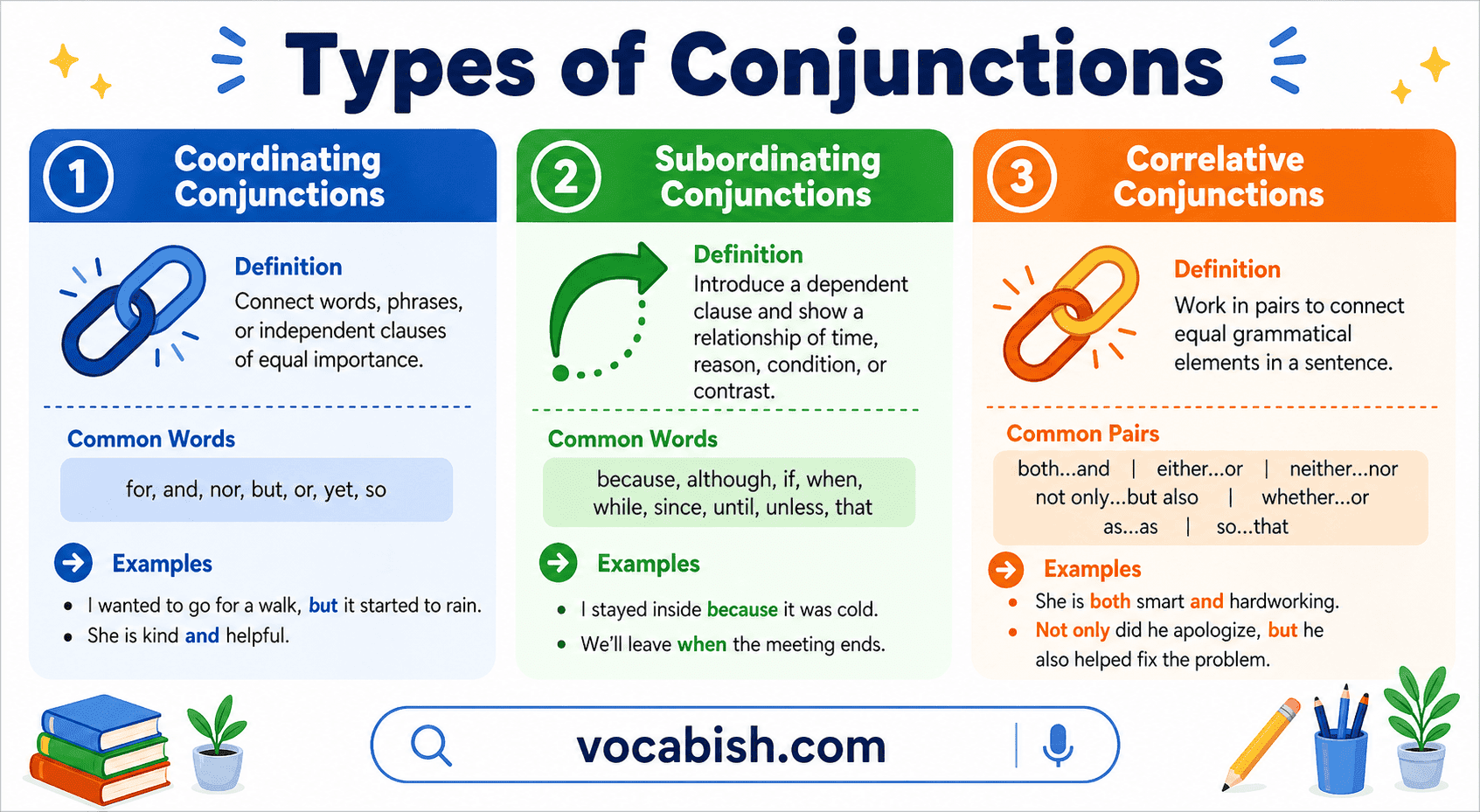

When you start learning English, one of the first grammar topics you meet is the noun. Every sentence uses nouns because they help us name people, places, animals, objects, feelings, and ideas. Without nouns, it would be difficult to communicate clearly.
Understanding Noun and Its Types makes reading, writing, and speaking much easier. Once you know how nouns work, you can build better sentences and express your ideas with confidence.
If you want to understand how English words function in sentences, read our complete guide to English word categories.
An Easy Guide to Types of Nouns
- A noun is a word that names something, such as a person, place, thing, or idea.
- In a sentence, nouns can function as the subject, direct object, indirect object, subject complement, object complement, appositive, or modifier.
- Proper nouns refer to specific names and always begin with a capital letter (e.g., London, Emma), while common nouns refer to general people or things (e.g., city, girl).
- Singular nouns name one person, place, or thing (book), while plural nouns name more than one (books). Possessive nouns show ownership (book’s cover).
- Concrete nouns refer to physical objects that can be experienced with the senses (apple), abstract nouns refer to ideas or qualities (honesty), and collective nouns refer to groups acting as one unit (team).
- Countable nouns can be counted individually (three chairs), while uncountable nouns refer to substances or concepts that are not usually counted (milk, knowledge).
- Nouns appear in almost every sentence we speak or write. Understanding Noun and Its Types helps you build stronger sentences and communicate more clearly.
Noun Definition
A noun is a naming word. It identifies a person, place, thing, animal, idea, feeling, or quality. Every language uses nouns to describe the world around us, and English is no different.
For example:
- Teacher teaches students.
- Hospital provides medical care.
- Computer helps us work.
- Friendship makes life meaningful.
Once you can recognize nouns, understanding sentence structure becomes much easier.
Nouns Can Name a Person
Many nouns refer to people, whether they are specific individuals or general roles.
Examples:
- doctor
- student
- mother
- David
- engineer
Sentences:
- The doctor examined the patient.
- David enjoys reading novels.
- My mother cooks delicious meals.
Nouns Can Name a Place
Places of every size can be nouns, from countries and cities to schools and parks.
Examples:
- school
- village
- beach
- Japan
- library
Sentences:
- The children walked to the school.
- We spent our vacation in Japan.
- She studies in the library every evening.
Nouns Can Name Things
Objects, animals, devices, food, and many everyday items are also nouns.
Examples:
- chair
- phone
- bicycle
- dog
- pencil
Sentences:
- The chair is made of wood.
- I lost my phone yesterday.
- Their dog loves playing outside.
Types of Nouns
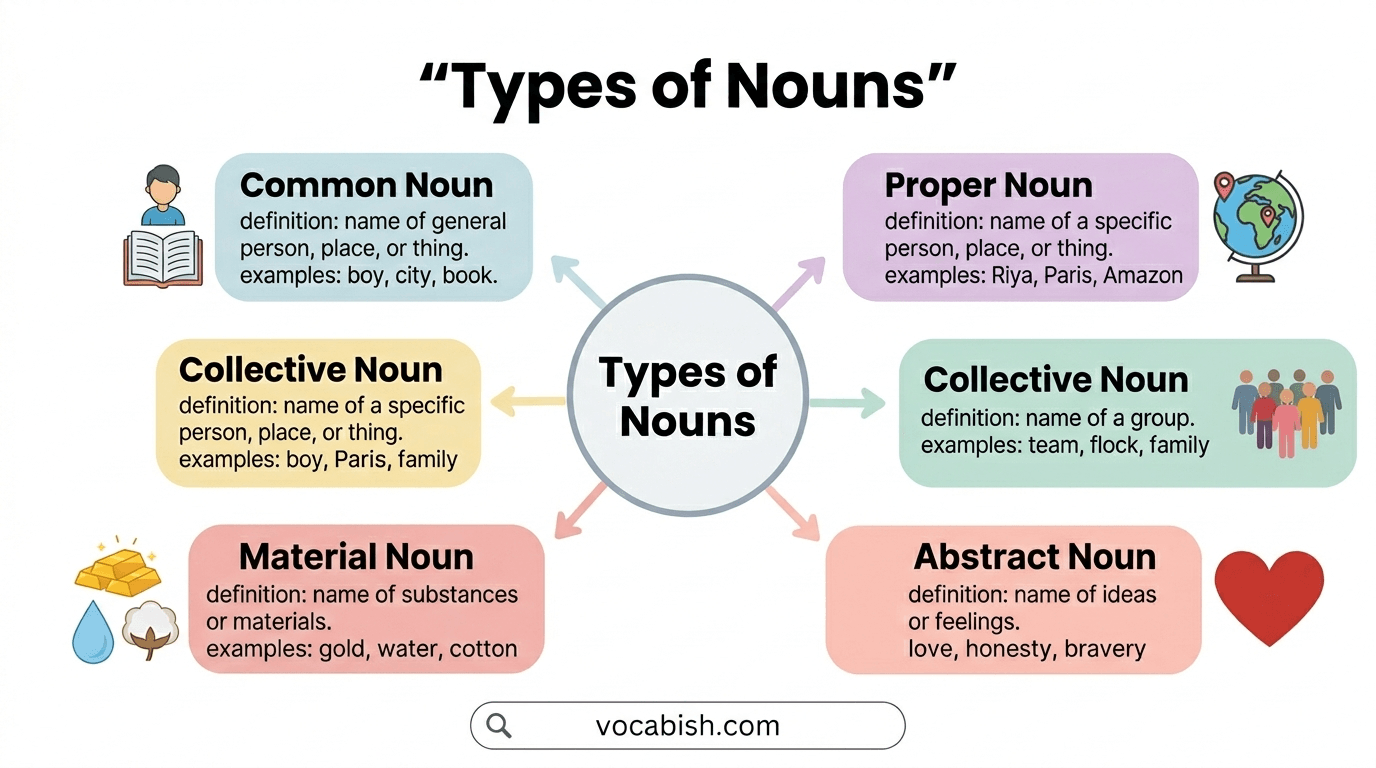
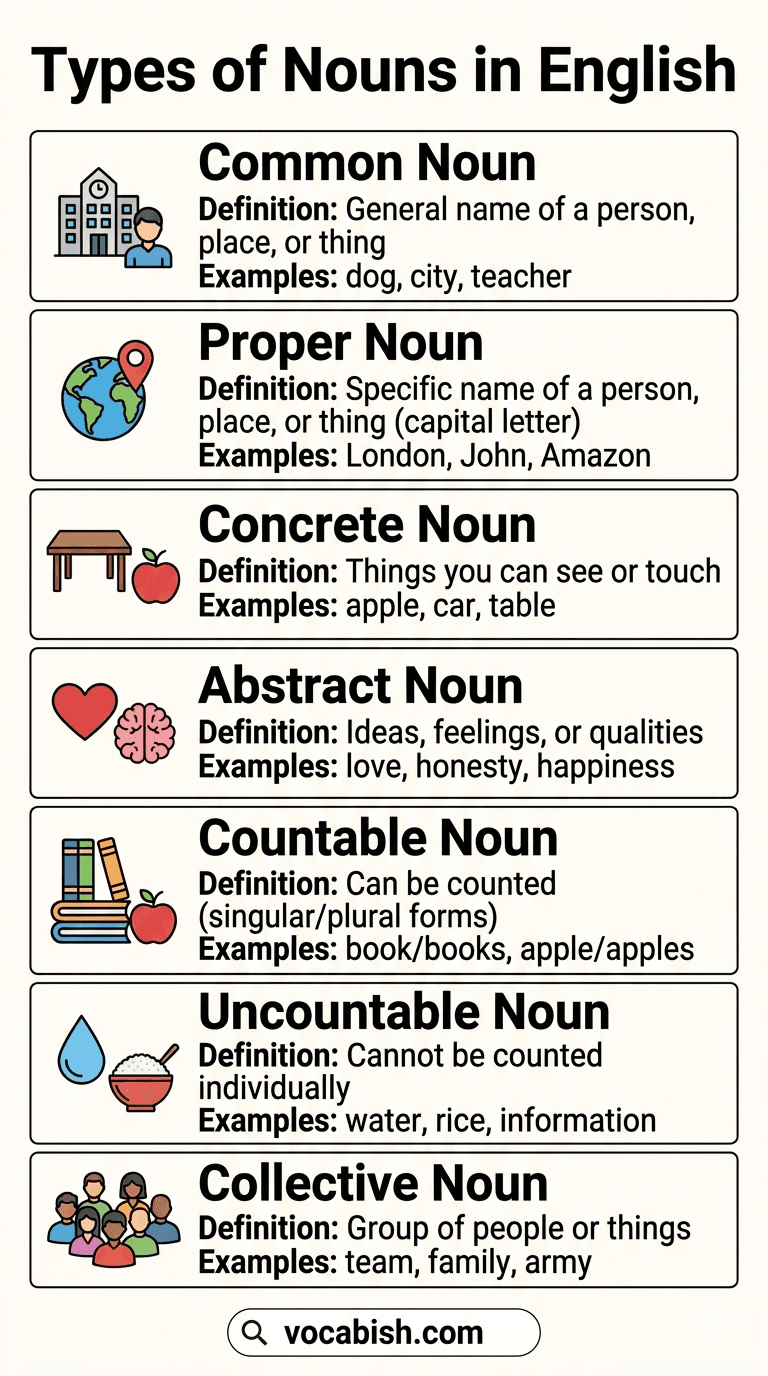
The Types of Nouns help us understand how different naming words are used in English. Some nouns identify real objects, while others describe ideas, groups, or specific names. Learning these categories makes grammar easier and improves both writing and speaking skills.
Types of Common Nouns
Common or generic nouns can be divided into three subtypes: concrete nouns, abstract nouns, and collective nouns. Each subtype describes a different kind of thing or concept.
Concrete Nouns
Concrete nouns refer to things that can be experienced through one or more of the five senses.
Examples:
- apple
- table
- flower
- river
- guitar
Sentences:
- The flower smells wonderful.
- She placed the book on the table.
- The river flows through the valley.
Abstract Nouns
Abstract nouns name ideas, emotions, qualities, or states that cannot be physically touched.
Examples:
- happiness
- wisdom
- courage
- kindness
- peace
Sentences:
- Kindness costs nothing.
- His courage inspired everyone.
- We all hope for peace.
Collective Nouns
Collective nouns refer to a group of people, animals, or things considered as one unit.
Examples:
- team
- family
- class
- audience
- flock
Sentences:
- The team celebrated its victory.
- Our family enjoys hiking together.
- A flock of birds crossed the sky.
Proper Nouns vs. Common Nouns
One important distinction is whether a noun is a proper noun or a common noun. The difference depends on whether the noun refers to something specific or something general.
Proper Nouns
Proper nouns name unique people, places, organizations, holidays, or events and always begin with capital letters.
Examples:
- Olivia
- Australia
- Amazon
- Christmas
- Paris
Sentences:
- Olivia lives in Canada.
- We visited Paris last summer.
- Christmas is celebrated worldwide.
Common Nouns
Common nouns refer to general people, places, or things rather than specific names.
Examples:
- teacher
- city
- company
- holiday
- river
Sentences:
- The teacher explained the lesson.
- They explored a beautiful city.
- We crossed the river safely.
Singular vs. Plural Nouns
A singular noun names one person, place, animal, or thing, while a plural noun names more than one.
Examples:
- dog → dogs
- chair → chairs
- student → students
Forming Plural Nouns
Most nouns become plural by adding -s.
- car → cars
- apple → apples
Some require -es.
- box → boxes
- watch → watches
Others change spelling completely.
- child → children
- man → men
- mouse → mice
For a comprehensive guide on Singular and Plural Nouns, check it out: 100 Examples of Singular and Plural Nouns
Countable Nouns vs. Uncountable Nouns
Concrete and abstract common nouns can be further classified as either countable or uncountable. This distinction affects how we use numbers, articles, and quantifiers.
The difference affects articles, plurals, and quantity words.
Countable nouns | Uncountable nouns |
can be counted individually | are not usually counted individually |
have singular and plural forms | usually have no plural form |
use a or an in singular form | do not normally use a or an |
use many and few | use much and little |
Countable Nouns
Countable nouns can be counted individually and have singular and plural forms.
Examples:
- pen
- house
- apple
- student
Sentences:
- She owns three pens.
- We bought two houses.
Uncountable Nouns
Uncountable nouns represent substances, materials, or ideas that are not usually counted separately.
Examples:
- water
- sugar
- information
- furniture
- advice
Sentences:
- We need more water.
- The information was useful.
- She gave excellent advice.
Gerunds: Verbs Acting as Nouns
A gerund is the -ing form of a verb that functions as a noun.
Examples:
- Swimming is healthy.
- Reading improves vocabulary.
- Dancing makes her happy.
In these sentences, swimming, reading, and dancing act as nouns rather than verbs.
Nouns and the Possessive Case
The possessive case shows ownership or a relationship between nouns.
Possessive Case of Singular Nouns
Most singular nouns form the possessive by adding ‘s.
Examples:
- Sarah’s book
- John’s bicycle
- the cat’s tail
Sentences:
- Sarah’s notebook is on the desk.
- The cat’s toy rolled under the sofa.
Possessive Case of Plural Nouns
For plural nouns ending in -s, simply add an apostrophe after the s.
Examples:
- students’ classroom
- teachers’ meeting
- players’ uniforms
For irregular plural nouns not ending in -s, add ‘s.
Examples:
- children’s books
- men’s jackets
- women’s shoes
Related Resources: Nouns Cases in English
Functions of Nouns
Nouns perform several important jobs within sentences.
Nouns as Subjects
The subject tells who or what performs the action.
Examples:
- Emma sings beautifully.
- The dog barked loudly.
Nouns as Objects
Objects receive the action of the verb.
Examples:
- She bought a laptop.
- They watched the movie.
Direct object:
- I opened the door.
Indirect object:
- She gave her friend a gift.
Nouns as Subject and Object Complements
A subject complement renames or describes the subject.
- Sarah is a teacher.
An object complement gives additional information about the object.
- They elected James president.
Nouns as Appositives
An appositive is a noun placed next to another noun to explain or identify it.
Examples:
- My brother, Daniel, lives abroad.
- Paris, the capital, attracts millions of tourists.
Nouns as Modifiers
Sometimes one noun modifies another noun.
Examples:
- coffee cup
- school bus
- computer screen
- kitchen table
In these examples, the first noun describes the second noun.
Here’s a comprehensive guide: Functions of Nouns in English Sentences
Noun Types in a Short Passage
Read this paragraph:
On Saturday, Maria visited a museum with her family. The children admired a gold necklace and several paintings. Their excitement filled the quiet room, but the guide answered every question with patience.
The nouns can be classified as follows:
- Saturday — proper noun
- Maria — proper noun
- museum — common, concrete, countable noun
- family — common, collective, countable noun
- children — common, concrete, countable noun
- gold — common, material, uncountable noun
- necklace — common, concrete, countable noun
- paintings — common, concrete, countable noun
- excitement — common, abstract noun
- room — common, concrete, countable noun
- guide — common, concrete, countable noun
- question — common, countable noun
- patience — common, abstract, uncountable noun
This example shows that noun types work together rather than existing as completely separate groups.
Mini Test: Identify the Type of Noun
Identify the main noun type shown by the bold word in each sentence.
- Australia is famous for its unique wildlife.
- The audience remained silent.
- We need more rice for dinner.
- Her confidence improved quickly.
- The child dropped a spoon.
- My uncle bought two cars.
- The necklace is made of silver.
- They waited at the bus stop.
- Teacher is a common noun.
- We received useful information.
- The army moved towards the border.
- I had an interesting experience yesterday.
- There is not enough space in this bag.
- Friday is my busiest day.
- She placed three glasses on the shelf.
Answers with Explanations
- Australia — proper noun because it names a specific country.
- Audience — collective noun because it names a group of people.
- Rice — uncountable noun because it is treated as a substance.
- Confidence — abstract noun because it names a quality.
- Spoon — concrete noun because it can be seen and touched.
- Cars — countable noun because individual cars can be counted.
- Silver — material noun because it names a substance.
- Bus stop — compound noun because two words form one noun.
- Teacher — common noun because it gives a general name.
- Information — uncountable noun because it is not normally used in the plural.
- Army — collective noun because it refers to an organized group.
- Experience — countable noun because it means one particular event.
- Space — uncountable noun because it means available room.
- Friday — proper noun because it is the name of a specific day.
- Glasses — countable noun because it refers to individual drinking containers.
Frequently Asked Questions
Nouns are words that name people, places, animals, things, ideas, or feelings. For example, teacher, school, dog, book, and happiness are all nouns.
Here are some common examples of nouns:
Person: doctor, mother, student, Ali
Place: school, park, London, market
Thing: table, phone, pencil, car
Animal: cat, horse, bird, elephant
Idea or feeling: love, honesty, fear, freedom
Example sentence:
The student put his book on the table.
In this sentence, student, book, and table are nouns.
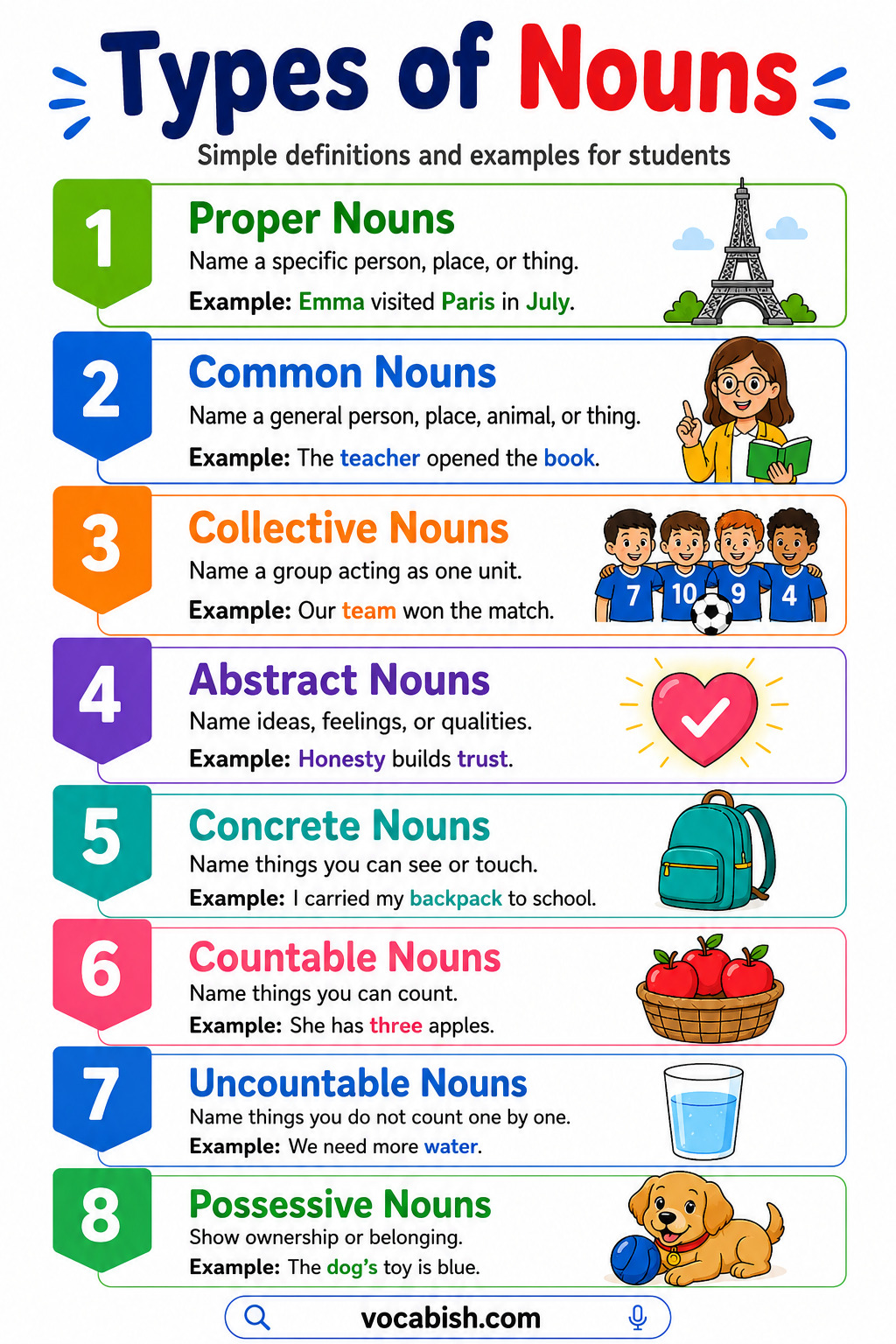
The different types of nouns include:
Proper noun: Emma, Pakistan, Monday
Common noun: girl, country, day
Concrete noun: apple, chair, dog
Abstract noun: kindness, courage, happiness
Collective noun: team, family, class
Countable noun: books, apples, students
Uncountable noun: water, sugar, advice
Possessive noun: Sarah’s bag, dog’s toy
To identify a noun, look for the word that names a person, place, thing, animal, or idea. You can ask yourself, “Who or what is this sentence about?”
Example:
The teacher opened the door.
Yes, a name is usually a noun. More specifically, it is a proper noun because it names a specific person, place, or thing.
Examples:
Sarah is a person’s name.
Paris is a city’s name.
Google is a company’s name.
Yes, some words can change their grammar role depending on how they are used.
Example:
Run is good exercise.
Here, run is used like a noun.
I run every morning.
Here, run is a verb because it shows an action.
Final Thoughts
A noun names a person, place, animal, object, group, substance, quality, feeling, event, or idea. Nouns can be divided into several types according to their names, meanings, number, or formation.
The main noun types include:
- Common nouns: general names such as teacher and city
- Proper nouns: specific names such as Sara and Paris
- Concrete nouns: things experienced through the senses
- Abstract nouns: feelings, ideas, qualities, and states
- Countable nouns: items that can be counted
- Uncountable nouns: things not usually counted separately
- Collective nouns: words for groups
- Material nouns: names of substances
- Compound nouns: nouns formed from two or more words
Remember that a noun may belong to more than one category. The word family, for example, is a common, collective, and countable noun. Context also matters because words such as coffee, paper, room, and experience can change their grammatical use according to their meaning.
The best way to understand noun types is not to memorize labels alone. Notice how nouns behave in complete sentences, especially with articles, plural endings, verbs, and quantity words.
You May Also Like