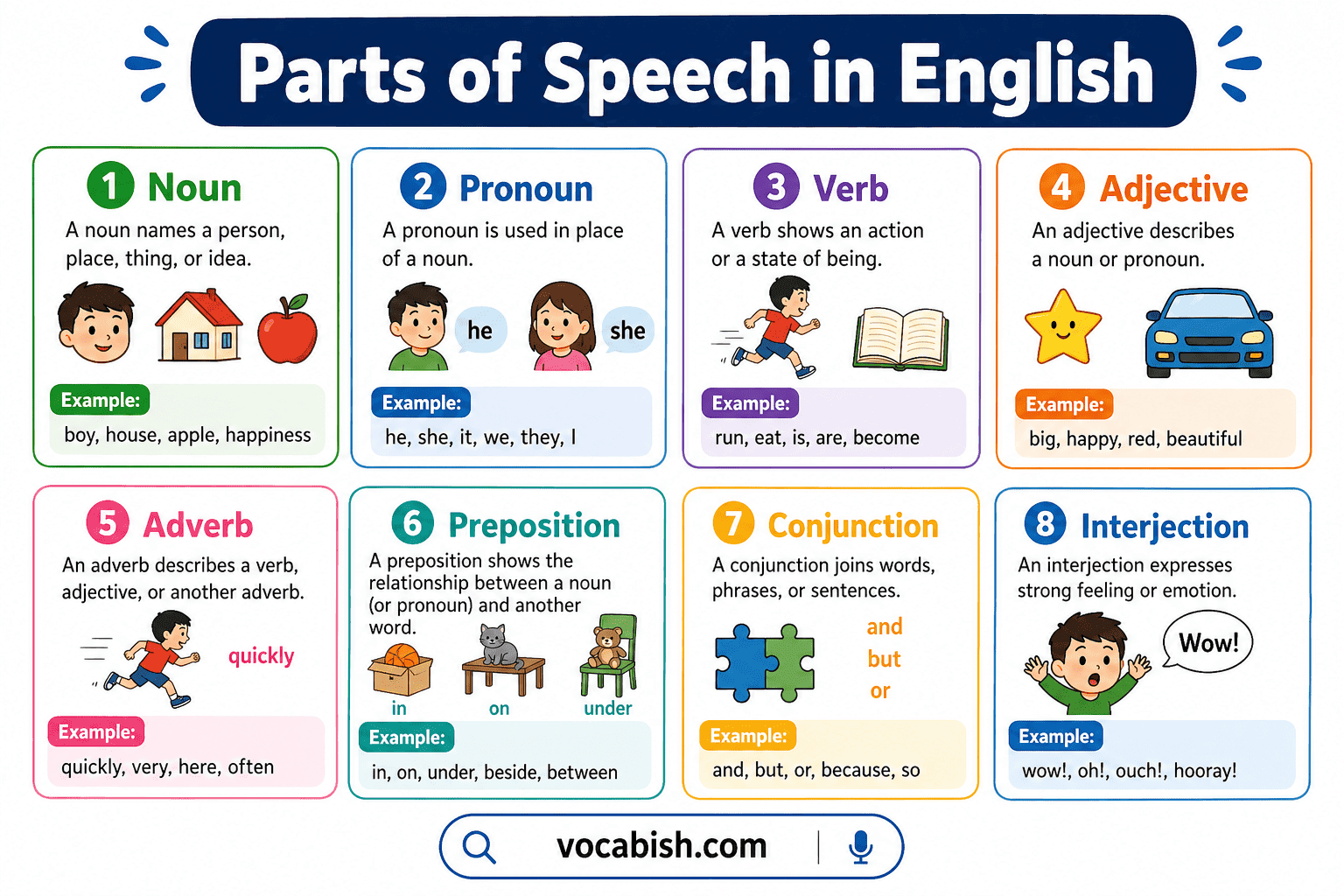

In this blog post, you will learn about interjection in English, a special part of speech used to express sudden emotions like surprise, joy, pain, or greeting. These short words may look small, but they carry strong meaning in real communication. You will also understand how interjections work in sentences and how they change the tone of what you say or write. Learning them helps you improve your speaking, reading, writing, and listening because you will start noticing how people express feelings in everyday English.
If you want to learn how different words behave in English sentences, explore our Parts of Speech category.
Introduction to Interjections
Interjections are those small words or short phrases you throw into a sentence when you want to express a sudden feeling or reaction. You already use them more than you think—especially when you speak naturally. The tricky part is that learners often don’t recognize them or don’t know how to use them correctly in writing.
Here’s the simple truth: interjections are emotional signals in language. They don’t connect grammar like other words do. Instead, they show how you feel in the moment.
If you’ve ever said “Wow!”, “Oh no!”, or “Hey!”, you’ve already used interjections correctly.
What is an Interjection? (Definition and Meaning)
An interjection is a word or short phrase that expresses a sudden emotion, reaction, or feeling. It is grammatically independent, which means it does not connect directly to the rest of the sentence structure.
We use interjections because spoken language is emotional. Grammar alone can’t always show excitement, surprise, pain, or joy. Interjections fill that gap quickly and naturally.
Interjections stand alone or are loosely attached to a sentence.
Examples:
- Wow! That’s an amazing view.
- Oh! I didn’t expect to see you here.
- Ouch! That really hurt.
- Hey! Watch where you’re going.
- Yay! We finally finished the project.
Most learners struggle because they try to treat interjections like normal sentence parts. They are not. Think of them as emotional “sound effects” in speech.
Why Interjections are Important in English
Interjections make your English sound natural, expressive, and human. Without them, your speech can feel flat or overly formal.
We use them for three main reasons:
- To express emotion instantly
- To make speech more natural and conversational
- To react quickly in real-life situations
Examples:
- Oh! I get it now.
- Great! Let’s start immediately.
- Oops! I dropped it again.
- Ah! That makes sense now.
- Phew! That was close.
A common mistake is ignoring interjections in speaking practice. Learners often sound too formal or robotic because they skip them.
Functions of Interjections in Sentences
Interjections don’t follow normal grammar rules, but they still serve clear functions.
1. Expressing emotion quickly
They show feelings instantly without needing full sentences.
2. Reacting to situations
They are used when something unexpected happens.
3. Adding emphasis
They make statements stronger or more expressive.
Examples:
- Wow! You passed the exam.
- Oh! That’s what you meant.
- Yikes! That looks dangerous.
- Hurray! We won the match.
- Aha! Now I understand.
Types of Interjections with Definition and Examples
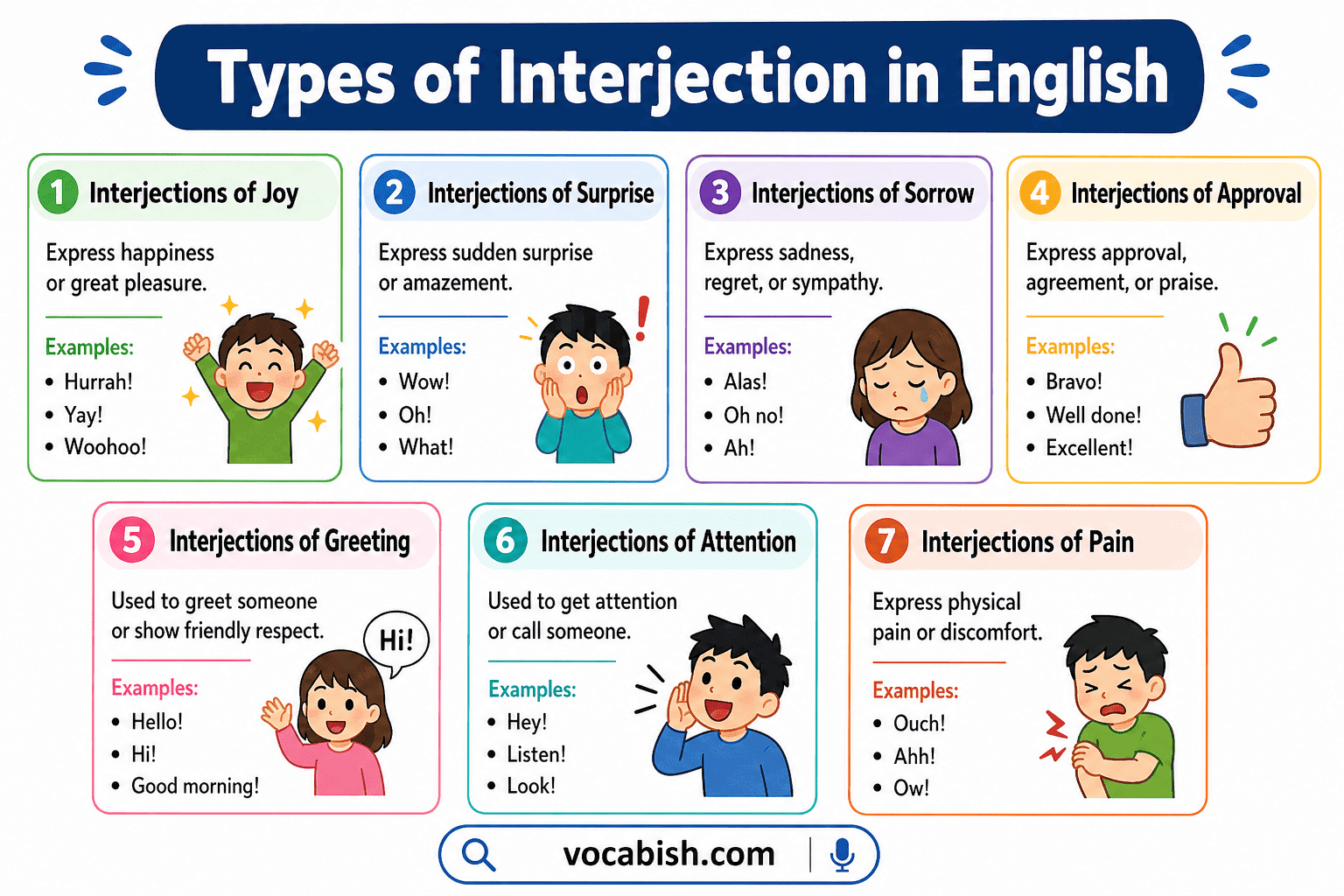
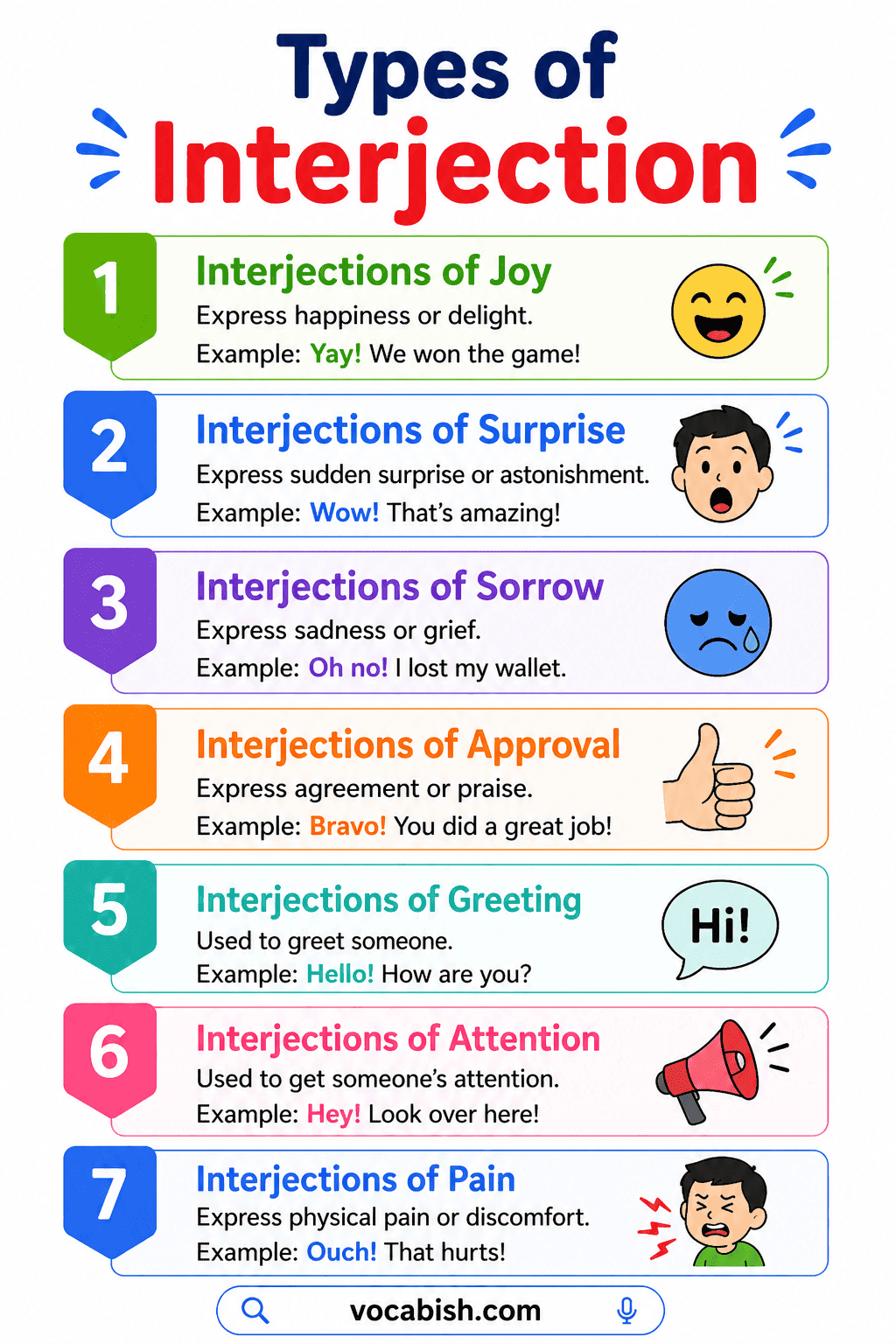
Interjections are grouped based on emotion. Understanding these categories helps you use them correctly in real-life speech.
1. Interjections of Joy
These express happiness or excitement.
Examples:
- Yay! We’re going on vacation.
- Hurray! We finished early.
- Wow! That’s incredible.
- Yippee! I passed the test.
- Oh! That’s wonderful news.
These are often overused in informal writing. In formal writing, they are usually avoided.
2. Interjections of Surprise
Used when something unexpected happens.
Examples:
- Oh! I didn’t see you there.
- Wow! That’s unbelievable.
- What! You already finished?
- Ah! So that’s the answer.
- Oh! I forgot my keys.
Learners often confuse surprise with joy. The difference is emotional direction—surprise can be positive or negative.
3. Interjections of Sorrow
These express sadness or disappointment.
Examples:
- Oh! That’s unfortunate.
- Alas! The project failed.
- Ah! I missed the chance.
- Oh no! It broke again.
- Oops! That was a mistake.
4. Interjections of Approval
Used to show agreement or praise.
Examples:
- Bravo! That was an excellent performance.
- Good! Keep going like that.
- Well done! You improved a lot.
- Nice! That’s a clever idea.
- Great! You handled it well.
5. Interjections of Greeting
Used when meeting or calling someone.
Examples:
- Hi! How are you?
- Hello! Long time no see.
- Hey! What’s up?
- Yo! How’s it going?
- Hi! Nice to meet you.
6. Interjections of Attention
Used to get someone’s focus.
Examples:
- Hey! Look over here.
- Listen! This is important.
- Look! Something is happening.
- Ahem! Can I speak now?
- Yo! Pay attention.
7. Interjections of Pain
Used when someone feels physical or emotional pain.
Examples:
- Ouch! That hurt.
- Ah! My head hurts.
- Eek! That scared me.
- Ow! I hit my elbow.
- Ouch! That’s sharp.
Common Interjections List
Here is a quick reference table for everyday interjections:
Emotion | Interjections | Usage |
|---|---|---|
Joy | Wow, Yay, Hurray | Happiness or success |
Surprise | Oh, What, Ah | Unexpected events |
Pain | Ouch, Ow | Physical discomfort |
Approval | Good, Bravo, Nice | Positive feedback |
Attention | Hey, Listen | Calling focus |
Rules for Using Interjections
Even though interjections feel casual, there are still rules.
- They are usually grammatically independent.
- They are often followed by punctuation.
- They can stand alone or appear at the start of a sentence.
- They should match the emotional context.
Do not overuse interjections in formal writing. They are more suitable for speech, dialogue, and informal writing.
Punctuation with Interjections
1. Using Commas
Commas are used when the emotion is mild or less intense.
Examples:
- Oh, I see what you mean.
- Well, that’s interesting.
- Hey, can you help me?
Comma use softens the emotional tone.
2. Using Exclamation Marks
Exclamation marks show strong emotion or urgency.
Examples:
- Wow! That’s amazing.
- Ouch! That hurt a lot.
- Yay! We did it.
Position of Interjections in Sentences
Interjections usually appear in three positions:
Position | Example | Explanation |
|---|---|---|
Beginning | Oh! I forgot my wallet | Most common position |
Middle | I, well, don’t agree | Slight pause or hesitation |
End | That was close, phew! | Reaction after action |
How to Identify an Interjection in a Sentence
You can identify interjections by asking simple questions:
- Does the word show emotion?
- Can it stand alone?
- Does removing it change grammar but not meaning?
Example analysis:
- Wow! That was fast.
Here, “Wow” shows emotion and can stand alone, so it is an interjection.
Another example:
- Oh! I didn’t know that.
Again, “Oh” expresses reaction, not grammatical function.
Common Mistakes with Interjections
1. Using interjections in formal writing
Wrong: The results are, wow!, surprising.
Correct: The results are surprising.
Why: Interjections are informal.
2. Missing punctuation
Wrong: Oh I forgot
Correct: Oh! I forgot
Why: Emotional expression needs punctuation.
3. Overusing interjections
Wrong: Wow! Wow! Wow! That’s amazing.
Correct: Wow! That’s amazing.
Why: Repetition weakens impact.
4. Misplacing interjections
Wrong: I went oh to the store.
Correct: Oh! I went to the store.
Why: Interjections don’t function inside sentence structure.
5. Confusing interjections with verbs
Wrong: She wow the audience.
Correct: Wow! She impressed the audience.
Why: “Wow” is not a verb.
Exercises of Interjection
1. Identify the Interjection
Find the interjection in each sentence:
- Wow! That’s incredible.
- Ouch! I burned my hand.
- Hey! Come here.
- Oh! I understand now.
- Yay! We won.
Answer key:
- Wow
- Ouch
- Hey
- Oh
- Yay
2. Fill in the Blanks
Choose the correct interjection:
- ___! That was a close call.
- ___! I didn’t expect that.
- ___! Stop right there.
- ___! I forgot my phone.
- ___! You did a great job.
Answer key:
- Phew
- Oh
- Hey
- Oh
- Well done
3. Multiple Choice Questions
- Which is an interjection of pain?
- a) Wow
- b) Ouch
- c) Bravo
- Which shows surprise?
- a) Oh
- b) Hey
- c) Good
- What punctuation is common with interjections?
- a) Period
- b) Exclamation mark
- c) Colon
Answer key:
- b
- a
- b
FAQs about Interjections
An interjection is a word or short phrase used to express sudden emotion like surprise, joy, pain, or excitement. It stands alone and is not grammatically connected to the sentence.
Common interjections include wow, oh, ouch, hey, hooray, and alas. These words express emotions such as surprise, pain, greeting, or happiness in spoken English.
Interjections are usually placed at the beginning of a sentence and followed by punctuation. They can also stand alone to express strong emotion or reaction.
Interjections are often followed by an exclamation mark for strong emotion or a comma for mild emotion. The punctuation depends on the intensity of feeling expressed.
Interjections include joy, surprise, pain, sorrow, greeting, approval, and attention. Each type expresses a different emotion used in real-life communication and spoken English.
An interjection is not a complete sentence. It only expresses emotion, while a sentence has a subject and verb that give complete meaning or information.
Interjections are mostly used in informal writing and speech. In formal writing, they are usually avoided unless used in direct dialogue or quoted speech.
Summary on Types of Interjections
Interjections in English are words that show strong feelings. They are grouped based on the emotion they express, which helps you use them in the right situation.
Interjections of joy show happiness, like “wow” or “yay.” Interjections of surprise express sudden reactions, like “oh” or “what.” Interjections of sorrow show sadness, such as “oh no” or “alas.” Interjections of approval are used to praise, like “good” or “well done.” Interjections of greeting and attention help you talk to someone or get attention, like “hi” or “hey.” Interjections of pain show discomfort, like “ouch.”
You May Also Like: