
In this blog post, you will learn the difference between altogether and all together. These two expressions look similar, but they have different meanings and grammar uses. Many learners feel confused because one word is an adverb, while the other is a phrase that describes people or things in a group. When you understand how each form works in a sentence, you can avoid common mistakes and write with greater accuracy. Knowing the difference will also improve your speaking, reading, and listening skills. Keep reading to master their correct usage with helpful examples.
Meanings of Altogether and All Together
Altogether
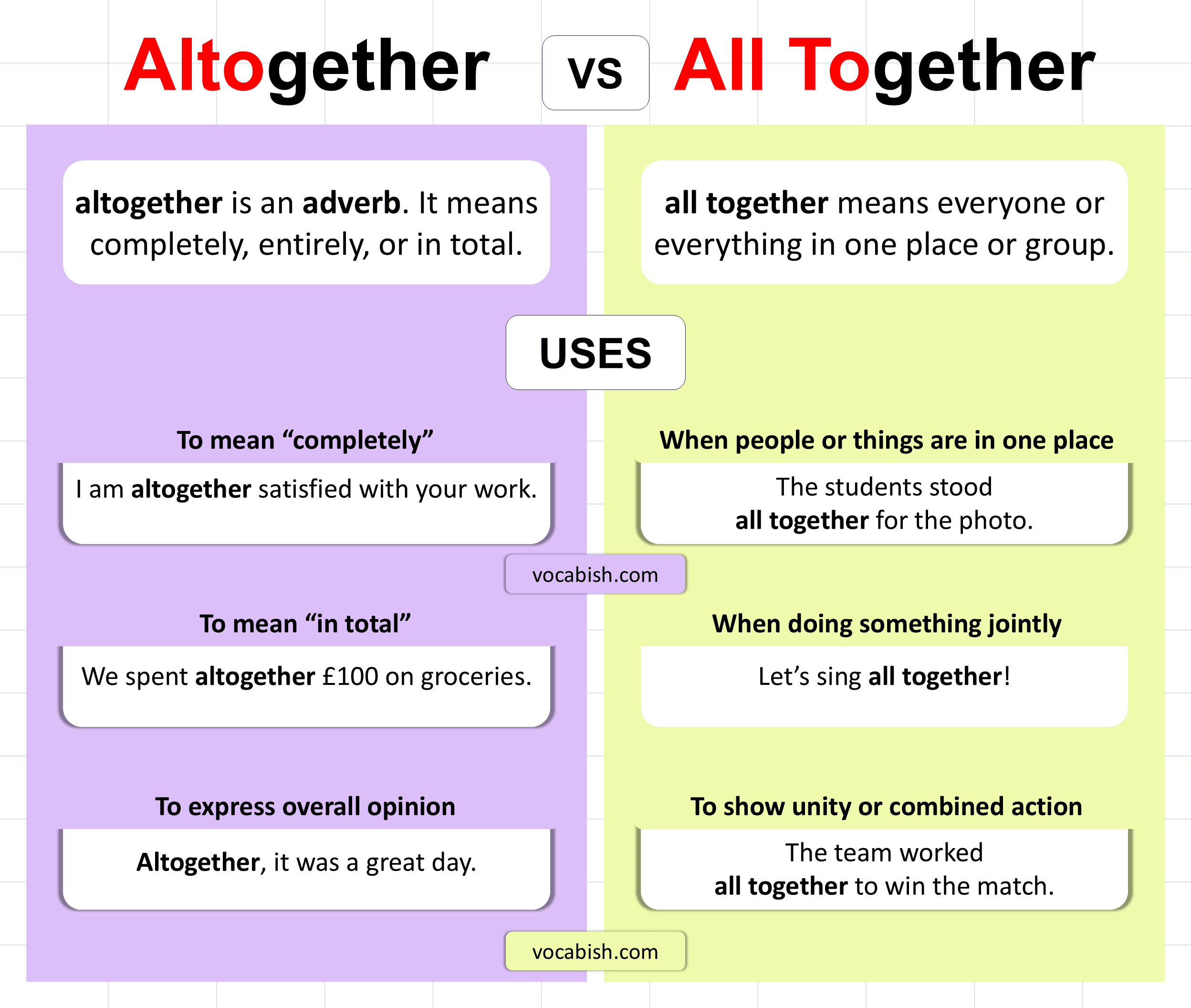
The word altogether is an adverb. It means completely, entirely, or in total.
Examples:
- The movie was altogether boring.
- There were altogether 20 people at the meeting.
All Together
The phrase all together means everyone or everything in one place or group.
Examples:
- The children sang all together at the school concert.
- Let’s sit all together at the same table.
Differences Between Altogether and All Together
| Word / Phrase | Part of Speech | Meaning | Example |
|---|---|---|---|
| Altogether | Adverb | Completely / In total | It’s altogether too expensive. |
| All Together | Phrase | Everyone or everything together | They arrived all together at the party. |
- Use altogether when you mean completely or in total.
- Use all together when people or things are gathered in one place.
Usage of Altogether
1. To mean “completely”
I am altogether satisfied with your work.
2. To mean “in total”
We spent altogether £100 on groceries.
3. To express overall opinion
Altogether, it was a great day.
Usage of All Together
1. When people or things are in one place
The students stood all together for the photo.
2. When doing something jointly
Let’s sing all together!
3. To show unity or combined action
The team worked all together to win the match.
Formal and Informal Uses of Altogether and All Together
Formal Uses:
- Altogether, the company made a huge profit.
- The guests arrived all together for the conference.
Informal Uses:
- We were all together at the picnic.
- The plan failed altogether because of poor timing.
Sentences with the Use of Altogether
- The plan was altogether successful.
- It’s altogether too late to change the schedule.
- We paid altogether £50 for the tickets.
- The story was altogether boring and too long.
- I altogether agree with your opinion.
- There were altogether ten people in the room.
- It was an altogether wonderful experience.
- The teacher was altogether satisfied with our work.
- That’s altogether too much sugar for one cup of tea.
- The weather was altogether pleasant during our trip.
- I forgot my homework altogether this morning.
- It’s altogether a different situation now.
- The journey took altogether three hours.
- She looked altogether surprised by the news.
- We have altogether four cats and two dogs.
- The exam was altogether easier than I expected.
- I’m not altogether sure about this idea.
- He stopped coming to class altogether.
- The hotel staff were altogether very kind and helpful.
- Altogether, it was a great day for everyone.
Sentences with the Use of All Together
- Let’s sit all together at the table.
- The children sang all together at the concert.
- We arrived all together at the airport.
- The family posed all together for a photo.
- They laughed all together after hearing the joke.
- The students stood all together in one line.
- Let’s go all together to the park.
- The birds flew all together across the sky.
- The guests left all together after the dinner.
- We travelled all together in one car.
- The team worked all together to finish the project.
- The choir sang beautifully all together.
- We spent the weekend all together at the beach.
- The friends decided to stay all together in one room.
- They shouted all together, “Happy Birthday!”
- The villagers gathered all together in the square.
- We must work all together to solve this problem.
- The class clapped all together at the end of the play.
- Let’s clean the house all together and finish early.
- The students walked all together back to the bus.
Summary on All Together vs Altogether
- Altogether → Means completely, entirely, or in total.
- All Together → Means everyone or everything in one group.
- Main Difference:
Altogether = Adverb of totality.
All Together = Phrase showing unity or grouping.
FAQs on Altogether vs All Together
What is the main difference between altogether and all together?
Altogether means completely or in total, while all together means in one group.
Can both be used in the same sentence?
Yes! Example: It’s altogether better when we work all together.
Is altogether one word or two?
Altogether is one word (adverb), while all together is a phrase of two words.
Is altogether more formal?
Altogether is often used in both formal and informal writing, especially for totals or opinions.
How can I remember the difference?
If you can separate “all” and “together” and still make sense, use all together. Otherwise, use altogether.
Read More