
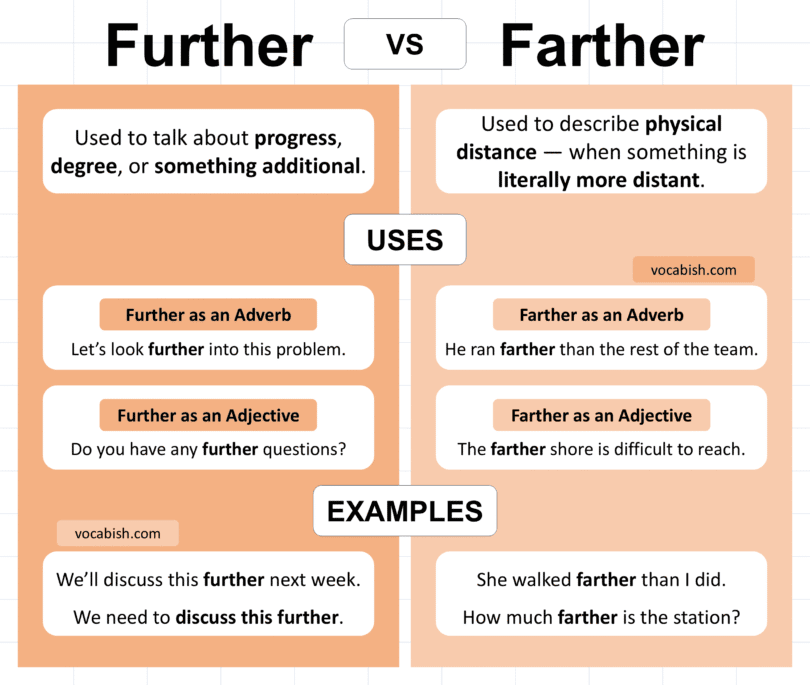

Further vs farther are often confused because both words can describe distance, progress, or degree. The main difference is that farther usually refers to measurable physical distance, while further commonly means additional, more, or to a greater extent. Learning this distinction will help you choose the correct word in everyday writing and conversation.
Further vs Farther: Quick Answer
Both words can show that something extends beyond its current point. Their main difference concerns the kind of distance being discussed.
Word | Main Meaning | Typical Use | Example |
|---|---|---|---|
Farther | At or to a greater physical distance | Measurable distance | The station is farther away. |
Further | Additional, more, or to a greater degree | Ideas, details, progress, and figurative distance | We need further information. |
Further | At or to a greater physical distance | Also accepted for physical distance | We cannot walk any further. |
A useful memory rule is:
- Use farther for distance you could measure.
- Use further for additional information, progress, time, or degree.
What Does Farther Mean?
Farther is the comparative form connected with the word far. It usually refers to a greater distance in physical space.
Farther meaning
Farther means at, to, or over a greater physical distance.
You can often measure this distance in metres, kilometres, miles, or steps.
Examples of farther
- My new school is farther from home.
- We walked farther than we had planned.
- Which town is farther away?
- The farther entrance is closed.
- Her house is two kilometres farther down the road.
In each example, farther describes an actual location or movement through physical space.
Farther as an adverb
As an adverb, farther describes how far someone or something moves or is located.
- The children ran farther into the field.
- I cannot drive any farther tonight.
- The boat travelled farther from the shore.
Farther as an adjective
As an adjective, farther comes before a noun and describes the more distant one.
- Use the farther door.
- They reached the farther side of the lake.
- We could see the farther hills.
This adjective use is correct, although phrases such as “the far side” may sound more natural in everyday conversation.
What Does Further Mean?
Further has a wider range of meanings than farther. It can mean additional, more advanced, or to a greater degree.
It may describe ideas, discussions, progress, time, study, action, or figurative distance. It can also refer to physical distance.
Further meaning: additional or more
Further often means additional or more.
- Please contact us for further information.
- No further action is required.
- The teacher gave us further instructions.
- We experienced further delays.
- The police asked further questions.
You cannot replace further with farther in these examples because the sentences do not involve physical distance.
Further meaning: to a greater degree
Further can show that an action, situation, or idea develops beyond its current level.
- We need to investigate the problem further.
- Reading will further improve your vocabulary.
- The new evidence confused the situation further.
- Let us discuss this point further.
- Prices may fall further next month.
Here, further means more deeply, more completely, or to a greater extent.
Further meaning: more advanced
Further can describe progress, development, or a later stage.
- She plans to continue her further education.
- The project cannot move further without approval.
- Their research has advanced further than expected.
- This course prepares students for further study.
Further for physical distance
Further is also accepted when discussing physical distance.
- How much further do we have to walk?
- The hotel is further down the road.
- We cannot travel any further today.
- Move a little further away from the door.
This use is especially common in British English, but it also appears in other forms of English.
For learners who want a clear distinction, farther remains a helpful choice for measurable physical distance.
Further and Farther: Key Differences
The difference becomes easier when you identify whether the sentence describes physical space or an additional amount.
Situation | Use | Example |
|---|---|---|
Measurable physical distance | Farther is often preferred | London is farther from here than Oxford. |
Additional details | Further | Please provide further details. |
More discussion | Further | We will discuss the matter further. |
Greater progress | Further | She has progressed further in her training. |
Figurative distance | Further | Nothing could be further from the truth. |
Physical distance in general usage | Either may be possible | We cannot go farther/further. |
The clearest distinction
Compare these sentences:
- We drove farther than yesterday.
- We discussed the problem further.
The first sentence refers to road distance. The second refers to a more detailed discussion.
When both words may be correct
Both words can sometimes describe physical distance:
- The shop is farther down the street.
- The shop is further down the street.
Both sentences are grammatically acceptable. Farther makes the physical-distance meaning more specific, while further is more flexible.
How to Choose Further or Farther
Before choosing a word, ask whether the distance could be measured with a ruler, map, or unit of distance.
Choose farther for measurable distance
Use farther when the sentence involves:
- Miles or kilometres
- Steps or metres
- Travel between locations
- Movement across physical space
- One place being more distant than another
Examples:
- The airport is farther than the railway station.
- Daniel threw the ball farther than Leo.
- We walked five kilometres farther.
- Their village lies farther north.
Choose further for additional amounts
Use further when you could replace the word with additional, more, or to a greater degree.
Examples:
- We need further evidence.
We need additional evidence. - Let us examine the issue further.
Let us examine the issue more closely. - There will be no further delay.
There will be no additional delay.
Try the “additional” test
Replace the word with additional.
If the sentence still makes sense, choose further:
- further information → additional information
- further questions → additional questions
- further research → additional research
- further action → additional action
“Farther information” and “farther research” are incorrect because information and research do not represent physical distances.
Grammar and Parts of Speech
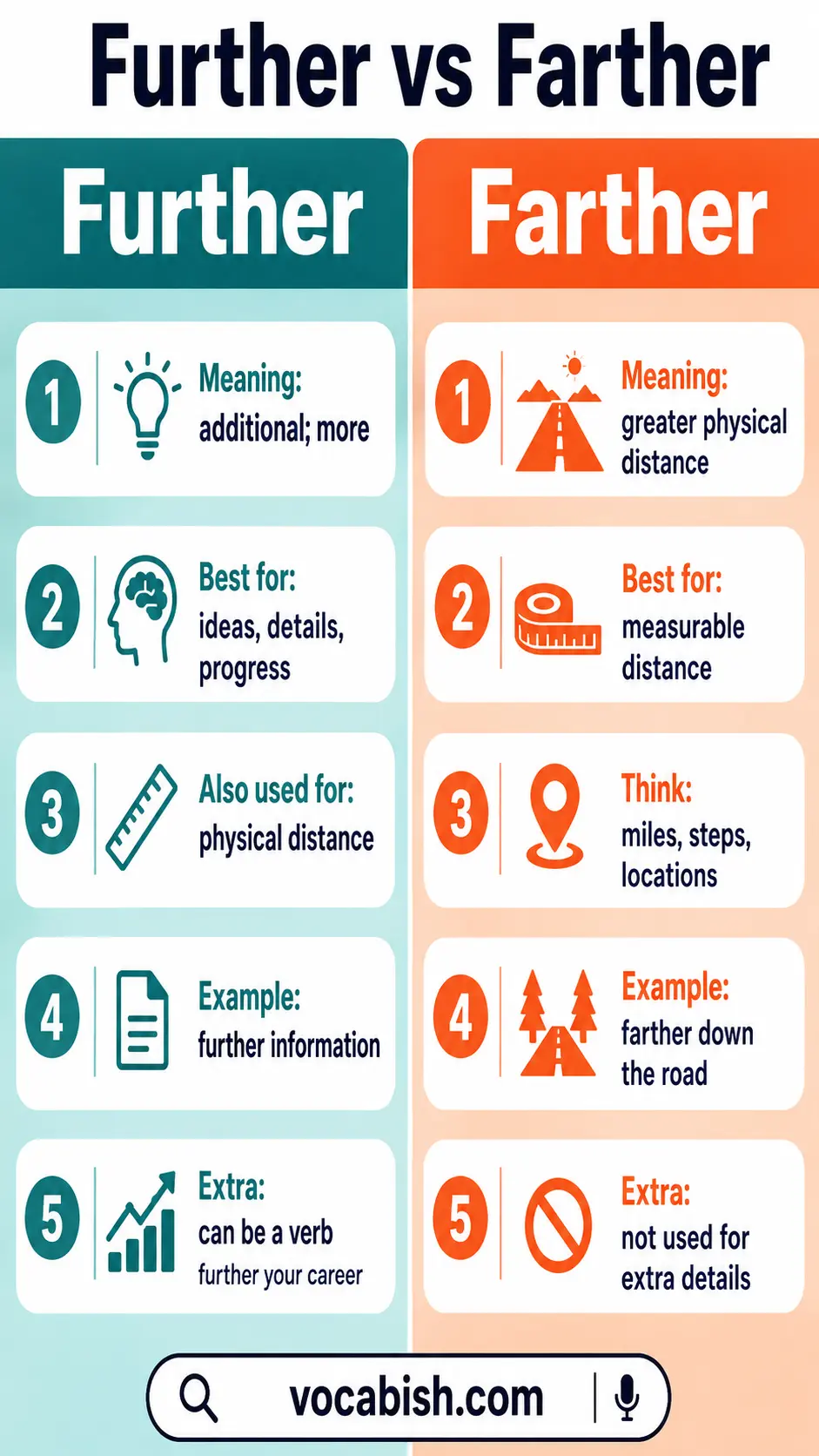
Further and farther do not have exactly the same grammatical range. Farther mainly works as an adjective or adverb, while further can also be a verb.
Farther as an adjective
Farther modifies a noun:
- the farther shore
- the farther building
- the farther corner
Farther as an adverb
Farther modifies a verb, adjective, or another adverb:
- She walked farther.
- The car moved farther away.
- Can you throw it farther?
Further as an adjective
Further can mean additional:
- further information
- further discussion
- further study
- further action
- further problems
Further as an adverb
Further can mean more, to a greater degree, or over a greater distance:
- Think about it further.
- Do not move any further.
- The situation developed further.
- We should investigate further.
Further as a verb
As a verb, to further means to help something develop, progress, or succeed.
- The course will further your career.
- The organisation works to further education.
- These talks may further international cooperation.
- She took the course to further her knowledge.
Farther cannot be used as a verb.
Incorrect:
- The course will farther your career.
Correct:
- The course will further your career.
Common Expressions with Further
Further appears in several common expressions. Learning them as complete phrases can help you use the word naturally.
Until further notice
This means until another announcement or instruction is given.
- The library is closed until further notice.
- Classes have been cancelled until further notice.
Without further ado
This means without more delay or unnecessary discussion.
- Without further ado, let us begin the presentation.
- Without further ado, I would like to introduce our guest.
Further from the truth
This expression means completely untrue or very inaccurate.
- The claim could not be further from the truth.
- Her description was further from the truth than she realised.
Because the expression refers to figurative distance, further is the standard choice.
Take something further
This means to continue, develop, or advance something.
- I would like to take this discussion further.
- They decided not to take the complaint further.
- She hopes to take her studies further.
Further education
Further education means study completed after a particular stage of schooling, especially education after secondary school in some countries.
- He returned to college for further education.
- The programme gives adults access to further education.
Common Mistakes to Avoid
Most errors happen when farther is used for something that is not a physical distance.
- Use further information, not farther information.
- Write discuss it further, not discuss it farther.
- Use farther when you want to emphasize measurable physical distance.
- Remember that only further can function as a verb.
- Use further from the truth for figurative distance.
Practice Examples
These examples show how meaning determines the correct word.
Examples with farther
- The second campsite is farther from the river.
- Mia can swim farther than her brother.
- We parked farther away to avoid traffic.
- Which planet is farther from the Sun?
- The dog ran farther into the garden.
Examples with further
- We need further clarification before making a decision.
- The manager refused to comment further.
- Heavy rain caused further damage.
- She took evening classes to further her career.
- Nothing could be further from the truth.
Examples where either may work
When describing physical distance, both words may be acceptable:
- We cannot walk any farther.
- We cannot walk any further.
- The café is farther down the road.
- The café is further down the road.
Farther is more specific to physical distance. Further is more common across a wider range of contexts.
Choose the correct word
- Please send us ______ information.
Answer: further - My office is ______ from the entrance than yours.
Answer: farther - We need to study the results ______.
Answer: further - The runner travelled ______ than anyone expected.
Answer: farther - This training may ______ your professional development.
Answer: further - There were no ______ complaints.
Answer: further - The blue house is ______ down the street.
Answer: farther or further
FAQs About Further and Farther
Sometimes. Both can describe distance, but farther is usually preferred for measurable physical distance, while further also means additional or more advanced.
In modern usage, farther mainly refers to physical distance. It rarely describes ideas, time, degree, additional information, or abstract progress today.
Yes. Further can describe physical distance, especially in British English, though farther makes the distance meaning clearer for many English learners.
Use further information because it means additional information. Farther information is incorrect because no measurable physical distance is involved.
Further from the truth is the standard expression. It describes figurative distance from accuracy, not physical space that can be measured.
Go farther usually means travel a greater physical distance. Go further can mean continue physically, develop an idea, or make more progress.
Further can be an adjective in further details and further study. It also works as an adverb and, less commonly, a verb.
Both are correct. Farther away emphasizes physical distance, while further away is also common, particularly in British English and general conversation.
Conclusion
The further vs farther difference mainly depends on the type of distance involved. Use farther for measurable physical distance and further for additional information, greater progress, degree, or figurative distance.
Remember this quick rule: farther relates to physical space; further usually means more. Further can also describe physical distance, but it has many uses that farther does not have.
You May Also Like
