
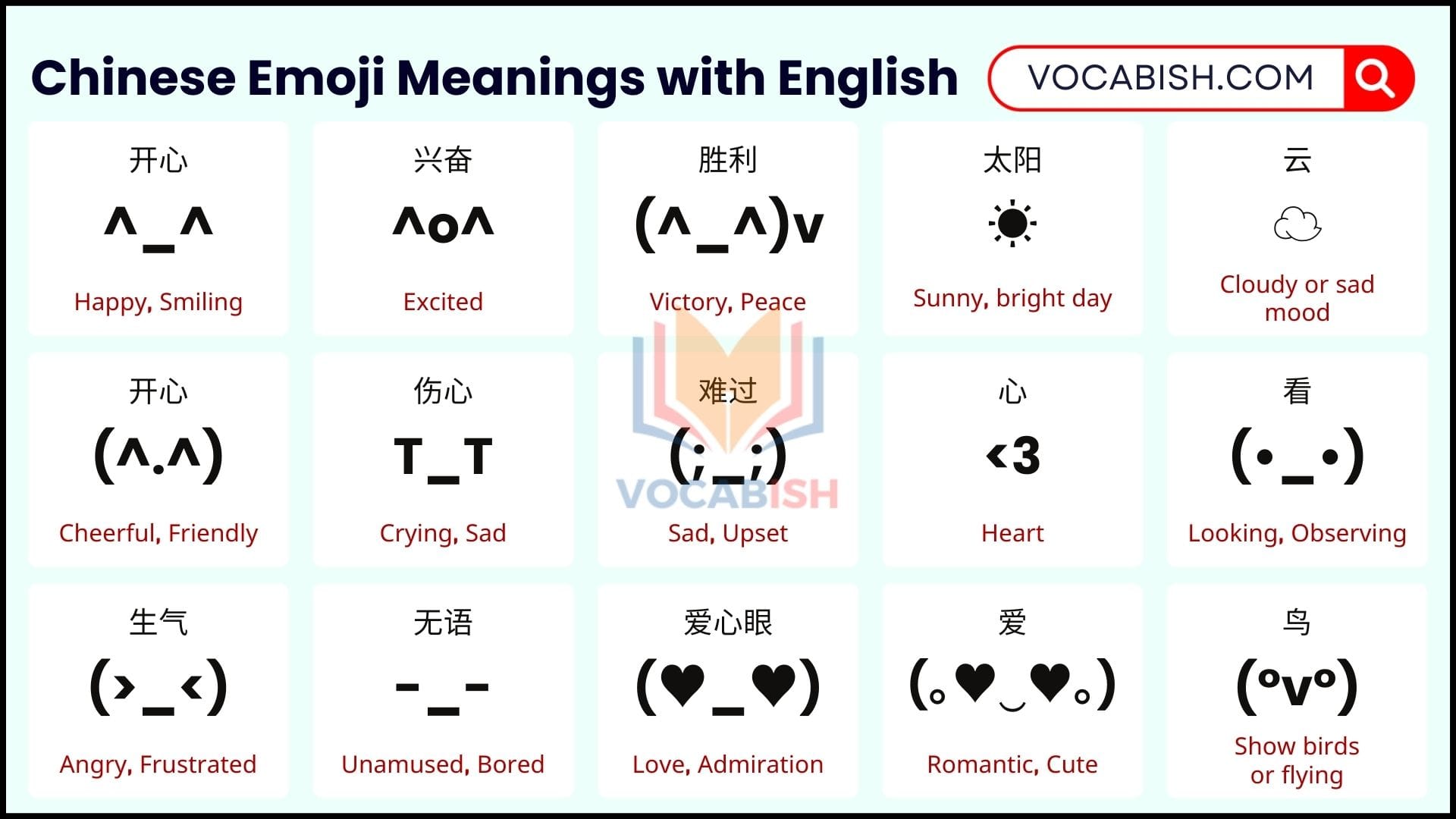
In this blog post, you will learn the meanings of popular Chinese emojis and how to use them in everyday English conversations. Chinese emojis are text symbols that show emotions, actions, and objects. Understanding them helps English learners improve speaking, reading, writing, and listening skills by recognizing feelings and messages quickly. Mastering these symbols makes communication more natural and expressive.
What are Chinese Emojis?
Chinese emojis, often called Kaomoji, are text-based symbols that show emotions, actions, or objects. They are widely used in messaging apps in China. Learning their meanings in English helps you:
- Understand casual online chats.
- Recognize emotions without words.
- Express yourself in fun and modern ways.
- Improve your reading and writing with symbols.
Chinese Emoji Meanings with English
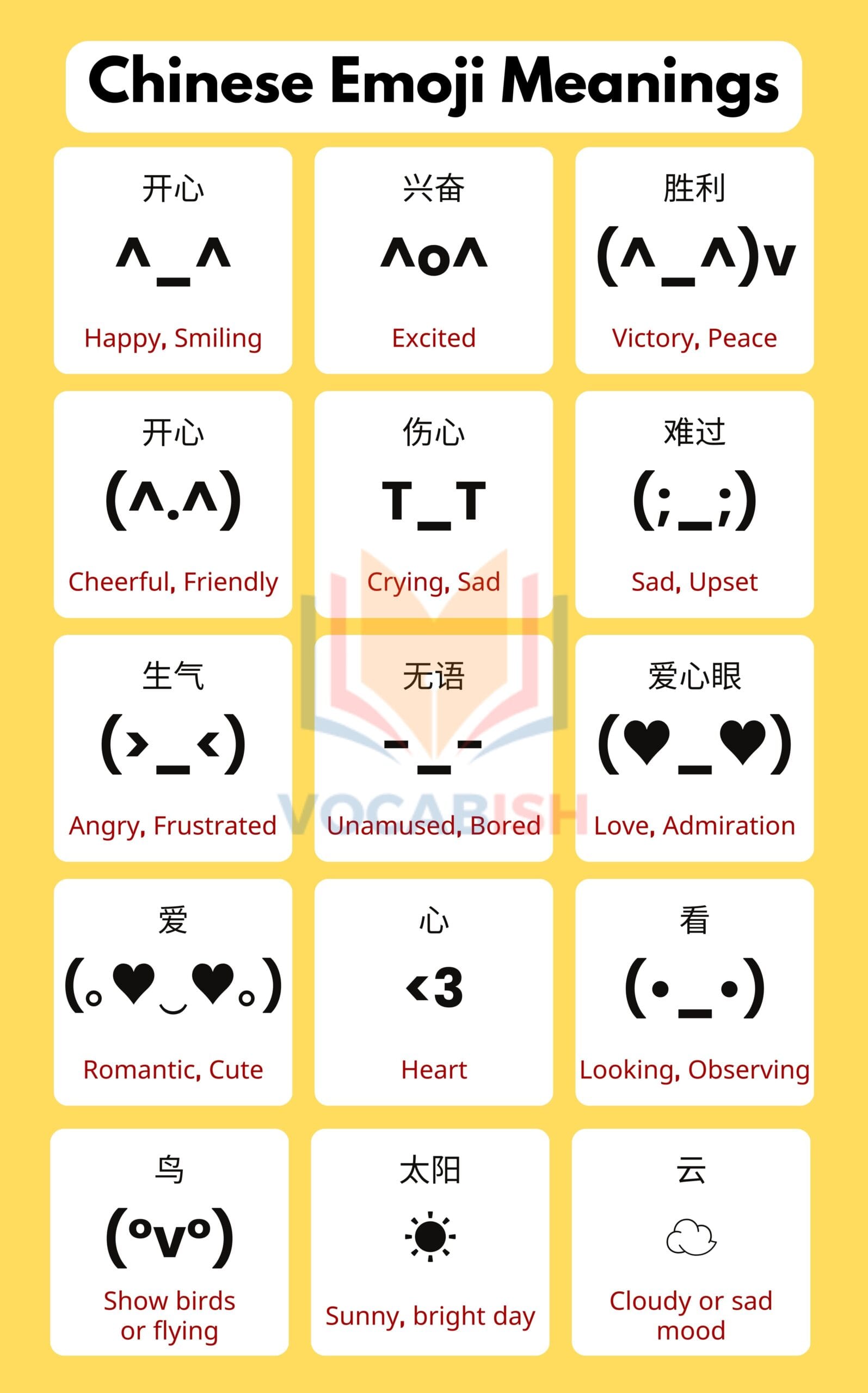
In this section, each emoji is shown with its Chinese meaning, English meaning, usage, and an example.
Smile and Happy Emojis
| Emoji | Chinese | English Meaning | Use | Example |
|---|---|---|---|---|
| ^_^ | 开心 | Happy, Smiling | Show happiness or friendliness | “I got an A on my test! ^_^” |
| ^o^ | 兴奋 | Excited | Show excitement or joy | “We are going to the park! ^o^” |
| (^_^)v | 胜利 | Victory, Peace | Show success or peace | “I finished my homework! (^_^)v” |
| (^.^) | 开心 | Cheerful, Friendly | Casual greeting or fun | “Good morning! (^.^)” |
Sad and Angry Emojis
| Emoji | Chinese | English Meaning | Use | Example |
|---|---|---|---|---|
| T_T | 伤心 | Crying, Sad | Show sadness or disappointment | “I lost my book T_T” |
| (;_;) | 难过 | Sad, Upset | Show being upset | “It’s raining today (;_;)” |
| (>_<) | 生气 | Angry, Frustrated | Show frustration or annoyance | “My phone broke (>_<)” |
| -_- | 无语 | Unamused, Bored | Show tiredness or lack of interest | “Another homework? -_-” |
Love and Heart Emojis
| Emoji | Chinese | English Meaning | Use | Example |
|---|---|---|---|---|
| (♥_♥) | 爱心眼 | Love, Admiration | Show love or adoration | “I love this song (♥_♥)” |
| (。♥‿♥。) | 爱 | Romantic, Cute | Show romantic feelings | “You are amazing! (。♥‿♥。)” |
| <3 | 心 | Heart | Simple love or friendship | “Happy Birthday! <3” |
| (^3^) | 亲吻 | Kiss, Love | Send a kiss to someone | “Good night! (^3^)” |
Action and Daily Life Emojis
| Emoji | Chinese | English Meaning | Use | Example |
|---|---|---|---|---|
| ( ̄︶ ̄) | 吃饭 | Eating | Show eating or enjoying food | “Time for lunch! ( ̄︶ ̄)” |
| (╯°□°)╯︵ ┻━┻ | 发脾气 | Angry, Throwing Table | Express frustration humorously | “My computer crashed! (╯°□°)╯︵ ┻━┻” |
| (•_•) | 看 | Looking, Observing | Watching or noticing something | “I see you! (•_•)” |
| (-_-) zzZ | 睡觉 | Sleeping | Show tiredness or sleep | “Good night everyone (-_-) zzZ” |
Nature and Animals Emojis
| Emoji | Chinese | English Meaning | Use | Example |
|---|---|---|---|---|
| (=^・^=) | 猫 | Cat | Show cute pet or animal | “I love cats (=^・^=)” |
| (°v°) | 鸟 | Bird | Show birds or flying | “Look at the bird! (°v°)” |
| (❀◕‿◕) | 花 | Flower | Beauty, nature | “The garden is beautiful (❀◕‿◕)” |
| ☀ | 太阳 | Sun | Sunny, bright day | “It’s sunny today ☀” |
| ☁ | 云 | Cloud | Cloudy or sad mood | “It’s cloudy ☁” |
Tips for Using Chinese Emojis in English
- Use the emoji naturally: Combine with English words for clarity.
- Learn by category: Emotions, actions, daily life, and nature.
- Practice in context: Try writing short sentences with the emojis.
- Observe native usage: Check chats or social media for inspiration.
- Avoid overuse: One or two emojis are enough to express feelings clearly.
Conclusion
Chinese emojis are fun, expressive, and useful for online communication. By learning their English meanings and usage, you can read messages easily, express emotions clearly, and use modern text symbols confidently. Start practicing today by picking a few emojis and writing sentences with them.
FAQs
Chinese emojis, also called Kaomoji, are text-based symbols that show emotions, actions, or objects. They use letters, punctuation, and characters to express feelings like happiness (^_^) or sadness (T_T). Learning Chinese emojis helps English learners understand online messages and communicate naturally in chats or social media.
Learning Chinese emojis improves reading, writing, and communication skills. They help you understand casual online messages, express emotions clearly, and make your English messages more lively. Using popular emojis like (^^) for happy or (♥♥) for love makes your chats modern and friendly.
The emoji ^^ means happy or smiling. It shows joy, friendliness, or excitement. English learners can use it in messages to express happiness. For example: “I passed my test! ^^” makes your text positive and cheerful, just like speaking in English.
T_T represents crying or sadness. It is used to show disappointment, frustration, or feeling upset. For example: “I lost my book T_T” clearly shows sadness. Learning this emoji helps English learners read emotional messages correctly.
The heart emoji (♥♥) shows love, admiration, or affection. It is used in English messages to express romantic or friendly feelings. Example: “I love this song (♥♥)” helps learners combine symbols with words naturally in casual chat.
(^o^) expresses excitement or joy. It is commonly used when someone feels happy or enthusiastic. Example: “We are going to the park! (^o^)” helps learners convey strong positive emotions in online messages or texts.
The emoji (><) represents anger or frustration. Use it when something is annoying or stressful. Example: “My phone broke (><)” communicates feelings clearly. English learners can use it to show emotions without writing long explanations.
Yes! Chinese emojis like (^^) happy, T_T crying, and (♥♥) love are widely understood. Using them in English messages helps learners express feelings quickly, make texts engaging, and understand casual online conversations better. Combining emojis with words improves vocabulary and communication.
Related Articles: