
Many English learners get confused between Complement and Compliment because they sound alike but have different meanings. Understanding the difference is important for accurate writing and speaking, and it also helps improve your reading and listening skills. In this blog post, you will learn how to use Complement and Compliment correctly, with examples that show their meanings and practical uses in everyday English.
You can explore our 100 confusing words list to expand your vocabulary skills!
Meanings of Complement and Compliment
Complement
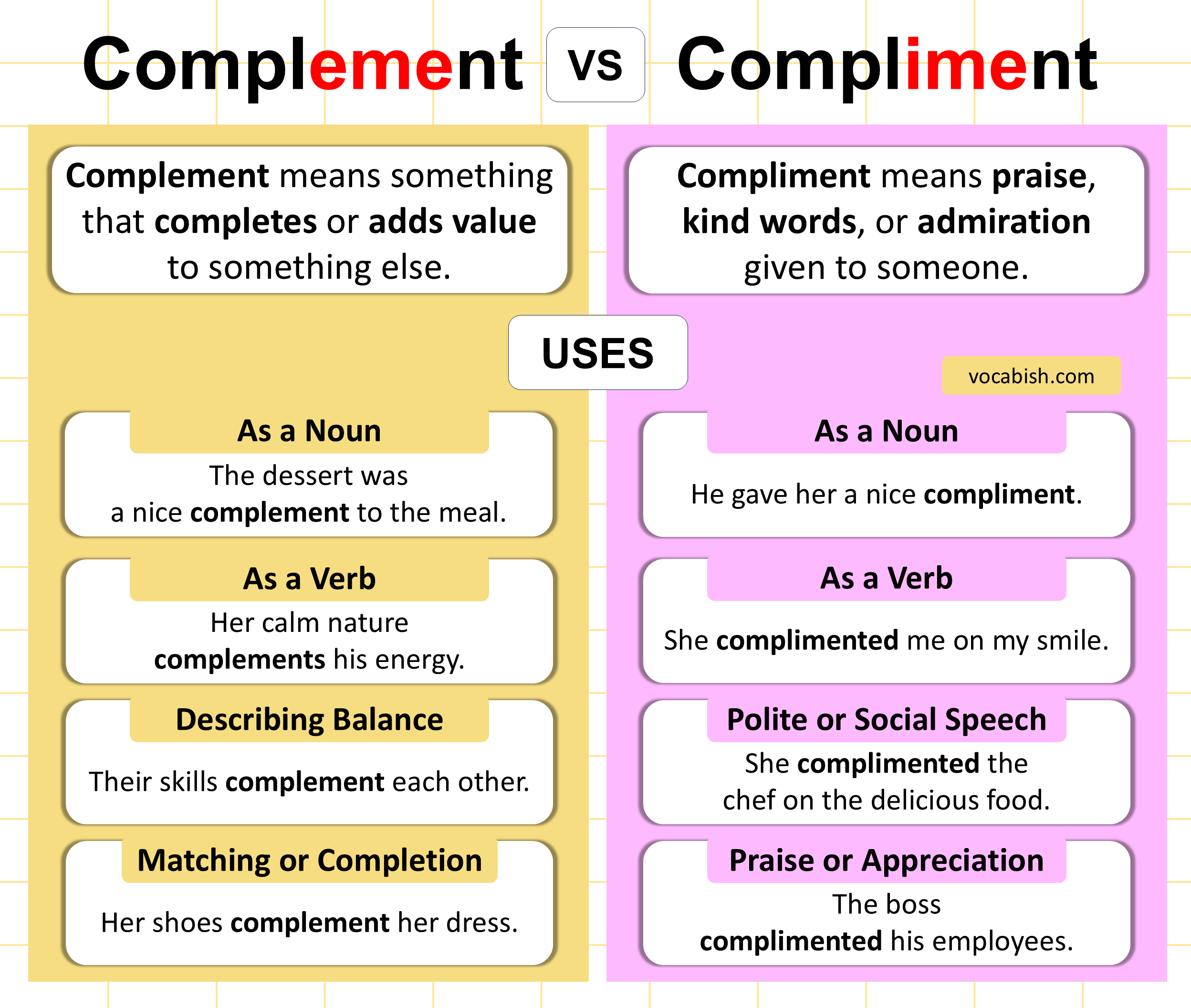
Complement means something that completes or adds value to something else. It can also mean two things that look or work well together.
Example:
- Her red shoes complement her dress.
Compliment
Compliment means praise, kind words, or admiration given to someone. It’s used when someone says something nice or polite.
Example:
- He gave her a compliment on her smile.
Usage of Complement
| Function | Meaning | Example |
|---|---|---|
| Noun | Something that completes or goes well with another thing | The salad is a good complement to the meal. |
| Verb | To go well with or enhance something | The painting complements the room’s design. |
| Used For | Things, people, ideas that fit or balance each other | Their talents complement each other perfectly. |
Steps to Use “Complement”
- Use “complement” when two things fit perfectly together.
- It can describe appearance, style, colour, or function.
- It can be used as both a noun and a verb.
Examples:
- The wine perfectly complements the meal.
- Blue and yellow are complementary colours.
- Her handbag is a perfect complement to her outfit.
- These two skills complement each other.
In short:
Complement = Completes or Matches
Usage of Compliment
| Function | Meaning | Example |
|---|---|---|
| Noun | A kind remark or praise | He gave her a nice compliment. |
| Verb | To say something nice or express admiration | She complimented me on my smile. |
| Used For | Words of praise or appreciation | The boss complimented his employees. |
Steps to Use “Compliment”
- Use “compliment” when giving praise.
- It can be used as a noun or verb.
- Add on after “compliment” when you mention the reason.
Examples:
- She complimented him on his cooking.
- He gave me a nice compliment about my hair.
- Your teacher complimented your hard work.
- I received many compliments on my presentation.
In short:
Compliment = Praise or Admire
Difference Between Complement and Compliment
| Feature | Complement | Compliment |
|---|---|---|
| Meaning | Completes or goes well with something | Says something nice or praises |
| Part of Speech | Noun / Verb | Noun / Verb |
| Used for | Things that match or complete each other | Expressing admiration or appreciation |
| Example | Her shoes complement her dress. | He complimented her dress. |
| Memory Tip | “E” = Enhance or Complete | “I” = I like it! (Praise) |
Formal and Informal Uses
Formal Uses
- Complement: The new policy complements the old one perfectly.
- Compliment: He was complimented for his outstanding performance.
Informal Uses
- Complement: That hat really complements your outfit!
- Compliment: She complimented me on my new haircut.
Example Sentences for Complement
- Her necklace perfectly complements her dress.
- Hard work and discipline complement each other.
- The sauce is a great complement to the pasta.
- The blue curtains complement the white walls.
- A good dessert complements any meal.
- Their personalities complement each other well.
- The soft music complements the romantic mood.
- The cushions are a nice complement to the sofa.
- The painting complements the room’s design.
- Exercise and a healthy diet complement each other.
- The team members complement one another’s skills.
- This flavour complements the chocolate perfectly.
- The dress complements her skin tone beautifully.
- Friendship and trust complement a strong relationship.
- The salad is the ideal complement to the main dish.
- The two colours complement each other well.
- Good lighting complements home décor.
- The teacher’s calm nature complements her teaching style.
- The background music complements the scene.
- This app complements your daily routine.
Example Sentences for Compliment
- She complimented me on my handwriting.
- He gave her a compliment about her singing.
- I received a nice compliment on my outfit.
- The boss complimented the team for their hard work.
- She smiled after hearing the compliment.
- He complimented her cooking.
- That’s the best compliment I’ve ever received.
- People complimented him on his kindness.
- The teacher complimented the student for improving.
- She complimented me on my new shoes.
- I want to compliment you on your creativity.
- His words were a lovely compliment.
- The customer complimented the waiter’s service.
- They complimented the chef after the meal.
- He complimented me for my confidence.
- I appreciate your compliment.
- She always knows how to give a good compliment.
- He complimented her on her performance.
- The coach complimented the players’ teamwork.
- Receiving that compliment made my day.
FAQs About Complement vs Compliment
What is the main difference between complement and compliment?
Complement means something that completes or matches something else, while compliment means praise or kind words.
Can both words be used as verbs?
Yes. Complement and compliment can both be verbs — but they have different meanings.
How can I remember the difference easily?
Remember:
Complement = Completes
Compliment = Praise
Which spelling means to say something nice?
Use compliment (with “i”) when giving praise or admiration.
Which spelling means to match or go well together?
Use complement (with “e”) when things fit or complete each other.
Read More