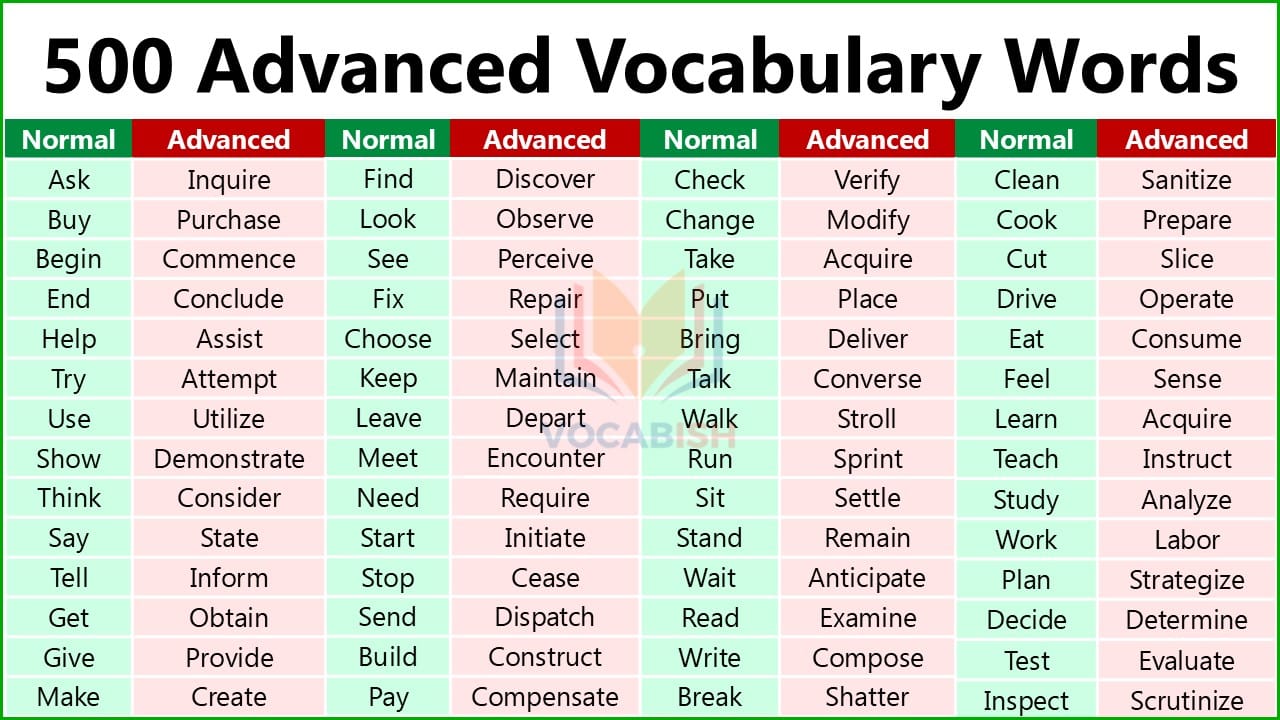

Many English learners use simple English words in their everyday conversation, and their speaking skills show that they are very beginners. But worry not. Here, I am going to share with you a huge list of 500+ advanced vocabulary words to empower your vocabulary and help you sound more native and advanced. Learning these normal vs advanced vocabulary words helps you talk with more confidence in your everyday speaking.
After learning these advanced vocabulary words, you will start noticing a positive change in your English little by little. You will understand conversations more easily, speak with more confidence, and use better words in your daily communication. Many words that once looked difficult will slowly become part of your normal speaking and writing.
Now it is time to learn the words step by step and understand how they are used in real life. Let’s begin with today’s lesson.
What Are Normal and Advanced English Words?
A normal word is a basic word people use every day. An advanced word has a similar meaning but sounds more polished, formal, or expressive.
Examples:
Normal Word | Advanced Word | Meaning |
|---|---|---|
Happy | Delighted | Very happy |
Sad | Miserable | Very sad |
Big | Massive | Very large |
Small | Tiny | Very small |
A quick tip to remember this is: learn advanced words in pairs with simple words.
Why Do We Use Advanced Vocabulary?
Advanced vocabulary helps English learners speak and write in a more natural and meaningful way. Instead of using the same basic words again and again, learners can use better words to express ideas more clearly and confidently.
When people use advanced words correctly, their English sounds more fluent and polished in conversations, school work, interviews, emails, and daily communication. It also becomes easier to understand native speakers because many advanced words are commonly used in real English.
Advantages of Advanced Vocabulary
Better Speaking Skills
Advanced vocabulary helps you explain your thoughts more naturally while speaking English. Your conversations sound smoother and more confident.
- Happy → Delighted
- Big → Massive
Stronger Writing Skills
Using better vocabulary makes your writing more interesting and professional. It helps in essays, emails, messages, and exams.
- Help → Assist
- Show → Demonstrate
Easier Understanding of English
Films, books, podcasts, and native conversations often include advanced words. Learning them improves your listening and reading skills step by step.
- Ask → Inquire
- Start → Commence
More Confidence While Speaking
When you know different ways to express the same idea, you feel less nervous during conversations and public speaking.
- Afraid → Terrified
- Smart → Intelligent
Helps You Sound More Natural
Native speakers often use advanced vocabulary in daily communication. Learning these words helps your English sound more real and less repetitive.
- Tell → Inform
- Get → Obtain
List of Advanced Vocabulary Words in English
In this section, we are going to learn everyday simple words and their advanced forms to speak English like native speakers. This list contains 100+ basic and advanced words used daily. We will also see some example sentences that will help us to know how we can use them in our everyday conversation. Let’s learn something interesting:
Everyday Feelings and Emotions
Feelings and emotions words help us explain how we feel in different situations during the day.
Normal | Advanced |
|---|---|
Happy | Delighted |
Sad | Miserable |
Angry | Furious |
Afraid | Terrified |
Tired | Exhausted |
Surprised | Astonished |
Worried | Anxious |
Calm | Relaxed |
Shy | Timid |
Brave | Courageous |
Friendly | Amiable |
Lonely | Isolated |
Excited | Thrilled |
Confused | Perplexed |
Proud | Honourable |
Lazy | Idle |
Honest | Truthful |
Kind | Compassionate |
Clever | Intelligent |
Silly | Ridiculous |
Funny | Hilarious |
Rude | Impolite |
Polite | Courteous |
Jealous | Envious |
Gentle | Tender |
Examples
- Delighted -> Very happy -> She was delighted after passing the test.
- Furious -> Very angry -> My father was furious about the broken window.
- Anxious -> Worried -> He felt anxious before the interview.
Daily Actions and Verbs
Action words are very important because we use them whenever we talk about daily activities.
Normal | Advanced |
|---|---|
Ask | Inquire |
Buy | Purchase |
Help | Assist |
Get | Obtain |
Leave | Depart |
Eat | Consume |
Show | Demonstrate |
Start | Commence |
End | Conclude |
Use | Utilise |
Tell | Inform |
Keep | Preserve |
Build | Construct |
Find | Discover |
Give | Provide |
Need | Require |
Try | Attempt |
Choose | Select |
Speak | Communicate |
Watch | Observe |
Fix | Repair |
Change | Modify |
Improve | Refine |
Pay | Compensate |
Grow | Expand |
Examples
- Purchase -> Buy -> She purchased a new phone yesterday.
- Repair -> Fix -> The mechanic repaired my bicycle.
- Inform -> Tell -> Please inform me about the meeting.
Words Used in School and Study
School and study words are used when we talk about learning, homework, teachers, and exams.
Normal | Advanced |
|---|---|
Teacher | Educator |
Student | Pupil |
Book | Publication |
Lesson | Session |
Test | Examination |
Answer | Response |
Idea | Concept |
Mistake | Error |
Skill | Ability |
Goal | Objective |
Topic | Subject |
Mark | Grade |
Learn | Acquire |
Read | Examine |
Write | Compose |
Explain | Clarify |
Think | Consider |
Remember | Recall |
Practice | Exercise |
Study | Analyse |
Simple | Straightforward |
Difficult | Complicated |
Correct | Accurate |
Wrong | Incorrect |
Clever | Brilliant |
Examples
- Acquire -> Learn -> Children acquire language quickly.
- Compose -> Write -> She composed a short essay.
- Objective -> Goal -> His objective is to improve English.
Words for Talking About People
These words help us describe a person’s behaviour, attitude, or nature in simple English.
Normal | Advanced |
|---|---|
Rich | Wealthy |
Poor | Needy |
Strong | Powerful |
Weak | Fragile |
Beautiful | Gorgeous |
Ugly | Unattractive |
Young | Youthful |
Old | Elderly |
Fast | Rapid |
Slow | Sluggish |
Busy | Occupied |
Famous | Renowned |
Safe | Secure |
Dangerous | Hazardous |
Healthy | Fit |
Sick | Ill |
Noisy | Deafening |
Quiet | Silent |
Smart | Intellectual |
Stubborn | Obstinate |
Lucky | Fortunate |
Unlucky | Unfortunate |
Careful | Cautious |
Careless | Negligent |
Strange | Peculiar |
Food and Daily Life Words
Food and daily life words are useful for talking about meals, shopping, home, and everyday activities.
Normal | Advanced |
|---|---|
Hungry | Starving |
Thirsty | Dehydrated |
Food | Cuisine |
Drink | Beverage |
Restaurant | Café |
Taste | Flavour |
Smell | Aroma |
Clean | Spotless |
Dirty | Filthy |
House | Residence |
Room | Chamber |
Job | Occupation |
Shop | Store |
Money | Finances |
Clothes | Garments |
Bag | Luggage |
Car | Vehicle |
Bus | Transport |
Road | Route |
Holiday | Vacation |
Trip | Journey |
Place | Location |
Home | Household |
Family | Relatives |
Friend | Companion |
Common Adjectives We Use Every Day
Adjectives are describing words that make our sentences more clear and interesting.
Normal | Advanced |
|---|---|
Big | Enormous |
Small | Miniature |
Good | Excellent |
Bad | Awful |
Important | Significant |
Interesting | Fascinating |
Boring | Tedious |
Easy | Effortless |
Hard | Challenging |
Bright | Luminous |
Dark | Gloomy |
Hot | Scorching |
Cold | Freezing |
Wet | Damp |
Dry | Arid |
Soft | Delicate |
Hard | Solid |
Strong | Sturdy |
Weak | Feeble |
Rich | Prosperous |
Poor | Destitute |
Empty | Vacant |
Full | Packed |
New | Modern |
Old | Ancient |
To avoid confusion, remember that advanced words are not always formal; many are common in films and conversations too.
Travel and Communication Words
Travel and communication words are used when we talk about journeys, transport, phone calls, or meeting people.
Normal | Advanced |
|---|---|
Talk | Converse |
Meet | Encounter |
Call | Contact |
Message | Notification |
Travel | Journey |
Fly | Depart |
Arrive | Reach |
Map | Guide |
Ticket | Pass |
Hotel | Accommodation |
Airport | Terminal |
Train | Railway |
Plan | Arrange |
Delay | Postpone |
Hurry | Rush |
Wait | Remain |
Visit | Explore |
Move | Relocate |
Stop | Halt |
Return | Revisit |
Help | Support |
Lead | Direct |
Follow | Pursue |
Join | Participate |
Explain | Describe |
Workplace and Business Words
These words are used in offices, companies, shops, and professional life.
Normal | Advanced |
|---|---|
Boss | Manager |
Worker | Employee |
Company | Organisation |
Meeting | Conference |
Deal | Agreement |
Idea | Proposal |
Rule | Regulation |
Salary | Income |
Work | Labour |
Sell | Market |
Buy | Acquire |
Team | Staff |
Office | Workplace |
Plan | Strategy |
Problem | Issue |
Success | Achievement |
Failure | Defeat |
Improve | Upgrade |
Customer | Client |
Product | Item |
Service | Facility |
Goal | Target |
Talk | Negotiate |
Help | Cooperate |
Check | Inspect |
500 Advanced Vocabulary Words in English
Here’s the list of 500 daily used normal vs advanced English words:
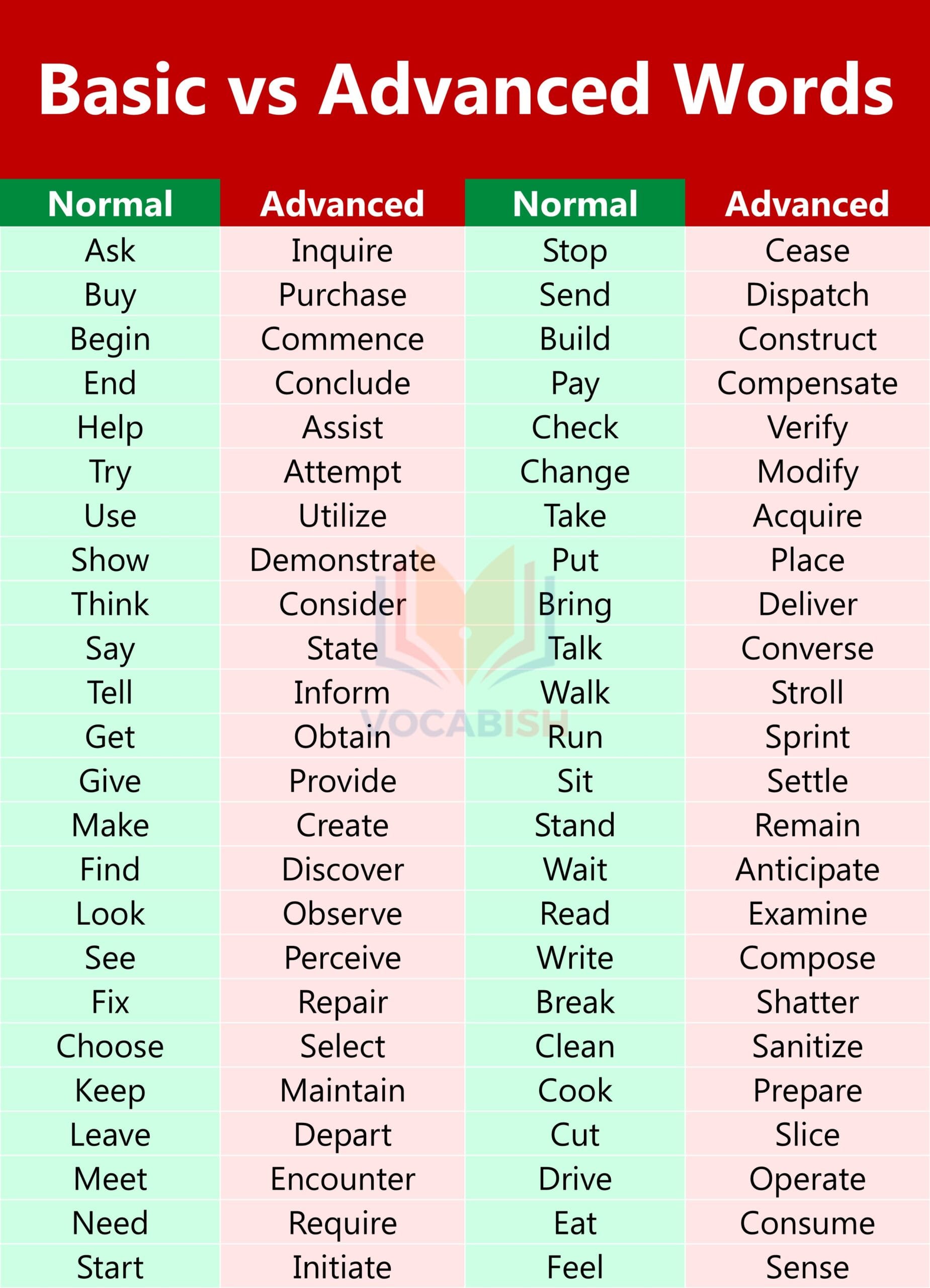
Daily Used Normal Vs Advanced English Words
Normal | Advanced |
|---|---|
Big | Enormous |
Small | Tiny |
Fast | Rapid |
Slow | Sluggish |
Easy | Effortless |
Hard | Difficult |
Old | Ancient |
New | Modern |
Bad | Awful |
Good | Excellent |
Clean | Immaculate |
Dirty | Filthy |
Rich | Wealthy |
Poor | Needy |
Hot | Scorching |
Cold | Freezing |
Bright | Luminous |
Dark | Gloomy |
Near | Nearby |
Far | Distant |
Full | Packed |
Empty | Vacant |
Cheap | Inexpensive |
Expensive | Costly |
Noisy | Rowdy |
Quiet place | Tranquil |
Short | Brief |
Long | Lengthy |
Tall | Towering |
Low | Minimal |
High | Elevated |
Thick | Dense |
Thin | Slim |
Soft | Tender |
Wet | Damp |
Dry | Arid |
Simple | Basic |
Complex | Complicated |
Clear | Obvious |
Weird | Strange |
Real | Genuine |
Fake | Artificial |
Busy | Occupied |
Free | Available |
Safe | Secure |
Sharp | Keen |
Round | Circular |
Flat | Level |
Rough | Coarse |
Smooth | Sleek |
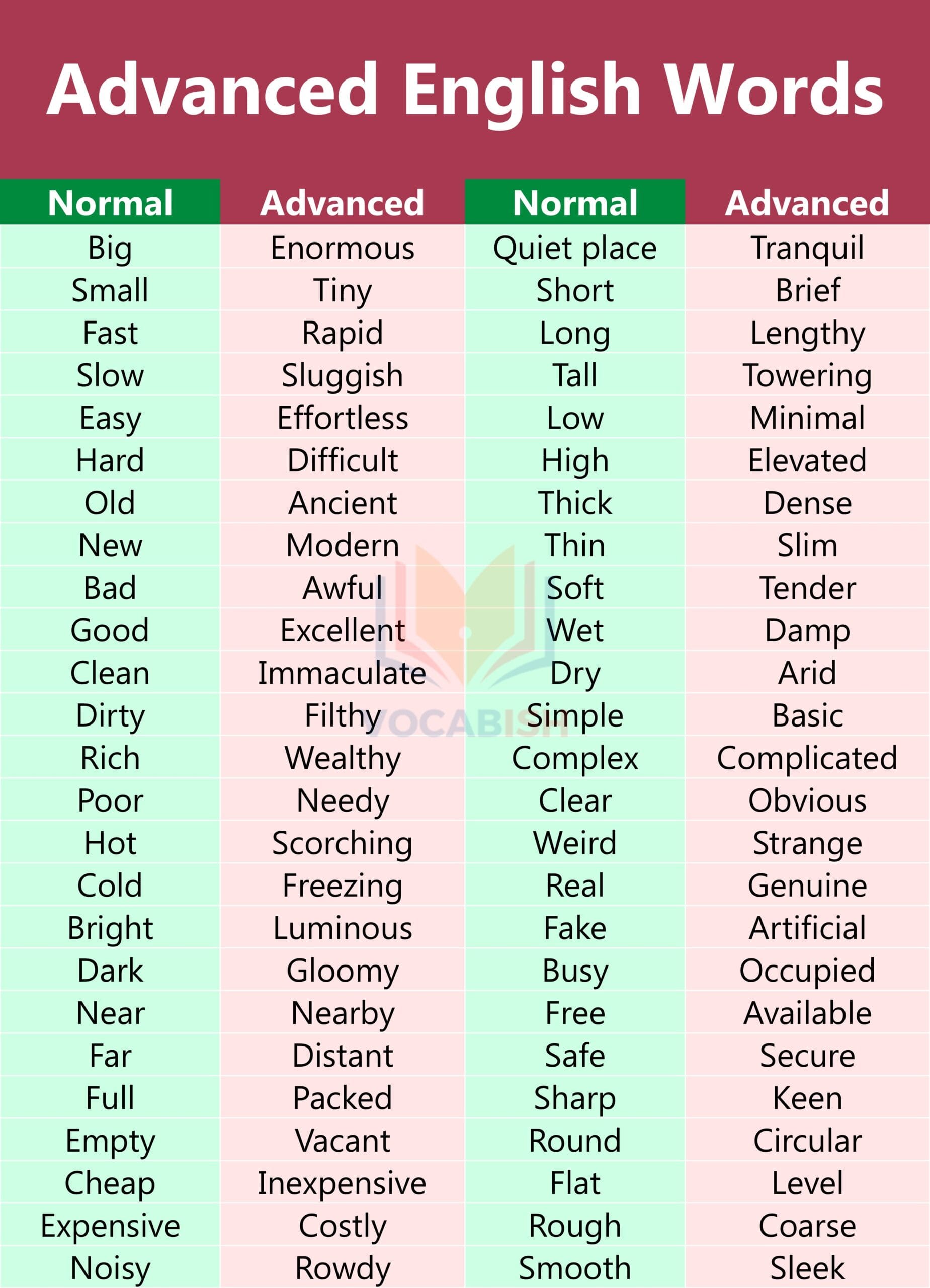
Normal Vs Advanced English Vocabulary Words
Normal | Advanced |
|---|---|
Learn | Acquire |
Teach | Instruct |
Study | Analyze |
Know | Comprehend |
Guess | Assume |
Understand | Grasp |
Explain | Clarify |
Answer | Respond |
Job | Occupation |
Work | Labor |
Plan | Strategize |
Decide | Determine |
Test | Evaluate |
Inspect | Scrutinize |
Solve | Resolve |
Endeavor | Strive |
Support | Aid |
Lead | Guide |
Follow | Pursue |
Manage | Supervise |
Improve | Enhance |
Transform | Convert |
Reduce | Minimize |
Increase | Maximize |
Generate | Produce |
Draft | Outline |
Review | Assess |
Reinforce | Strengthen |
Relearn | Refresh |
Launch | Initiate |
Finalize | Complete |
Participate | Engage |
Contemplate | Meditate |
Deliberate | Consider deeply |
Recall | Remember |
Neglect | Ignore |
Concentrate | Focus |
Fail | Collapse |
Succeed | Achieve |
Apply | Implement |
Recognize | Identify |
Improve again | Upgrade |
Learn deeply | Master |
Teach clearly | Illustrate |
Decide firmly | Resolve |
Finish strongly | Accomplish |
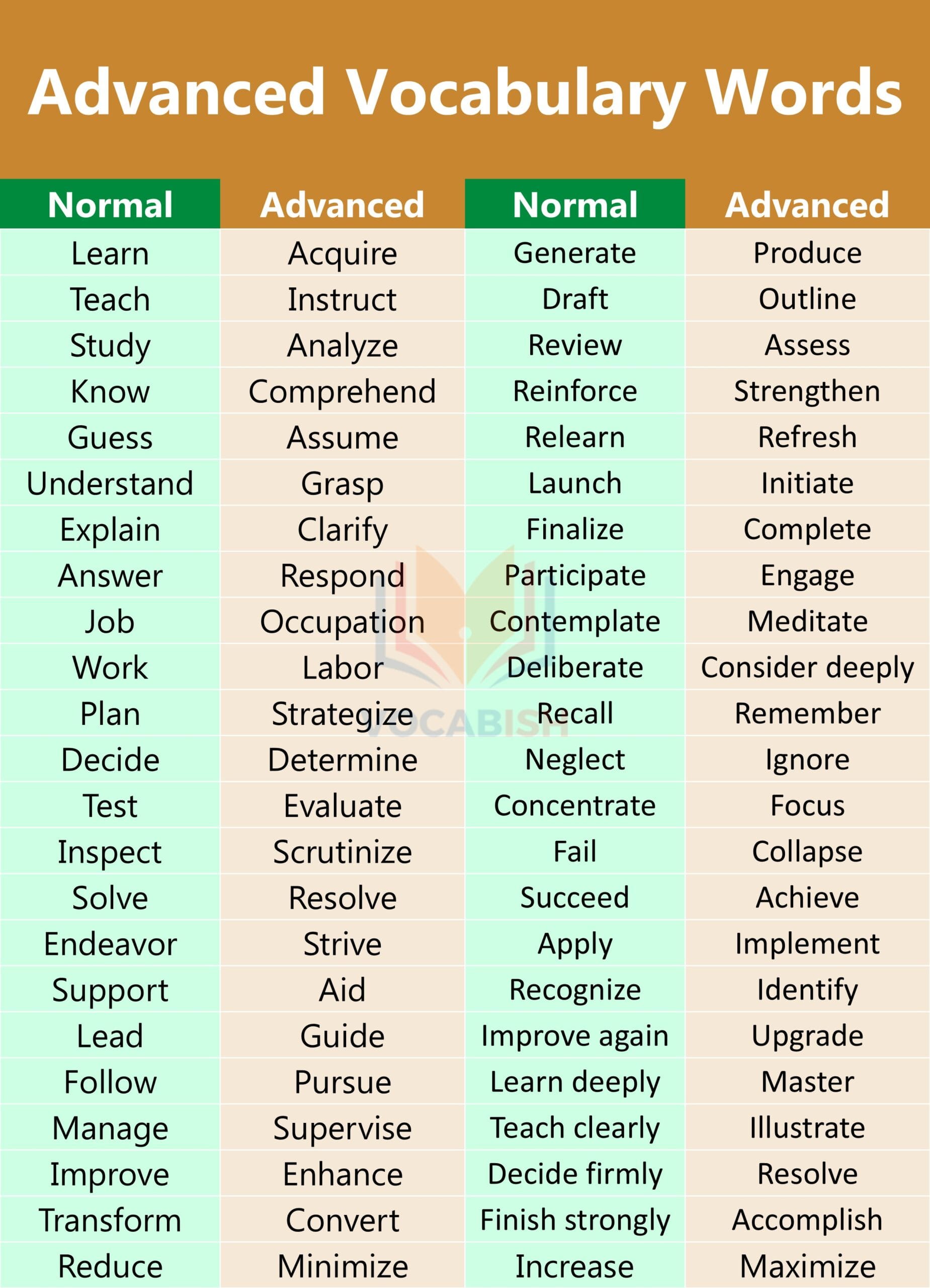
500 Normal Vs Advanced English Vocabulary Words
Normal | Advanced |
|---|---|
Talk | Discuss |
Speak | Articulate |
Say sorry | Apologize |
Answer back | Reply |
Complain | Protest |
Promise | Pledge |
Agree | Consent |
Disagree | Object |
Argue | Debate |
Tell secret | Confide |
Explain clearly | Elaborate |
Ask nicely | Request |
Ask strongly | Demand |
Say no | Refuse |
Say yes | Accept |
Invite | Host |
Meet people | Socialize |
Call | Contact |
Write message | Notify |
Talk loudly | Shout |
Talk quietly | Whisper |
Say bad things | Criticize |
Praise | Commend |
Thank | Appreciate |
Greet | Welcome |
Introduce | Present |
Give news | Announce |
Share | Distribute |
Tell story | Narrate |
Ask for help | Seek |
Say goodbye | Farewell |
Ask politely | Entreat |
Insist | Urge |
Declare | Proclaim |
Talk too much | Ramble |
Talk short | Summarize |
Tell truth | Confess |
Say wrong | Misstate |
Say strongly | Assert |
Talk formally | Address |
Explain briefly | Outline |
Talk seriously | Confer |
Argue strongly | Contend |
Speak softly | Murmur |
Talk clearly | Enunciate |
Say with anger | Snarl |
Say with joy | Exclaim |
Speak wisely | Advise |
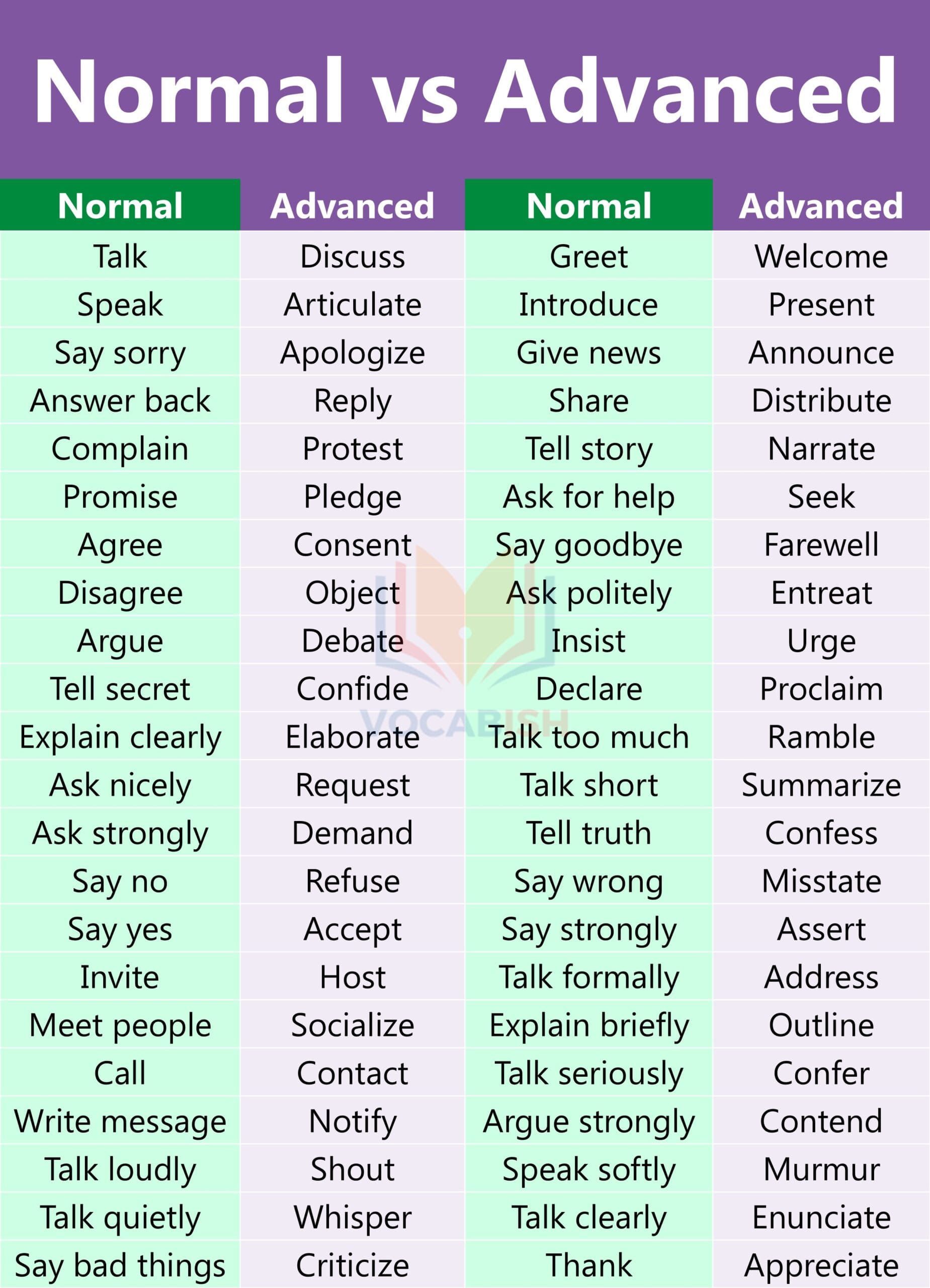
Advanced English Vocabulary for Daily Use
Normal | Advanced |
|---|---|
Big problem | Crisis |
Small problem | Issue |
Chance | Opportunity |
Danger | Peril |
Idea | Concept |
Reason | Motive |
Result | Outcome |
Goal | Objective |
Plan | Blueprint |
Rule | Regulation |
Order | Command |
Law | Legislation |
Group | Collective |
Team | Squad |
Crowd | Assembly |
Place | Location |
Area | Region |
City | Metropolis |
Village | Hamlet |
Country | Nation |
World | Globe |
Earth | Planet |
Jobless | Unemployed |
Rich person | Tycoon |
Poor person | Pauper |
Leader | Authority |
Boss | Supervisor |
Worker | Employee |
Friend | Companion |
Enemy | Rival |
Guest | Visitor |
Stranger | Foreigner |
Child | Minor |
Adult | Grown-up |
Old person | Elderly |
Baby | Infant |
Parent | Guardian |
Wife | Spouse |
Husband | Partner |
Brother | Sibling |
Sister | Sibling (female) |
People | Public |
Man | Gentleman |
Woman | Lady |
Kid | Youth |
Teenager | Adolescent |
Family | Household |
Relative | Kinsman |
Neighbor | Resident |
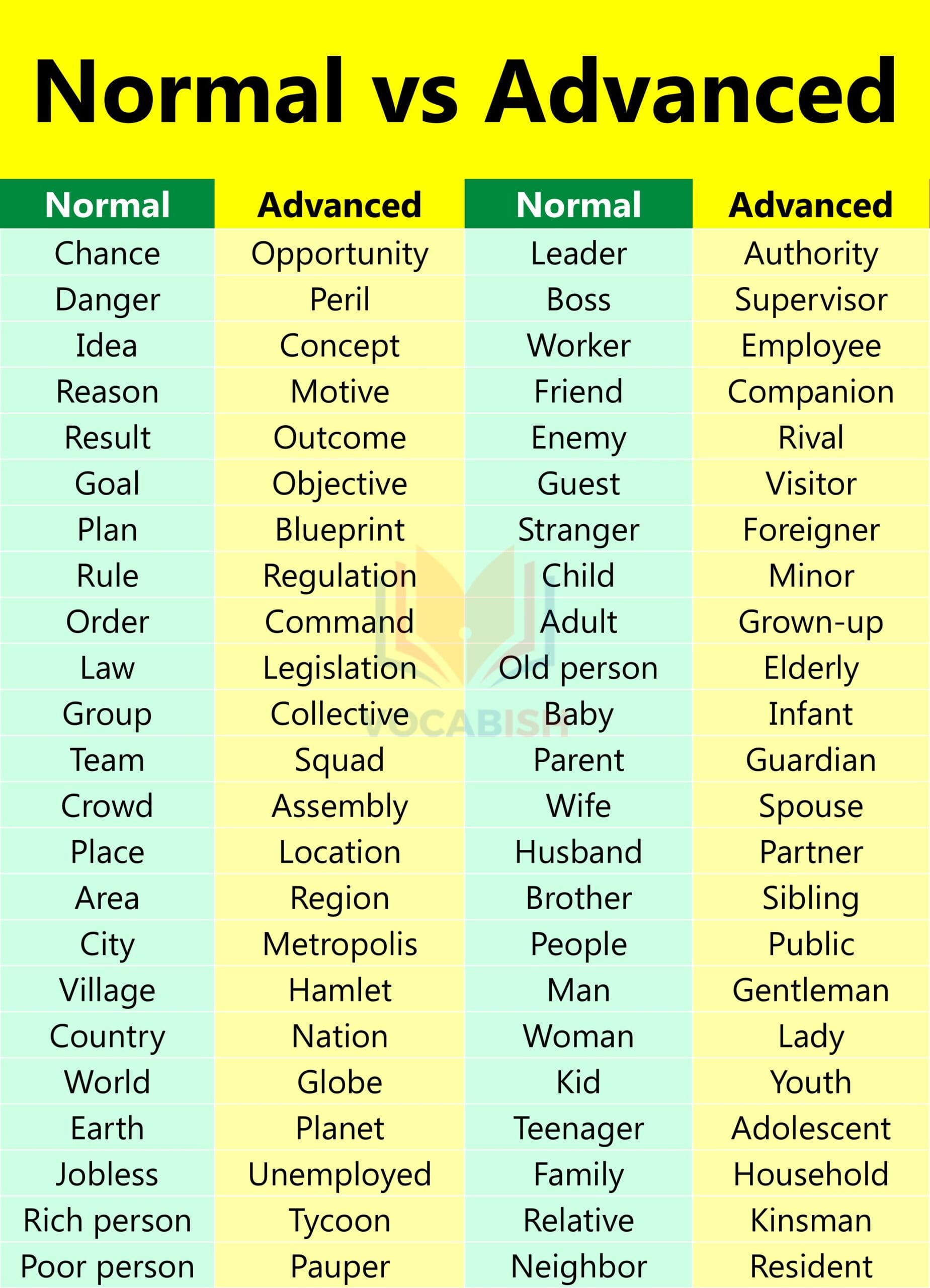
Normal Vs Advanced English Vocabulary Words
Normal Words | Advanced Words |
|---|---|
Big mistake | Blunder |
Small mistake | Error |
Lie | Deception |
Truth | Fact |
Fight | Conflict |
War | Battle |
Peace | Harmony |
Noise | Disturbance |
Silence | Stillness |
Mess | Chaos |
Order | Discipline |
Trouble | Difficulty |
Fun | Amusement |
Joke | Humor |
Laugh | Giggle |
Cry | Weep |
Shout | Yell |
Sleep | Slumber |
Wake up | Awaken |
Rest | Relaxation |
Dream | Fantasy |
Fear | Dread |
Love | Affection |
Hate | Detest |
Hope | Aspiration |
Wish | Desire |
Need badly | Desperate |
Want strongly | Crave |
Like a lot | Adore |
Like a little | Favor |
Think hard | Ponder |
Think again | Reconsider |
Forget completely | Erase |
Remember clearly | Memorize |
Learn slowly | Absorb |
Learn fast | Grasp quickly |
Try hard | Struggle |
Give up | Surrender |
Win | Triumph |
Lose | Defeat |
End finally | Terminate |
Go away | Depart |
Come back | Return |
Stay | Remain |
Move | Relocate |
Travel | Journey |
Go fast | Hurry |
Go slow | Linger |
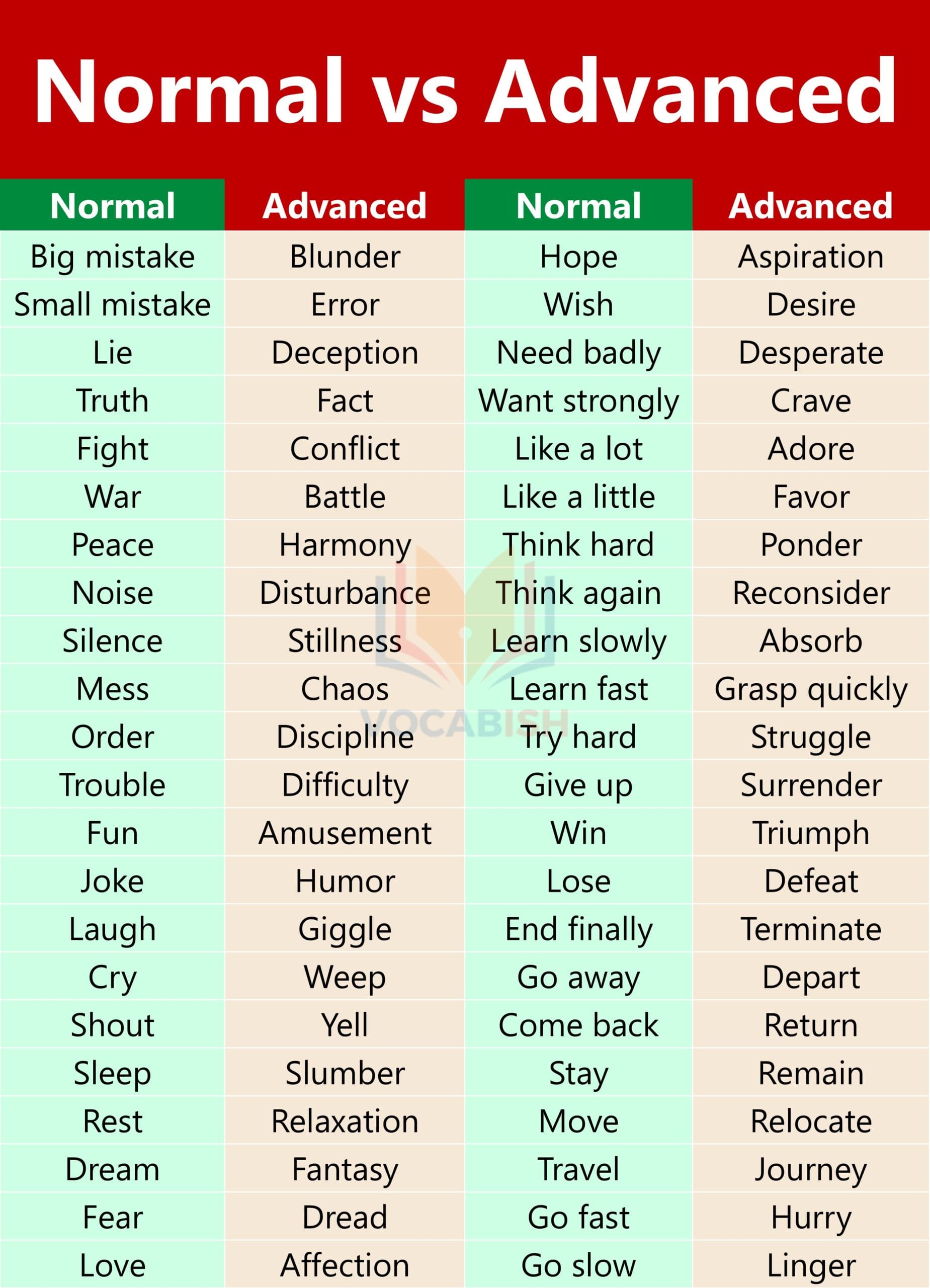
List of Normal vs. Advanced English Words
Normal English Words | Advanced English Words |
|---|---|
Big house | Mansion |
Small house | Cottage |
Room | Chamber |
Bed | Mattress |
Chair | Seat |
Table | Desk |
Light | Illumination |
Dark place | Shadow |
Window | Opening |
Door | Entrance |
Wall | Partition |
Roof | Ceiling |
Floor | Surface |
Road | Highway |
Street | Avenue |
Bridge | Crossing |
Park | Garden |
Forest | Woodland |
Tree | Oak |
Flower | Blossom |
Grass | Lawn |
Water | Liquid |
River | Stream |
Sea | Ocean |
Lake | Reservoir |
Mountain | Peak |
Hill | Ridge |
Stone | Rock |
Sand | Dust |
Air | Atmosphere |
Fire | Flame |
Smoke | Fumes |
Cloud | Mist |
Rain | Drizzle |
Snow | Frost |
Wind | Breeze |
Storm | Tempest |
Sun | Star |
Moon | Satellite |
Sky | Heavens |
Day | Daylight |
Night | Darkness |
Morning | Dawn |
Evening | Dusk |
Noon | Midday |
Today | Present |
Tomorrow | Future |
Yesterday | Past |
Time | Era |
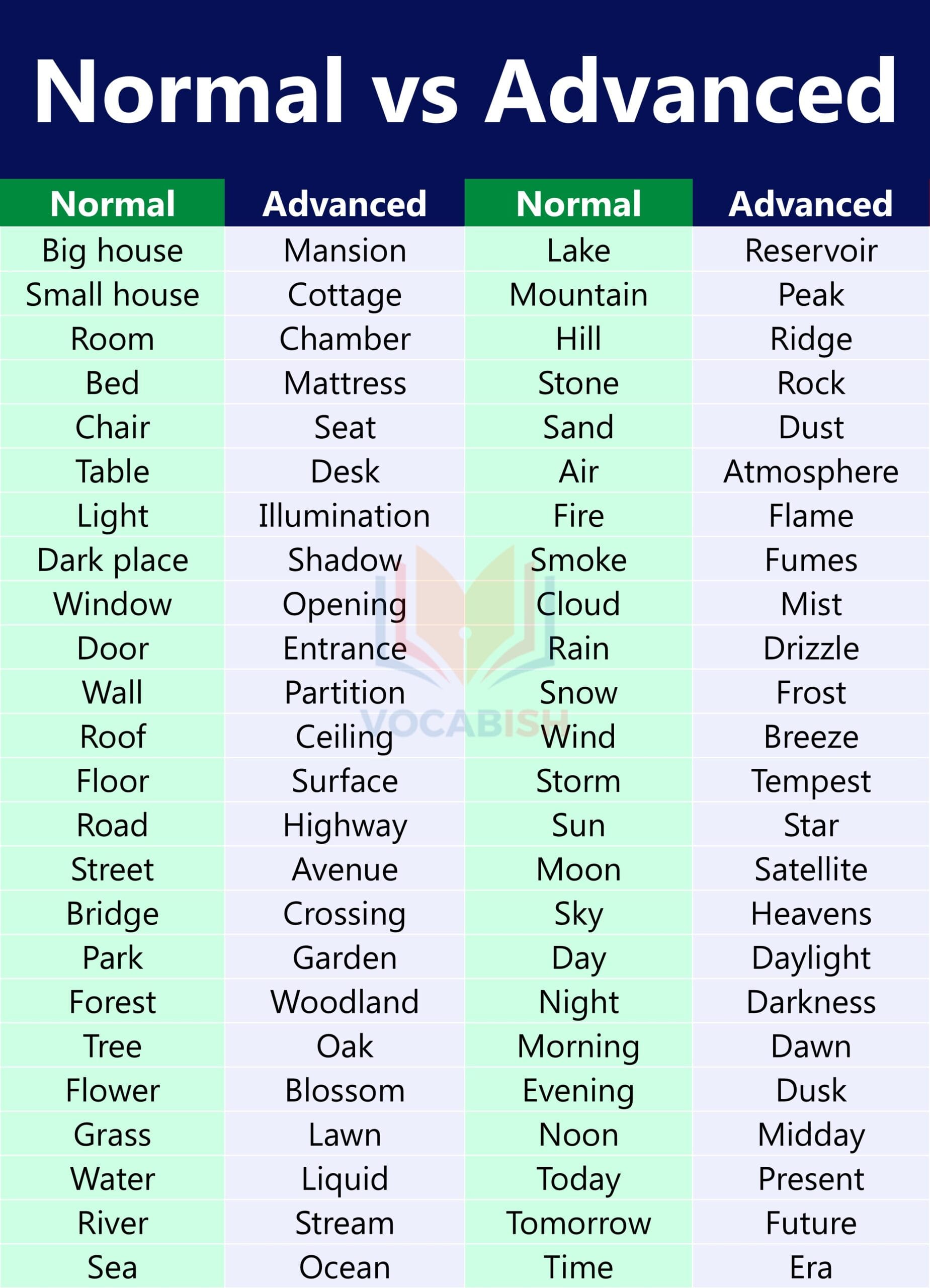
Normal English vs Advanced English PDF
Normal Words | Advanced Words |
|---|---|
Eat too much | Overeat |
Drink too much | Overdrink |
Spend too much | Overspend |
Sleep too much | Oversleep |
Talk too much | Overtalk |
Work too much | Overwork |
Think too much | Overthink |
Run too fast | Dash |
Walk slowly | Amble |
Look carefully | Inspect |
Look quickly | Glance |
Look again | Recheck |
Look away | Avoid |
Watch closely | Monitor |
Listen carefully | Attend |
Hear accidentally | Overhear |
Hear well | Detect |
Smell bad | Stink |
Smell good | Fragrance |
Taste bad | Bitter |
Taste good | Delicious |
Touch gently | Caress |
Hit hard | Strike |
Push hard | Shove |
Pull hard | Yank |
Hold tightly | Clutch |
Drop suddenly | Release |
Open slowly | Unfold |
Close tightly | Seal |
Break slowly | Crack |
Break completely | Smash |
Build slowly | Assemble |
Build fast | Erect |
Fix quickly | Patch |
Fix well | Restore |
Clean deeply | Purify |
Wash lightly | Rinse |
Dry fully | Dehydrate |
Heat strongly | Boil |
Cool down | Chill |
Burn lightly | Scorch |
Freeze hard | Solidify |
Melt slowly | Dissolve |
Mix well | Blend |
Separate | Divide |
Join | Unite |
Connect | Link |
Remove | Eliminate |
Add | Insert |
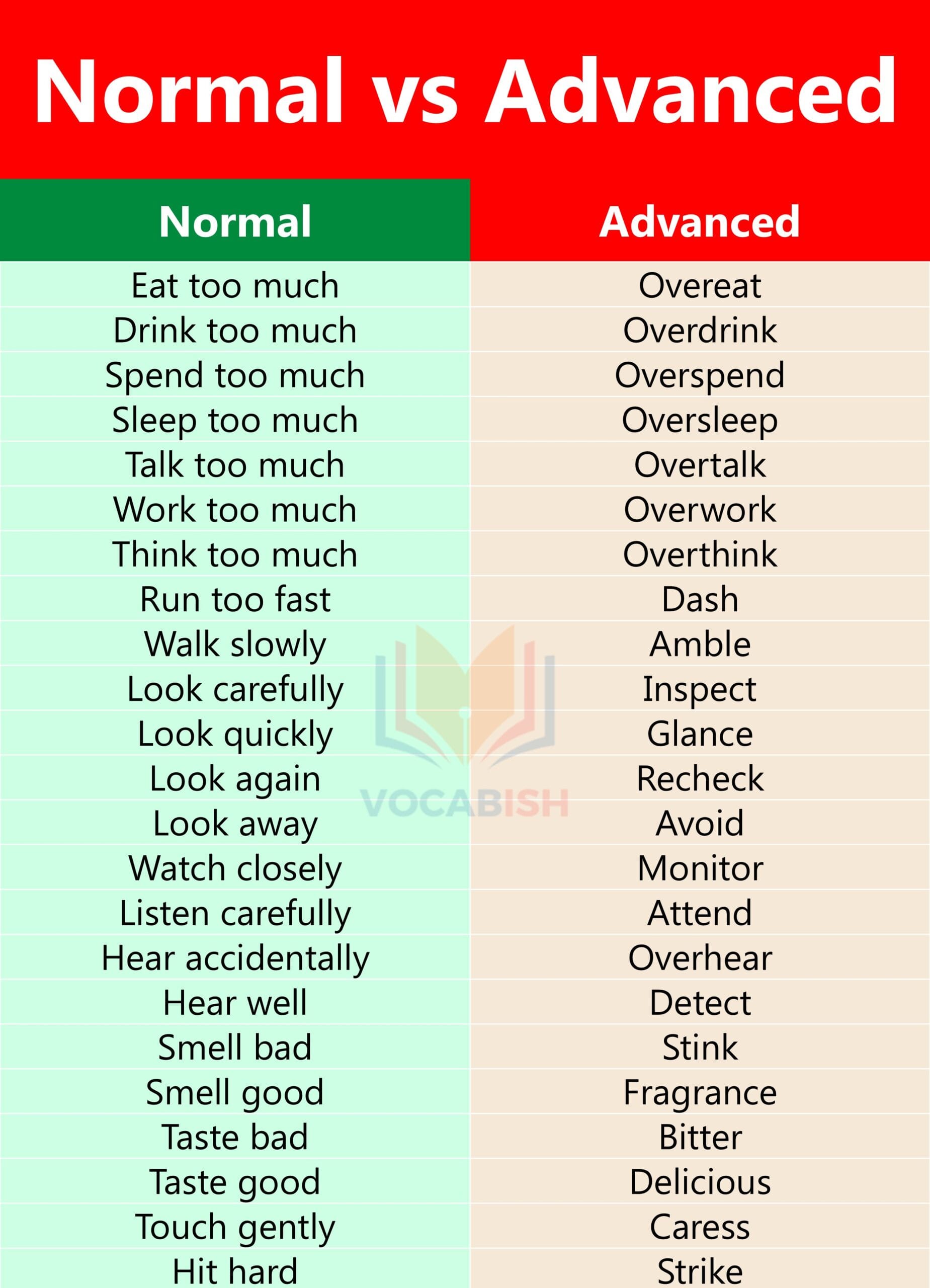
Normal vs Advanced English Words PDF
Normal Vocabulary | Advanced Vocabulary |
|---|---|
Big success | Breakthrough |
Small success | Progress |
Big failure | Disaster |
Small failure | Setback |
New idea | Innovation |
Old idea | Tradition |
Strong belief | Conviction |
Weak belief | Doubt |
Clear answer | Solution |
Hard question | Puzzle |
Simple truth | Reality |
False story | Myth |
Big change | Revolution |
Small change | Adjustment |
Big difference | Contrast |
Small difference | Variation |
Big risk | Gamble |
Small risk | Chance |
Big surprise | Shock |
Small surprise | Twist |
Big effort | Dedication |
Small effort | Attempt |
Big fear | Phobia |
Small fear | Worry |
Big joy | Euphoria |
Small joy | Pleasure |
Big pain | Agony |
Small pain | Ache |
Big love | Devotion |
Small love | Liking |
Big hate | Hatred |
Small hate | Dislike |
Big hope | Dream |
Small hope | Expectation |
Big goal | Ambition |
Small goal | Target |
Big wish | Desire |
Small wish | Request |
Big memory | Impression |
Small memory | Trace |
Big story | Epic |
Small story | Tale |
Big event | Occasion |
Small event | Incident |
Big mistake | Catastrophe |
Small mistake | Slip |
Big help | Support |
Small help | Favor |
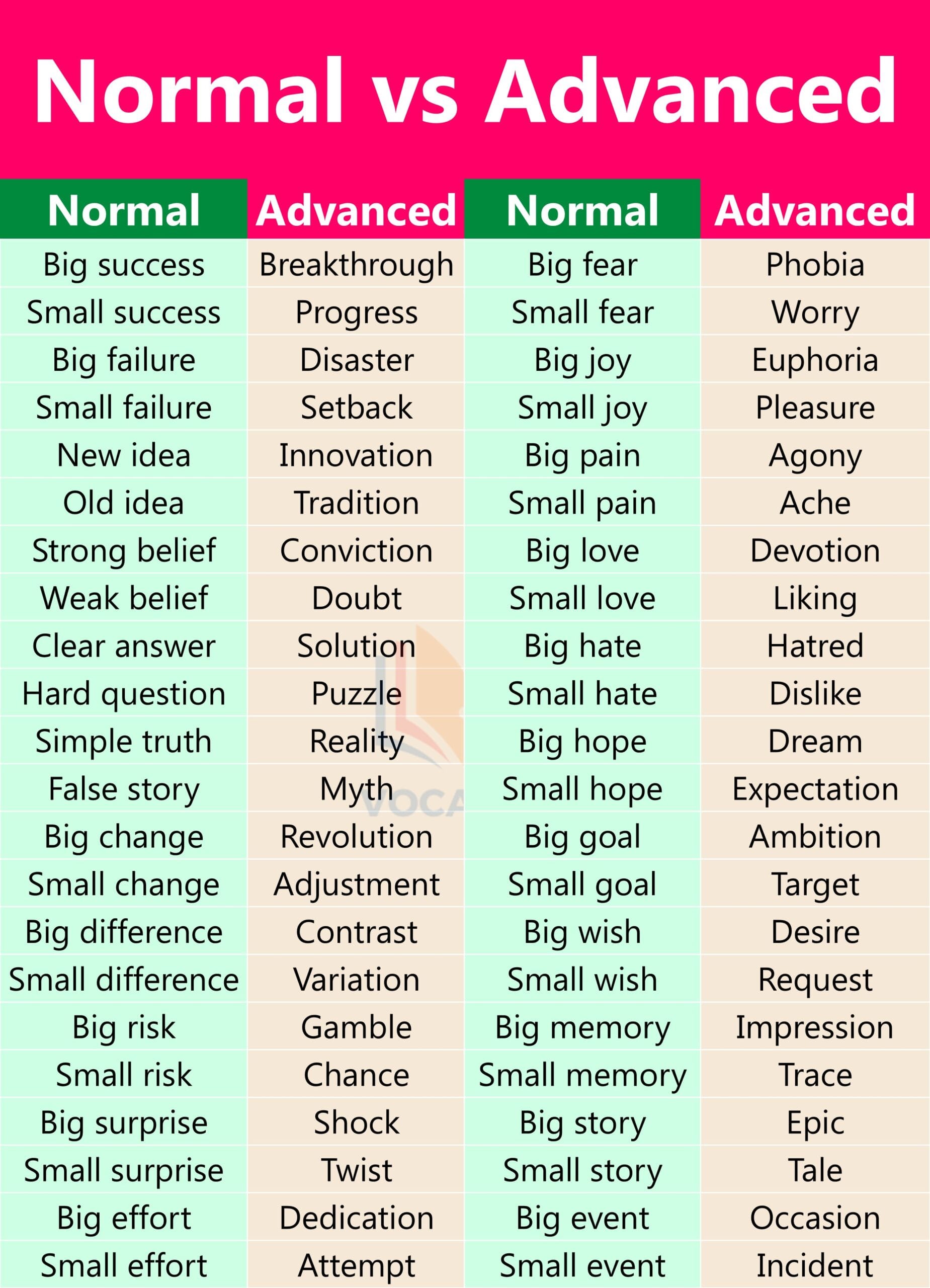
Normal and Advanced Sentences
Here’s the table that shows how to use these normal and advanced English words in sentences:
Normal Sentence | Advanced Sentence |
|---|---|
I will ask the teacher for help. | I will inquire about the course details. |
She wants to buy a new phone. | She plans to purchase a new phone. |
Let’s start the meeting now. | The meeting will commence at 10 a.m. |
The class will end soon. | The class will conclude in five minutes. |
Can you help me with this work? | Can you assist me with this task? |
I will try my best. | I will attempt to solve the problem. |
Please use this pen. | Please utilize this pen for the test. |
He will show his project. | He will demonstrate his project. |
I think this is correct. | I consider this answer correct. |
She said hello to me. | She stated her opinion clearly. |
I need to get a book. | I need to obtain a reference book. |
They will give us homework. | They will provide us with homework. |
He will make a plan. | He will create a detailed plan. |
I can’t find my keys. | I finally discovered the truth. |
She looked at the sky. | She observed the stars carefully. |
I see the problem now. | I perceive the situation clearly. |
Please fix the chair. | Please repair the broken chair. |
You must choose one option. | You must select one option. |
Try to keep your room clean. | Try to maintain your room neatly. |
We will leave early. | We will depart early in the morning. |
I will meet my friend. | I will encounter many new people there. |
I need some advice. | I require your guidance. |
Please stop talking. | Please cease talking now. |
I will send the email. | I will dispatch the message today. |
They will build a house. | They will construct a new house. |
Please check your work. | Please verify your answers. |
We must change our plan. | We must modify our strategy. |
I will take the book. | I will acquire the book tomorrow. |
Please bring your notebook. | Please deliver the documents. |
They like to talk a lot. | They like to converse in English. |
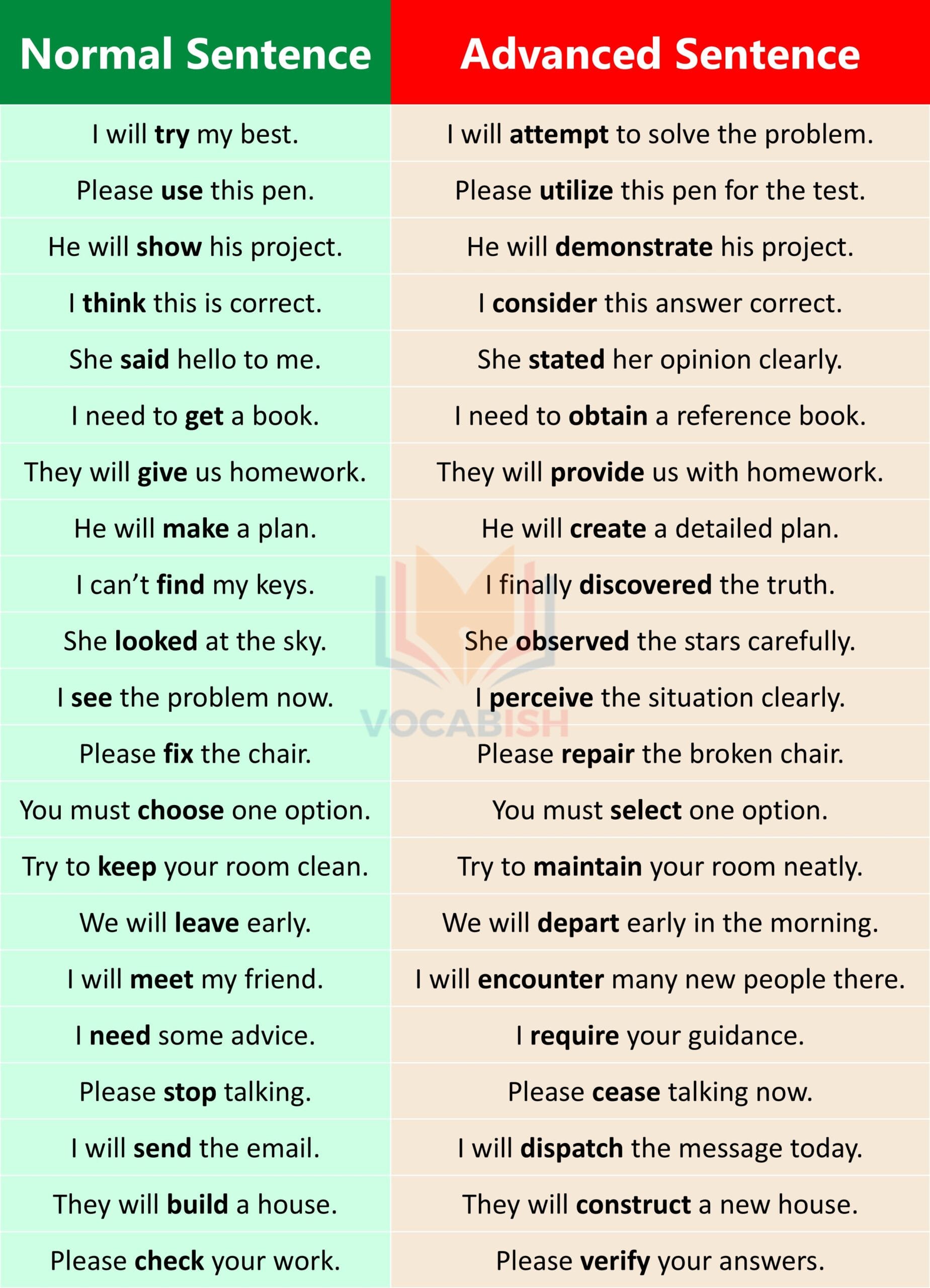
Normal vs Advanced English PDF
Normal and Advanced English Words PDF
FAQs about Advanced English Words
Advanced English words are vocabulary used to express ideas more precisely and formally. They often replace basic words, such as assist instead of help or purchase instead of buy.
Common advanced English word examples include assist (help), purchase (buy), inquire (ask), observe (see), and reside (live). These words provide more precise meanings in formal communication.
Basic English words are simple and commonly used in everyday speech, while advanced English words are more precise and formal. For example, start is basic, while commence is advanced.
You can learn advanced English words by reading books, studying vocabulary lists, learning synonyms of common words, and practicing them in sentences. Regular reading and writing help reinforce new vocabulary naturally.
Some advanced English words include meticulous (very careful), abundant (more than enough), innovative (introducing new ideas), resilient (able to recover quickly), and profound (very deep or meaningful).
A short list of very advanced English words includes ubiquitous, eloquent, pragmatic, diligent, ambiguous, coherent, inevitable, and comprehensive. These words are common in academic writing and formal communication.
Yes, English has thousands of advanced words because the language has developed over centuries and borrowed vocabulary from many languages. This large vocabulary allows precise and detailed expression.
Related Articles: