
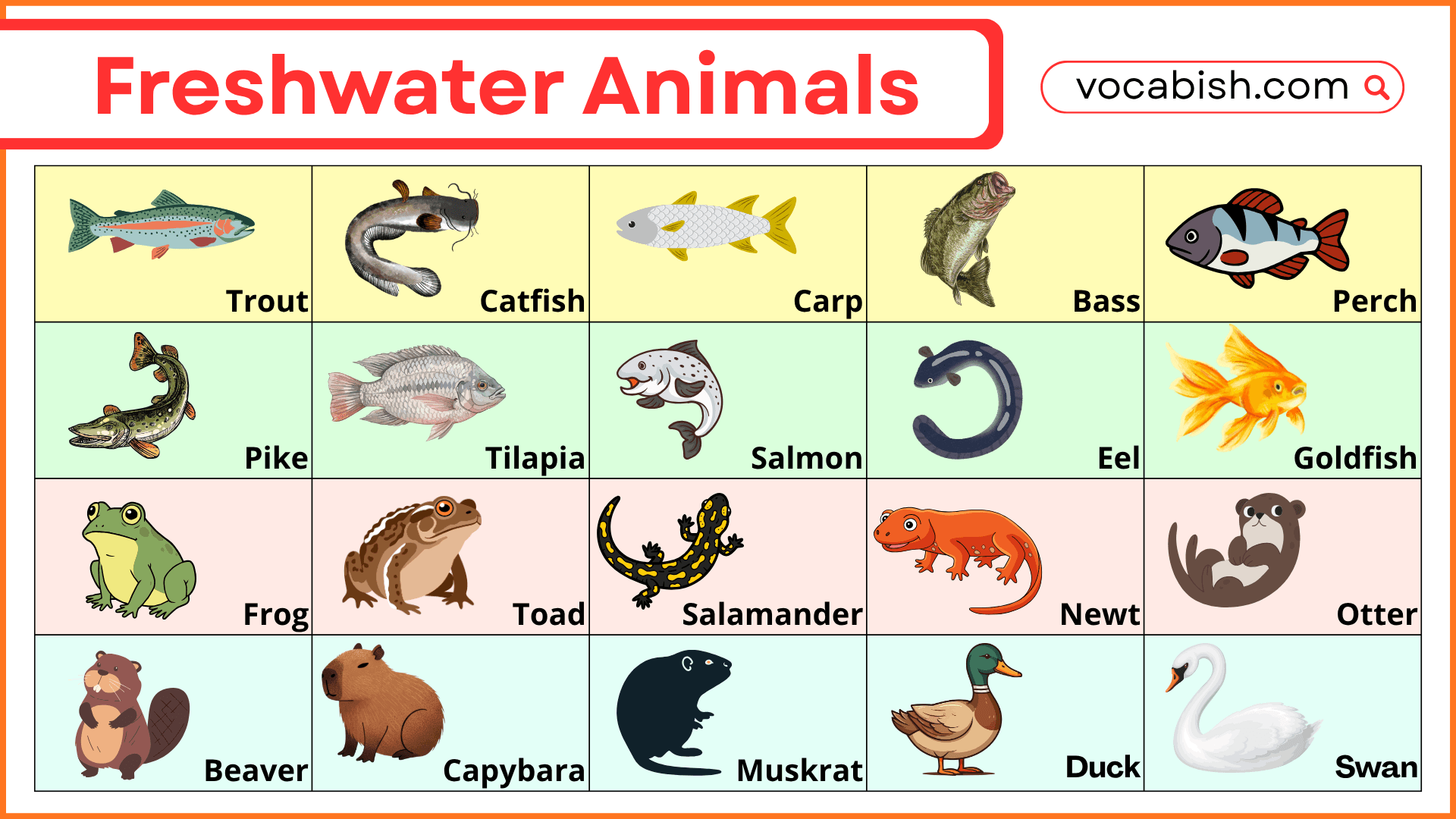
In this blog post, you will learn the names of 100+ freshwater animals in English, along with pictures to help you remember them better. Knowing these words is important because it helps you understand conversations, books, and videos about rivers, lakes, and ponds. By studying these animal names, you can improve your speaking, reading, writing, and listening skills at the same time. Using pictures with vocabulary makes it easier to remember and use these words confidently in daily life and English lessons.
What Are Freshwater Animals?
Freshwater animals are living beings that survive in non-salty water like rivers, ponds, lakes, and streams. They cannot live in the ocean or sea because saltwater can harm them. These animals are very important for nature because they keep water clean, help in the food chain, and support the environment.
Examples:
- Fish like Trout and Catfish
- Amphibians like Frogs and Salamanders
- Insects like Dragonflies and Water Beetles
- Mammals like Otters and Beavers
- Birds like Ducks and Kingfishers

List of Common Freshwater Animals Names
Here is a short and simple list of common freshwater animals with their basic information.
| Animal Name | Type | Where It Lives |
|---|---|---|
| Trout | Fish | Rivers and Streams |
| Catfish | Fish | Lakes and Rivers |
| Frog | Amphibian | Ponds and Marshes |
| Toad | Amphibian | Wetlands and Ponds |
| Otter | Mammal | Rivers and Lakes |
| Beaver | Mammal | Rivers and Streams |
| Duck | Bird | Lakes and Ponds |
| Kingfisher | Bird | Riversides |
| Turtle | Reptile | Ponds and Lakes |
| Crayfish | Crustacean | Freshwater Streams |
Types of Freshwater Animals
Freshwater animals come in different types. Each plays a special role in nature.
| Type | Examples | Description |
|---|---|---|
| Fish | Trout, Catfish | Live fully in water and breathe through gills. |
| Amphibians | Frog, Salamander | Live both in water and on land. |
| Mammals | Otter, Beaver | Warm-blooded and give birth to young ones. |
| Birds | Duck, Kingfisher | Fly above water and eat fish or insects. |
| Reptiles | Turtle, Snake | Cold-blooded and often found near rivers. |
| Insects | Dragonfly, Water Beetle | Small creatures that live near or on water. |
1. Freshwater Fish Names
Freshwater fish live in rivers, lakes, and ponds. They breathe through gills and are very important for the ecosystem and food chain.
Common Freshwater Fish Names:
Trout
Trout are fast-swimming freshwater fish commonly found in cool rivers and streams with clear water.
Example: “I went fishing by the river and caught a trout for dinner.”
Catfish
Catfish are freshwater fish with long whiskers, often feeding near the bottom of rivers or ponds.
Example: “The catfish hid under the rocks, making it tricky to catch.”
Carp
Carp are large, slow-moving freshwater fish commonly found in ponds, lakes, and rivers worldwide.
Example: “A carp jumped near the pond’s edge while I was feeding the ducks.”
Pike
Pike are long, sharp-toothed predatory fish that hunt smaller fish in lakes and rivers.
Example: “The pike chased the smaller fish across the lake quickly.”
Perch
Perch are small, colourful freshwater fish often found in clean rivers and shallow waters.
Example: “I saw a perch swimming near the riverbank while boating yesterday.”
Bass
Bass are popular freshwater fish prized by anglers, usually living in calm lakes or slow rivers.
Example: “He caught a big bass during our weekend fishing trip.”
Tilapia
Tilapia are freshwater fish commonly farmed in ponds due to their hardiness and fast growth.
Example: “We bought fresh tilapia from the market for tonight’s dinner.”
2. Freshwater Amphibians Names
Amphibians live both in water and on land. They usually start their life in water and later move to land.
Common Freshwater Amphibians Names:
Frog
Frogs are small animals that jump, make croaking sounds, and live near water or ponds.
Example: “I saw a frog sitting on the pond lily this morning.”
Toad
Toads are similar to frogs but have dry, rough skin and prefer drier habitats.
Example: “A toad crawled across the garden path after the rain.”
Salamander
Salamanders are smooth-skinned amphibians resembling lizards, often found near damp soil or streams.
Example: “We found a salamander hiding under the damp log in the forest.”
Newt
Newts are small amphibians that live in ponds and swim gracefully in calm water.
Example: “The newt swam slowly across the pond while we watched quietly.”
3. Freshwater Mammals Names
These mammals live around or in freshwater areas. They have fur, breathe air, and many of them are great swimmers.
Common Freshwater Mammals Names:
Otter
Otters are playful mammals that swim quickly in rivers or lakes and mainly eat fish.
Example: “The otter dived into the river, catching a fish in its paws.”
Beaver
Beavers are mammals famous for building dams and lodges using wood, branches, and mud.
Example: “The beaver built a large dam across the small stream.”
Capybara
Capybaras are the world’s largest rodents, living near rivers and ponds in groups.
Example: “A capybara sat quietly by the riverbank with its friends.”
Muskrat
Muskrats are small, furry mammals that build burrows or lodges along riverbanks and ponds.
Example: “The muskrat swam out of its burrow to look for food.”
4. Freshwater Birds Names
Freshwater birds live near rivers, lakes, and ponds. They feed on fish, insects, and plants from the water.
Common Freshwater Birds Names:
Duck
Ducks are water birds with webbed feet that swim easily in ponds, lakes, and rivers.
Example: “The duck paddled across the pond, quacking loudly at the children.”
Swan
Swans are large, graceful white birds with long necks, often seen gliding on calm water.
Example: “A swan floated elegantly on the lake near the park.”
Kingfisher
Kingfishers are brightly coloured birds that dive quickly into water to catch small fish.
Example: “The kingfisher perched on the branch before diving into the river for a fish.”
Heron
Herons are tall birds with long legs that stand still to hunt fish in shallow water.
Example: “A heron waited patiently by the riverbank, catching fish for its meal.”
Goose
Geese are birds with long necks and loud calls, often seen grazing or swimming near lakes.
Example: “The goose honked loudly while walking along the lake’s edge.”
5. Freshwater Reptiles Names
These reptiles live in or near freshwater. They are cold-blooded and need sunlight to stay warm.
Common Freshwater Reptiles Names:
Turtle
Turtles are reptiles with hard shells that live both in water and on land for protection.
Example: “The turtle crawled slowly onto the riverbank to sunbathe on the rocks.”
Crocodile
Crocodiles are large, powerful reptiles that live in rivers, swamps, and lakes, hunting fish or animals.
Example: “The crocodile floated silently in the river, waiting for prey.”
Water Snake
Water snakes are non-poisonous reptiles that swim easily in lakes, rivers, and ponds to catch food.
Example: “A water snake slid quickly into the pond when it sensed danger.”
Terrapin
Terrapins are small freshwater turtles often found in ponds, slow-moving rivers, and shallow waters.
Example: “The terrapin rested on a log, enjoying the warm sunlight.”
6. Freshwater Insects Names
Freshwater insects are tiny creatures that live on or near water. They help to keep the water clean and feed other animals.
Common Freshwater Insects Names:
Dragonfly
Dragonflies are colourful insects that fly above water, catching mosquitoes and other small insects for food.
Example: “A dragonfly hovered over the pond, eating mosquitoes near the water’s surface.”
Water Beetle
Water beetles swim underwater and have shiny, hard wings that help them move quickly in water.
Example: “The water beetle dived beneath the lily pads, searching for tiny insects.”
Mosquito Larva
Mosquito larvae are the early stage of mosquitoes, living in still water before turning into adults.
Example: “I saw mosquito larvae wriggling in the stagnant pond near our garden.”
Mayfly
Mayflies are small insects that live near rivers and streams for only a short adult life.
Example: “A mayfly skimmed across the river surface, living only a single day.”
Water Strider
Water striders are insects that walk on the water surface using long, thin legs to move.
Example: “A water strider glided quickly across the pond, staying on the water without sinking.”
Freshwater Animals Names for Kids
Here’s a short and easy list of freshwater animals that kids can learn easily. Each animal has a simple description to help young learners remember.
Frog
Frogs are small animals that jump and live near ponds, lakes, or rivers, making croaking sounds.
Example: “The frog jumped from the lily pad into the pond.”
Duck
Ducks are water birds with webbed feet that swim and quack in ponds and lakes.
Example: “The duck paddled across the pond looking for food.”
Fish
Fish are animals that live in water, swim with fins, and breathe using gills.
Example: “The fish swam quickly around the aquarium.”
Turtle
Turtles are reptiles with hard shells that live in water or on land for protection.
Example: “The turtle crawled slowly onto a rock to enjoy the sun.”
Otter
Otters are playful mammals that swim in rivers and eat fish for food.
Example: “The otter splashed in the river while holding a fish.”
Beaver
Beavers are mammals that build dams with wood and branches in rivers or streams.
Example: “The beaver carefully carried a stick to add to its dam.”
Dragonfly
Dragonflies are colourful insects that fly above water and eat mosquitoes and small insects.
Example: “The dragonfly hovered above the pond, catching tiny insects.”
Crab
Freshwater crabs are small animals with claws that walk sideways and live near rivers or ponds.
Example: “The crab scuttled quickly along the riverbank.”
Swan
Swans are large white birds with long necks that glide gracefully on lakes or ponds.
Example: “The swan swam slowly across the calm pond.”
Toad
Toads are similar to frogs but have dry, bumpy skin and live in gardens or near ponds.
Example: “A toad sat quietly on the garden path after the rain.”
A to Z Freshwater Animals Names List
| A Animals | B Animals | C Animals |
|---|---|---|
| Axolotl | Beaver | Catfish |
| Alligator Gar | Bass | Carp |
| Asian Arowana | Bluegill | Crayfish |
| Amphiuma | Bullfrog | Cichlid |
| African Clawed Frog | Barbel Fish | Capybara |
| D Animals | E Animals | F Animals |
| Duck | Eel | Frog |
| Damselfly | Electric Catfish | Fish (Freshwater) |
| Dragonfly | Electric Eel | Flathead Catfish |
| Diving Beetle | Emerald Shiner | Freshwater Crab |
| Darter Fish | Elephantnose Fish | Freshwater Snail |
| G Animals | H Animals | I Animals |
| Goldfish | Heron | Inchworm |
| Guppy | Hippopotamus | Icefish |
| Garfish | Herring Gull | Indian Carp |
| Glass Catfish | Hydropsyche Larva | Ivory Gull |
| Grass Carp | Horned Frog | Iridescent Shark |
| J Animals | K Animals | L Animals |
| Jack Dempsey Fish | Kingfisher | Lamprey |
| Japanese Koi | Killifish | Loach |
| Jungle Cat | Kissing Gourami | Lungfish |
| Jackfish | Knifefish | Leopard Frog |
| Jewel Cichlid | Kite (bird) | Largemouth Bass |
| M Animals | N Animals | O Animals |
| Minnow | Newt | Otter |
| Mosquito Fish | Neon Tetra | Osprey |
| Muskrat | Nile Perch | Olive Ridley Turtle |
| Mollies | Nandu Bird | Orfe Fish |
| Manatee | Nymph (Dragonfly) | Oscar Fish |
| P Animals | Q Animals | R Animals |
| Pike | Queen Snake | River Dolphin |
| Perch | Quillback | River Otter |
| Piranha | Quokka (swamp regions) | River Turtle |
| Pond Skater | Queenfish | Rainbow Trout |
| Platypus | Quillwort Snail | Red-eared Slider |
| S Animals | T Animals | U Animals |
| Salmon | Turtle | Urchin (freshwater type) |
| Sturgeon | Toad | Uaru Fish |
| Stickleback | Tilapia | Umbra Fish |
| Snail | Trout | Upside-down Catfish |
| Swan | Terrapin | Upland Goose |
| V Animals | W Animals | X Animals |
| Vampire Tetra | Water Beetle | X-Ray Tetra |
| Vundu Catfish | Water Buffalo | Xenopus Frog |
| Valley Quail | Water Snake | Xingu River Ray |
| Velvet Catfish | Water Strider | Xestochilus Fish |
| Viviparous Carp | Wood Duck | Xiphophorus Fish |
| Y Animals | Z Animals | |
| Yellow Perch | Zebra Fish | |
| Yellow-bellied Slider | Zander | |
| Yellow Bullhead | Zebra Mussel | |
| Yellowtail Catfish | Zigzag Eel | |
| Yabby | Zambezi Shark |
Why Freshwater Animals Are Important
Freshwater animals help to balance nature. They control insects, clean water, and provide food for humans and other animals. Without them, rivers and lakes would not stay healthy.
Examples:
- Beavers build dams that create safe homes for many animals.
- Fish like Trout help in keeping the ecosystem healthy.
- Frogs eat insects and control their population.
Facts About Freshwater Animals
- About 41% of all fish species live in freshwater.
- Otters can hold their breath underwater for up to 8 minutes.
- Beavers are known as nature’s engineers because they build strong dams.
- Frogs breathe through both their skin and lungs.
Freshwater animals make our rivers and lakes full of life. They are a key part of the natural environment and help us in many ways. By learning their names and roles, you can understand nature better and improve your English vocabulary too.
If you want to learn more about animal names, visit our Vocabulary Learning Section to explore more animal word lists and improve your English learning journey.
FAQs
What are freshwater animals?
Freshwater animals are creatures that live in water with little or no salt, such as rivers, lakes, ponds, and streams. Examples include fish, frogs, turtles, and otters.
What are some common freshwater animals’ names?
Common freshwater animals include Trout, Catfish, Frog, Otter, Duck, Turtle, and Beaver. They live in clean water and play an important role in nature.
How are freshwater animals different from saltwater animals?
Freshwater animals live in non-salty water, while saltwater animals live in the ocean or sea. Freshwater animals cannot survive in saltwater because of its high salt level.
What types of animals live in freshwater?
Freshwater habitats include fish, amphibians, reptiles, birds, mammals, and insects. Each type has species that are well adapted to rivers and lakes.
Why are freshwater animals important?
Freshwater animals help keep water clean, control insects, and support the food chain. They are vital for a healthy ecosystem and environment.
Read More