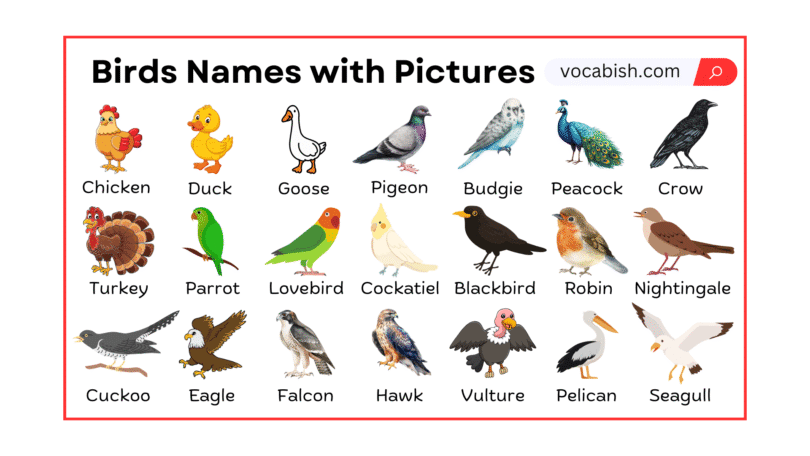

There are many types of birds, including songbirds, water birds, birds of prey, seabirds, flightless birds, tropical birds, and domestic birds. Each group is identified by its habitat, behaviour, body features, or way of life.
This guide presents bird names in English with pictures and simple categories, making them easier to recognise and remember. You will find familiar birds such as sparrows, pigeons, parrots, ducks, eagles, owls, and flamingos, along with species from forests, wetlands, oceans, farms, and cities. It is designed for vocabulary learners, students, teachers, and nature lovers who want a clear and practical introduction to birds. Birds form one of the most varied groups in our guide to types of animals.
What Are Birds?
Birds are warm-blooded vertebrate animals with feathers, wings, beaks, and two legs. Most birds can fly, but flightless species such as ostriches, penguins, emus, and kiwis cannot.
Birds lay eggs and live in a wide range of habitats. Different species eat seeds, fruit, insects, fish, small animals, nectar, or plants. Their bodies, beaks, feet, and feathers are adapted to their particular environments and lifestyles.
How Are Birds Grouped?
Birds can be grouped scientifically by their evolutionary relationships. For everyday learning, however, it is easier to organise them by:
- Habitat, such as forests, wetlands, or oceans
- Behaviour, such as hunting, Habitat, such as forests, singing, or migrating
- Physical features, such as size, beak shape, or colour
- Movement, including flying, swimming, wading, or running
- Human use, such as pet, farm, or domestic birds
These categories are practical rather than strict. For example, a duck may be described as a water bird, wetland bird, migratory bird, or domestic bird.
Top 20 Most Common Types of Birds
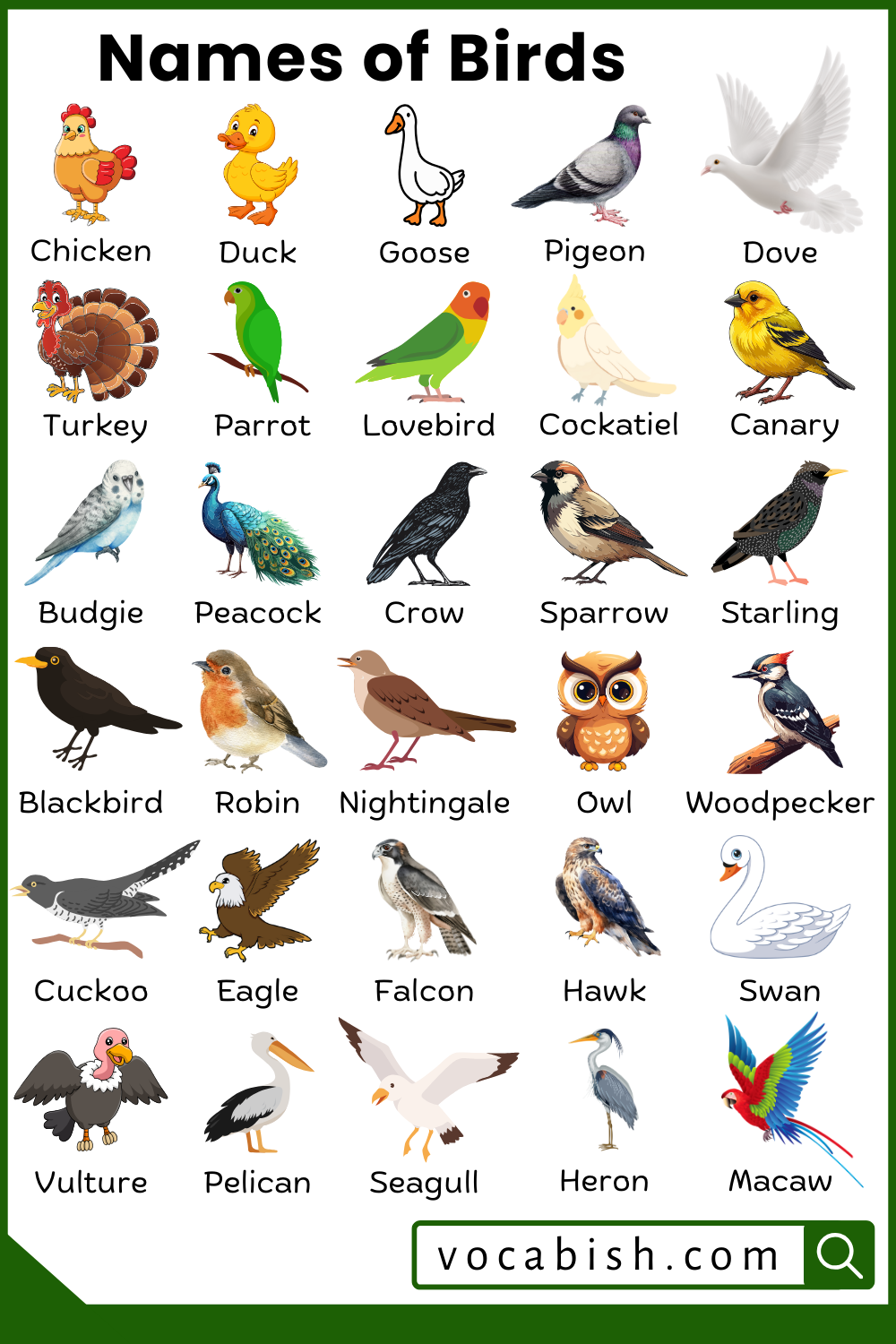
Birds come in different shapes, sizes, and colours. Some live near homes and gardens, while others prefer forests, wetlands, and open fields. Here are 20 common types of birds you can recognise in everyday life.
Sparrow
Small, social birds commonly found near homes, farms, and gardens. They mainly eat seeds and insects.
Pigeon
Adaptable birds often seen in cities and countryside. They have excellent navigation skills.
Crow
Highly intelligent black birds with strong beaks. They eat fruit, insects, seeds, and scraps.
Dove
Gentle-looking relatives of pigeons known for soft cooing calls and slim bodies.
Robin
Small songbirds often recognised by their orange or reddish breast feathers.
Parrot
Colourful birds with curved beaks and gripping feet. Some can imitate human speech.
Eagle
Large birds of prey with sharp talons, hooked beaks, and excellent eyesight.
Owl
Mostly nocturnal hunters with forward-facing eyes and nearly silent flight.
Duck
Water birds with webbed feet and waterproof feathers. They swim and feed in shallow water.
Goose
Large waterfowl with long necks. Many species migrate in organised groups.
Swan
Large, graceful water birds with long necks. They are strong swimmers and flyers.
Chicken
Domestic ground birds raised for eggs and meat. They eat seeds, plants, and insects.
Turkey
Large ground birds native to North America. Wild and domestic varieties are common.
Peacock
The male peafowl, famous for its long and colourful display feathers.
Woodpecker
Tree-climbing birds with strong beaks used to find insects beneath bark.
Kingfisher
Brightly coloured birds with long bills. Many species catch fish from the water.
Hummingbird
Tiny American birds that hover while feeding on flower nectar and insects.
Seagull
Adaptable coastal and inland birds commonly found near water and cities.
Flamingo
Tall pink water birds with long legs and curved filter-feeding bills.
Crane
Tall birds with long legs and necks, known for migration and courtship dances.
List of All Types of Birds with Names and Pictures
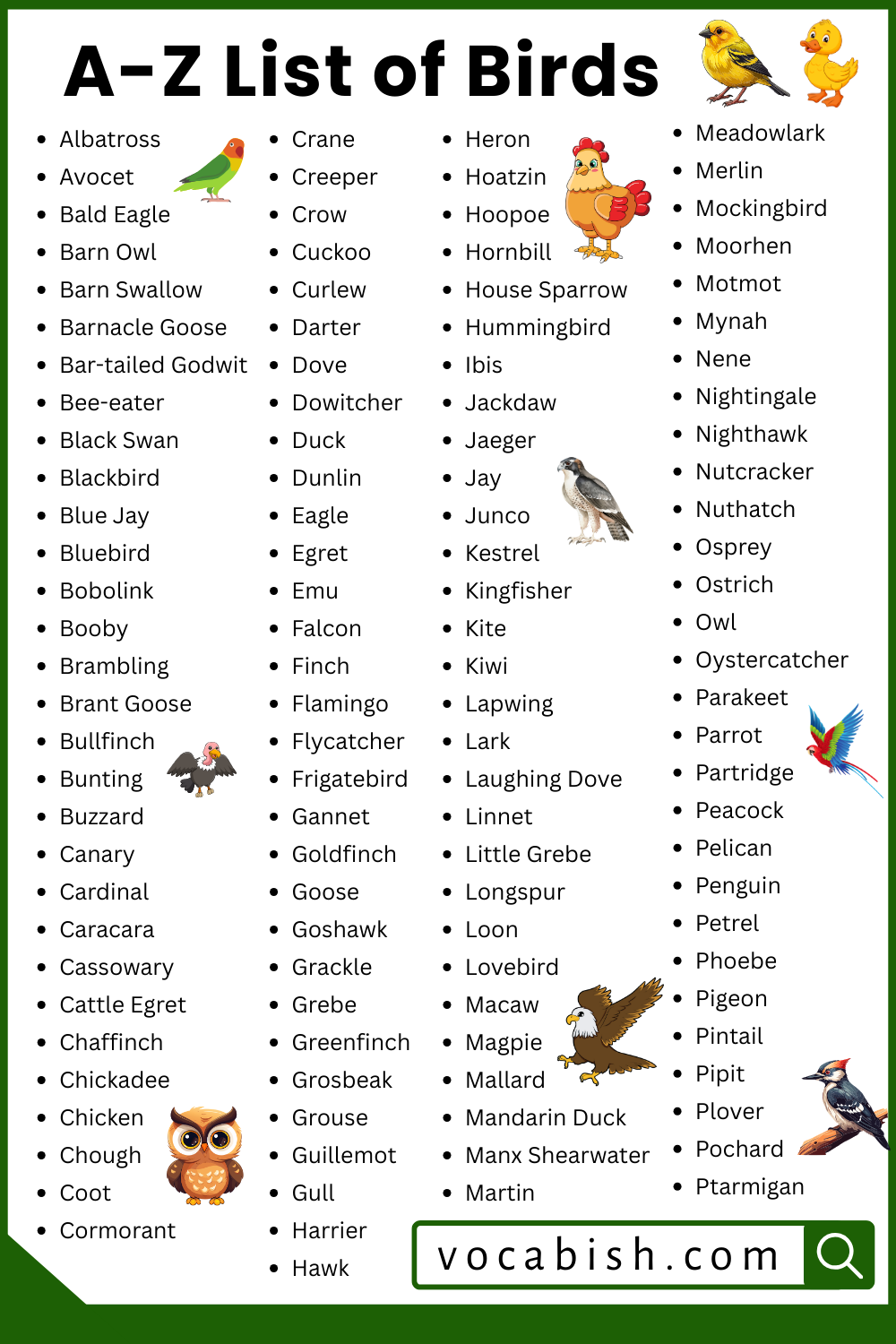
The list of all types of bird names in English includes garden birds, songbirds, water birds, shorebirds, seabirds, birds of prey, owls, flightless birds, tropical birds, forest birds, grassland birds, domestic birds, migratory birds, and many more. Each group includes birds with similar habitats, physical features, behaviours, or lifestyles. Learning these bird names helps English learners expand their vocabulary and recognise different bird species.
For another visual reference, explore the RSPB Birds A–Z Guide.
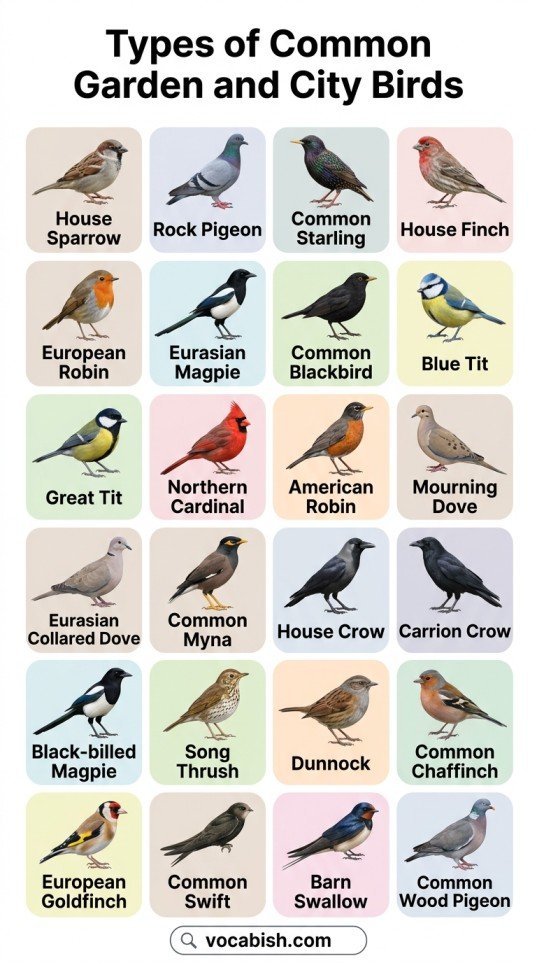
1. Types of Common Garden and City Birds
House sparrows, pigeons, robins, starlings, crows, and magpies are common garden and city birds. They often live near homes, parks, gardens, and streets, where they find food and nesting places.
House Sparrow | Rock Pigeon | Common Starling |
House Finch | European Robin | Eurasian Magpie |
Common Blackbird | Blue Tit | Great Tit |
Northern Cardinal | American Robin | Mourning Dove |
Eurasian Collared Dove | Common Myna | House Crow |
Carrion Crow | Black-billed Magpie | Song Thrush |
Dunnock | Common Chaffinch | European Goldfinch |
Common Swift | Barn Swallow | Common Wood Pigeon |
2. Songbirds and Perching Birds
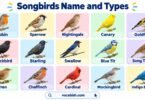
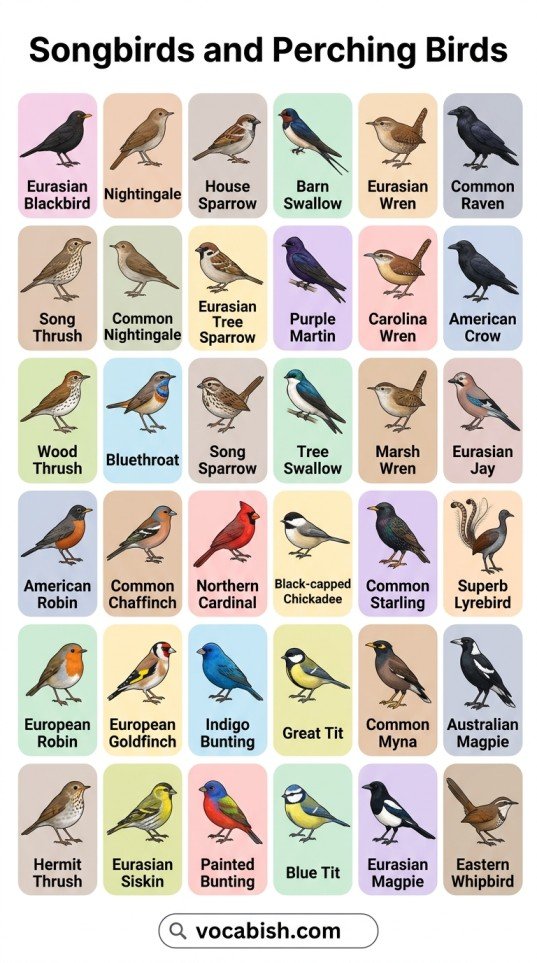
Robins, thrushes, finches, sparrows, warblers, and wrens are well-known songbirds and perching birds. Many have distinctive calls or songs and use their feet to grip branches while resting.
Eurasian Blackbird | Song Thrush | Wood Thrush |
American Robin | European Robin | Hermit Thrush |
Nightingale | Common Nightingale | Bluethroat |
Common Chaffinch | European Goldfinch | Eurasian Siskin |
House Sparrow | Eurasian Tree Sparrow | Song Sparrow |
Northern Cardinal | Indigo Bunting | Painted Bunting |
Barn Swallow | Purple Martin | Tree Swallow |
Black-capped Chickadee | Great Tit | Blue Tit |
Eurasian Wren | Carolina Wren | Marsh Wren |
Common Starling | Common Myna | Eurasian Magpie |
Common Raven | American Crow | Eurasian Jay |
Superb Lyrebird | Australian Magpie | Eastern Whipbird |
3. Types of Water and Wetland Birds
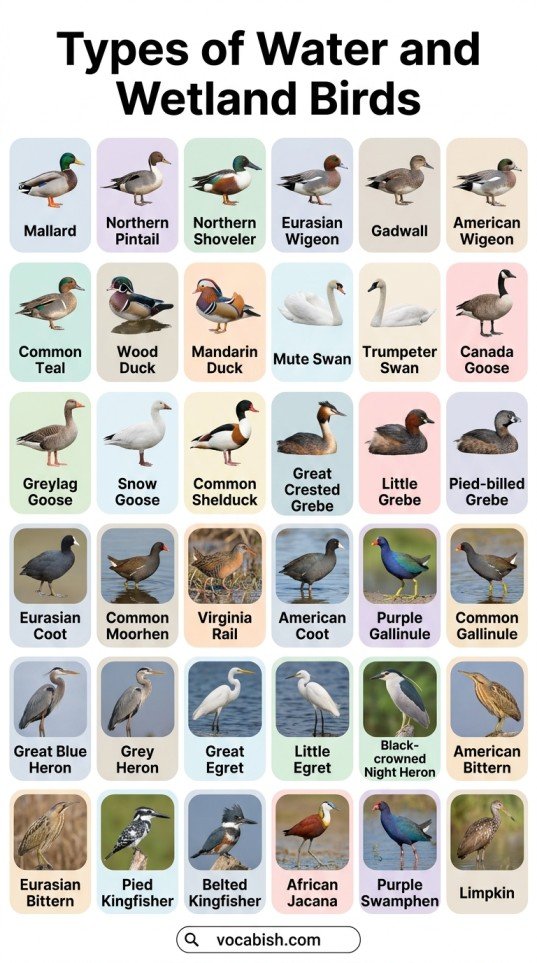
Ducks, geese, swans, grebes, coots, herons, and egrets are commonly found in wetlands. They live around lakes, rivers, ponds, marshes, and other water-rich habitats.
Mallard | Northern Pintail | Northern Shoveler |
Eurasian Wigeon | Gadwall | American Wigeon |
Common Teal | Wood Duck | Mandarin Duck |
Mute Swan | Trumpeter Swan | Canada Goose |
Greylag Goose | Snow Goose | Common Shelduck |
Great Crested Grebe | Little Grebe | Pied-billed Grebe |
Eurasian Coot | Common Moorhen | Virginia Rail |
American Coot | Purple Gallinule | Common Gallinule |
Great Blue Heron | Grey Heron | Great Egret |
Little Egret | Black-crowned Night Heron | American Bittern |
Eurasian Bittern | Pied Kingfisher | Belted Kingfisher |
African Jacana | Purple Swamphen | Limpkin |
4. Types of Shorebirds and Wading Birds
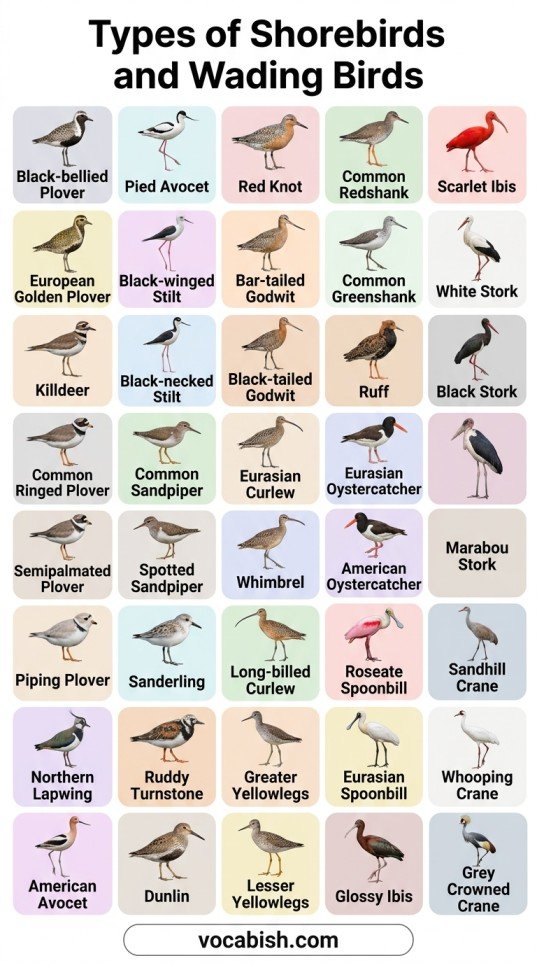
Plovers, sandpipers, godwits, curlews, stilts, and avocets often search for food along shorelines and in shallow water. Herons, storks, and spoonbills also feed in wetlands, using their long legs or specialised bills.
Black-bellied Plover | European Golden Plover | Killdeer |
Common Ringed Plover | Semipalmated Plover | Piping Plover |
Northern Lapwing | American Avocet | Pied Avocet |
Black-winged Stilt | Black-necked Stilt | Common Sandpiper |
Spotted Sandpiper | Sanderling | Ruddy Turnstone |
Dunlin | Red Knot | Bar-tailed Godwit |
Black-tailed Godwit | Eurasian Curlew | Whimbrel |
Long-billed Curlew | Greater Yellowlegs | Lesser Yellowlegs |
Common Redshank | Common Greenshank | Ruff |
Eurasian Oystercatcher | American Oystercatcher | Roseate Spoonbill |
Eurasian Spoonbill | Glossy Ibis | Scarlet Ibis |
White Stork | Black Stork | Marabou Stork |
Sandhill Crane | Whooping Crane | Grey Crowned Crane |
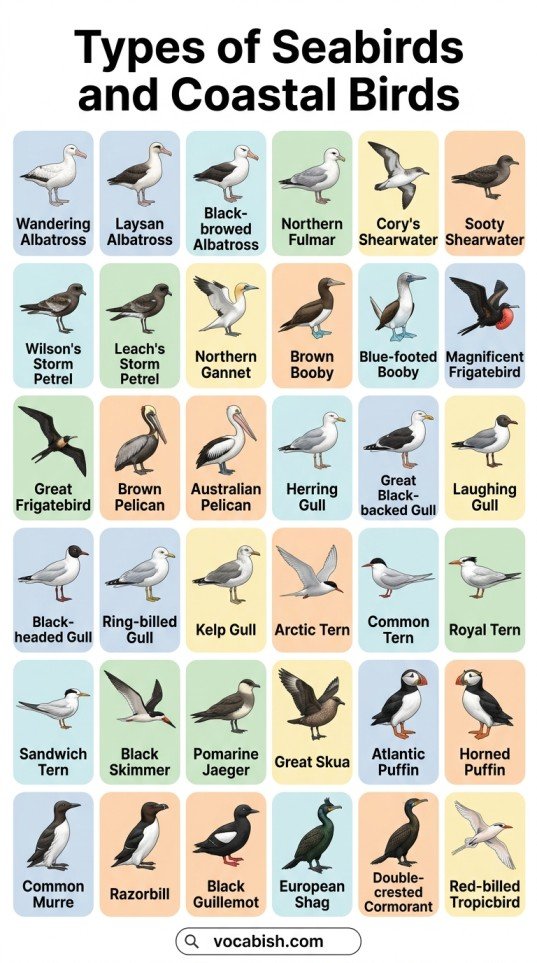
5. Types of Seabirds and Coastal Birds
Albatrosses, petrels, gulls, terns, puffins, gannets, and boobies are associated with seas and coastlines. Many feed on fish or other marine animals, while some spend much of their lives flying over the ocean.
Wandering Albatross | Laysan Albatross | Black-browed Albatross |
Northern Fulmar | Cory’s Shearwater | Sooty Shearwater |
Wilson’s Storm Petrel | Leach’s Storm Petrel | Northern Gannet |
Brown Booby | Blue-footed Booby | Magnificent Frigatebird |
Great Frigatebird | Brown Pelican | Australian Pelican |
Herring Gull | Great Black-backed Gull | Laughing Gull |
Black-headed Gull | Ring-billed Gull | Kelp Gull |
Arctic Tern | Common Tern | Royal Tern |
Sandwich Tern | Black Skimmer | Pomarine Jaeger |
Great Skua | Atlantic Puffin | Horned Puffin |
Common Murre | Razorbill | Black Guillemot |
European Shag | Double-crested Cormorant | Red-billed Tropicbird |
6. Birds of Prey and Their Names
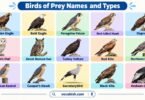
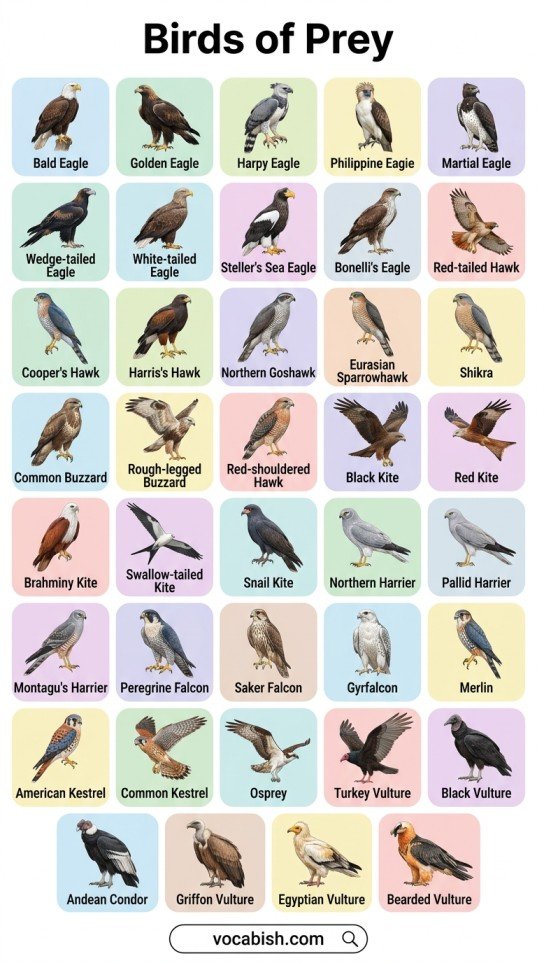
Eagles, hawks, falcons, kites, harriers, and vultures are well-known birds of prey. Many hunt animals using sharp talons and hooked bills, while vultures mainly feed on carcasses.
Bald Eagle | Golden Eagle | Harpy Eagle |
Philippine Eagle | Martial Eagle | Wedge-tailed Eagle |
White-tailed Eagle | Steller’s Sea Eagle | Bonelli’s Eagle |
Red-tailed Hawk | Cooper’s Hawk | Harris’s Hawk |
Northern Goshawk | Eurasian Sparrowhawk | Shikra |
Common Buzzard | Rough-legged Buzzard | Red-shouldered Hawk |
Black Kite | Red Kite | Brahminy Kite |
Swallow-tailed Kite | Snail Kite | Northern Harrier |
Pallid Harrier | Montagu’s Harrier | Peregrine Falcon |
Saker Falcon | Gyrfalcon | Merlin |
American Kestrel | Common Kestrel | Osprey |
Turkey Vulture | Black Vulture | Andean Condor |
Griffon Vulture | Egyptian Vulture | Bearded Vulture |
7. Names of Owls and Nocturnal Birds
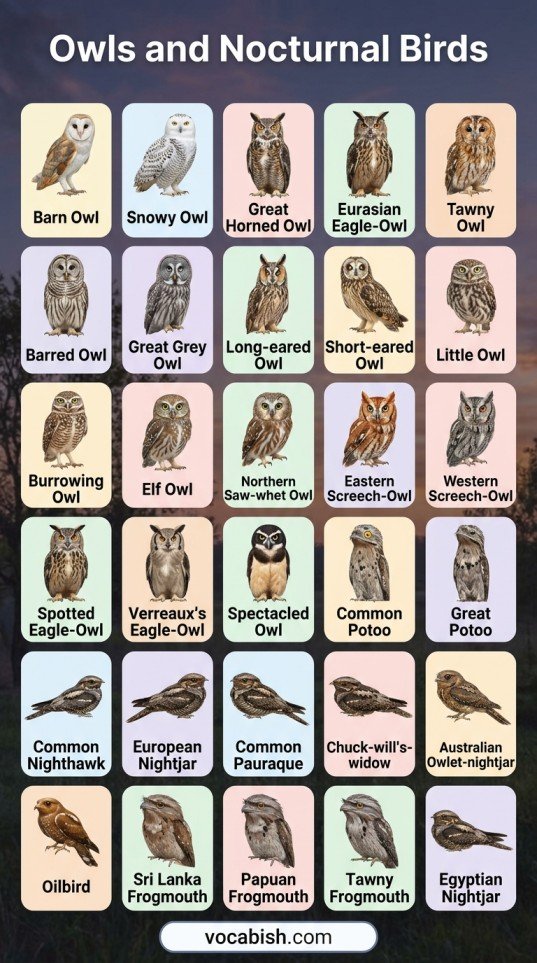
Barn owls, snowy owls, eagle-owls, nightjars, and potoos are examples of owls and other birds active at night. Many owls have excellent low-light vision and specialised hearing that help them locate prey in darkness.
Barn Owl | Snowy Owl | Great Horned Owl |
Eurasian Eagle-Owl | Tawny Owl | Barred Owl |
Great Grey Owl | Long-eared Owl | Short-eared Owl |
Little Owl | Burrowing Owl | Elf Owl |
Northern Saw-whet Owl | Eastern Screech-Owl | Western Screech-Owl |
Spotted Eagle-Owl | Verreaux’s Eagle-Owl | Spectacled Owl |
Common Potoo | Great Potoo | Common Nighthawk |
European Nightjar | Common Pauraque | Chuck-will’s-widow |
Australian Owlet-nightjar | Oilbird | Sri Lanka Frogmouth |
Papuan Frogmouth | Tawny Frogmouth | Egyptian Nightjar |
8. Types of Flightless and Ground Birds
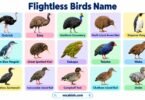
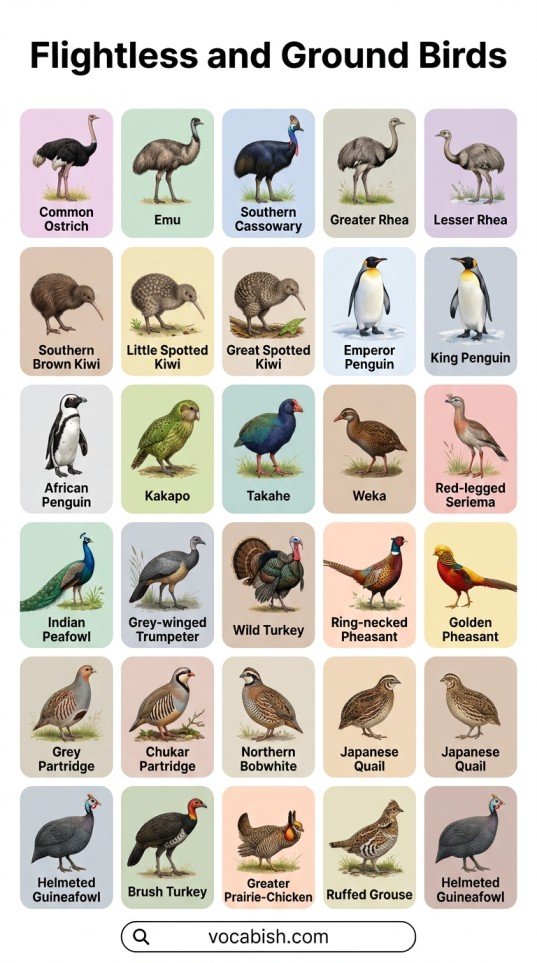
Ostriches, emus, cassowaries, kiwis, rheas, and penguins are flightless birds. Many walk or run on land, while penguins use their wings to swim. Some ground birds, such as pheasants and quails, can fly short distances.
Common Ostrich | Emu | Southern Cassowary |
Greater Rhea | Lesser Rhea | North Island Brown Kiwi |
Southern Brown Kiwi | Little Spotted Kiwi | Great Spotted Kiwi |
Emperor Penguin | King Penguin | African Penguin |
Kakapo | Takahe | Weka |
Red-legged Seriema | Grey-winged Trumpeter | Wild Turkey |
Ring-necked Pheasant | Golden Pheasant | Indian Peafowl |
Grey Partridge | Chukar Partridge | Northern Bobwhite |
Japanese Quail | Helmeted Guineafowl | Brush Turkey |
Greater Prairie-Chicken | Ruffed Grouse | Willow Ptarmigan |
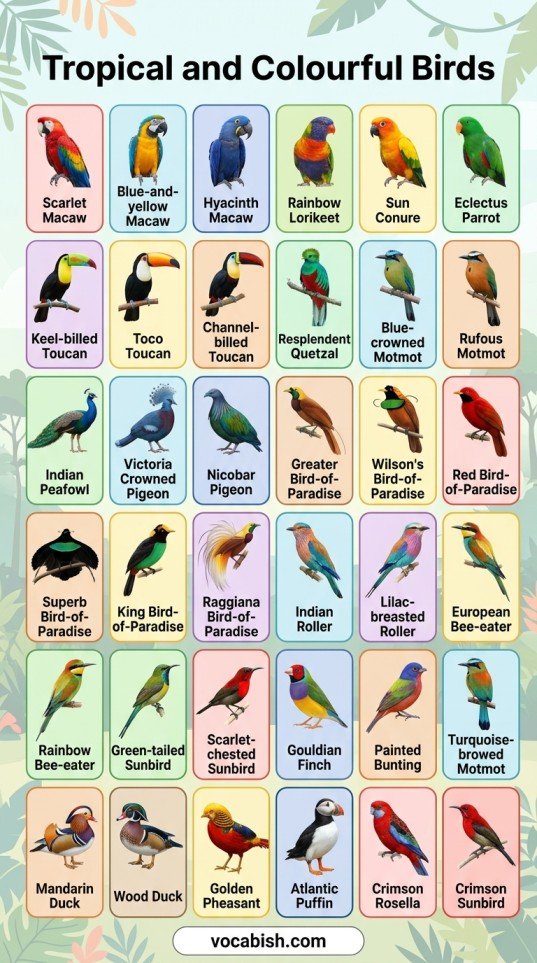
9. Names of Tropical and Colourful Birds
Macaws, toucans, parrots, bee-eaters, rollers, and birds-of-paradise are known for their colourful feathers. Many live in tropical forests, where bright plumage can help attract mates or support communication.
Scarlet Macaw | Blue-and-yellow Macaw | Hyacinth Macaw |
Rainbow Lorikeet | Sun Conure | Eclectus Parrot |
Keel-billed Toucan | Toco Toucan | Channel-billed Toucan |
Resplendent Quetzal | Blue-crowned Motmot | Rufous Motmot |
Indian Peafowl | Victoria Crowned Pigeon | Nicobar Pigeon |
Greater Bird-of-Paradise | Wilson’s Bird-of-Paradise | Red Bird-of-Paradise |
Superb Bird-of-Paradise | King Bird-of-Paradise | Raggiana Bird-of-Paradise |
Indian Roller | Lilac-breasted Roller | European Bee-eater |
Rainbow Bee-eater | Green-tailed Sunbird | Scarlet-chested Sunbird |
Gouldian Finch | Painted Bunting | Turquoise-browed Motmot |
Mandarin Duck | Wood Duck | Golden Pheasant |
Atlantic Puffin | Crimson Rosella | Crimson Sunbird |
10. Names of Forest and Woodland Birds
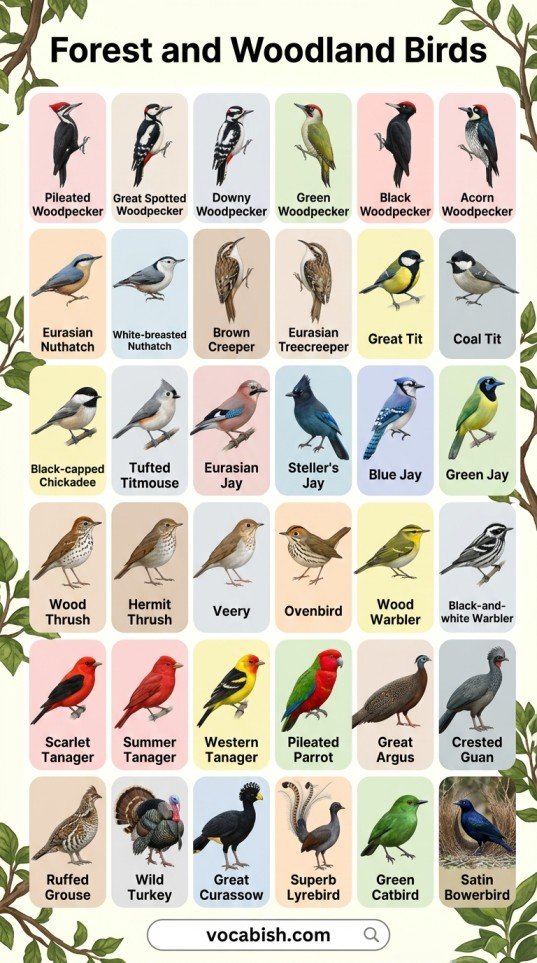
Woodpeckers, nuthatches, jays, thrushes, warblers, and lyrebirds inhabit forests and woodlands. They use trees for shelter, nesting, feeding, and protection, with different species occupying different forest layers.
Pileated Woodpecker | Great Spotted Woodpecker | Downy Woodpecker |
Green Woodpecker | Black Woodpecker | Acorn Woodpecker |
Eurasian Nuthatch | White-breasted Nuthatch | Brown Creeper |
Eurasian Treecreeper | Great Tit | Coal Tit |
Black-capped Chickadee | Tufted Titmouse | Eurasian Jay |
Steller’s Jay | Blue Jay | Green Jay |
Wood Thrush | Hermit Thrush | Veery |
Ovenbird | Wood Warbler | Black-and-white Warbler |
Scarlet Tanager | Summer Tanager | Western Tanager |
Pileated Parrot | Great Argus | Crested Guan |
Ruffed Grouse | Wild Turkey | Great Curassow |
Superb Lyrebird | Green Catbird | Satin Bowerbird |
11. Types of Grassland, Desert, and Open-Country Birds
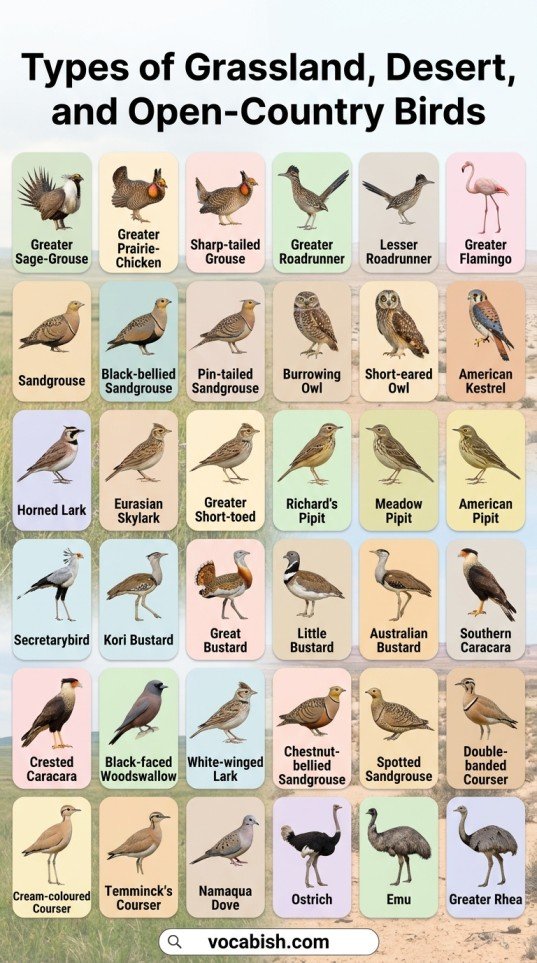
Larks, bustards, coursers, sandgrouse, roadrunners, and prairie-chickens live in open habitats. Many are adapted to limited tree cover, hot or dry conditions, and life on the ground.
Greater Sage-Grouse | Greater Prairie-Chicken | Sharp-tailed Grouse |
Greater Roadrunner | Lesser Roadrunner | Greater Flamingo |
Sandgrouse | Black-bellied Sandgrouse | Pin-tailed Sandgrouse |
Burrowing Owl | Short-eared Owl | American Kestrel |
Horned Lark | Eurasian Skylark | Greater Short-toed Lark |
Richard’s Pipit | Meadow Pipit | American Pipit |
Secretarybird | Kori Bustard | Great Bustard |
Little Bustard | Australian Bustard | Southern Caracara |
Crested Caracara | Black-faced Woodswallow | White-winged Lark |
Chestnut-bellied Sandgrouse | Spotted Sandgrouse | Double-banded Courser |
Cream-coloured Courser | Temminck’s Courser | Namaqua Dove |
Ostrich | Emu | Greater Rhea |
12. Names of Domestic, Farm, and Pet Birds
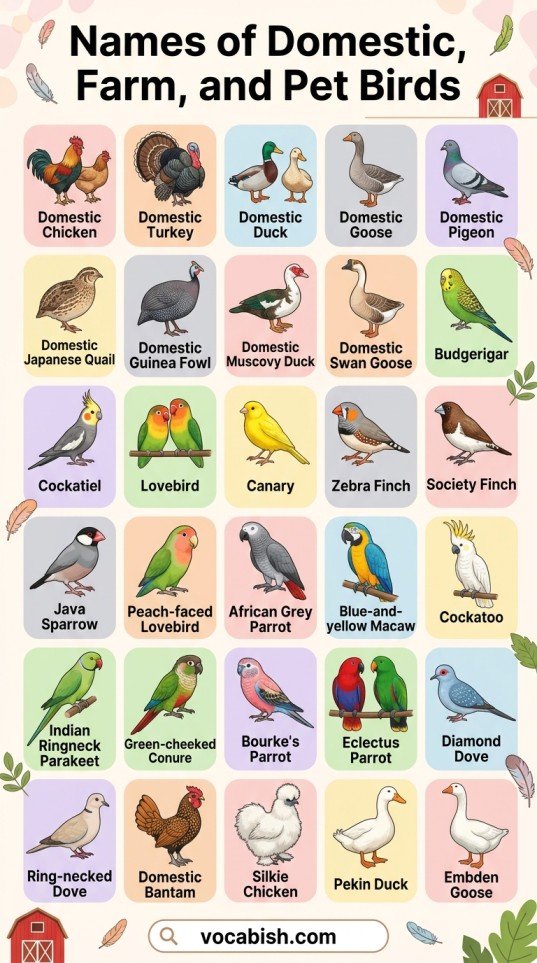
Chickens, ducks, geese, turkeys, and quails are commonly kept on farms for eggs, meat, or other purposes. Budgerigars, cockatiels, canaries, lovebirds, and parrots are popular pet birds.
Domestic Chicken | Domestic Turkey | Domestic Duck |
Domestic Goose | Domestic Pigeon | Domestic Japanese Quail |
Domestic Guinea Fowl | Domestic Muscovy Duck | Domestic Swan Goose |
Budgerigar | Cockatiel | Lovebird |
Canary | Zebra Finch | Society Finch |
Java Sparrow | Peach-faced Lovebird | African Grey Parrot |
Blue-and-yellow Macaw | Cockatoo | Indian Ringneck Parakeet |
Green-cheeked Conure | Bourke’s Parrot | Eclectus Parrot |
Diamond Dove | Ring-necked Dove | Domestic Bantam |
Silkie Chicken | Pekin Duck | Embden Goose |
13. List of Small Birds
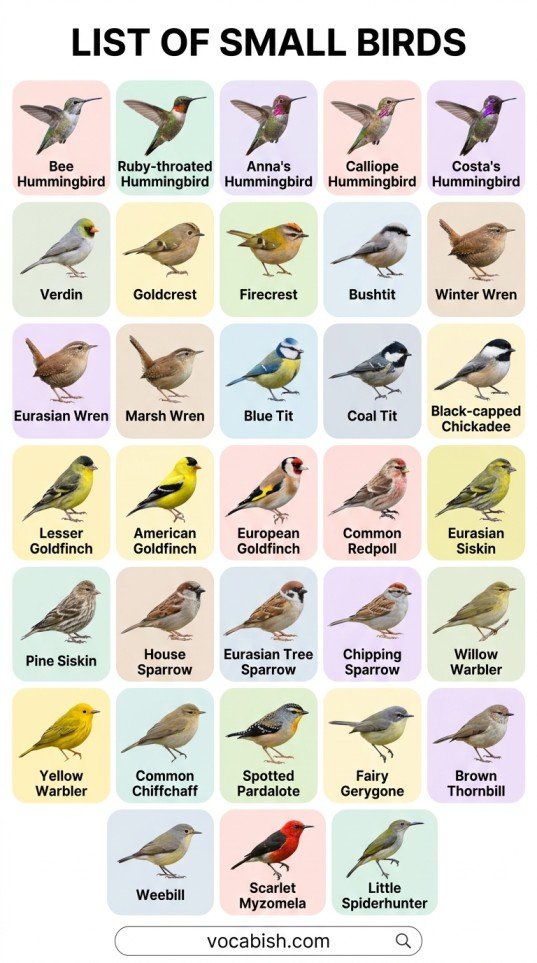
Hummingbirds, goldcrests, wrens, tits, finches, and small sparrows are examples of small birds. Their diets vary by species and may include insects, seeds, nectar, or fruit.
Bee Hummingbird | Ruby-throated Hummingbird | Anna’s Hummingbird |
Calliope Hummingbird | Costa’s Hummingbird | Verdin |
Goldcrest | Firecrest | Bushtit |
Winter Wren | Eurasian Wren | Marsh Wren |
Blue Tit | Coal Tit | Black-capped Chickadee |
Lesser Goldfinch | American Goldfinch | European Goldfinch |
Common Redpoll | Eurasian Siskin | Pine Siskin |
House Sparrow | Eurasian Tree Sparrow | Chipping Sparrow |
Willow Warbler | Yellow Warbler | Common Chiffchaff |
Spotted Pardalote | Fairy Gerygone | Brown Thornbill |
Weebill | Scarlet Myzomela | Little Spiderhunter |
14. Names of Large Birds
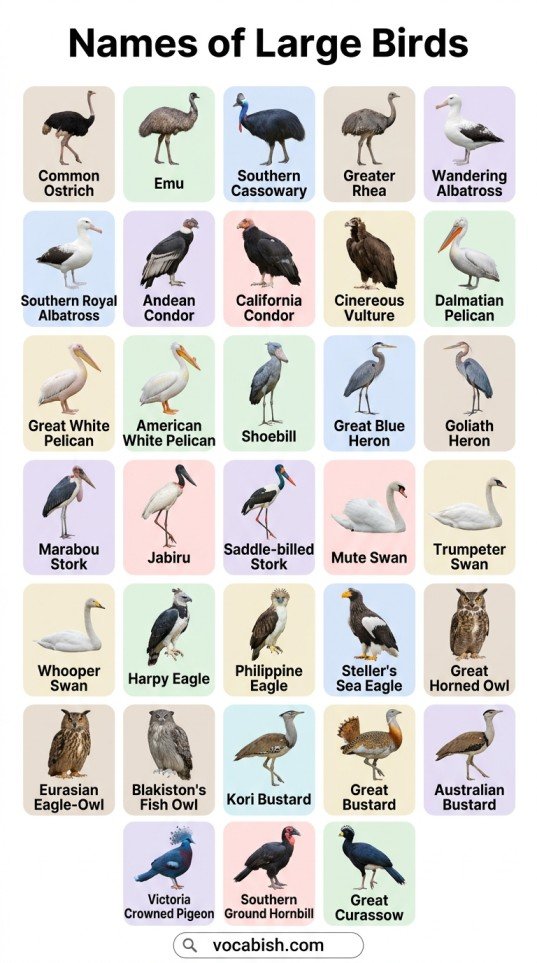
Ostriches, emus, cassowaries, albatrosses, condors, pelicans, and large swans are among the most impressive birds by size or wingspan. Some are tall and heavy, while others have exceptionally long wings for soaring over long distances.
Common Ostrich | Emu | Southern Cassowary |
Greater Rhea | Wandering Albatross | Southern Royal Albatross |
Andean Condor | California Condor | Cinereous Vulture |
Dalmatian Pelican | Great White Pelican | American White Pelican |
Shoebill | Great Blue Heron | Goliath Heron |
Marabou Stork | Jabiru | Saddle-billed Stork |
Mute Swan | Trumpeter Swan | Whooper Swan |
Harpy Eagle | Philippine Eagle | Steller’s Sea Eagle |
Great Horned Owl | Eurasian Eagle-Owl | Blakiston’s Fish Owl |
Kori Bustard | Great Bustard | Australian Bustard |
Victoria Crowned Pigeon | Southern Ground Hornbill | Great Curassow |
15. Types of Parrots and Parrot-Like Birds
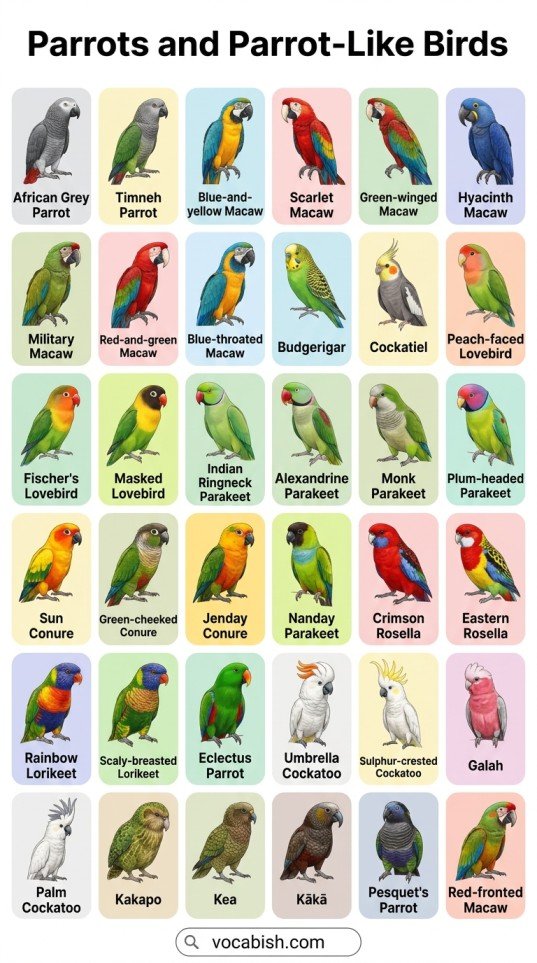
Macaws, cockatoos, budgerigars, lovebirds, conures, lorikeets, and African grey parrots belong to the parrot group. Many have curved bills and strong feet for climbing, holding food, and handling objects.
African Grey Parrot | Timneh Parrot | Blue-and-yellow Macaw |
Scarlet Macaw | Green-winged Macaw | Hyacinth Macaw |
Military Macaw | Red-and-green Macaw | Blue-throated Macaw |
Budgerigar | Cockatiel | Peach-faced Lovebird |
Fischer’s Lovebird | Masked Lovebird | Indian Ringneck Parakeet |
Alexandrine Parakeet | Monk Parakeet | Plum-headed Parakeet |
Sun Conure | Green-cheeked Conure | Jenday Conure |
Nanday Parakeet | Crimson Rosella | Eastern Rosella |
Rainbow Lorikeet | Scaly-breasted Lorikeet | Eclectus Parrot |
Umbrella Cockatoo | Sulphur-crested Cockatoo | Galah |
Palm Cockatoo | Kakapo | Kea |
Kākā | Pesquet’s Parrot | Red-fronted Macaw |
16. Types of Ducks, Geese, and Swans
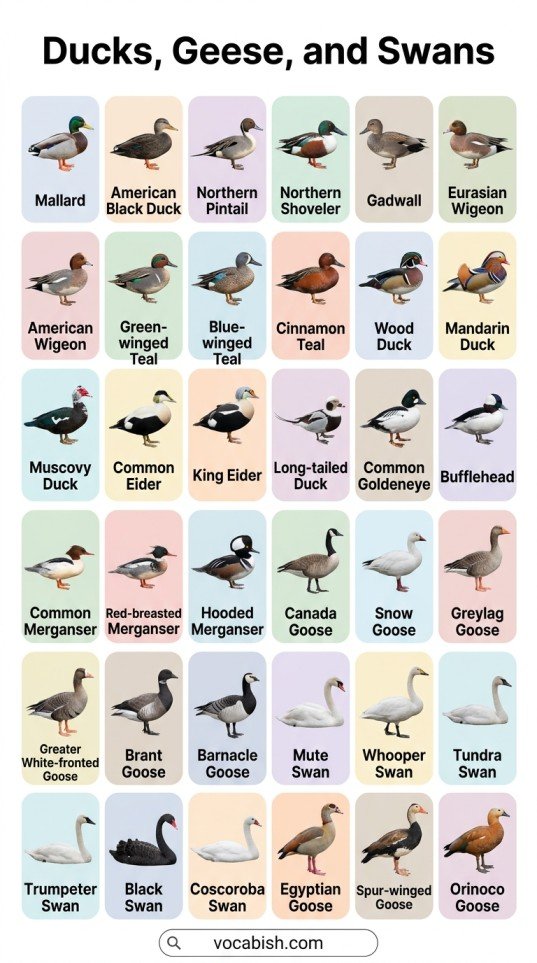
Mallards, wood ducks, Canada geese, greylag geese, mute swans, and trumpeter swans belong to the waterfowl group. Ducks are generally smaller, geese are often medium-sized, and swans are usually larger with long necks.
Mallard | American Black Duck | Northern Pintail |
Northern Shoveler | Gadwall | Eurasian Wigeon |
American Wigeon | Green-winged Teal | Blue-winged Teal |
Cinnamon Teal | Wood Duck | Mandarin Duck |
Muscovy Duck | Common Eider | King Eider |
Long-tailed Duck | Common Goldeneye | Bufflehead |
Common Merganser | Red-breasted Merganser | Hooded Merganser |
Canada Goose | Snow Goose | Greylag Goose |
Greater White-fronted Goose | Brant Goose | Barnacle Goose |
Mute Swan | Whooper Swan | Tundra Swan |
Trumpeter Swan | Black Swan | Coscoroba Swan |
Egyptian Goose | Spur-winged Goose | Orinoco Goose |
17. Types of Pigeons and Doves
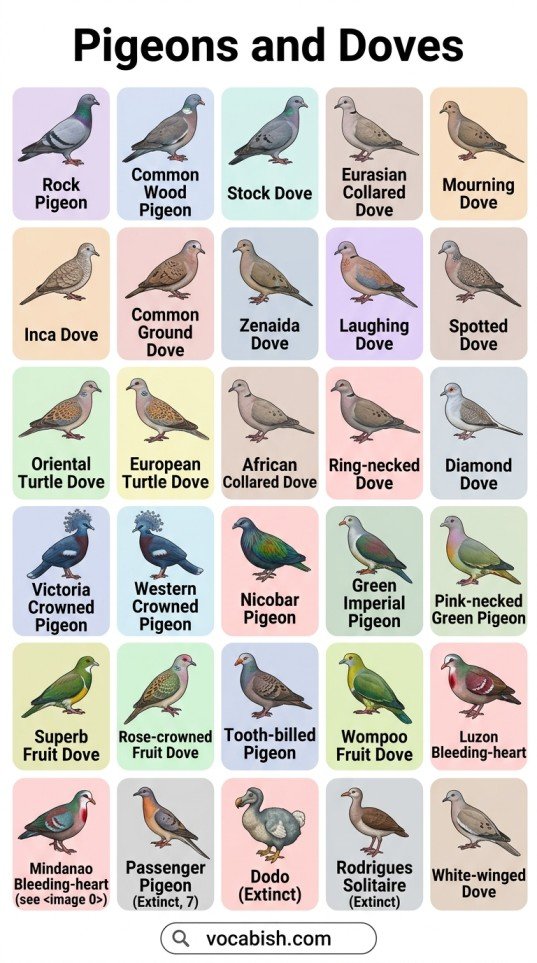
Rock pigeons, wood pigeons, collared doves, mourning doves, and fruit doves belong to the pigeon and dove family. They are found in cities, forests, grasslands, and islands, and many feed mainly on seeds or fruit.
Rock Pigeon | Common Wood Pigeon | Stock Dove |
Eurasian Collared Dove | Mourning Dove | White-winged Dove |
Inca Dove | Common Ground Dove | Zenaida Dove |
Laughing Dove | Spotted Dove | Oriental Turtle Dove |
European Turtle Dove | African Collared Dove | Ring-necked Dove |
Diamond Dove | Victoria Crowned Pigeon | Western Crowned Pigeon |
Nicobar Pigeon | Green Imperial Pigeon | Pink-necked Green Pigeon |
Wompoo Fruit Dove | Superb Fruit Dove | Rose-crowned Fruit Dove |
Tooth-billed Pigeon | Luzon Bleeding-heart | Mindanao Bleeding-heart |
Passenger Pigeon | Dodo | Rodrigues Solitaire |
18. Finches, Sparrows, and Similar Small Birds
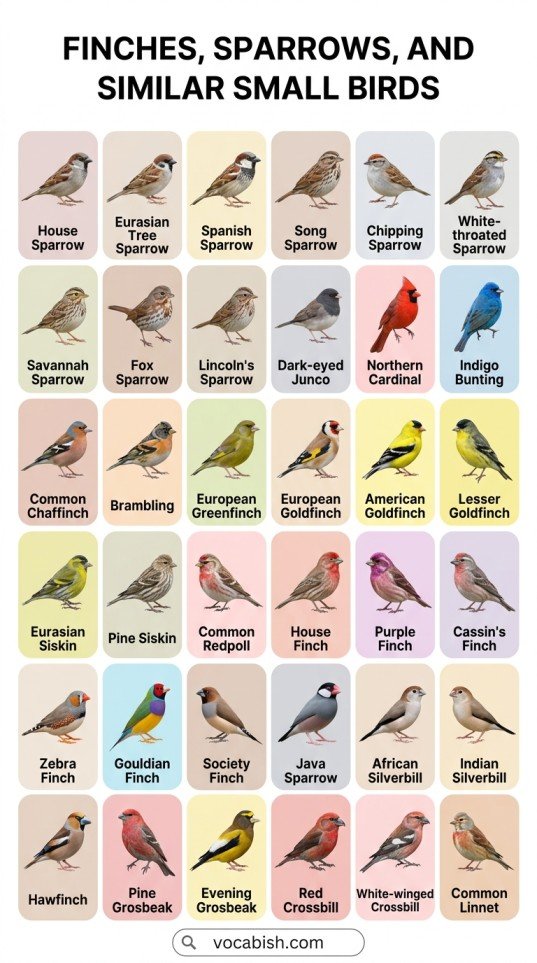
House sparrows, chaffinches, goldfinches, siskins, redpolls, and crossbills are small birds, many of which feed on seeds. Finches often have strong, compact bills, while sparrows commonly forage on the ground or around vegetation.
House Sparrow | Eurasian Tree Sparrow | Spanish Sparrow |
Song Sparrow | Chipping Sparrow | White-throated Sparrow |
Savannah Sparrow | Fox Sparrow | Lincoln’s Sparrow |
Dark-eyed Junco | Northern Cardinal | Indigo Bunting |
Common Chaffinch | Brambling | European Greenfinch |
European Goldfinch | American Goldfinch | Lesser Goldfinch |
Eurasian Siskin | Pine Siskin | Common Redpoll |
House Finch | Purple Finch | Cassin’s Finch |
Zebra Finch | Gouldian Finch | Society Finch |
Java Sparrow | African Silverbill | Indian Silverbill |
Hawfinch | Pine Grosbeak | Evening Grosbeak |
Red Crossbill | White-winged Crossbill | Common Linnet |
19. Birds Known for Long-Distance Migration
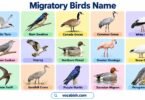
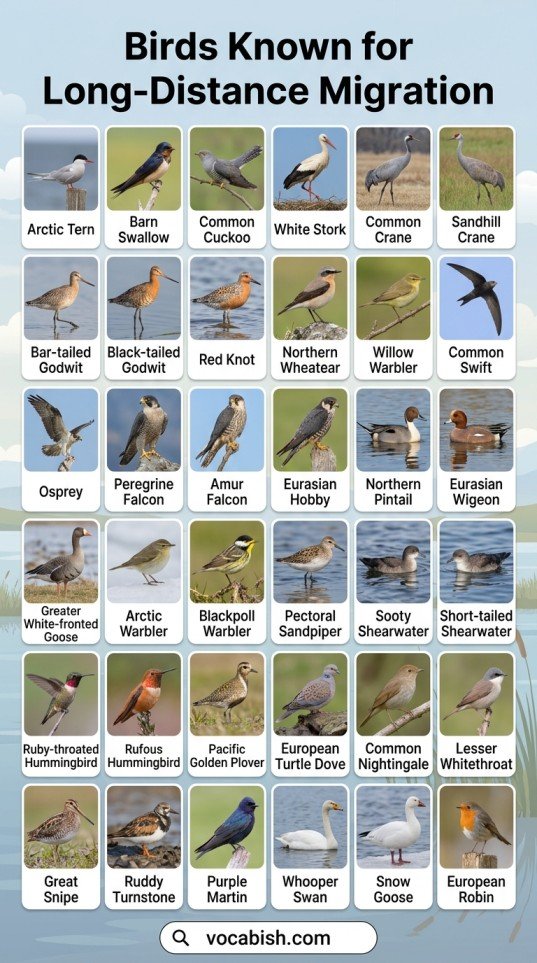
Arctic terns, bar-tailed godwits, barn swallows, common cuckoos, white storks, and many warblers migrate between seasonal habitats. They travel to find food, suitable breeding grounds, or more favourable weather.
Arctic Tern | Barn Swallow | Common Cuckoo |
White Stork | Common Crane | Sandhill Crane |
Bar-tailed Godwit | Black-tailed Godwit | Red Knot |
Northern Wheatear | Willow Warbler | Common Swift |
Osprey | Peregrine Falcon | Amur Falcon |
Eurasian Hobby | Northern Pintail | Eurasian Wigeon |
Greater White-fronted Goose | Arctic Warbler | Blackpoll Warbler |
Pectoral Sandpiper | Sooty Shearwater | Short-tailed Shearwater |
Ruby-throated Hummingbird | Rufous Hummingbird | Pacific Golden Plover |
European Turtle Dove | Common Nightingale | Lesser Whitethroat |
Great Snipe | Ruddy Turnstone | Purple Martin |
Whooper Swan | Snow Goose | European Robin |
20. Birds with Unusual Beaks
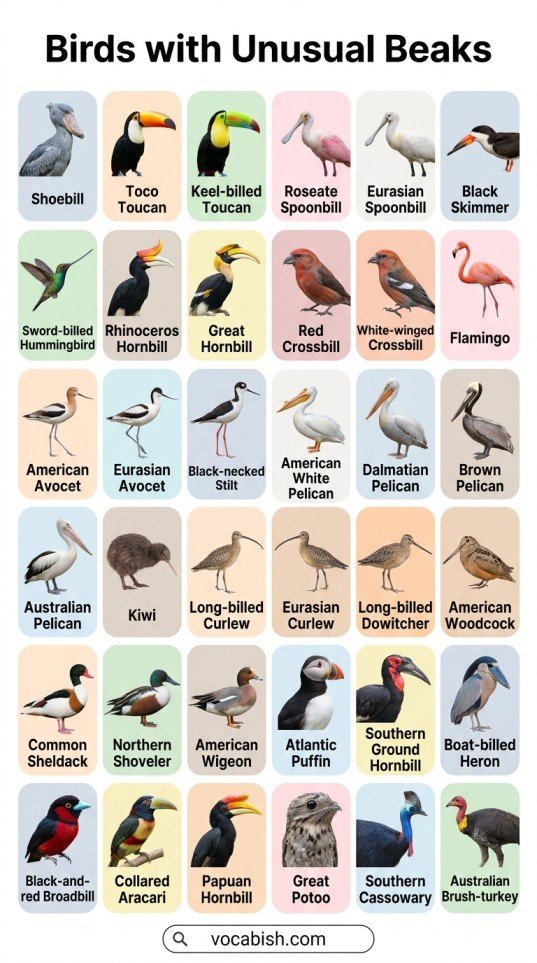
Shoebills, toucans, spoonbills, skimmers, crossbills, and sword-billed hummingbirds have distinctive bills adapted to particular feeding methods. Their beaks help them catch prey, reach nectar, filter food, or extract seeds.
Shoebill | Toco Toucan | Keel-billed Toucan |
Roseate Spoonbill | Eurasian Spoonbill | Black Skimmer |
Sword-billed Hummingbird | Rhinoceros Hornbill | Great Hornbill |
Red Crossbill | White-winged Crossbill | Flamingo |
American Avocet | Eurasian Avocet | Black-necked Stilt |
American White Pelican | Dalmatian Pelican | Brown Pelican |
Australian Pelican | Kiwi | Long-billed Curlew |
Eurasian Curlew | Long-billed Dowitcher | American Woodcock |
Common Shelduck | Northern Shoveler | American Wigeon |
Atlantic Puffin | Southern Ground Hornbill | Boat-billed Heron |
Black-and-red Broadbill | Collared Aracari | Papuan Hornbill |
Great Potoo | Southern Cassowary | Australian Brush-turkey |
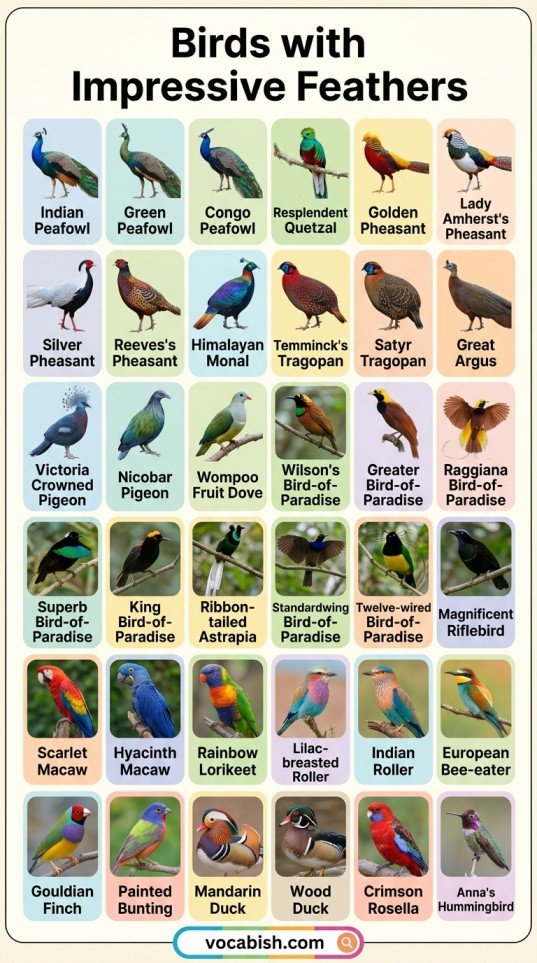
21. Birds with Impressive Feathers
Peafowls, pheasants, birds-of-paradise, quetzals, macaws, and mandarin ducks are known for striking plumage. Their feather colours, patterns, and shapes can help attract mates, provide camouflage, or support communication.
Indian Peafowl | Green Peafowl | Congo Peafowl |
Resplendent Quetzal | Golden Pheasant | Lady Amherst’s Pheasant |
Silver Pheasant | Reeves’s Pheasant | Himalayan Monal |
Temminck’s Tragopan | Satyr Tragopan | Great Argus |
Victoria Crowned Pigeon | Nicobar Pigeon | Wompoo Fruit Dove |
Wilson’s Bird-of-Paradise | Greater Bird-of-Paradise | Raggiana Bird-of-Paradise |
Superb Bird-of-Paradise | King Bird-of-Paradise | Ribbon-tailed Astrapia |
Standardwing Bird-of-Paradise | Twelve-wired Bird-of-Paradise | Magnificent Riflebird |
Scarlet Macaw | Hyacinth Macaw | Rainbow Lorikeet |
Lilac-breasted Roller | Indian Roller | European Bee-eater |
Gouldian Finch | Painted Bunting | Mandarin Duck |
Wood Duck | Crimson Rosella | Anna’s Hummingbird |
Birds Types Comparison Chart
Bird group | Common examples | Typical habitat |
|---|---|---|
Garden and city birds | Sparrow, pigeon, crow | Parks, buildings and gardens |
Songbirds | Robin, nightingale, thrush | Gardens, forests and woodland |
Water birds | Duck, swan, coot | Lakes, rivers and ponds |
Wading birds | Heron, crane, stork | Marshes and shallow water |
Seabirds | Gull, puffin, albatross | Coasts, islands and oceans |
Birds of prey | Eagle, falcon, hawk | Forests, mountains and open land |
Nocturnal birds | Owl, nightjar, potoo | Forests, farms and grasslands |
Flightless birds | Ostrich, penguin, kiwi | Land, coasts and islands |
Tropical birds | Macaw, toucan, hornbill | Tropical forests |
Domestic birds | Chicken, duck, budgerigar | Farms, homes and aviaries |
Useful Bird Vocabulary in English
Word | Simple meaning | Example |
|---|---|---|
Bird | A feathered vertebrate animal | A bird landed on the branch. |
Beak | The hard mouth of a bird | The eagle has a hooked beak. |
Feather | The soft outer covering of a bird | The peacock has colourful feathers. |
Wing | A body part used for flying | The bird opened its wings. |
Talon | A sharp claw on a bird of prey | The hawk caught prey with its talons. |
Flock | A group of birds | A flock of geese flew overhead. |
Nest | A place where birds lay eggs | The robin built a nest. |
Chick | A young bird | The duck followed its chicks. |
Hatch | To come out of an egg | The eggs will hatch soon. |
Migrate | To travel seasonally | Many birds migrate in winter. |
Perch | To rest on a branch or raised place | The parrot perched on a branch. |
Plumage | All the feathers covering a bird | The male has bright plumage. |
Singular and Plural Bird Words
Most bird names follow standard English plural rules:
- One eagle → two eagles
- One parrot → three parrots
- One pigeon → several pigeons
- One duck → many ducks
Some group words have irregular plural forms:
- One goose → two geese
- One grouse → several grouse
- One quail → several quail
The word bird becomes birds when referring to more than one:
- One bird is sitting in the tree.
- Five birds are sitting in the tree.
How to Learn Bird Names in English
Learn by Habitat
Study related names together. For example, learn duck, swan, heron, coot, and kingfisher as water-related birds.
Connect Names with Pictures
Notice one recognisable feature in every image, such as the toucan’s bill, the flamingo’s legs, or the peacock’s display feathers.
Learners can also use the Audubon Bird Guide to compare bird pictures, habitats, sizes, and identifying features.
Practise in Short Sentences
Use new names in simple sentences:
- A sparrow is sitting on the fence.
- The owl hunts at night.
- Swans are swimming across the lake.
- A woodpecker is climbing the tree.
- The eagle has powerful talons.
Review Small Groups
Learn five to ten names at one time. Review them regularly instead of trying to memorise the entire article in one session.
Listen to Bird Names
Hearing each name helps with pronunciation. Pay attention to difficult words such as albatross, cormorant, cassowary, guillemot, and ptarmigan.
Download Types of Birds PDF
FAQs About Types of Birds
Birds can be grouped as songbirds, water birds, seabirds, birds of prey, flightless birds, ground birds, tropical birds, nocturnal birds, domestic birds, and migratory birds.
Common bird names include sparrow, pigeon, crow, dove, robin, parrot, eagle, owl, duck, goose, chicken, woodpecker, kingfisher, hummingbird, and seagull.
Scientists recognise more than 10,000 living bird species. The total varies because scientific organisations sometimes classify, combine, or separate species differently.
The common ostrich is the largest living bird. It cannot fly, but its powerful legs allow it to run quickly across open African landscapes.
The bee hummingbird is generally recognised as the smallest living bird. It is native to Cuba and is smaller than many large insects.
Flightless birds include ostriches, emus, cassowaries, rheas, kiwis, penguins, kakapos, wekas, and takahes. Their bodies are adapted for running, swimming, or walking.
Yes. Penguins are flightless seabirds with feathers, beaks, wings, and eggs. Their wings have evolved into strong flippers used for swimming underwater.
No. Bats are flying mammals. They have fur instead of feathers, give birth to live young, and feed their babies with milk.
Birds of prey are hunting or scavenging birds with hooked beaks and strong talons. Eagles, hawks, falcons, kites, vultures, and owls belong to this broad group.
Pigeons and doves belong to the same family. The names are used informally, with “dove” often applied to smaller or more slender species.
Summary of Bird Names
- Birds are warm-blooded vertebrates covered with feathers.
- They have beaks, wings, two legs, and lay eggs.
- Most birds fly, but some species are flightless.
- Birds live in cities, forests, wetlands, grasslands, deserts, mountains, and oceans.
- Common birds include sparrows, pigeons, crows, robins, ducks, and parrots.
- Birds of prey include eagles, hawks, falcons, vultures, and owls.
- Water birds include ducks, swans, geese, herons, and coots.
- Popular pet birds include budgerigars, cockatiels, canaries, and lovebirds.
- Pictures, categories, and short sentences make bird vocabulary easier to learn.
Final Thoughts
Learning different types of birds and their names in English becomes easier when the words are organised into useful groups. Start with familiar birds from your garden, neighbourhood, or local park, and then explore water birds, forest birds, seabirds, birds of prey, and tropical species.
Connect each name with a picture and one noticeable feature. A flamingo has long pink legs, a toucan has a large bill, and an owl has forward-facing eyes. These visual connections make vocabulary more memorable for learners while helping nature lovers identify birds more confidently.
For global bird records and conservation information, visit the BirdLife DataZone.
You May Also Like