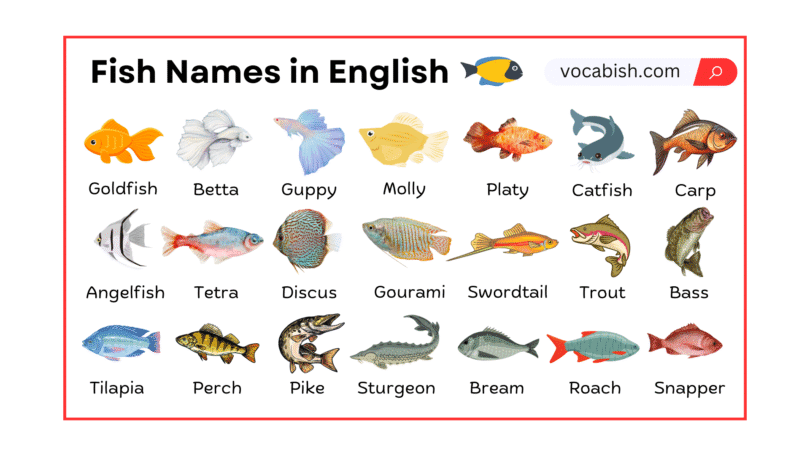

Fish are among the most diverse animals on Earth. They live in quiet ponds, fast-moving rivers, colourful coral reefs, deep oceans, and many other aquatic environments. Learning the different types of fish can help English learners improve their vocabulary while also understanding the natural world.
This visual vocabulary guide introduces more than 250 fish names in English. You will discover familiar aquarium fish, freshwater species, ocean fish, edible fish, powerful predators, bottom-dwelling species, and rare deep-sea animals. Each category includes short descriptions that highlight the fish’s appearance, habitat, behaviour, or most recognisable feature.
Some species appear in more than one category because a fish may be freshwater, edible, predatory, or popular in aquariums at the same time. Use the pictures to connect each name with its appearance, and return to the alphabetical list whenever you need a quick vocabulary review.
What Are Fish?
Fish are aquatic vertebrate animals, which means they live in water and have backbones. Most fish take oxygen from the water through gills and use fins to swim, balance, turn, and stop. They can live in freshwater, saltwater, or both at different stages of their lives.
Most fish are cold-blooded, so the temperature of their bodies changes with the surrounding water. However, fish are extremely diverse, and not every species has the same body shape, scales, habitat, or reproductive method.
Simple Definition of a Fish
Fish are aquatic animals with backbones that usually breathe through gills and swim using fins. They may live in freshwater, saltwater, or both during different stages of life.
Where Do Fish Live?
Fish live in almost every type of natural water environment. Their habitats include rivers, streams, lakes, ponds, wetlands, coral reefs, coastal waters, deep-sea trenches, and the open ocean.
Some fish remain in one habitat throughout their lives. Others, such as many salmon, travel between freshwater and saltwater.
Are All Aquatic Animals Fish?
Not every animal living in water is a fish. Whales, dolphins, and seals are mammals. Octopuses and shellfish are invertebrates, while jellyfish and starfish are not true fish despite their names.

Features of Fish
Fish species differ greatly, but many share several important physical and biological features. These characteristics help them breathe, move, find food, avoid predators, and survive in aquatic environments.
Gills
Most fish use gills to remove dissolved oxygen from water. Water passes across the gills, where oxygen enters the bloodstream and carbon dioxide leaves the body.
Fins
Fins help fish swim, turn, stop, balance, and maintain direction. Different fins perform different jobs, and their shape varies according to the fish’s habitat and swimming style.
Scales and Skin
Many fish have scales that protect their bodies. Others have smooth skin, bony plates, tiny scales, or scales that are deeply embedded and difficult to see.
Streamlined Body
Many active swimmers have streamlined bodies that reduce resistance in the water. This shape helps species such as tuna, mackerel, and sharks move efficiently.
Cold-Blooded Body
Most fish depend on the surrounding water to regulate their body temperature. Their activity and metabolism may change when the water becomes warmer or colder.
Backbone
True fish are vertebrates, meaning they have a spinal column or backbone. Sharks and rays also have backbones, although their skeletons consist mainly of cartilage rather than bone.
Different Reproduction Methods
Many fish reproduce by laying eggs. Others give birth to live young, while a few species protect eggs or developing babies inside specialised body structures.
List of Fish Names in English
The following fish names are arranged in practical groups based on habitat, appearance, behaviour, human use, and popularity. These categories make the vocabulary easier to learn, although some species logically belong to more than one group.
Common and Domestic Types of Fish
Common fish are species that many people easily recognise. The term “domestic fish” generally refers to fish kept in homes, ponds, farms, or aquariums. Unlike dogs or cattle, most pet fish are better described as captive or selectively bred rather than fully domesticated.
Fish name | Important description |
|---|---|
Goldfish | Goldfish have rounded bodies and may appear orange, red, white, black, or golden. They are widely kept in indoor aquariums and outdoor ponds. |
Guppy | The guppy is a small, peaceful fish known for its colourful fan-shaped tail. Its manageable care requirements make it popular with beginners. |
Betta Fish | Betta fish have vivid colours and long, flowing fins. Males can be highly territorial and should not automatically be housed together. |
Koi | Koi are ornamental varieties of common carp. They are usually kept in outdoor ponds and are admired for their bright colours and individual patterns. |
Common Carp | Common carp are sturdy freshwater fish with thick bodies and barbels near the mouth. They are important in fishing, food production, and aquaculture. |
Molly | Mollies are small live-bearing fish available in black, silver, orange, and patterned varieties. They usually adapt well to peaceful community aquariums. |
Platy | Platies have compact bodies and come in many bright colour combinations. They are active, social, and relatively easy for new aquarium keepers. |
Swordtail | Male swordtails have a long, pointed extension on the lower part of the tail. They are active live-bearing fish closely related to platies. |
Angelfish | Freshwater angelfish have tall, compressed bodies and long triangular fins. Their elegant appearance makes them a favourite in larger home aquariums. |
Zebra Danio | Zebra danios are small, energetic fish with dark horizontal stripes. They are hardy, fast-moving, and happiest when kept in groups. |
Types of Freshwater Fish
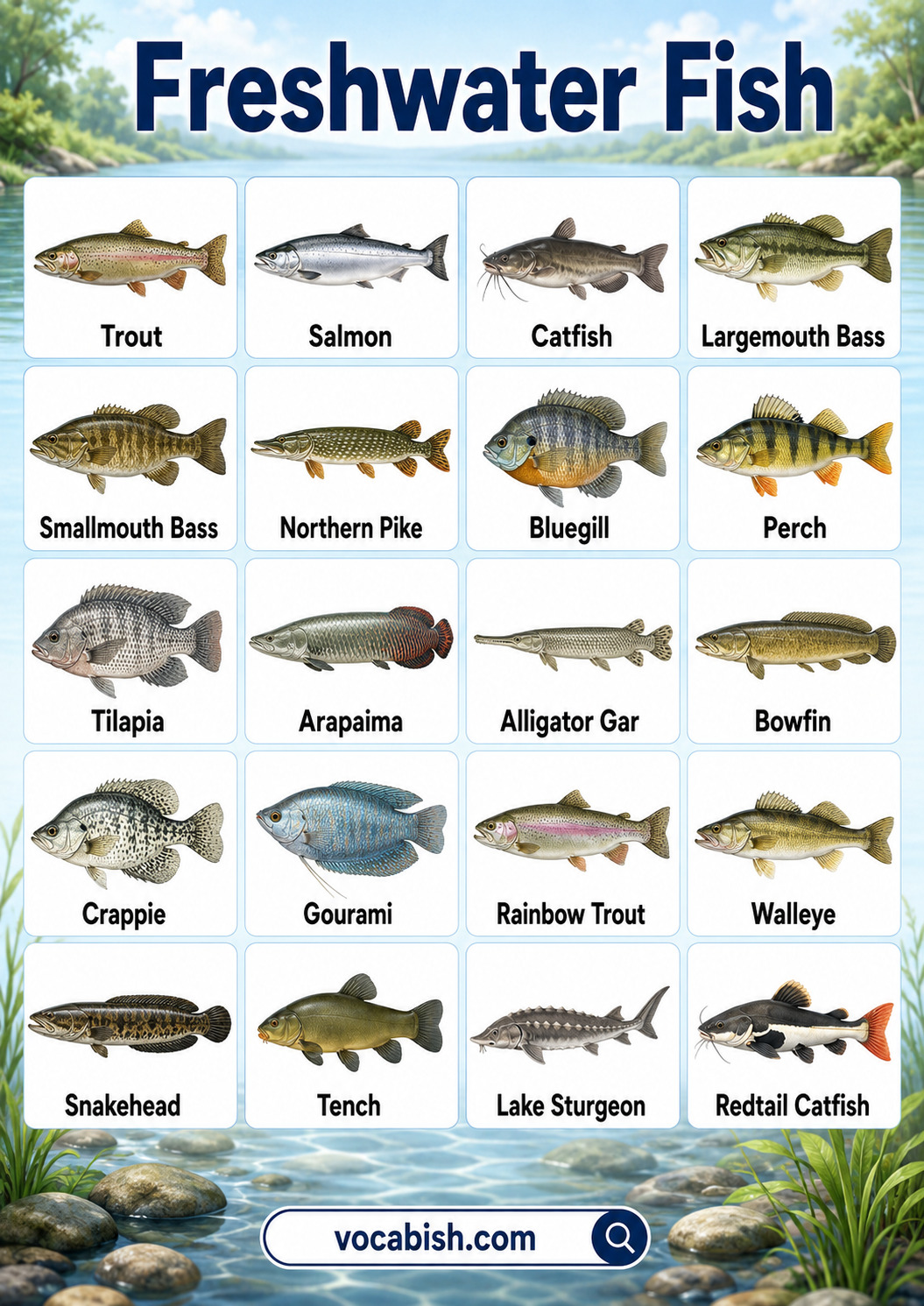
Freshwater fish live mainly in rivers, lakes, ponds, reservoirs, wetlands, and streams where the water contains very little dissolved salt. These types of fish range from tiny minnows to giant Amazonian and Asian species.
Fish name | Important description |
|---|---|
Trout | Trout usually have streamlined bodies with dark spots or speckles. Many species prefer cool, clean, oxygen-rich rivers, streams, and lakes. |
Salmon | Many salmon hatch in freshwater, migrate to the ocean, and later return to freshwater to reproduce. This journey is called an anadromous migration. |
Catfish | Catfish are recognised by whisker-like sensory organs called barbels. Many species search for food near the bottom, especially in murky water. |
Largemouth Bass | This predatory freshwater fish has a mouth that extends beyond the eye. It is especially popular among recreational anglers in North America. |
Smallmouth Bass | Smallmouth bass have smaller mouths than largemouth bass and often prefer clearer, cooler water. They are powerful swimmers and energetic sport fish. |
Northern Pike | Northern pike have long bodies, pointed snouts, and sharp teeth. They hide among aquatic plants before making sudden attacks on smaller animals. |
Bluegill | Bluegills have deep, rounded bodies and dark flaps near their gills. They are common in ponds, lakes, reservoirs, and slow-moving rivers. |
Perch | Many perch have vertical stripes and spiny dorsal fins. They usually live in lakes and rivers and feed on insects, crustaceans, and smaller fish. |
Tilapia | Tilapia are warm-water freshwater fish widely raised for food. They grow relatively quickly and play an important role in global aquaculture. |
Arapaima | The arapaima is a huge Amazonian fish that must regularly reach the surface to breathe air. It has a long body and large protective scales. |
Alligator Gar | Alligator gar have broad snouts, sharp teeth, and armour-like scales. They are among the largest freshwater fish found in North America. |
Bowfin | Bowfin are ancient-looking predators with long dorsal fins and powerful jaws. They can survive in warm, low-oxygen freshwater habitats. |
Bream | The name bream refers to several deep-bodied freshwater fish. Many feed on small invertebrates, plants, and other material near the bottom. |
Brook Trout | Brook trout display colourful spots and pale markings along their fins. They thrive in cold, clear streams and lakes with high oxygen levels. |
Brown Trout | Brown trout usually have brown or golden bodies covered with dark and reddish spots. They are native to Europe but have been introduced elsewhere. |
Bullhead | Bullheads are small catfish with broad heads and barbels around their mouths. They often tolerate muddy water and low oxygen better than many fish. |
Chub | Chub are sturdy members of the carp family. They commonly live in rivers and streams and eat insects, plants, and small aquatic animals. |
Crappie | Crappies are deep-bodied freshwater sport fish with spotted patterns. Black crappie and white crappie are the two best-known species. |
Discus | Discus fish have round, flattened bodies and dramatic colours. They come from slow-moving Amazonian waters and require stable aquarium conditions. |
Electric Eel | The electric eel is actually a type of knifefish. It can produce electrical discharges for navigation, communication, defence, and hunting. |
Freshwater Angelfish | Freshwater angelfish have tall bodies that help them move between submerged roots and plants. They originally come from tropical South American waters. |
Freshwater Drum | Freshwater drum have deep bodies and can produce low sounds using specialised muscles. They inhabit large rivers, reservoirs, and lakes. |
Gudgeon | Gudgeons are small bottom-feeding fish often found in rivers and streams. They use sensitive barbels to locate food among sand and gravel. |
Gourami | Gouramis can breathe atmospheric air with a specialised labyrinth organ. Many species inhabit warm, slow-moving waters with dense vegetation. |
Grayling | Grayling have large, colourful dorsal fins and prefer cool, clean rivers. They belong to the salmon family and mainly eat aquatic insects. |
Lake Sturgeon | Lake sturgeon are long-lived fish with bony plates instead of ordinary scales. They feed along the bottom of large lakes and rivers. |
Loach | Loaches are small, bottom-oriented fish with elongated bodies. Many species hide among rocks, wood, or plants and become active when searching for food. |
Minnow | Minnow commonly refers to numerous small freshwater fish, especially members of the carp family. They are important prey for birds and larger fish. |
Mudfish | The name mudfish describes several fish adapted to muddy, shallow, or low-oxygen habitats. The exact species meant depends on the region. |
Muskellunge | Muskellunge, often called muskie, are large predators related to northern pike. They have long bodies and attack prey with sudden bursts of speed. |
Paddlefish | Paddlefish have long, paddle-shaped snouts containing sensitive receptors. They swim through freshwater while filtering tiny organisms from the water. |
Peacock Bass | Peacock bass are colourful South American cichlids rather than true bass. They are fast, aggressive predators popular with sport fishers. |
Rainbow Trout | Rainbow trout have silvery bodies with dark spots and a pinkish stripe along each side. They live in cool streams, rivers, and lakes. |
Redtail Catfish | Redtail catfish are large Amazonian fish with broad heads and bright red-orange tails. Their eventual size makes them unsuitable for ordinary home aquariums. |
Roach | Roach are silvery freshwater fish with reddish fins. They often gather in schools and live in slow rivers, canals, ponds, and lakes. |
Snakehead | Snakeheads have long bodies and can breathe atmospheric air. Some species survive short periods outside water when conditions remain moist. |
Tambaqui | Tambaqui are deep-bodied Amazonian fish with strong teeth adapted for crushing fruits, seeds, and nuts that fall into flooded forests. |
Tench | Tench have thick bodies, small scales, and olive-green colouring. They generally prefer slow-moving or still water with abundant vegetation. |
Walleye | Walleye have large light-sensitive eyes that help them hunt in dim or cloudy water. They are valued as both sport and food fish. |
Whitefish | Whitefish are cool-water members of the salmon family. They usually have silvery bodies and inhabit deep northern lakes and rivers. |
Types of Saltwater and Ocean Fish
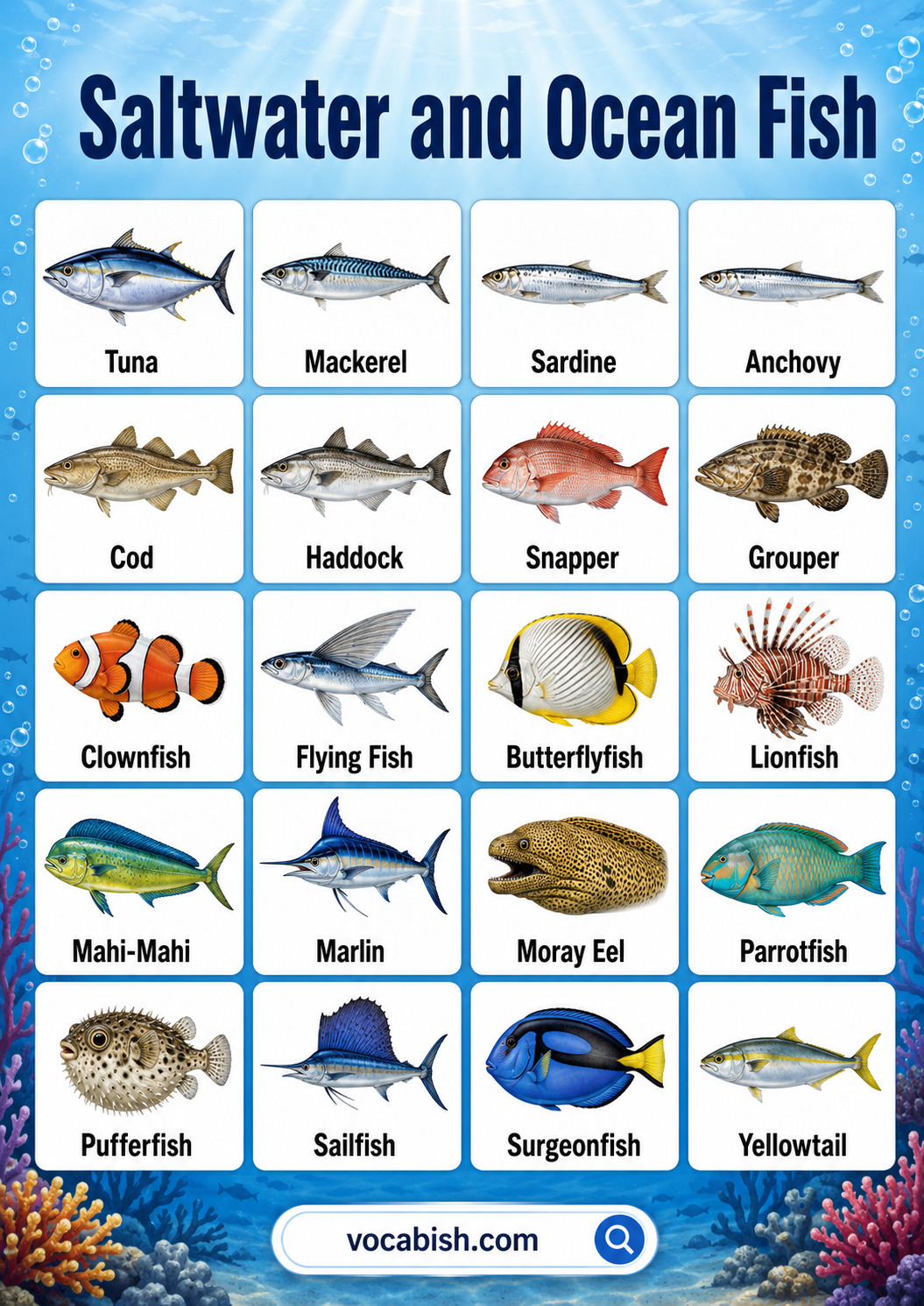
Saltwater fish live in seas and oceans. Some stay near coral reefs or rocky coasts, while others inhabit sandy seafloors, deep water, or the open ocean far from land.
Fish name | Important description |
|---|---|
Tuna | Tuna have powerful, streamlined bodies designed for continuous swimming. Several species travel long distances through warm and temperate ocean waters. |
Mackerel | Mackerel are fast schooling fish with slender bodies and dark wavy markings. Their oily flesh supports an active open-water lifestyle. |
Sardine | Sardines are small silver fish that form large schools. They feed mainly on plankton and are important prey for seabirds, mammals, and larger fish. |
Anchovy | Anchovies are small schooling fish with narrow bodies and large mouths. They are important in marine food webs and are widely used as food. |
Cod | Cod are cold-water fish usually found close to the seafloor. They have pale, flaky flesh and have supported major commercial fisheries. |
Haddock | Haddock are relatives of cod with a dark line along the body and a noticeable dark mark above the pectoral fin. |
Snapper | Snappers have strong bodies, pointed teeth, and large mouths. Most species inhabit tropical or subtropical reefs and rocky coastal environments. |
Grouper | Groupers are heavy-bodied reef predators with broad mouths. Instead of chasing prey for long distances, they often use sudden suction to capture it. |
Clownfish | Clownfish have bright orange, white, black, or yellow patterns. They live closely with sea anemones, gaining protection among their stinging tentacles. |
Flying Fish | Flying fish have enlarged pectoral fins that allow them to glide above the ocean surface. This behaviour may help them escape predators. |
Albacore | Albacore are medium-sized tuna with unusually long pectoral fins. They migrate through open oceans and are commonly sold in canned products. |
Barramundi | Barramundi can live in fresh, brackish, and saltwater. They are large predatory fish found in the Indo-Pacific region and northern Australia. |
Bluefish | Bluefish are powerful schooling predators with sharp teeth. They inhabit coastal and open waters and feed aggressively on smaller fish. |
Bonito | Bonitos are fast members of the mackerel and tuna family. Their streamlined bodies help them pursue schooling prey in open water. |
Butterflyfish | Butterflyfish have thin bodies, small mouths, and colourful patterns. They commonly search coral reefs for tiny invertebrates and coral tissue. |
Cardinalfish | Cardinalfish are generally small reef fish with large eyes. Many become more active at night and shelter in caves or among corals during daylight. |
Cobia | Cobia are large, dark fish that often swim near sharks, rays, turtles, buoys, and floating objects. They are strong predators and valued food fish. |
Conger Eel | Conger eels have long, muscular bodies and live in rocky holes, reefs, or deep seafloor habitats. Some species grow considerably larger than freshwater eels. |
Damselfish | Damselfish are small, active reef fish that frequently defend territories. Some species maintain patches of algae as a personal food source. |
Dogfish | Dogfish are relatively small sharks, often with slender bodies. Some species have defensive spines positioned in front of their dorsal fins. |
Dragonet | Dragonets are small bottom-dwelling marine fish with broad heads and decorative patterns. Many move across sand or rubble using their fins. |
Emperor Fish | Emperor fish have strong jaws and are common around reefs, seagrass beds, and sandy coastal areas. They feed on crustaceans, molluscs, and smaller fish. |
Flounder | Flounders are flatfish that rest on the seabed with both eyes on one side. Their colouring helps them blend into sand or mud. |
Goatfish | Goatfish have two sensory barbels beneath the chin. They use them to search through sand for worms, crustaceans, and other hidden prey. |
Goby | Gobies are a huge group of mostly small fish. Many live on the bottom, and some have fused pelvic fins that form a gripping disc. |
Grunt | Grunts are reef and coastal fish capable of producing grunting sounds by grinding teeth and amplifying the vibrations within their bodies. |
Halfbeak | Halfbeaks have elongated lower jaws and usually swim close to the water’s surface. They feed on small animals and floating material. |
Herring | Herring are silvery schooling fish found mainly in northern waters. Their enormous schools provide food for numerous marine predators. |
Hogfish | Hogfish are wrasses with long snouts used to search through sand and reef material. Large adults may develop prominent forehead profiles. |
John Dory | John Dory has a thin, tall body, spiny fins, and a dark circular mark on each side. It approaches prey slowly before extending its mouth. |
Lionfish | Lionfish have striped bodies, fan-shaped fins, and venomous defensive spines. Their slow, controlled movements hide an effective hunting technique. |
Marlin | Marlin are large open-ocean predators with pointed bills. Their strong, streamlined bodies allow them to swim quickly over long distances. |
Mahi-Mahi | Mahi-mahi have high foreheads and brilliant blue, green, and gold colouring. They grow quickly and inhabit warm offshore waters. |
Moray Eel | Moray eels have elongated bodies and usually hide in reef crevices. They repeatedly open their mouths to move water across their gills. |
Needlefish | Needlefish have very slender bodies and long jaws lined with small teeth. They usually hunt near the surface of tropical and temperate waters. |
Ocean Sunfish | The ocean sunfish has a huge, compressed body and a shortened tail area. It often feeds on jelly-like animals and other soft-bodied prey. |
Parrotfish | Parrotfish use fused, beak-like teeth to scrape algae from reefs. Their feeding activity helps create fine coral sand in tropical environments. |
Pufferfish | Pufferfish can rapidly inflate their bodies when threatened. Many species also contain powerful defensive toxins in certain organs or tissues. |
Rabbitfish | Rabbitfish have small mouths, oval bodies, and venomous fin spines. They mainly graze on algae around reefs and coastal vegetation. |
Remora | Remoras have suction discs on top of their heads. They use these discs to attach temporarily to sharks, turtles, rays, and other large animals. |
Rockfish | Rockfish commonly live around reefs, rocky slopes, and deep coastal habitats. Many species grow slowly and can live for several decades. |
Sailfish | Sailfish have long bills and very tall dorsal fins resembling sails. They hunt schooling fish in warm and temperate ocean waters. |
Sea Bass | Sea bass is a common name used for several marine fish with strong bodies and large mouths. Many live around reefs and rocky coasts. |
Sea Bream | Sea bream are deep-bodied coastal fish with strong teeth. Different species feed on shellfish, plants, crustaceans, and smaller animals. |
Seahorse | Seahorses are upright fish with curled tails and tube-shaped mouths. They swim slowly and anchor themselves to plants or coral using their tails. |
Sergeant Major | This damselfish has a silver-yellow body marked by dark vertical bars. It is commonly seen around tropical reefs, docks, and rocky shores. |
Sheepshead | Sheepshead have strong, human-like front teeth used to crush barnacles, crabs, shellfish, and other hard-bodied prey. |
Squirrelfish | Squirrelfish usually have reddish bodies, large eyes, and spiny fins. They hide in reef crevices during the day and feed mainly at night. |
Surgeonfish | Surgeonfish have sharp blade-like structures near the base of their tails. Most species graze on algae across tropical coral reefs. |
Tarpon | Tarpon are large, silvery coastal fish known for powerful leaps. They can gulp air at the surface when oxygen levels are low. |
Tilefish | Tilefish are colourful bottom-associated fish that often dig burrows in sand or shelter around rocky ledges in deeper water. |
Triggerfish | Triggerfish have strong teeth and a locking dorsal spine. Many use their jaws to crush sea urchins, molluscs, and crustaceans. |
Trumpetfish | Trumpetfish have extremely long bodies and tube-shaped snouts. They often hover vertically near coral before striking at small prey. |
Wrasse | Wrasses form a colourful and highly varied family of reef fish. Many search the reef for molluscs, crustaceans, parasites, or small fish. |
Yellowtail | Yellowtail is a name used for several fast marine fish with noticeable yellow tails. Many species form schools and are important in commercial fishing. |
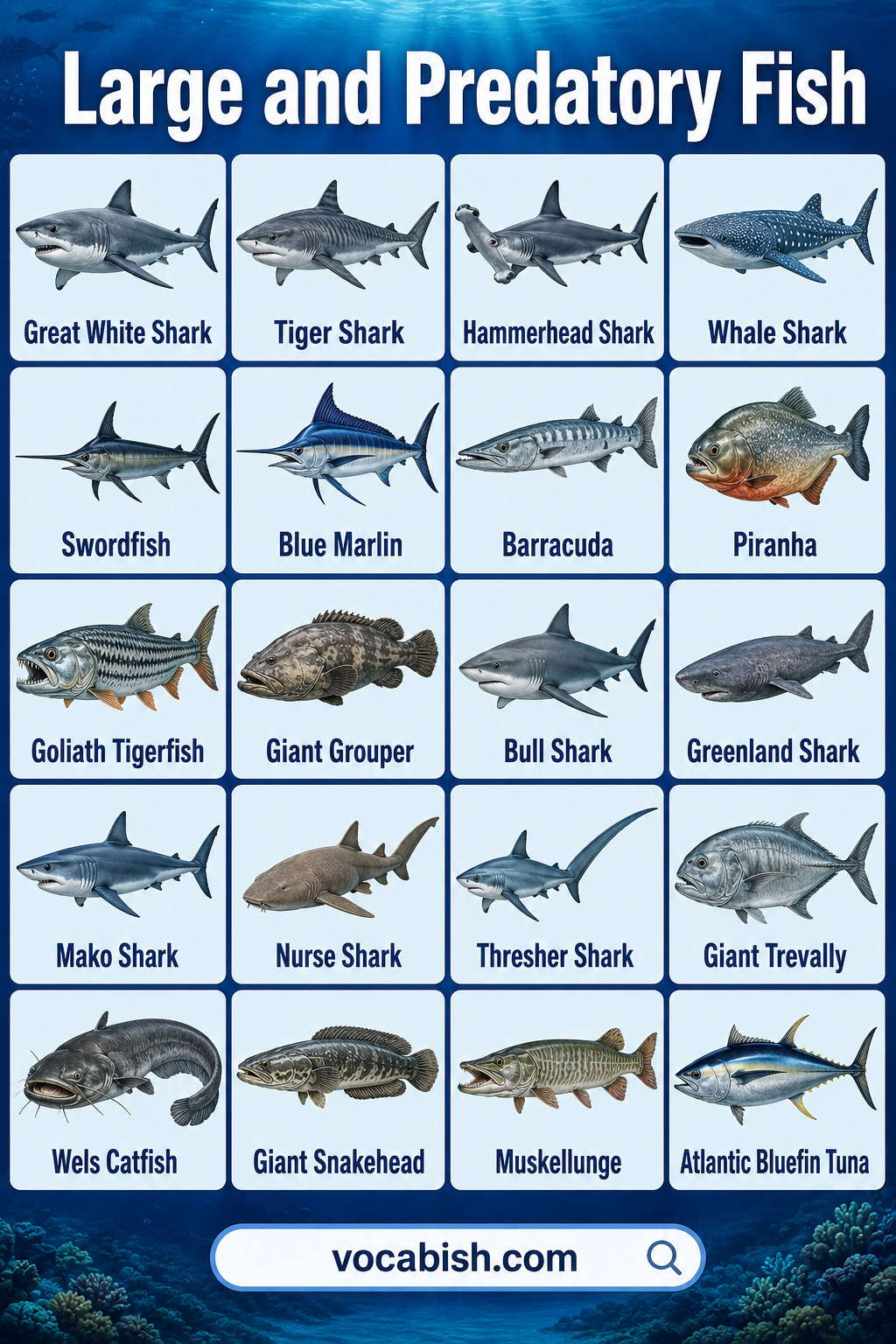
Types of Large and Predatory Fish
Predatory fish hunt or consume other animals, including smaller fish, crustaceans, squid, birds, or marine mammals. However, large size does not automatically make a fish aggressive or dangerous to people.
Fish name | Important description |
|---|---|
Great White Shark | Great white sharks have powerful bodies and rows of serrated teeth. They are major marine predators that hunt fish, seals, and other animals. |
Tiger Shark | Tiger sharks have broad diets and may investigate many kinds of food. Younger individuals display dark vertical markings that fade with age. |
Hammerhead Shark | Hammerhead sharks have wide, flattened heads with eyes positioned far apart. The unusual shape supports sensory detection and precise movement. |
Whale Shark | The whale shark is the world’s largest living fish. Despite its size, it filters plankton and small animals rather than hunting large prey. |
Swordfish | Swordfish have long, flattened bills and muscular bodies. They use speed and rapid movements to strike or weaken schools of prey. |
Blue Marlin | Blue marlin are large, fast predators with pointed bills and strong crescent-shaped tails. They travel through tropical and subtropical oceans. |
Barracuda | Barracudas have long bodies, large jaws, and sharp teeth. They rely on camouflage and sudden acceleration when attacking smaller fish. |
Piranha | Piranhas are South American freshwater fish with sharp interlocking teeth. Diet and behaviour differ widely among species, and many also eat plants or carrion. |
Goliath Tigerfish | This African freshwater predator has a muscular body and large exposed teeth. It hunts fish in powerful rivers and large lakes. |
Giant Grouper | Giant groupers are enormous reef fish with broad mouths. They usually capture prey through a rapid expansion of the mouth that creates suction. |
Bull Shark | Bull sharks have stocky bodies and can move between saltwater and freshwater. They are found in warm coastal waters and some major rivers. |
Greenland Shark | Greenland sharks are slow-moving predators and scavengers from cold northern waters. They grow gradually and are among the longest-lived vertebrates known. |
Lemon Shark | Lemon sharks have yellowish-brown colouring that blends with sandy coastal habitats. They commonly inhabit shallow tropical and subtropical waters. |
Mako Shark | Mako sharks have streamlined bodies, pointed snouts, and powerful tails. They are highly active predators known for speed and energetic leaps. |
Nurse Shark | Nurse sharks are broad-headed bottom dwellers that often rest during the day. They use suction to capture fish, squid, and crustaceans. |
Oceanic Whitetip Shark | This open-ocean shark has long, rounded fins with pale tips. It travels widely through warm offshore waters in search of food. |
Reef Shark | Reef sharks patrol coral reefs, channels, and drop-offs. Their slender bodies allow them to move efficiently through complex reef habitats. |
Thresher Shark | Thresher sharks have extremely long upper tail lobes. They can use their tails to stun or disorient schooling fish. |
Giant Trevally | Giant trevallies are powerful tropical predators with deep bodies. They hunt fish and other animals around reefs, lagoons, and coastal waters. |
Wels Catfish | Wels catfish are very large European and Asian freshwater predators. They use barbels and sensitive hearing to locate prey in cloudy water. |
Giant Snakehead | Giant snakeheads are large air-breathing predators from Southeast Asia. They hunt fish, frogs, crustaceans, and other aquatic animals. |
Muskellunge | Muskellunge hide among vegetation or underwater structures before rushing toward prey. Their long jaws contain numerous sharp teeth. |
Atlantic Bluefin Tuna | Atlantic bluefin tuna are large, warm-bodied ocean predators capable of long migrations. Their powerful swimming muscles support sustained speed. |
Arapaima | Arapaima are giant freshwater predators from the Amazon basin. They surface regularly to breathe and feed on fish and other available animals. |
Alligator Gar | Alligator gar are patient ambush predators with broad jaws and needle-like teeth. They often remain nearly motionless before striking. |
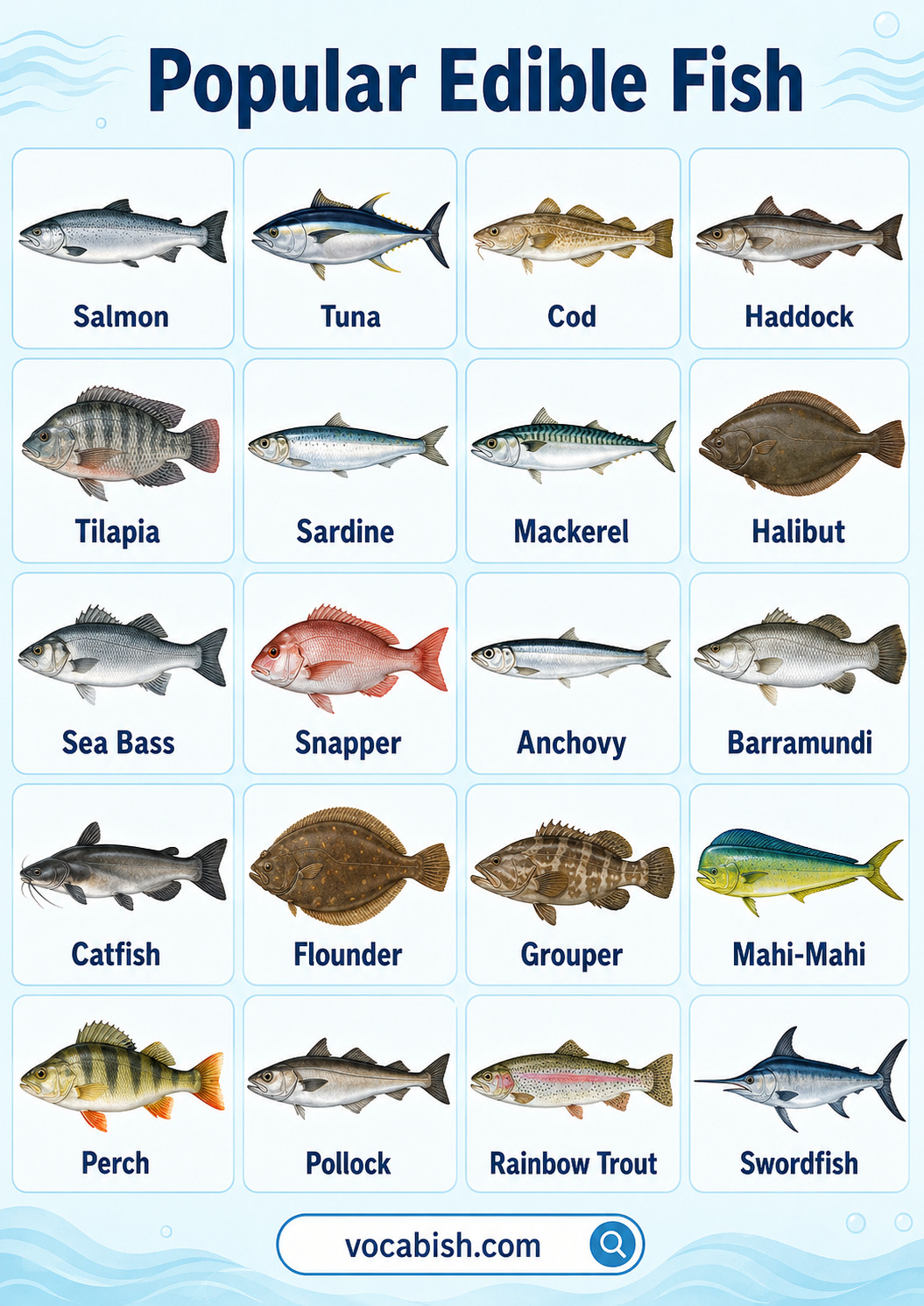
Types of Popular Edible Fish
These fish are eaten in different regions of the world. Availability, preparation methods, fishing laws, health advice, and sustainability can vary by species and location.
Fish name | Important description |
|---|---|
Salmon | Salmon has pink or orange flesh with a rich flavour. It is commonly grilled, baked, smoked, poached, canned, or served raw when properly prepared. |
Tuna | Tuna has firm, dense flesh and a mild to rich flavour depending on the species. It is sold fresh, frozen, canned, or prepared in raw dishes. |
Cod | Cod has mild-tasting white flesh that separates into large flakes when cooked. It works well in baked, fried, grilled, and stewed dishes. |
Haddock | Haddock has lean white flesh and a gentle flavour. It is frequently fried, baked, poached, or smoked. |
Tilapia | Tilapia has a mild taste and soft white flesh. Its affordability and widespread farming make it common in everyday meals. |
Sardine | Sardines have oily flesh and a stronger flavour than many white fish. They may be grilled, smoked, pickled, or sold in cans. |
Mackerel | Mackerel has rich, oily flesh and a distinctive flavour. It is often grilled, baked, smoked, or preserved. |
Halibut | Halibut is a large flatfish with firm white flesh and a mild taste. Its thick portions are suitable for grilling and roasting. |
Sea Bass | Sea bass usually has moist flesh, a delicate flavour, and a tender texture. It is commonly roasted or cooked whole. |
Snapper | Snapper has firm flesh and a mildly sweet flavour. Depending on size, it may be grilled, steamed, baked, or fried whole. |
Anchovy | Anchovies have a strong savoury taste, especially when cured in salt. Small amounts are used in sauces, dressings, pizzas, and spreads. |
Barramundi | Barramundi has firm white flesh and a mild, buttery flavour. It can be grilled, steamed, pan-fried, or baked. |
Black Cod | Black cod, also called sablefish, has rich, silky flesh with a high natural oil content. It works especially well when roasted or marinated. |
Bluefish | Bluefish has moist, strongly flavoured flesh. It is best eaten fresh and is commonly grilled, baked, or smoked. |
Branzino | Branzino is the Italian name commonly used for European sea bass. It has delicate white flesh and is often roasted whole. |
Catfish | Catfish has mild flesh that readily absorbs seasonings. It is frequently fried, grilled, baked, or added to soups and stews. |
Carp | Carp is eaten widely in Europe and Asia. Its flavour and texture depend strongly on the fish’s habitat, freshness, and preparation. |
Flounder | Flounder has thin, delicate fillets and a mild taste. It cooks quickly and is suitable for baking, frying, or rolling around fillings. |
Grouper | Grouper has thick, firm white flesh and a mild flavour. It is commonly grilled, fried, roasted, or used in seafood stews. |
Hake | Hake has tender white flesh and a mild, slightly sweet flavour. It is popular in European, African, and South American cooking. |
Herring | Herring has oily, flavourful flesh. It may be eaten fresh, smoked, salted, fermented, or pickled depending on regional traditions. |
Mahi-Mahi | Mahi-mahi has lean, firm flesh and a mild taste. It holds together well when grilled, baked, or pan-seared. |
Milkfish | Milkfish is an important food fish in Southeast Asia. Its flesh is mild, although it naturally contains many fine bones. |
Monkfish | Monkfish has dense, firm flesh with a mildly sweet flavour. Only certain portions are commonly eaten, especially the muscular tail. |
Mullet | Mullet has firm flesh and a stronger flavour that varies by habitat. It may be grilled, fried, smoked, or salted. |
Perch | Perch has lean, lightly flavoured flesh. Smaller fillets are often pan-fried, while larger portions may be baked or grilled. |
Pollock | Pollock has mild white flesh and is widely used in frozen fillets, fish fingers, imitation crab products, and fast-food dishes. |
Pomfret | Pomfret has delicate flesh and a mild taste. It is commonly steamed, fried, grilled, or cooked whole in Asian cuisines. |
Rainbow Trout | Rainbow trout has tender flesh with a mild, slightly nutty flavour. It is often baked, grilled, smoked, or pan-fried. |
Redfish | Redfish is a common name applied to several edible species. Many have firm flesh suitable for grilling, blackening, or roasting. |
Sole | Sole has thin, delicate flesh and a subtle flavour. It is often lightly fried, poached, or cooked with butter and lemon. |
Swordfish | Swordfish has dense, steak-like flesh that remains firm during grilling. Consumption guidance may vary because large predatory fish can accumulate mercury. |
Turbot | Turbot is a broad flatfish with firm, delicate flesh. It is valued in European cooking and often roasted or poached. |
Walleye | Walleye has mild, clean-tasting flesh with a fine texture. It is commonly fried, grilled, or baked in North America. |
Whitefish | Whitefish has pale, mild flesh and a tender texture. It may be baked, smoked, poached, or used in spreads and salads. |
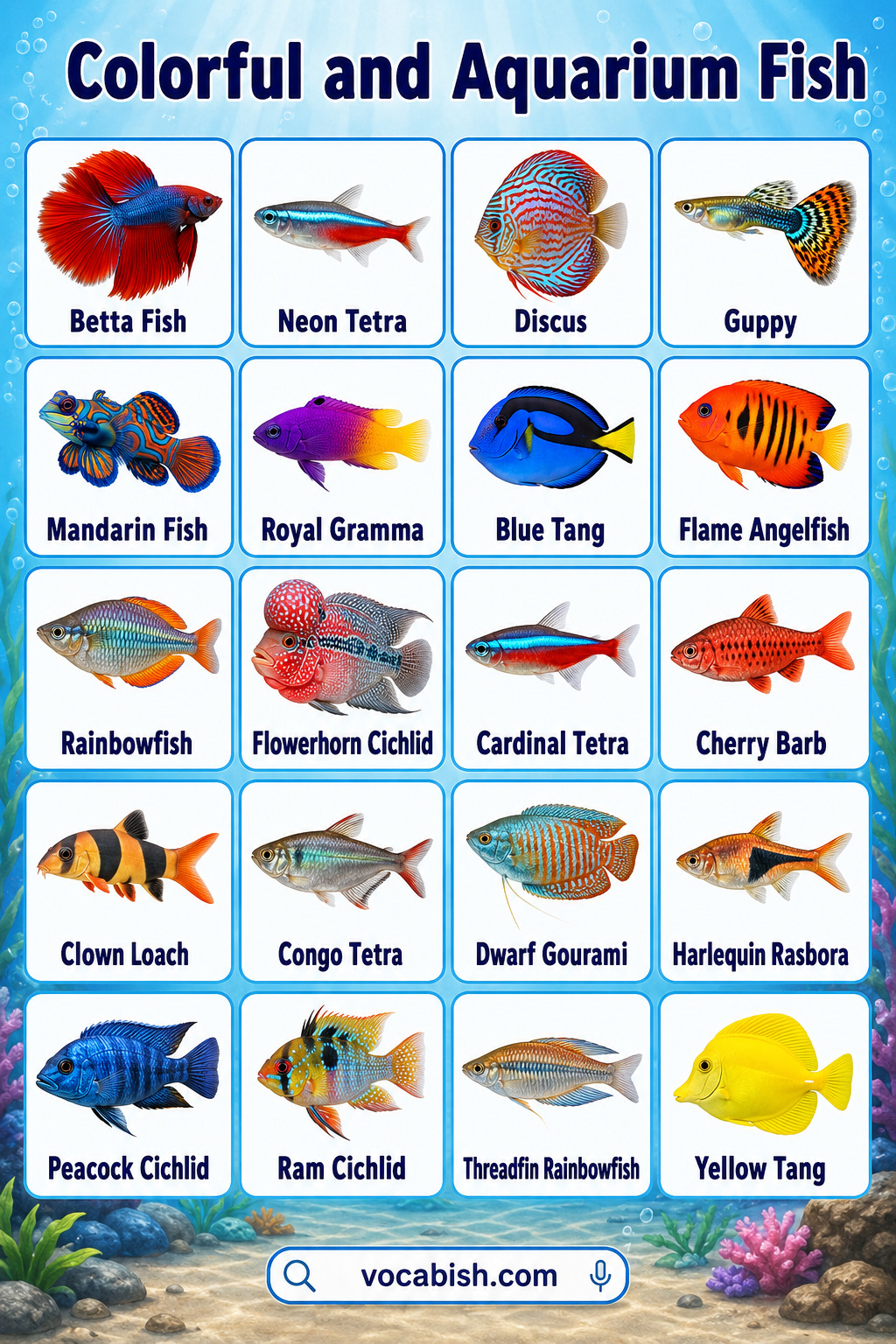
Types of Colorful and Aquarium Fish
These fish are admired for bright colours, decorative markings, unusual body shapes, or graceful fins. Freshwater and marine aquarium species have different water, space, diet, and social requirements.
Fish name | Important description |
|---|---|
Betta Fish | Bettas display brilliant colours and flowing fins. They require warm, clean water and careful housing because males can be strongly territorial. |
Neon Tetra | Neon tetras are tiny schooling fish with glowing blue stripes and red colouring. Their colours stand out best when they swim in groups. |
Discus | Discus have round bodies covered with stripes, spots, or colourful patterns. They need warm water and carefully controlled aquarium conditions. |
Guppy | Guppies are small live-bearing fish available in countless colour and tail varieties. Males are usually more brightly decorated than females. |
Mandarin Fish | Mandarin fish have extraordinary blue, orange, and green patterns. These small marine fish live around sheltered reefs and feed on tiny organisms. |
Royal Gramma | Royal grammas have purple front halves and yellow rear halves. They are small reef fish that often shelter beneath ledges or inside caves. |
Blue Tang | Blue tangs have bright blue bodies, dark curved markings, and yellow tails. They need spacious marine aquariums with room to swim. |
Flame Angelfish | Flame angelfish have orange-red bodies marked by dark vertical bars. They are active marine fish that graze and explore rocky reef structures. |
Rainbowfish | Rainbowfish often display reflective colours that intensify under good lighting. They are energetic schooling fish requiring open swimming space. |
Flowerhorn Cichlid | Flowerhorn cichlids have vivid patterns and large forehead humps. They are selectively bred aquarium fish with territorial behaviour. |
Cardinal Tetra | Cardinal tetras resemble neon tetras, but their red stripe extends along most of the body. They look especially striking in large schools. |
Cherry Barb | Male cherry barbs develop deep red colouring, particularly during breeding. They are active but generally peaceful freshwater fish. |
Clown Loach | Clown loaches have orange bodies crossed by broad black bands. They are social bottom dwellers that can eventually grow quite large. |
Congo Tetra | Congo tetras have reflective rainbow colouring and flowing fins. They are active African schooling fish best kept with peaceful companions. |
Dwarf Gourami | Dwarf gouramis display blue, red, or orange patterns. They can breathe surface air and prefer calm, well-planted aquariums. |
Electric Blue Acara | This aquarium cichlid has intense metallic blue colouring. It is usually less aggressive than many larger cichlids but still needs adequate territory. |
Endler’s Livebearer | Male Endler’s livebearers have tiny bodies marked with vivid orange, green, black, and blue patches. They are active and reproduce readily. |
Firefish | Firefish have pale bodies that change into red, orange, or purple toward the tail. These marine fish often hover near reef shelters. |
Harlequin Rasbora | Harlequin rasboras have copper-coloured bodies with dark triangular markings. They are peaceful schooling fish suited to planted aquariums. |
Killifish | Killifish include many small species with bright colours and intricate patterns. Their water and breeding requirements vary considerably. |
Koi Angelfish | Koi angelfish have white, orange, yellow, and black patterns inspired by ornamental koi. Their tall fins require an aquarium with sufficient height. |
Lemon Tetra | Lemon tetras have translucent yellow bodies with dark and yellow fin markings. They are peaceful fish that look best in schools. |
Moorish Idol | Moorish idols have bold black, white, and yellow bands with long dorsal streamers. Their specialised needs make them difficult aquarium fish. |
Pearl Gourami | Pearl gouramis have reddish-brown bodies covered with pearly spots. A dark horizontal line runs from the mouth toward the tail. |
Peacock Cichlid | Male peacock cichlids develop intense blue, red, orange, or yellow colouring. They originate from Lake Malawi in East Africa. |
Powder Blue Tang | Powder blue tangs have light blue bodies, dark faces, and yellow dorsal areas. They require stable marine conditions and significant swimming space. |
Ram Cichlid | Ram cichlids are small freshwater fish with blue spots, yellow colouring, and dark markings. They prefer warm, stable, peaceful environments. |
Rummy-Nose Tetra | Rummy-nose tetras have bright red faces and black-and-white striped tails. Their tight schooling behaviour creates an attractive aquarium display. |
Siamese Algae Eater | Siamese algae eaters have silver bodies with dark horizontal stripes. They are valued for grazing on several forms of aquarium algae. |
Threadfin Rainbowfish | Threadfin rainbowfish have delicate bodies and extended fin rays. Mature males display their fins while interacting with other fish. |
Zebra Pleco | Zebra plecos have bold black-and-white stripes and flattened, armoured bodies. They require warm, oxygen-rich water and plenty of hiding places. |
Yellow Tang | Yellow tangs have bright yellow, disc-shaped bodies. They are active marine herbivores that graze algae throughout the day. |
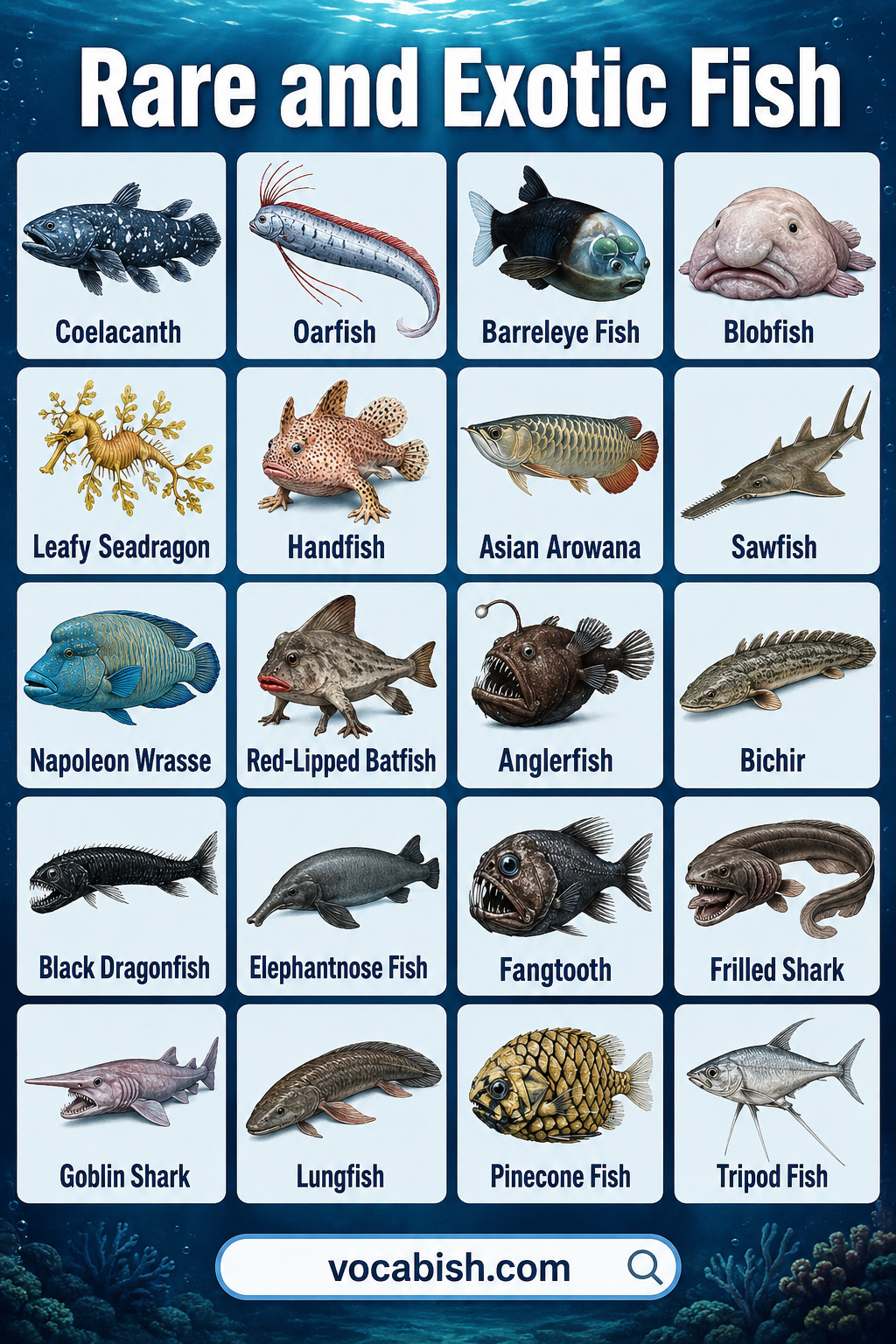
Types of Rare and Exotic Fish
Rare fish may have small populations, limited habitats, or restricted natural ranges. The word “exotic” usually describes fish that look unusual, live in unfamiliar environments, or are not native to a particular region. However, an unusual appearance does not necessarily mean that a species is endangered.
Fish name | Description |
|---|---|
Coelacanth | The coelacanth is a deep-water fish once known only from fossils. Living specimens were documented in the twentieth century, making it one of the most famous discoveries in modern zoology. |
Oarfish | Oarfish have extremely long, silver, ribbon-like bodies and bright red fins. They usually live in deep ocean water and are rarely observed alive near the surface. |
Barreleye Fish | This deep-sea fish has a transparent area on its head and unusual tubular eyes. Its eyes can rotate to locate prey swimming above or in front of it. |
Blobfish | Blobfish live under intense pressure in deep ocean habitats. Their famous soft appearance becomes more noticeable when they are brought rapidly to the surface. |
Leafy Seadragon | Leafy seadragons have leaf-shaped body extensions that help them blend into seaweed. They are close relatives of seahorses and pipefish. |
Handfish | Some handfish use modified pectoral fins to move across the seabed. They usually walk or push themselves along the bottom instead of swimming continuously. |
Asian Arowana | Asian arowanas have long bodies, large reflective scales, and upward-facing mouths. They are valued by collectors, although international trade and ownership may be legally restricted. |
Sawfish | Sawfish are actually rays rather than typical bony fish. Their long, tooth-lined snouts help them detect, strike, and control prey. |
Napoleon Wrasse | Also called the humphead wrasse, this large reef fish has thick lips and a prominent forehead hump. Adults can grow to an impressive size. |
Red-Lipped Batfish | This unusual bottom fish has bright red lips, a flattened body, and modified fins. It moves across the seafloor more often than it swims. |
African Butterflyfish | African butterflyfish live near the surface of calm freshwater habitats. Their upward-facing mouths help them catch insects that fall onto the water. |
Alligator Pipefish | This long, narrow fish has a tube-shaped snout and a rigid body. Like seahorses, male pipefish carry the developing eggs. |
Anglerfish | Many anglerfish have a modified fin spine that acts like a fishing lure. Deep-sea species may use natural light to attract prey in darkness. |
Bichir | Bichirs are ancient-looking African freshwater fish with armoured scales and separate dorsal finlets. They can also breathe atmospheric air. |
Black Dragonfish | Black dragonfish live in deep ocean water and have dark, narrow bodies. Their large teeth and light-producing organs help them hunt in darkness. |
Blind Cavefish | Blind cavefish live in underground rivers and caves where sunlight does not reach. Some populations have reduced eyesight and little body colouring. |
Bluefin Notho | This small African killifish is known for its bright blue, red, and yellow markings. It completes its life cycle quickly in temporary pools. |
Bowmouth Guitarfish | The bowmouth guitarfish has a ray-like head and a shark-like body. It feeds on shellfish, crustaceans, and other animals near the seafloor. |
Candiru | Candiru is a name used for several small Amazonian catfish. Some species feed on the blood of larger fish by entering their gill areas. |
Cookiecutter Shark | This small shark attaches to larger marine animals and removes round pieces of flesh. Its bite leaves a distinctive circular mark. |
Elephantnose Fish | Elephantnose fish have extended lower jaws that resemble small trunks. They produce weak electrical signals to navigate and locate food. |
Fangtooth | Fangtooth fish have extremely large teeth compared with their body size. They live in deep, dark ocean habitats and feed on smaller animals. |
Frilled Shark | Frilled sharks have long, eel-like bodies and rows of sharp teeth. They usually inhabit deep ocean slopes and are rarely seen alive. |
Ghost Knifefish | Ghost knifefish have long bodies and ribbon-like fins. They use weak electrical fields for navigation, communication, and finding objects in dark water. |
Giant Oarfish | The giant oarfish is one of the longest bony fish in the world. Its narrow silver body can grow several metres in length. |
Goblin Shark | Goblin sharks have long flattened snouts and jaws that can extend forward rapidly. They usually live in deep marine environments. |
Gulper Eel | Gulper eels have enormous mouths and expandable stomachs. These features allow them to swallow relatively large prey in deep water. |
Icefish | Several Antarctic icefish have pale or nearly colourless blood. They are specially adapted to survive in extremely cold ocean conditions. |
Lancetfish | Lancetfish have long bodies, sharp teeth, and tall dorsal fins. They are active deep-water predators with a varied diet. |
Lungfish | Lungfish can breathe air using lung-like organs. Some African species survive dry seasons by remaining inactive inside hardened mud. |
Megamouth Shark | The megamouth shark is a large filter-feeding species with a broad mouth. It was first documented in the 1970s and is still rarely observed. |
Mudskipper | Mudskippers use their fins to move across wet mud. They can remain outside water for periods as long as their skin and gill areas stay moist. |
Opah | Opah are large, round ocean fish with silver bodies and red fins. They can maintain much of their body at a warmer temperature than the surrounding water. |
Paddlefish | Paddlefish have long, paddle-shaped snouts containing sensitive receptors. They filter tiny organisms from freshwater while swimming. |
Pinecone Fish | Pinecone fish have strong, plate-like scales and light-producing organs near their mouths. Their patterned bodies resemble pinecones. |
Ratfish | Ratfish are cartilaginous relatives of sharks and rays. They have large eyes, tapering tails, and strong tooth plates for crushing food. |
Ropefish | Ropefish have long, eel-like bodies and can breathe atmospheric air. They may survive briefly outside water when the environment remains damp. |
Stonefish | Stonefish closely resemble rocks or coral rubble. Their dorsal spines contain venom used mainly for protection against predators. |
Telescope Fish | Telescope fish have large, tube-shaped eyes adapted for detecting faint light. They live in deep parts of the ocean. |
Tripod Fish | Tripod fish have extremely long fin rays that support them above the seabed. They face the current and wait for small drifting animals. |
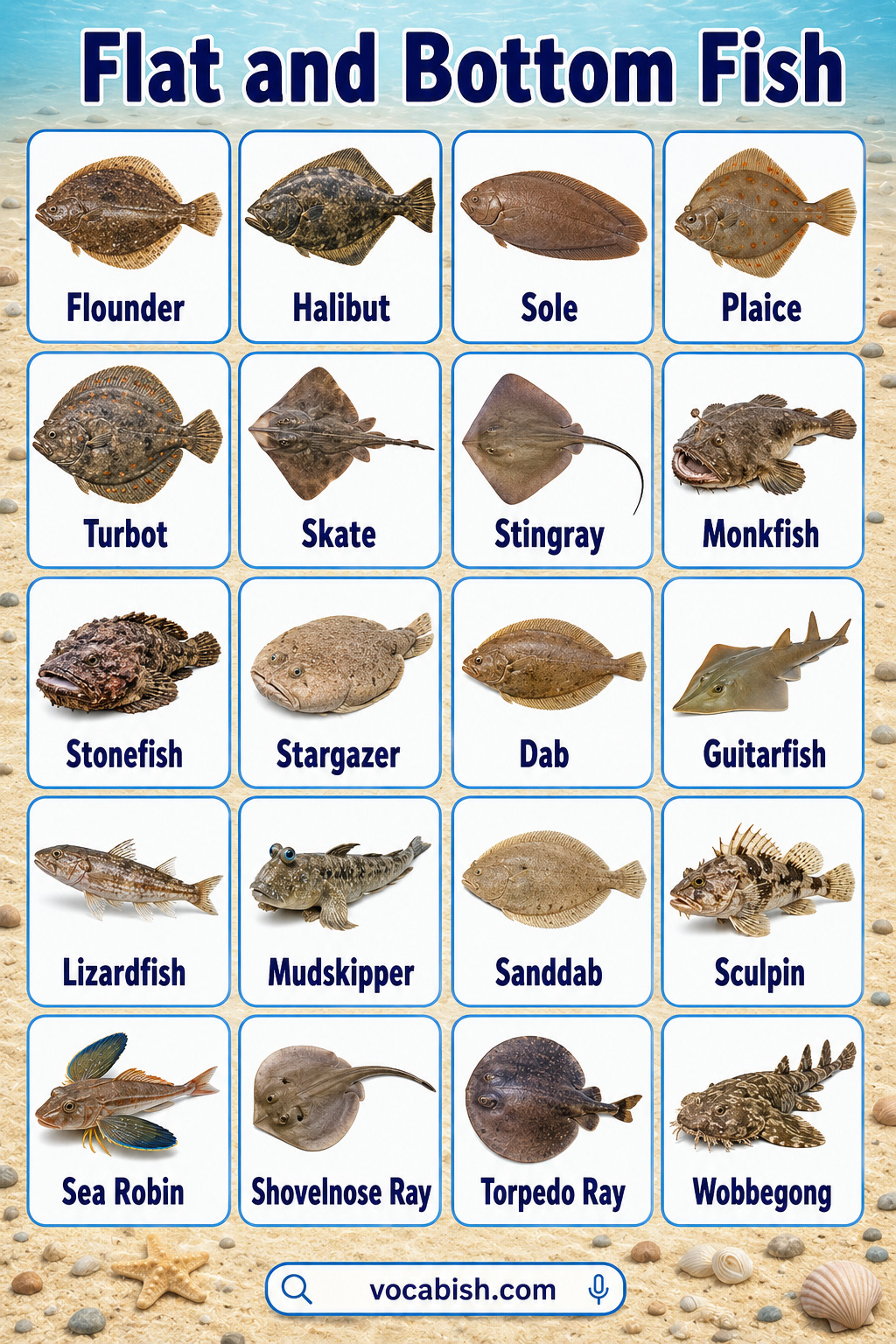
Types of Flat and Bottom Fish
Flatfish usually have flattened bodies and spend most of their time close to the seabed. Other bottom-dwelling fish may not be flat, but they commonly rest, hide, hunt, or feed near sand, mud, rocks, and coral.
Fish name | Description |
|---|---|
Flounder | Adult flounders have flat bodies with both eyes positioned on one side. Their mottled colouring helps them disappear against sand or mud. |
Halibut | Halibut are large flatfish found mainly in cold northern waters. Their dark upper surfaces help them blend into the seabed. |
Sole | Sole have thin, oval bodies and small mouths. They usually remain close to sandy or muddy ocean bottoms. |
Plaice | Plaice are flatfish recognised by orange or reddish spots on their upper surfaces. They commonly live on soft seabeds in northern waters. |
Turbot | Turbot have broad, nearly circular bodies and rough upper skin. They often partly bury themselves while waiting for prey. |
Skate | Skates are cartilaginous fish related to sharks and rays. Their broad pectoral fins create a flattened, diamond-like body. |
Stingray | Stingrays have wide, flat bodies and wing-like fins. Many species possess a defensive spine on the tail. |
Monkfish | Monkfish have broad heads, huge mouths, and narrow bodies. They remain near the bottom and ambush animals that swim close enough. |
Stonefish | Stonefish rest almost motionless on rocky or sandy bottoms. Their natural camouflage makes them difficult for predators and prey to notice. |
Stargazer | Stargazers often bury themselves in sand with only their eyes and mouths visible. They attack fish and other animals passing overhead. |
Dab | Dabs are small flatfish with rough upper surfaces. They are commonly found on sandy seabeds in coastal waters. |
Guitarfish | Guitarfish combine a ray-like flattened head with a shark-like tail. They search along the bottom for shellfish, fish, and crustaceans. |
Lizardfish | Lizardfish rest on sand or coral with their heads raised. Their sharp teeth allow them to grab smaller fish quickly. |
Mudskipper | Mudskippers live around tidal mudflats and mangrove areas. They use their strong fins to move, feed, and defend territories on wet mud. |
Sanddab | Sanddabs are small flatfish that live on sandy ocean bottoms. Their mottled colouring provides effective camouflage. |
Sculpin | Sculpins have broad heads and large pectoral fins. Many species blend naturally with stones, gravel, or underwater plants. |
Sea Robin | Sea robins have large, wing-like fins and separate finger-shaped rays. They use these sensitive rays to search the bottom for food. |
Shovelnose Ray | Shovelnose rays have pointed snouts and elongated bodies. They feed on small fish, crustaceans, and buried animals. |
Torpedo Ray | Torpedo rays can produce electrical shocks for hunting and defence. Their rounded, flattened bodies are suited to bottom habitats. |
Wobbegong | Wobbegongs are carpet sharks with flat, patterned bodies. They rest on reefs and ambush fish that swim within reach. |
Types of Other Famous Fish
Some fish are widely recognised because of their unusual appearance, behaviour, biology, or cultural popularity. Several may also fit into earlier categories, but their distinctive qualities make them worth learning separately.
Fish name | Description |
|---|---|
Seahorse | Seahorses are true fish with upright bodies, curled tails, and tube-shaped mouths. Male seahorses carry developing young inside a brood pouch. |
Pufferfish | Pufferfish can swallow water or air and inflate their bodies when threatened. This makes them harder for predators to bite or swallow. |
Electric Eel | The electric eel is actually a type of knifefish. It produces electrical signals for navigation, communication, defence, and hunting. |
Ocean Sunfish | Ocean sunfish have enormous compressed bodies and unusually shortened tail areas. They often swim near the surface of the ocean. |
Mudskipper | Mudskippers can move across wet land using their fins. Their raised eyes allow them to see clearly above the mud. |
Remora | Remoras have suction discs on their heads. They use them to attach temporarily to sharks, turtles, rays, and other large animals. |
Archerfish | Archerfish shoot streams of water at insects sitting above the surface. When the insect falls, the fish quickly catches it. |
Climbing Perch | Climbing perch can breathe atmospheric air with a specialised organ. They may survive outside water temporarily in damp conditions. |
Four-Eyed Fish | Four-eyed fish swim close to the surface. Each eye is divided so the fish can see above and below the water at the same time. |
Lanternfish | Lanternfish have rows of light-producing organs on their bodies. They are extremely important food for larger animals in deep-ocean ecosystems. |
Anemonefish | Anemonefish is another name for clownfish. A protective mucus coating allows them to live safely among sea anemone tentacles. |
Boxfish | Boxfish have rigid, box-shaped bodies protected by hard armour. They swim mainly by moving their small fins. |
Butterflyfish | Butterflyfish have thin bodies, bright patterns, and small mouths. They are commonly seen around tropical coral reefs. |
Cleaner Wrasse | Cleaner wrasses remove parasites and dead skin from larger fish. Other reef animals regularly visit their cleaning areas. |
Cowfish | Cowfish are boxfish with horn-like projections above their eyes. Their hard, angular bodies give them a distinctive appearance. |
Garfish | Garfish are narrow surface-swimming fish with long, beak-like jaws. They are sometimes called needlefish in certain regions. |
Hatchetfish | Hatchetfish have deep, blade-shaped bodies. Deep-sea species use light-producing organs to hide their silhouettes from predators. |
Knifefish | Knifefish have elongated bodies and long, waving fins. Several species use weak electrical fields to navigate dark or muddy water. |
Lionfish | Lionfish are known for striped bodies and broad decorative fins. Their dorsal spines contain venom used for defence. |
Pipefish | Pipefish are close relatives of seahorses with narrow bodies and tube-shaped mouths. In many species, males carry the eggs. |
Porcupinefish | Porcupinefish inflate their bodies when threatened, causing their long spines to stand outward. This creates an effective defence against predators. |
Sand Eel | Sand eels are slender schooling fish that often bury themselves in sand. They are an important food source for seabirds and larger fish. |
Scorpionfish | Scorpionfish have excellent camouflage and often remain still on reefs or rocky bottoms. Many species possess venomous defensive spines. |
Stickleback | Sticklebacks are small fish with separate dorsal spines. Male sticklebacks often build nests and protect the eggs. |
Trumpetfish | Trumpetfish have long bodies and narrow, tube-shaped mouths. They sometimes hide beside larger fish while approaching prey. |
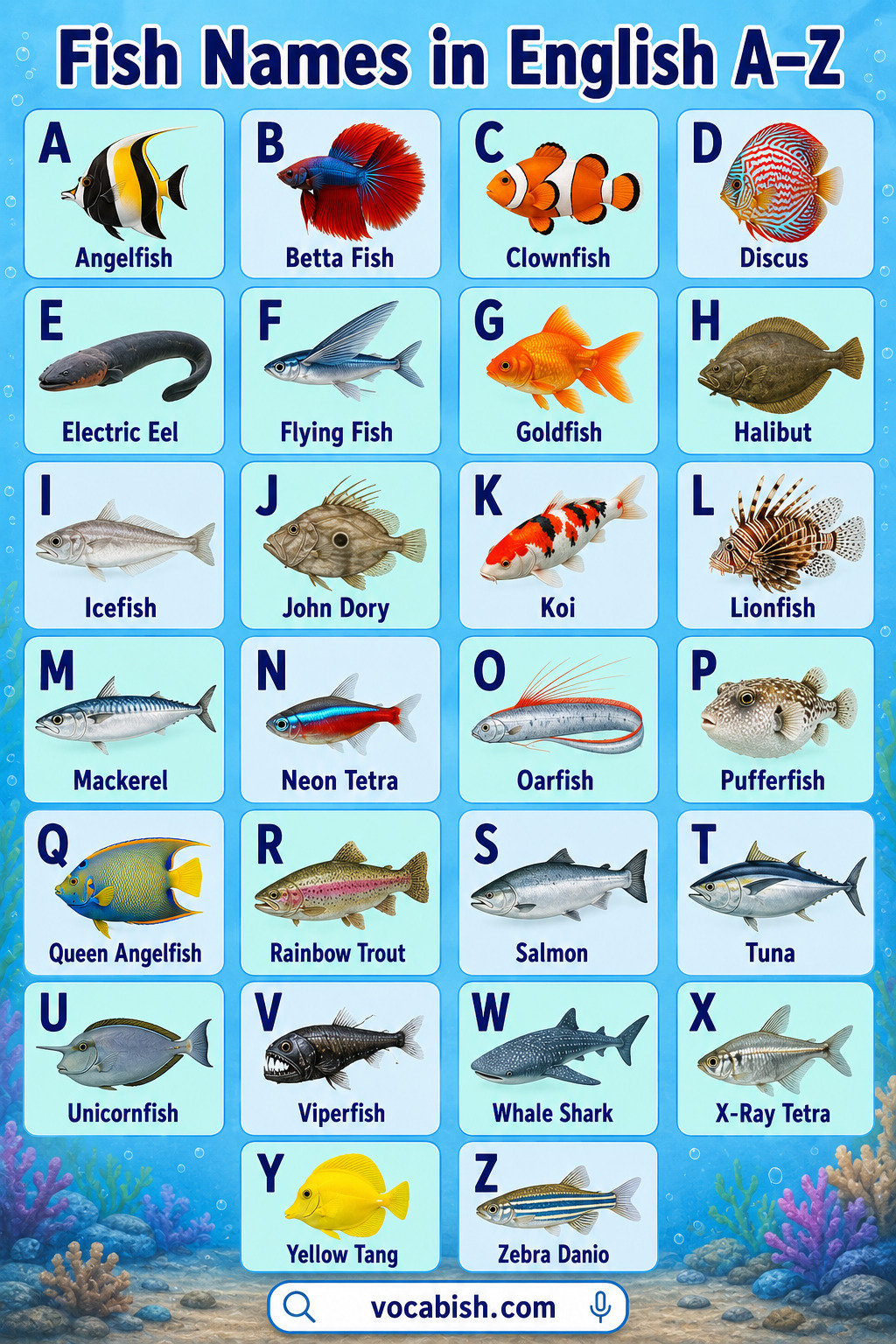
List of 250+ Fish Names in English A–Z
The following alphabetical list provides a compact reference for learners. It contains common, freshwater, saltwater, aquarium, edible, predatory, deep-sea, and unusual fish names.
Fish Names Starting with A
African Butterflyfish | African Lungfish | Albacore |
Alligator Gar | Amberjack | American Eel |
Anchovy | Angelfish | Anglerfish |
Antarctic Icefish | Arapaima | Archerfish |
Arctic Char | Arowana | Atlantic Cod |
Atlantic Halibut | Atlantic Herring | Atlantic Salmon |
Atlantic Sturgeon | Australian Lungfish |
Fish Names Beginning with B
Bala Shark | Ballan Wrasse | Bandfish |
Barb | Barbel | Barreleye Fish |
Barracuda | Barramundi | Bass |
Batfish | Betta Fish | Bichir |
Bigeye Tuna | Bitterling | Black Cod |
Black Dragonfish | Black Marlin | Blackfin Tuna |
Blacktip Reef Shark | Bleak | Blobfish |
Blue Marlin | Blue Shark | Blue Tang |
Bluefish | Bluefin Tuna | Bluegill |
Bonito | Bowfin | Bream |
Brook Trout | Brown Trout | Bull Shark |
Bullhead | Butterflyfish |
Names of Fish Starting with C
Cardinalfish | Carp | Catfish |
Cavefish | Char | Cherry Barb |
Chimaera | Chub | Cichlid |
Climbing Perch | Clown Loach | Clownfish |
Cobia | Cod | Coelacanth |
Common Carp | Conger Eel | Congo Tetra |
Cookiecutter Shark | Cornetfish | Cowfish |
Crappie | Creek Chub | Cusk |
Names of Fish Beginning with D
Dab | Damselfish | Danio |
Deep-Sea Dragonfish | Devil Ray | Discus |
Dogfish | Dolly Varden | Dragonet |
Drum | Dwarf Gourami |
Fish Names Beginning with E
Eagle Ray | Eartheater | Eel |
Eel Catfish | Electric Blue Acara | Electric Eel |
Elephantnose Fish | Emperor Angelfish | Emperor Fish |
Escolar | European Eel | European Perch |
Fish Names that Start with F
Fangtooth | Filefish | Fire Eel |
Firefish | Flathead | Flounder |
Flowerhorn Cichlid | Flying Fish | Forktail Blue-Eye |
Four-Eyed Fish | Freshwater Angelfish | Freshwater Drum |
Frilled Shark |
Names of Fish Beginning with G
Gar | Garfish | Ghost Knifefish |
Giant Gourami | Giant Grouper | Giant Snakehead |
Giant Trevally | Gilt-Head Bream | Glass Catfish |
Goblin Shark | Goby | Goldfish |
Golden Dorado | Goliath Tigerfish | Goatfish |
Gourami | Grass Carp | Grayling |
Greenland Shark | Grouper | Grunt |
Gudgeon | Gulper Eel | Guppy |
Names of Fish Beginning with H
Haddock | Hake | Halfbeak |
Halibut | Hammerhead Shark | Handfish |
Harlequin Rasbora | Hatchetfish | Hawkfish |
Herring | Hogfish | Horse Mackerel |
Houndfish |
Fish Names that Start with Letter I
Icefish | Ide |
Indian Ocean Mimic Surgeonfish | Indian Mackerel |
Fish Names Beginning with J
Jack Dempsey | Jack Mackerel |
John Dory | Japanese Eel |
Names of Fish Starting with K
Kelp Bass | Kelp Greenling | Killifish |
King Mackerel | Kingfish | Kissing Gourami |
Knifefish | Koi | Kokanee Salmon |
Names of Fish that Start with L
Lake Sturgeon | Lake Trout | Lamprey |
Lancetfish | Lanternfish | Largemouth Bass |
Leafy Seadragon | Lemon Shark | Lemon Tetra |
Leopard Shark | Lionfish | Loach |
Longfin Tuna | Longnose Gar | Lungfish |
Fish Names Beginning with M
Mackerel | Mahi-Mahi | Mandarin Fish |
Manta Ray | Marlin | Masu Salmon |
Medaka | Megamouth Shark | Milkfish |
Minnow | Molly | Monkfish |
Moorish Idol | Moray Eel | Mudfish |
Mudskipper | Mullet | Muskellunge |
Fish Names Starting with N
Napoleon Wrasse | Needlefish | Neon Tetra |
Nile Perch | Northern Pike | Nurse Shark |
Names of Fish Beginning with O
Oarfish | Ocean Sunfish | Oceanic Whitetip Shark |
Oilfish | Opah | Orange Roughy |
Oscar |
Names of Fish that Start with P
Paddlefish | Parrotfish | Peacock Bass |
Peacock Cichlid | Pearl Gourami | Perch |
Permit | Pike | Pikeperch |
Pinecone Fish | Pipefish | Plaice |
Platy | Pollock | Pomfret |
Porcupinefish | Powder Blue Tang | Pufferfish |
Pumpkinseed |
Fish Names that Begin with Q
Queen Angelfish | Queen Parrotfish |
Quillback Rockfish | Queen Triggerfish |
Fish Names Beginning with R
Rabbitfish | Rainbow Trout | Rainbowfish |
Ram Cichlid | Ratfish | Red Drum |
Red-Lipped Batfish | Red Snapper | Redfish |
Redtail Catfish | Reef Shark | Remora |
Roach | Rock Bass | Rockfish |
Ropefish | Royal Gramma | Rummy-Nose Tetra |
Names of Fish that Start with S
Sailfish | Salmon | Sand Eel |
Sand Tiger Shark | Sanddab | Sardine |
Sawfish | Scorpionfish | Sculpin |
Sea Bass | Sea Bream | Sea Robin |
Seahorse | Sergeant Major | Shad |
Shark | Sheepshead | Shovelnose Ray |
Siamese Algae Eater | Silver Dollar Fish | Skate |
Smallmouth Bass | Snakehead | Snapper |
Sole | Spanish Mackerel | Spiny Dogfish |
Squirrelfish | Stargazer | Stickleback |
Stingray | Stonefish | Sturgeon |
Sunfish | Surgeonfish | Swordfish |
Swordtail |
Names of Fish Start with the Letter T
Tambaqui | Tarpon | Telescope Fish |
Tench | Threadfin Rainbowfish | Thresher Shark |
Tiger Barb | Tiger Shark | Tilefish |
Tilapia | Tripod Fish | Triggerfish |
Trout | Trumpetfish | Tuna |
Turbot |
Fish Names Beginning with U
| Uaru | Unicornfish | Upside-Down Catfish |
Fish Names Beginning with V
| Vampire Fish | Velvetfish | Viperfish |
Names of Fish that Start with W
Wahoo | Walking Catfish | Walleye |
Warty Frogfish | Weever | Wels Catfish |
Whale Shark | White Bass | Whitefish |
Whiting | Wobbegong | Wolffish |
Wolf Eel | Wrasse |
Names of Fish that Start with X
| X-Ray Tetra | Xingu River Ray |
Fish Names Beginning with Y
Yellow Perch | Yellow Tang | Yellowfin Tuna |
Yellowtail | Yellowtail Amberjack |
Names of Fish that Start with Z
Zander | Zebra Danio |
Zebra Shark | Zebra Pleco |
Comparison Table for Different Types of Fish
The following table provides a quick comparison of several familiar fish according to habitat, general size, identifying feature, and category.
Fish name | Habitat | General size | Main feature | Common category |
|---|---|---|---|---|
Goldfish | Freshwater | Small | Bright ornamental colours | Aquarium fish |
Guppy | Freshwater | Very small | Colourful fan-shaped tail | Aquarium fish |
Salmon | Freshwater and saltwater | Medium to large | Long-distance migration | Edible fish |
Tuna | Saltwater | Medium to large | Fast, streamlined swimmer | Ocean fish |
Great White Shark | Saltwater | Large | Powerful marine predator | Predatory fish |
Whale Shark | Saltwater | Very large | Filter-feeding shark | Large fish |
Northern Pike | Freshwater | Medium to large | Long body and sharp teeth | Predatory fish |
Flounder | Mainly saltwater | Small to medium | Eyes on one side | Bottom fish |
Neon Tetra | Freshwater | Very small | Blue and red stripe | Aquarium fish |
Clownfish | Saltwater | Small | Lives with sea anemones | Reef fish |
Tilapia | Freshwater | Medium | Widely farmed for food | Edible fish |
Seahorse | Saltwater | Small | Upright body and curled tail | Famous fish |
Arapaima | Freshwater | Very large | Breathes atmospheric air | Large freshwater fish |
Lionfish | Saltwater | Small to medium | Decorative fins and venomous spines | Reef fish |
Halibut | Saltwater | Large | Large cold-water flatfish | Edible bottom fish |
How to Learn Fish Names in English
Learning hundreds of fish names may seem difficult, but the process becomes easier when the vocabulary is divided into practical groups. Study a small number of words at a time and connect each name with a picture, habitat, or physical feature.
Learn Fish by Category
Begin with simple groups such as freshwater fish, ocean fish, aquarium fish, edible fish, and predatory fish.
For example, learn trout, pike, perch, and catfish together as freshwater vocabulary. Study tuna, marlin, sardine, and mackerel as ocean fish.
Grouping related words helps you understand their meanings and remember them for longer.
Use Fish Pictures
A clear picture makes an unfamiliar fish name easier to remember. Focus on one noticeable feature for each animal.
You might remember a swordfish by its long bill, a flounder by its flat body, a seahorse by its curled tail, or a pufferfish by its ability to inflate.
Picture cards, visual charts, and labelled posters are particularly useful for beginners and young learners.
Practise Singular and Plural Forms
The usual plural of fish is also fish.
- I saw one fish in the pond.
- I saw six fish in the pond.
The word fishes may be used when referring to several different species or groups.
- The reef contains many tropical fishes.
Use Fish Names in Sentences
Practise each new word in a short sentence:
- A trout lives in freshwater.
- Tuna are fast ocean fish.
- The aquarium contains several colourful fish.
- A flounder has a flat body.
- Guppies are popular aquarium fish.
- The shark moved through the open ocean.
- A seahorse has a curled tail.
- Sardines swim in large schools.
Creating your own sentences helps you remember both the meaning and correct use of each word.
Review Names Alphabetically
Use the A–Z fish list as a revision checklist. Mark the names you already recognise and choose five to ten unfamiliar words for each study session.
Review the words after one day, one week, and one month. Regular recall is more effective than reading the entire list repeatedly.
Download PDF of Types of Fish
Frequently Asked Questions About Fish
Scientists recognise tens of thousands of fish species worldwide. The exact number changes as researchers discover new species and update the classification of known ones.
Scientifically, fish are commonly grouped as jawless, cartilaginous, and bony fish. In everyday language, they may also be grouped by habitat, size, appearance, behaviour, or human use.
Yes. Sharks are cartilaginous fish, meaning their skeletons are made mainly of cartilage rather than bone. They breathe through gills and move using fins.
Common fish names include goldfish, salmon, tuna, cod, trout, carp, catfish, sardine, mackerel, tilapia, guppy, clownfish, perch, and angelfish.
Goldfish, betta fish, guppies, tetras, mollies, platies, and angelfish are all widely kept. Popularity depends on location, aquarium size, experience, and availability.
No. Whales and dolphins are mammals. They breathe air through lungs, give birth to live young, and feed their babies with milk.
No. A starfish is a marine invertebrate more accurately called a sea star. It does not have a backbone, fins, scales, or gills like a true fish.
Mudskippers, lungfish, climbing perch, walking catfish, and some eels can survive outside water temporarily. They still require suitable moisture, temperature, and environmental conditions.
The whale shark is the largest living fish. It is a filter-feeding shark that eats plankton, small fish, and other tiny marine organisms.
Summary of Fish Names
- Fish are aquatic vertebrate animals.
- Most fish breathe through gills and move using fins.
- Fish can live in freshwater, saltwater, or both.
- They may be grouped by habitat, appearance, size, behaviour, and use.
- Aquarium fish include guppies, bettas, goldfish, mollies, and tetras.
- Common edible fish include salmon, tuna, cod, sardines, and tilapia.
- Predatory fish include sharks, pike, barracudas, marlin, and snakeheads.
- Flatfish include flounder, sole, halibut, plaice, and turbot.
- Unusual fish include oarfish, coelacanths, mudskippers, and barreleye fish.
- This guide contains more than 250 fish names in English.
Final Thoughts
Learning fish names is an enjoyable way to expand your English vocabulary while discovering the diversity of aquatic life. Instead of memorising every word at once, begin with one category, such as freshwater, aquarium, edible, or ocean fish.
Connect each name with a picture and one clear identifying feature. Use the alphabetical list for revision, practise the words in simple sentences, and review them regularly. Studying the different types of fish in organised groups will help you remember more vocabulary and use the names confidently in conversation, writing, and classroom activities.
You May Also Like