

In this blog post, you will learn the masculine and feminine of professions and jobs in English. These are words that show whether a person in a particular role is male or female, like actor and actress, or waiter and waitress. Understanding these words helps you master speaking, reading, writing, and listening skills. By studying them, you can use English more accurately in everyday life and professional situations.
What Are Masculine and Feminine Forms?
Masculine and feminine forms are words that show gender.
- Masculine words refer to men.
- Feminine words refer to women.
Example:
- Masculine: waiter → a man who serves food
- Feminine: waitress → a woman who serves food
Some words do not change for men and women, like teacher or doctor. Others have a special form, often ending with -ess, -trix, or other suffixes.
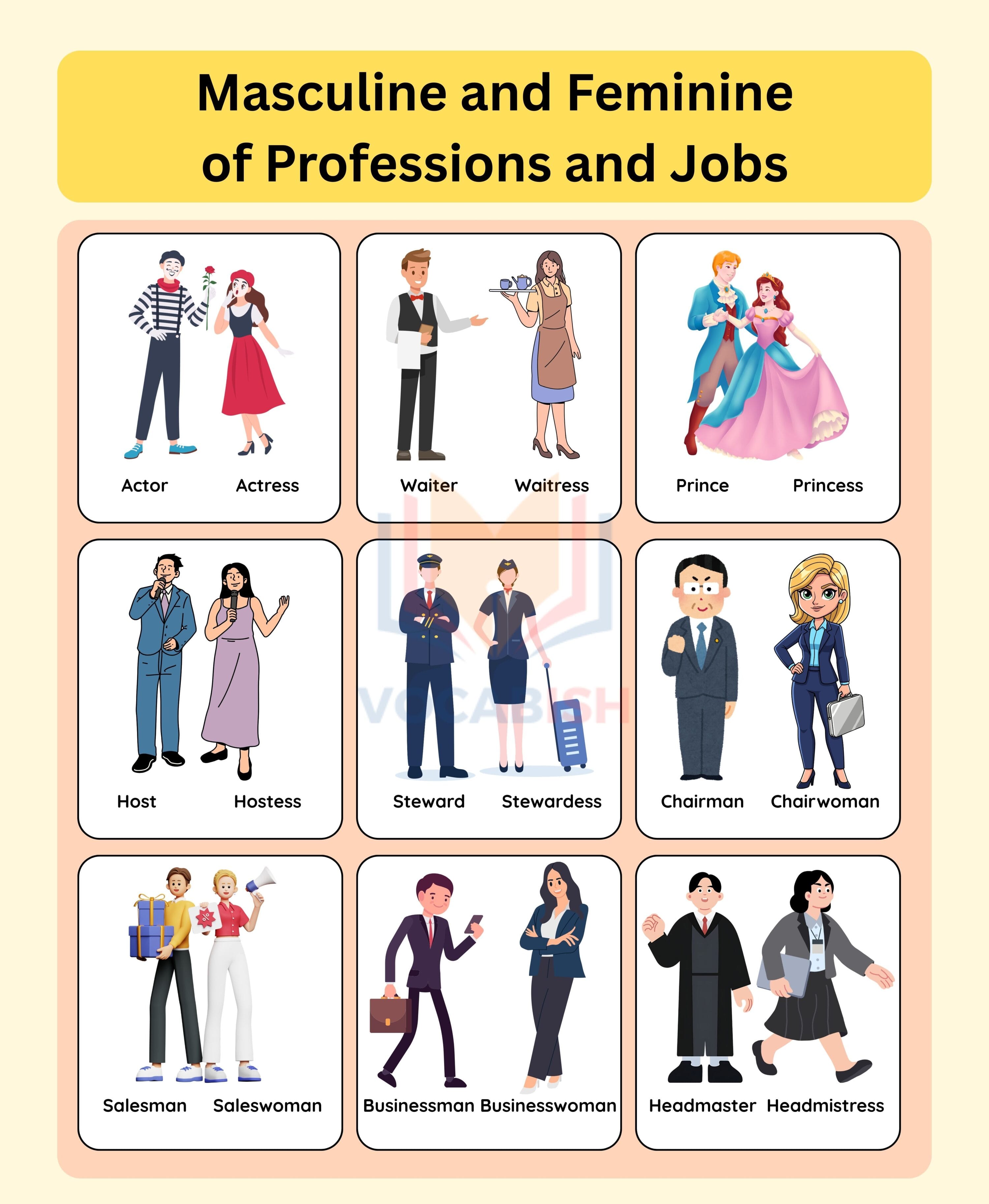
List of Masculine and Feminine forms
- Actor → Actress
- Waiter → Waitress
- Prince → Princess
- Host → Hostess
- Steward → Stewardess
- Chairman → Chairwoman
- Salesman → Saleswoman
- Businessman → Businesswoman
- Headmaster → Headmistress
- Midwife → Male Midwife
Masculine and Feminine of Professions and Jobs
Here are important profession words with masculine and feminine forms, easy explanations, and examples.
Daily Life Jobs
- Actor ↔ Actress – A person who acts in films or plays.
- Waiter ↔ Waitress – A person serving food in a restaurant.
- Prince ↔ Princess – A male or female member of a royal family.
- Host ↔ Hostess – A man or woman who welcomes guests.
- Steward ↔ Stewardess – A man or woman who helps passengers on a plane.
Education and School Jobs
- Teacher – A person who teaches students (same for both genders).
- Headmaster ↔ Headmistress – The principal of a school.
- Professor – A university teacher (gender-neutral).
- Tutor – A person who helps students individually (gender-neutral).
Healthcare Professions
- Doctor – A medical professional (gender-neutral).
- Nurse – A person who cares for patients (gender-neutral, but sometimes male nurse / female nurse is used).
- Midwife ↔ Male Midwife – A woman or man who helps deliver babies.
Business and Office Jobs
- Chairman ↔ Chairwoman – A person leading a company or organization.
- Salesman ↔ Saleswoman – A man or woman selling products.
- Businessman ↔ Businesswoman – A male or female working in business.
- Secretary – A person handling office tasks (gender-neutral, sometimes male secretary / female secretary is specified).
Tips for Learning Profession Vocabulary
- Group words by category – Daily life, school, healthcare, etc.
- Use flashcards – Write masculine on one side, feminine on the other.
- Practice speaking – Make simple sentences about real people you know.
- Read job ads – Notice how English uses gender-neutral or gender-specific terms.
- Listen and repeat – Watch English videos about careers to hear correct usage.
Conclusion
Knowing masculine and feminine forms of professions helps you speak confidently, understand texts, and use English professionally. Start by learning the most common words in daily life, school, healthcare, and business. Practice regularly, and soon these words will become natural in your speaking and writing.
FAQs
What is the masculine and feminine of professions in English?
The masculine and feminine of professions in English are words that show the gender of a person in a job. For example, actor is masculine, and actress is feminine. Some jobs like teacher or doctor are gender-neutral.
How do I form feminine words from masculine professions?
Many feminine professions are formed by adding endings like -ess, -trix, or -woman to masculine words. Examples: actor → actress, steward → stewardess, chairman → chairwoman. Some words are gender-neutral, like nurse or teacher, and do not change for men or women.
Which common professions have masculine and feminine forms?
Common professions with masculine and feminine forms include actor/actress, waiter/waitress, prince/princess, chairman/chairwoman, and salesman/saleswoman.
Are all job titles different for men and women in English?
No. Many modern English job titles are gender-neutral. Words like doctor, teacher, engineer, and nurse stay the same for both men and women. Only some traditional jobs have distinct masculine and feminine forms, like steward/stewardess or headmaster/headmistress.
What is the difference between gender-neutral and feminine forms of jobs?
Gender-neutral job words do not change for men or women, like doctor or nurse. Feminine forms are created from masculine forms, like actor → actress. Knowing the difference helps English learners use words correctly and communicate clearly in professional and everyday situations.
Related Articles: