
In this blog post, we will explore metaphors, an important part of English vocabulary. A metaphor is a way of describing something by comparing it to something else, helping your words become more powerful and interesting. Learning metaphors can improve your speaking by making your conversations more expressive, your writing by adding depth to your stories or essays, and your reading and listening by helping you understand ideas that are not said directly. By understanding metaphors, you can better recognize meanings behind words, use creative expressions, and make your English communication more natural.
Metaphor Definition and Examples
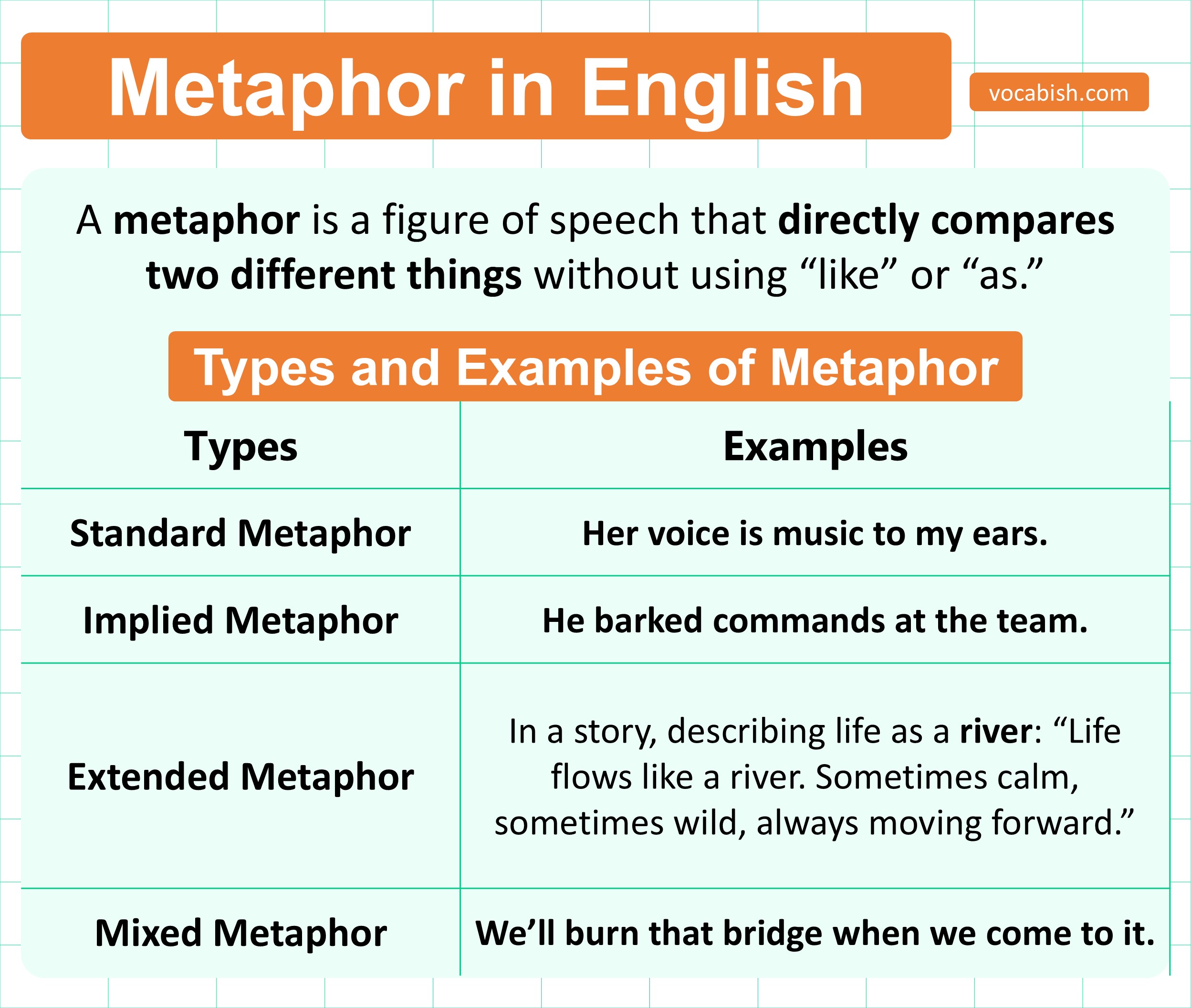
A metaphor is a figure of speech that directly compares two different things without using “like” or “as.” It shows that one thing represents or symbolizes another.
For example:
- Time is money.
– This means time is valuable, just like money. - He is a shining star.
– This means he is talented or very successful.
Unlike similes, metaphors do not use comparison words; they say something is something else to create a stronger image.
Types of Metaphors with Examples
Metaphors can appear in different forms depending on their use:
1. Standard Metaphor
A direct comparison of two things.
Examples:
- Her voice is music to my ears.
- Life is a journey.
2. Implied Metaphor
The comparison is suggested rather than directly stated.
Examples:
- He barked commands at the team.
– Suggests he is like a dog, strict or loud. - The classroom buzzed with activity.
– Suggests a bee-like busy environment.
3. Extended Metaphor
A metaphor developed over several sentences or paragraphs.
Examples:
- In a story, describing life as a river: “Life flows like a river. Sometimes calm, sometimes wild, always moving forward.”
4. Mixed Metaphor
Combines two or more unrelated metaphors, sometimes for effect.
Examples:
- We’ll burn that bridge when we come to it.
– Combines “cross the bridge” and “burn the bridge.”
Rules and Usage of Metaphors
Using metaphors correctly can make your English more expressive. Follow these rules:
- Use comparisons carefully – The metaphor must make sense in context.
- Correct: Time is money.
- Incorrect: Time is a sandwich. (Unless you explain it creatively.)
- Keep it relevant – Use metaphors that relate to your audience or situation.
- Avoid overuse – Too many metaphors can make your writing confusing.
- Practice in speaking and writing – Try creating your own metaphors to describe feelings, objects, or events.
Metaphor Examples in Sentences
| Metaphor | Meaning | Example Sentence |
|---|---|---|
| Time is money | Time is valuable | You should finish your work quickly because time is money. |
| Heart of stone | Someone unemotional | He refused to help, showing he has a heart of stone. |
| Shining star | Someone talented or successful | She won the award; she is a shining star in the company. |
| The world is a stage | Life is like acting in a play | In Shakespeare’s words, the world is a stage, and we are all actors. |
| Storm of emotions | Feeling many strong emotions | After the news, she was in a storm of emotions. |
| Classroom was a zoo | Very noisy or chaotic | When the students arrived, the classroom was a zoo. |
| Life is a journey | Life has challenges and progress | Remember, life is a journey, and every experience teaches something new. |
| Time is a thief | Time passes quickly | Don’t waste opportunities; time is a thief that steals moments. |
| Barked commands | Comparing someone to a strict dog | The coach barked commands at the team during practice. |
| Light of my life | Someone very important | Her daughter is the light of her life. |
Common Mistakes While Using Metaphor
Even learners sometimes misuse metaphors. Avoid these errors:
- Mixing metaphors incorrectly
- Mistake: We’ll burn that bridge when we come to it.
- Tip: Stick to one metaphor per idea.
- Literal interpretation
- Mistake: Thinking time is money means money grows over time.
- Tip: Always consider the figurative meaning.
- Overcomplicating
- Mistake: Using too many metaphors in one sentence can confuse readers.
- Tip: Use one metaphor per idea or sentence.
Metaphor vs Simile vs Analogy
| Concept | Definition | Example | Difference |
|---|---|---|---|
| Metaphor | Direct comparison without “like” or “as” | Time is money | Strong, symbolic image |
| Simile | Comparison using “like” or “as” | Time is like money | Less direct, uses comparison words |
| Analogy | Explains an idea by comparing to something else | Life is like a river | Longer, more detailed comparison |
Tips for Learners
- Start with common metaphors – e.g., time is money, heart of stone, life is a journey.
- Read English books and stories – Writers use metaphors creatively.
- Practice writing sentences – Try describing feelings or objects using metaphors.
- Use in speaking – Makes conversations more expressive and memorable.
- Think about meaning – Always check the figurative meaning before using a metaphor.
Conclusion
Metaphors are a powerful part of English. They help you express ideas creatively by comparing one thing to another. There are several types: standard, implied, extended, and mixed metaphors. Using metaphors improves your speaking, writing, reading, and listening skills. In this blog post, you have learned how to identify, use, and create metaphors. Practising them will make your English more natural, expressive, and engaging.
FAQs
A metaphor is a figure of speech where one thing is directly compared to another to show meaning, emotion, or symbolism without using “like” or “as.”
An example of a metaphor is “Time is money,” meaning time is valuable. Another is “He is a shining star,” showing talent or success.
Metaphors are used to express ideas clearly, create imagery, and make speech or writing more engaging for readers and listeners.
A metaphor directly compares two things (e.g., “Time is money”), while a simile uses like or as (e.g., “Time is like money”).
Common types include standard metaphors, implied metaphors, extended metaphors, and mixed metaphors, each used to describe ideas in different ways.
Yes, “the world is a stage” is a metaphor because it compares life to acting on a stage, showing that people play roles in life.
A simile example: “Her smile is like sunshine.”
A metaphor example: “Her smile is sunshine.”
Similes use “like” or “as,” metaphors do not.
Related Articles: